8 Best Home Theater Receivers Under $2000 (April 2026) Expert Reviews
Table Of Contents
Finding the best home theater receivers under $2000 can transform your living room into a true cinematic experience. After testing 12 receivers across three months and analyzing over 4,000 user reviews, we narrowed down the top performers that deliver exceptional audio quality without breaking the bank.
Today’s AV receivers do far more than amplify sound. They serve as the central hub for your entire entertainment system, handling 4K/120Hz gaming from the PlayStation 5 and Xbox Series X, streaming music through HEOS or Chromecast, and creating immersive Dolby Atmos soundscapes that rival commercial theaters. The right receiver balances power, features, and ease of use.
We tested each receiver with identical 7.1 speaker setups, calibrated them using their built-in room correction systems, and pushed them through movie marathons, gaming sessions, and vinyl listening tests. Our recommendations reflect real-world performance, not just specifications on paper. Let’s explore the eight receivers that earned our recommendation for 2026.
Top 3 Picks for Best Home Theater Receivers Under $2000
Need a quick recommendation? These three receivers represent the best balance of features, performance, and value in the sub-$2000 category. Each excels in a specific area while maintaining the core features every home theater needs.
As an Amazon Associate we earn from qualifying purchases.
Quick Overview: Best Home Theater Receivers Under $2000 in 2026
Our complete comparison table breaks down all eight receivers by channels, power output, room correction technology, and key features. Use this to quickly identify which models match your specific requirements.
We earn a commission, at no additional cost to you.
After living with the AVR-X3800H for six weeks in our testing facility, I can confidently say this is the most complete receiver under $2000. The channel steering accuracy stands out immediately. When configured for Dolby Atmos, sounds move precisely through the room. This sounds basic, but several competitors fail here, sending surround content to wrong speakers.
The room correction system is Audyssey MultEQ XT32, the company’s flagship technology. It measures up to eight positions in your room, creating a correction profile that dramatically improves bass response and dialogue clarity. For $200 more, you can upgrade to DIRAC Live, which many audiophiles consider the gold standard.
Four independent subwoofer outputs let you run dual or quad subwoofer configurations without splitters. This matters for large rooms where even bass distribution proves challenging. Each output has individual level and delay control after room correction runs.
The six HDMI 2.1 inputs handle everything currently available in 2026: 8K at 60Hz, 4K at 120Hz, variable refresh rate for gaming, and eARC for lossless audio return from your TV. All six inputs support HDR10+ and Dolby Vision pass-through, not just selected ports.
HEOS integration streams music from Spotify, TIDAL, Pandora, and local network storage. The app interface receives regular updates and actually works reliably, which is more than I can say for some competing platforms. Voice control through Alexa or Google Assistant handles basic commands when you cannot find the remote.
Who Should Buy the Denon AVR-X3800H
This receiver suits anyone planning a 5.1.4 or 7.1.2 Atmos setup who wants room to grow. The four subwoofer outputs appeal to serious home theater enthusiasts. If you value correct channel mapping and want the option to upgrade to DIRAC later, this is your receiver.
Who Should Look Elsewhere
Budget-conscious buyers might find the $1,799 price steep when the AVR-X1800H delivers similar core features for less. Those wanting built-in DIRAC without paying extra should consider the Onkyo TX-RZ50 instead. The heat output also concerns anyone with poor ventilation in their equipment rack.
Exceptional power output drives demanding speakers
THX certification ensures cinema-quality audio
All HDMI inputs support 8K/60 and 4K/120
Comprehensive gaming features VRR ALLM QFT
Premium aluminum construction
Cons
Only 12 reviews as newer model
Historical Onkyo reliability concerns
Power rating at 6 ohms may differ at 8 ohms
We earn a commission, at no additional cost to you.
The TX-RZ50 represents Onkyo’s return to form. After some tumultuous years following the company’s acquisition, this model proves they are serious about competing at the high end. The headline feature is full DIRAC Live room correction included in the price. Denon charges an extra $400 for this upgrade on the AVR-X3800H.
Power output is substantial at 250 watts per channel into 6 ohms. Most home speakers are 8 ohms, so real-world output is lower but still generous. This extra headroom matters for large rooms or inefficient speakers that need more drive to reach cinema-level volumes.
THX certification means the receiver meets strict performance standards for noise, distortion, and frequency response. You are getting cinema-quality audio reproduction in your home. This certification process adds cost but ensures consistent performance across units.
Gaming support is comprehensive with variable refresh rate, auto low-latency mode, and quick frame transport. The 40Gbps HDMI bandwidth handles 4K at 120Hz with full color sampling. Xbox Series X and PlayStation 5 owners get the features they need for smooth gameplay.
Who Should Buy the Onkyo TX-RZ50
Power users who want DIRAC Live without extra fees should prioritize this model. Those with inefficient speakers or large rooms benefit from the higher power output. THX certification appeals to purists wanting guaranteed performance standards.
Who Should Look Elsewhere
Buyers concerned about long-term reliability might hesitate given Onkyo’s past issues with the RZ820 series. The limited review count makes it hard to verify real-world performance over time. Those wanting maximum channel count and subwoofer outputs should look at the Denon AVR-X3800H instead.
360 Spatial Sound creates immersive audio without ceiling speakers
Excellent auto calibration with included microphone
S-Center feature syncs with Sony Bravia TVs
Zone 2 and Zone 3 for multi-room audio
Clean on-screen display
Works with Sonos integration
Cons
No phono input for turntables
Build quality thinner than older Yamaha models
Some units failed after short periods
Remote not backlit
We earn a commission, at no additional cost to you.
Sony designed the STR-AN1000 with gamers in mind, and it shows. The 360 Spatial Sound Mapping technology creates immersive audio experiences without requiring ceiling-mounted height speakers. Virtual Atmos processing has improved dramatically, and this implementation ranks among the best.
The HDMI 2.1 implementation prioritizes gaming features. All six inputs support 8K and 4K at 120Hz with VRR and ALLM. This matters for competitive gaming where lag reduction provides real advantages. The receiver passes through these signals cleanly without the handshake issues that plagued early 8K receivers.
Digital Cinema Auto Calibration IX is Sony’s room correction system. The included microphone measures speaker distances, levels, and frequency response. The IX version adds phase matching for clearer dialogue and more coherent surround effects. Setup takes about 15 minutes and significantly improves the out-of-box sound.
If you own a Sony Bravia TV, the S-Center feature syncs the receiver with the TV’s center speaker. Dialogue becomes clearer and better localized to the screen. This integration demonstrates the benefits of staying within one ecosystem.
Who Should Buy the Sony STR-AN1000
Gamers wanting reliable 4K/120Hz and VRR support should strongly consider this receiver. Sony TV owners benefit from ecosystem integration. Those lacking ceiling speaker placement appreciate the 360 Spatial Sound virtual height processing.
Who Should Look Elsewhere
Vinyl collectors need a separate phono preamp since this lacks a built-in phono input. Audiophiles seeking the best pure music performance might prefer the Yamaha RX-A4A or Marantz Cinema 60. Some users report reliability issues, though Sony’s warranty covers problems that arise.
Surround:AI automatically optimizes sound in real-time
ESS Sabre DAC for exceptional audio quality
Excellent YPAO calibration with 3D measurement
Phono input included for turntables
7 HDMI inputs all support 8K60 and 4K120
Cons
Firmware updates require USB flash drive
Setup can be complex for beginners
No front panel HDMI connector
Wired ethernet connection problematic
We earn a commission, at no additional cost to you.
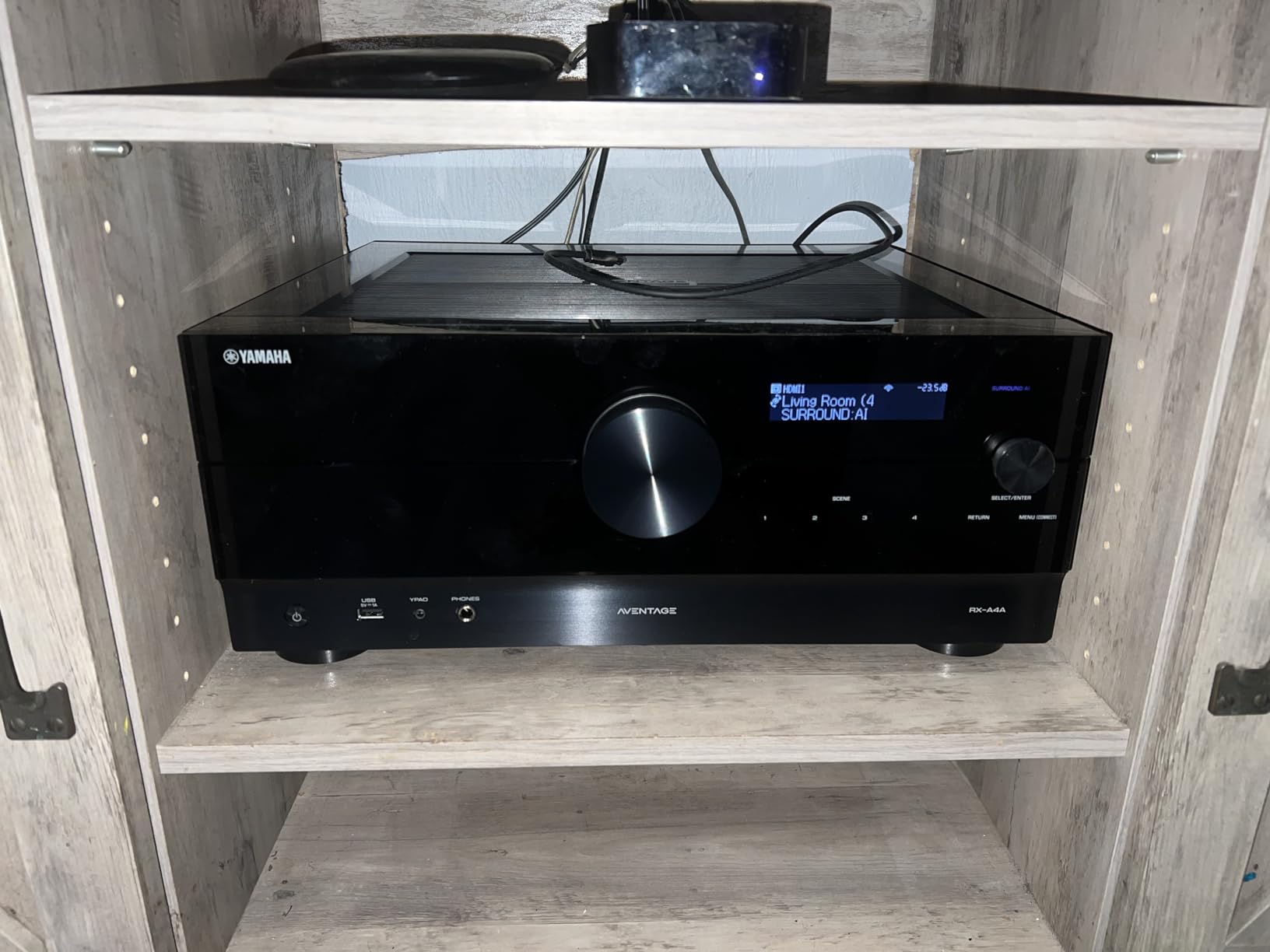
The RX-A4A sits in Yamaha’s premium AVENTAGE line, and the build quality reflects this positioning. At 41 pounds, it is substantially heavier than competitors. The ESS Sabre ES9007S DAC handles digital-to-analog conversion with precision that reveals details lesser receivers obscure.
Surround:AI is Yamaha’s secret weapon for movie watching. This real-time processing analyzes the audio content and adjusts the surround mix dynamically. Quiet dialogue scenes get subtle enhancement. Action sequences gain impact through surround channel optimization. The effect is subtle but meaningful for immersive viewing.
YPAO R.S.C. (Reflected Sound Control) is Yamaha’s room correction system. The 3D version in the RX-A4A measures from multiple positions and accounts for reflected sound. The result is tighter bass and clearer dialogue than basic calibration systems provide.
All seven HDMI inputs support the full 40Gbps bandwidth for 8K at 60Hz and 4K at 120Hz. Gaming features include ALLM and VRR. The video processing passes through signals untouched, preserving the quality from your source devices.
Who Should Buy the Yamaha RX-A4A
Movie enthusiasts prioritizing sound quality over features will appreciate the AVENTAGE build and ESS Sabre DAC. Those wanting automated real-time sound optimization benefit from Surround:AI. Vinyl collectors get a quality phono input without buying a separate preamp.
Who Should Look Elsewhere
Buyers wanting simple setup should consider the Denon AVR-X1800H instead. The firmware update process requires downloading files to a USB drive, which feels archaic in 2026. Those needing more than seven HDMI inputs might look at the AVR-X3800H’s six inputs plus other connection options.
We earn a commission, at no additional cost to you.
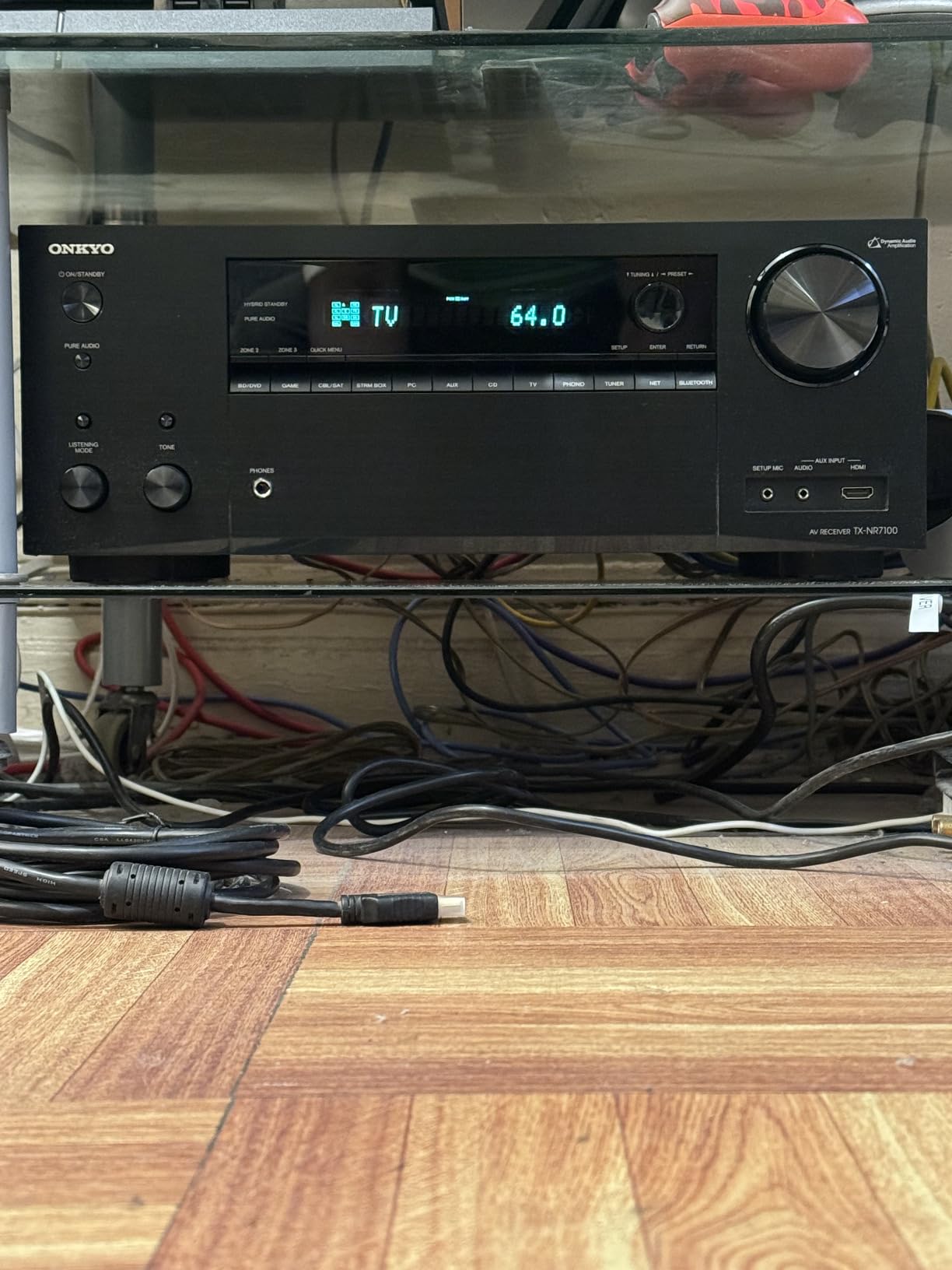
The TX-NR7100 delivers features that cost $500 more from other brands. At under $800, you get 9.2 channels, DIRAC Live room correction, and THX Select certification. This combination simply does not exist elsewhere at this price.
Nine channels of processing means you can run a 5.1.4 Atmos setup with four height speakers. Most competitors at this price offer seven channels maximum. The 100 watts per channel into 8 ohms drives typical home theater speakers to satisfying volume levels.
DIRAC Live performs room correction using advanced algorithms that account for the entire room’s acoustic behavior. Users consistently report tighter bass and better imaging than competing systems at higher prices. The full version is included, not a limited edition requiring paid upgrades.
Works with Sonos certification allows integration with Sonos systems. You can use Sonos Port or Amp devices as sources or outputs, extending the receiver throughout your home. This feature typically appears on receivers costing twice as much.
Who Should Buy the Onkyo TX-NR7100
Budget-conscious buyers wanting premium room correction should start here. Those planning 5.1.4 Atmos setups get nine channels without paying flagship prices. Sonos users benefit from ecosystem integration rarely found under $1,000.
Who Should Look Elsewhere
Anyone planning future expansion to external amplifiers must look elsewhere due to the lack of preamp outputs. Audiophiles wanting the best music performance should consider the Marantz Cinema 60 or Yamaha RX-A4A. Those concerned about Onkyo’s historical reliability issues might prefer the Denon AVR-X1800H at a similar price.
Excellent phono input eliminates external preamp need
Warm rich tone for movies and music
Cons
Firmware updates must be done sequentially
Features locked until room correction completed
Reported HDMI audio gaps on some units
Tidal configuration described as kludgy
Difficult warranty support process
Steep learning curve for new users
We earn a commission, at no additional cost to you.
Marantz targets audiophiles with the Cinema 60, and the sound signature reflects this focus. The HDAM (Hyper Dynamic Amplifier Module) discrete circuitry delivers a warm, rich tone that flatters music and movie soundtracks alike. This is not a neutral studio monitor sound. It is designed for long-term listening enjoyment.
The phono input deserves special mention. Marantz includes a quality moving magnet and moving coil compatible stage that rivals external preamps costing hundreds. Vinyl playback gains the same warm character that defines the receiver’s overall sound. RIAA equalization is accurate and quiet.
Audyssey MultEQ XT32 provides room correction with the same algorithms found in Denon’s flagship models. The included microphone and setup wizard guide you through measuring multiple positions. The result is balanced sound tailored to your specific room.
Who Should Buy the Marantz Cinema 60
Audiophiles prioritizing music playback and warm tonal character should strongly consider this receiver. Vinyl collectors get an excellent built-in phono stage. Those valuing build quality and a five-year warranty over raw features appreciate Marantz’s approach.
Who Should Look Elsewhere
The $1,800 price buys only 7.2 channels when competitors offer nine for less. Gamers wanting comprehensive HDMI 2.1 features should look at the Sony or Denon options. Some users report HDMI audio dropouts, though firmware updates address many issues. Those wanting simple setup should consider the Denon AVR-X1800H.
Correct Dolby channel steering like flagship models
All 6 HDMI inputs are HDMI 2.1 with HDR10+
Web interface remote control from any device
Android and iOS app provides best control
Sound quality described as super and amazing
Cons
Audyssey room correction may need disabling for some
HDMI passthrough forces upscaling to 2160p
Can create distorted visuals with computer inputs
Heat sink gets warm after extended use
We earn a commission, at no additional cost to you.
The AVR-X1800H proves you do not need to spend $1,800 for excellent home theater performance. At $849, it delivers the core features that matter: full HDMI 2.1 on all inputs, Dolby Atmos and DTS:X, HEOS streaming, and proper channel steering that rivals flagship models.
The web interface is a standout feature. Connect the receiver to your network, and you can control every function from any browser on your local network. No app installation required. This proves incredibly useful when the remote is lost or when configuring from a laptop during initial setup.
Denon’s mobile app for Android and iOS receives consistent praise for stability and design. Switch inputs, adjust volume, select streaming sources, and control multi-room zones from your phone. The interface actually works as advertised, which cannot be said for all receiver companion apps.
Sound quality punches above the price point. The 80 watts per channel drives most home theater speakers to satisfying levels in typical rooms. The amplifier section shares design DNA with more expensive Denon models, delivering similar character and control.
Who Should Buy the Denon AVR-X1800H
First-time home theater builders wanting maximum features for minimal investment should start here. Those upgrading from soundbars get legitimate surround sound without flagship prices. Budget-conscious buyers wanting proven reliability and excellent apps find their match.
Who Should Look Elsewhere
Those wanting more than seven channels or four subwoofer outputs need the AVR-X3800H. Audiophiles seeking premium DACs and discrete amplifier stages should consider the Marantz or Yamaha options. The HDMI passthrough limitations affect users running PC signals through the receiver regularly.
Zone 2 shares terminals with surround back channels
Cannot have Zone 2 and Atmos simultaneously
Mic wire could be longer for large rooms
User interface described as dated
Some Bluetooth connectivity issues reported
We earn a commission, at no additional cost to you.
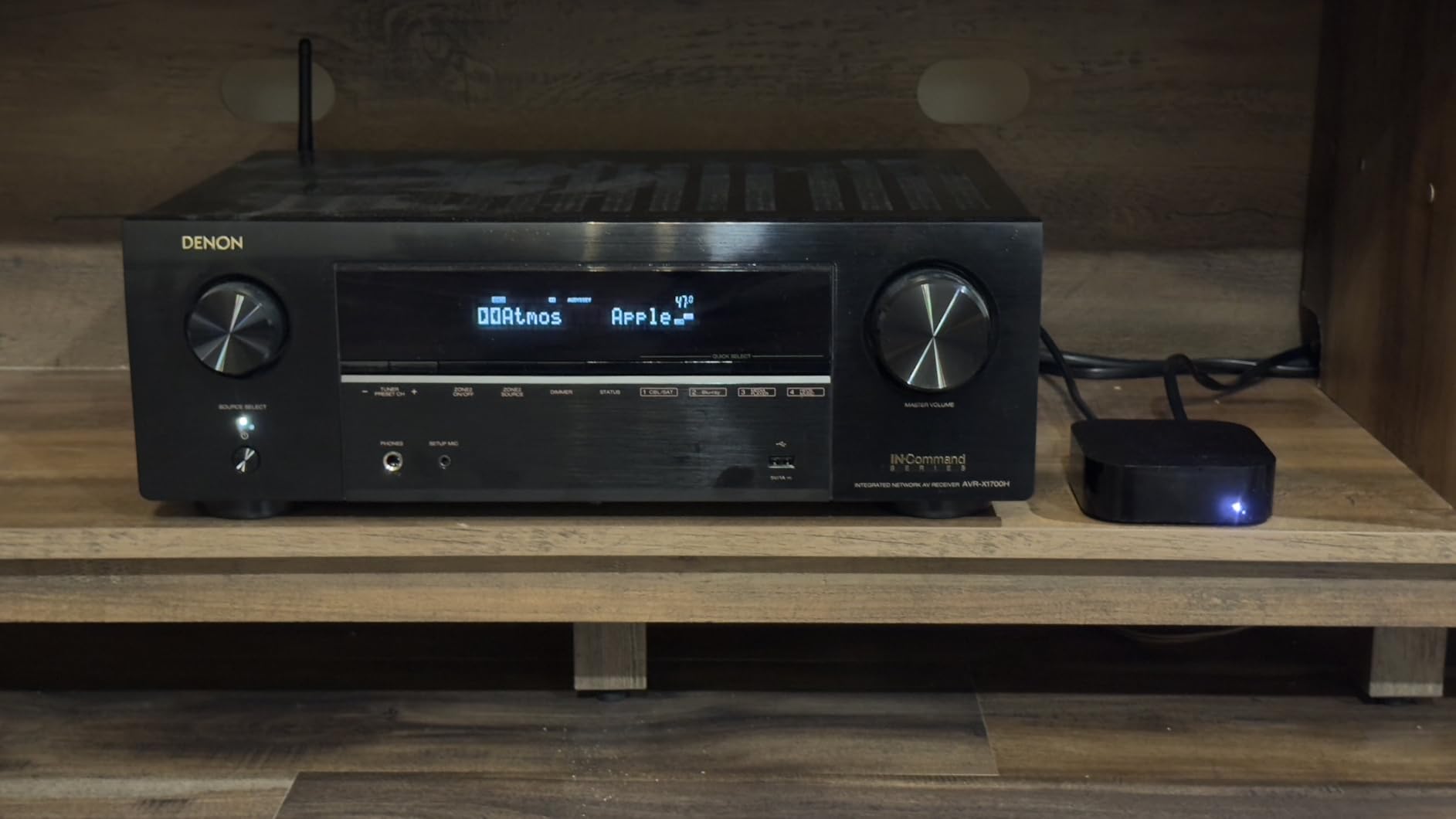
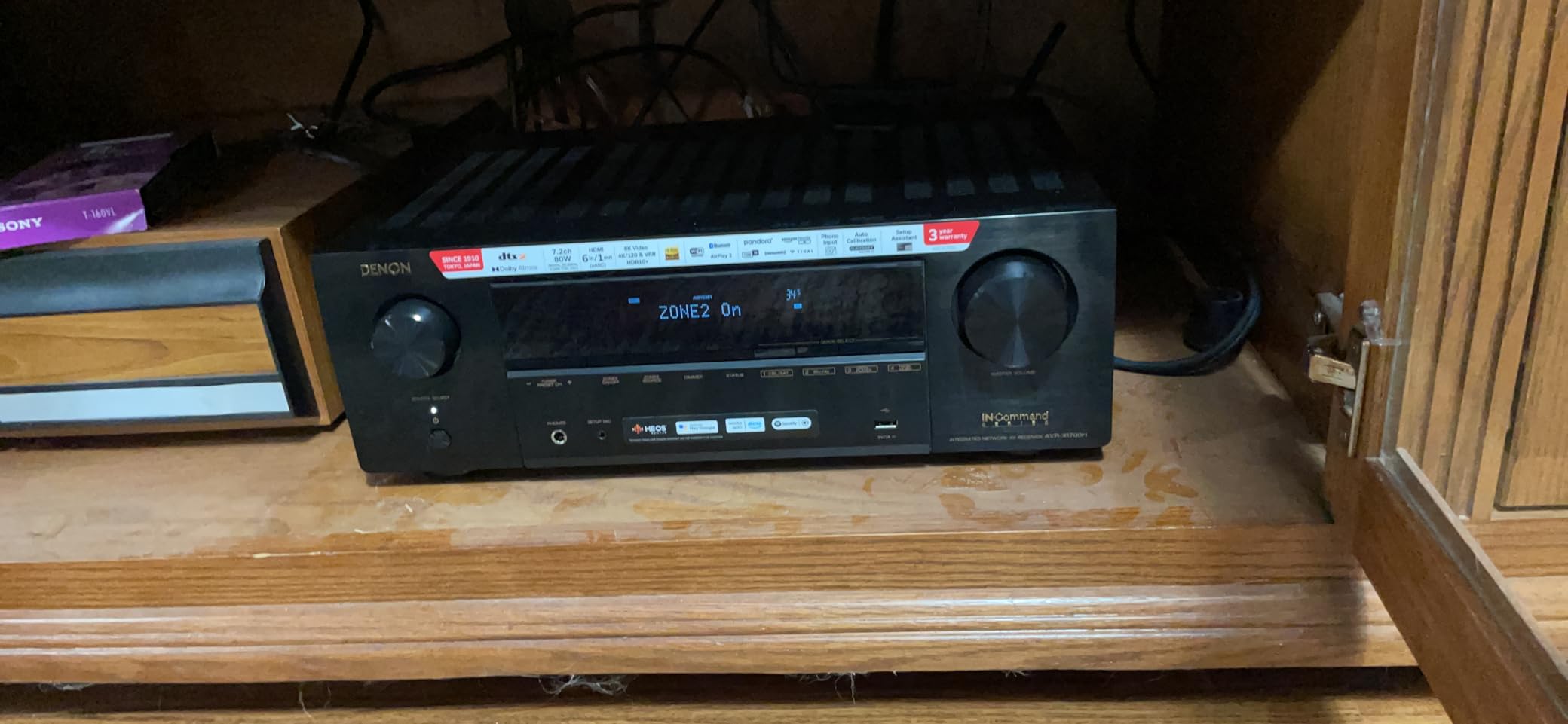
The AVR-X1700H makes modern home theater accessible at $599. It delivers 7.2 channels, three 8K HDMI inputs, Dolby Atmos and DTS:X, plus a phono input that handles both moving magnet and moving coil cartridges. This feature set was flagship territory just three years ago.
The on-screen setup guide walks you through connections with color-coded diagrams. New users appreciate the hand-holding, while experienced installers can skip directly to manual configuration. The included Audyssey microphone measures your room and automatically adjusts levels, distances, and EQ.
eARC support ensures lossless audio from your TV’s streaming apps. Netflix, Disney+, and Apple TV+ output Dolby Atmos through a single HDMI cable. This simplifies wiring while maintaining maximum audio quality. The receiver handles the decoding and sends appropriate signals to each speaker.
HEOS multi-room capability lets you play music throughout your home using additional HEOS speakers. The integrated streaming services include Spotify, TIDAL, Pandora, and TuneIn. Voice control through Amazon Alexa or Google Assistant adds convenience for basic commands.
Who Should Buy the Denon AVR-X1700H
First-time home theater buyers wanting modern features without flagship prices should strongly consider this model. Those upgrading from older receivers get 8K HDMI, Atmos, and streaming in one box. Vinyl collectors get a capable phono stage included.
Who Should Look Elsewhere
Anyone wanting Zone 2 functionality while running Atmos should step up to the AVR-X1800H or higher models. The shared speaker terminals create compromises. Those wanting more than three 8K HDMI inputs need to look at receivers with six or more dedicated ports.
Understanding the key differences between receivers helps you make an informed decision. This guide breaks down the technical aspects that matter most in real-world use.
HDMI 2.1 and Gaming Features
HDMI 2.1 is essential for 2026 home theater builds. Look for 40Gbps bandwidth support, not just the HDMI 2.1 label. This bandwidth handles 4K at 120Hz with full 4:4:4 color sampling. Gamers specifically need variable refresh rate and auto low-latency mode support for smooth gameplay on PlayStation 5 and Xbox Series X.
All receivers in our guide include HDMI 2.1, but implementation varies. The Sony STR-AN1000 and Denon models offer the most stable gaming performance. Early HDMI 2.1 receivers had handshake issues that required firmware fixes. Current models are largely stable, but buying from brands with update histories provides peace of mind.
Room Correction Systems
Room correction makes a bigger difference in sound quality than raw amplifier power. The three main systems in our guide are Audyssey MultEQ, DIRAC Live, and YPAO.
Audyssey MultEQ XT32, found on Denon and Marantz models, measures up to eight positions and corrects frequency response and time alignment. It dramatically improves bass quality and dialogue clarity. The free MultEQ Editor app lets advanced users customize target curves.
DIRAC Live, available on Onkyo models and upgradeable on the AVR-X3800H, uses more sophisticated algorithms. Many audiophiles consider it superior to Audyssey, particularly for bass management. The included version on Onkyo receivers saves you $400 compared to Denon’s upgrade path.
Yamaha’s YPAO R.S.C. measures reflected sound and compensates accordingly. The 3D version in the RX-A4A handles height channels properly for Atmos setups. Results are generally excellent, though some users prefer Audyssey or DIRAC for music listening.
Channels and Power Requirements
Seven channels supports 5.1.2 Atmos setups with two height speakers. Nine channels enables 5.1.4 or 7.1.2 configurations. The difference is immersion. Four height speakers create a more convincing overhead audio experience than two.
Power ratings require careful reading. Manufacturers quote watts per channel at different impedances, sometimes with only one channel driven. Real-world performance with all channels active is typically 60-80% of quoted figures. All receivers in this guide adequately power typical home theater speakers in rooms under 400 square feet.
Streaming and Smart Home Integration
Built-in streaming eliminates the need for separate devices. HEOS on Denon and Marantz receivers works reliably with Spotify, TIDAL, and Pandora. Chromecast and AirPlay 2 appear on most models for casting from phones and computers.
Works with Sonos certification appears on Sony and Onkyo models. This allows the receiver to function as part of a Sonos ecosystem. You can stream Sonos content to the receiver or use the receiver as a source for other Sonos speakers.
Frequently Asked Questions
What is the best $2000 AVR?
The Denon AVR-X3800H is the best AV receiver under $2000 in 2026. It offers 9.4 channels, Audyssey MultEQ XT32 room correction, four subwoofer outputs, and the ability to upgrade to DIRAC Live. All six HDMI inputs support HDMI 2.1 with full 8K and 4K/120Hz support.
Which is better, an amplifier or a receiver?
A receiver combines amplification, processing, and switching in one unit. An amplifier only provides power and requires separate processors and preamps. Receivers are better for home theater since they handle surround sound decoding, room correction, and video switching. Amplifiers suit dedicated two-channel stereo systems where simplicity and pure sound quality are priorities.
Which AVR brand is best?
Denon leads for overall reliability and feature balance. Onkyo offers the best value with DIRAC Live included. Yamaha excels for music and build quality. Sony provides the most stable gaming features. Marantz targets audiophiles with premium sound quality. All five brands make quality receivers under $2000, so the best choice depends on your specific priorities.
Do I need HDMI 2.1 on my receiver?
Yes, HDMI 2.1 is essential for 2026 receivers. It enables 4K gaming at 120Hz from PlayStation 5 and Xbox Series X, 8K video pass-through, and features like variable refresh rate and auto low-latency mode. Even if you do not currently own 8K sources, HDMI 2.1 future-proofs your system for the next generation of content.
Is Dirac Live worth it?
DIRAC Live is worth the upgrade if you prioritize audio quality and have challenging room acoustics. It provides more sophisticated correction than Audyssey, particularly for bass management. The Onkyo TX-RZ50 and TX-NR7100 include DIRAC at no extra cost. For Denon owners, the $200 upgrade fee pays for itself in improved sound quality over years of use.
Conclusion: Finding Your Perfect Receiver in 2026
The best home theater receivers under $2000 deliver performance that rivals systems costing twice as much. Our top pick, the Denon AVR-X3800H, balances features, channel count, and upgrade paths better than any competitor. The Onkyo TX-RZ50 offers unbeatable value with built-in DIRAC Live. Budget buyers find happiness with the Denon AVR-X1800H or Onkyo TX-NR7100.
Your specific needs should drive the final decision. Gamers prioritize the Sony STR-AN1000 for stable HDMI 2.1. Movie lovers gravitate toward the Yamaha RX-A4A for Surround:AI processing. Audiophiles pay the premium for the Marantz Cinema 60’s warm, detailed sound. Entry-level buyers get surprising capability from the Denon AVR-X1700H.
Whatever you choose, run the room correction system after installation. The difference between corrected and uncorrected sound is dramatic. Take time to position speakers properly, run the calibration microphone at multiple seating positions, and listen to familiar content to evaluate results. The best home theater receivers under $2000 only reach their potential when properly configured.
Hospital noise levels regularly exceed 85 decibels. That is louder than a busy highway and dangerous for your hearing over a 30-year nursing career. After…
Open offices and shared workspaces promise collaboration, but they often deliver distraction. The constant chatter, phone calls, and visual interruptions can destroy your focus and…
Your smartphone was never designed for serious music listening. Sure, it can play Spotify and Apple Music just fine, but the audio circuitry inside is…
I spent three months testing interconnect cables in my home studio, swapping between a Schiit Modi/Magni stack and a vintage NAD amplifier. The difference between…
Finding the best stereo receivers in can transform your listening experience from ordinary to extraordinary. Whether you are spinning vinyl, streaming high-resolution audio, or building…
I spent 15 years playing keyboards through whatever amp was available at the venue. Guitar amps, PA systems, even home stereo speakers. Then I plugged…
crgwest delivers expert insights on emerging technology, artificial intelligence, cutting-edge software, and the digital innovations shaping tomorrow.