
When a motor winding shorts out on a 480V production line at 2 AM, the last thing you need is a questionable insulation resistance reading. I have been in enough industrial panels and switchgear rooms to know that a reliable megohmmeter is not optional gear. It is the difference between catching degraded insulation during scheduled downtime and dealing with catastrophic failure three weeks later. That is exactly why our team put together this guide to the best high-voltage insulation testers for industrial electricians.
Insulation testers, also called megohmmeters or meggers, work by applying a controlled high DC voltage across insulation and measuring the resulting leakage current. The meter calculates resistance using Ohm’s Law and displays the result in megohms, gigohms, or even teraohms. Higher resistance readings mean healthier insulation. Simple concept, but the instrument you choose matters a lot when you are testing transformer windings, motor insulation, cable runs, or switchgear in an industrial environment.
Fluke and Megger dominate the professional conversation on job sites and in online forums. But after comparing 10 models across voltage ranges, safety ratings, data capabilities, and real user feedback, I found several options that deserve your attention. Some cost far less than the big-name brands while delivering consistent results. Others justify their premium price with features that save serious time during preventive maintenance rounds. Let me walk you through the top picks for 2026.
Top 3 Picks for High-Voltage Insulation Testers
Best High-Voltage Insulation Testers for Industrial Electricians in 2026
| Product | Specs | Action |
|---|---|---|
 Klein Tools ET600
|
|
Check Latest Price |
 Fluke 1507
|
|
Check Latest Price |
 Fluke 1535
|
|
Check Latest Price |
 HIOKI IR4057-50
|
|
Check Latest Price |
 IDEAL 61-795
|
|
Check Latest Price |
 Fluke 1503/EX LEAD
|
|
Check Latest Price |
 VLUUKE KD2677F
|
|
Check Latest Price |
 BTMETER BT-6688B
|
|
Check Latest Price |
 GLTL Hi-Pot AC/DC Tester
|
|
Check Latest Price |
 Fluke 1503
|
|
Check Latest Price |
1. Klein Tools ET600 – Best Overall Insulation Tester
Klein Tools ET600 Multimeter, Megohmmeter Insulation Tester, 4000 Ohms Resistance, 125V/250V/500V/1000V, Auto-Ranging TRMS Multimeter
125V/250V/500V/1000V Test Voltages
TRMS Multimeter + Megohmmeter
CAT III/CAT IV Rated
4000M Ohm Max Resistance
1.4 lbs
Pros
- Excellent value versus Fluke alternatives
- Auto-ranging TRMS for accuracy
- Rugged rubberized drop-safe housing
- Built-in voltage detection with alarm
- Combines multimeter and insulation tester
Cons
- 4000-count resolution less granular than lab meters
- Bulky for tight spaces without alligator clips
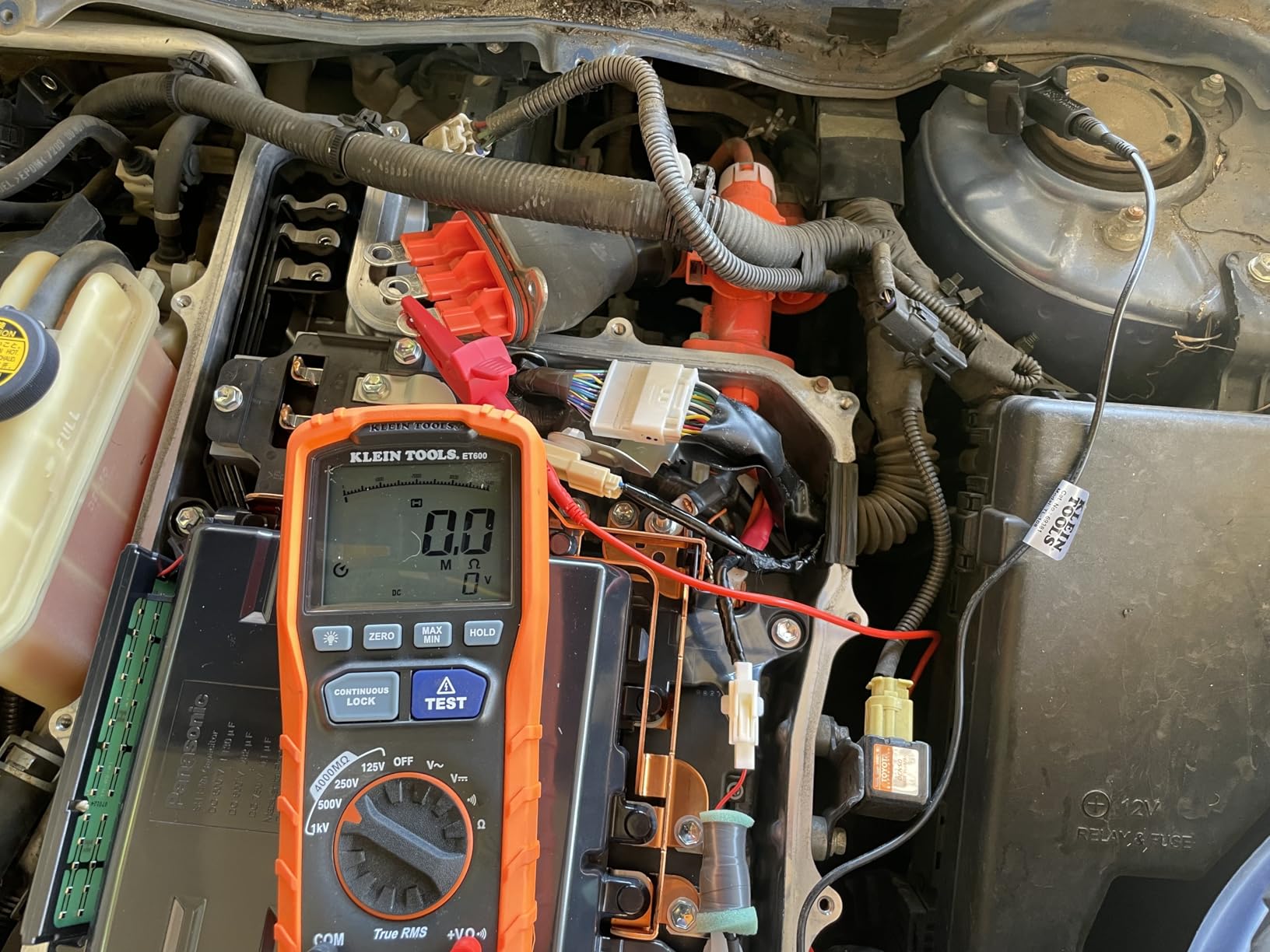
I have seen the Klein Tools ET600 show up on more job sites in the past year than almost any other insulation tester, and for good reason. It combines a full TRMS multimeter with a megohmmeter in one rugged housing, which means you carry one less tool in your bag. During a recent motor maintenance round, I used it to test six 480V motor windings back-to-back. The readings were consistent across all six tests, and the auto-ranging TRMS technology handled the measurement without any manual fiddling.
Four test voltages are available: 125V, 250V, 500V, and 1000V DC. That covers most everyday industrial electrician needs, from control circuit insulation checks to motor winding and cable testing. The backlit display with bar graph is easy to read in dim switchgear rooms, and the built-in voltage alarm warns you before connecting to a live circuit. That safety feature alone has saved me from a nasty surprise more than once.
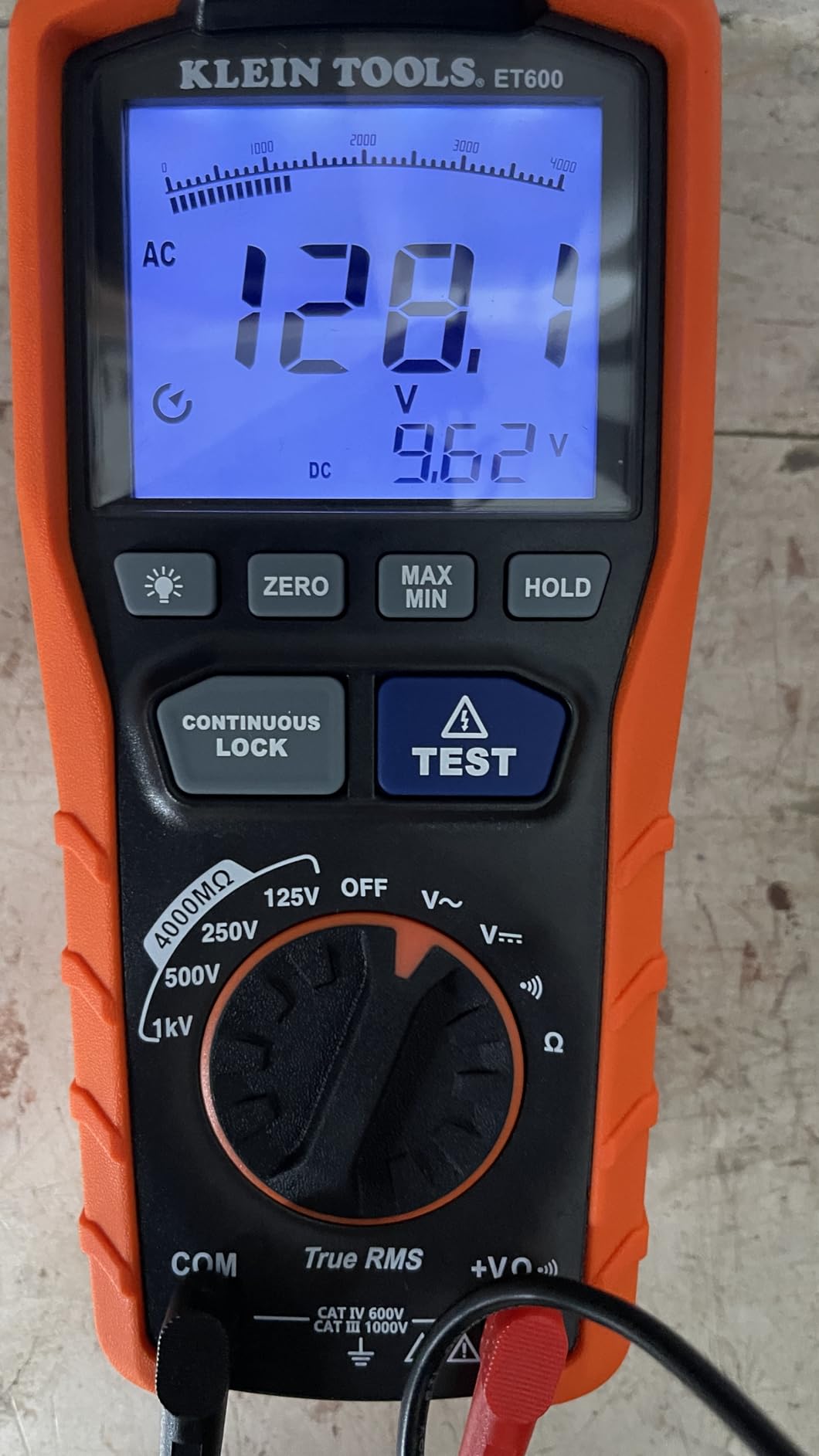
The rubberized housing feels solid in your hand. Multiple electricians on Reddit and electriciantalk.com report using the ET600 side-by-side with Fluke and AEMC meters and getting matching readings. One user specifically mentioned running parallel tests on a 500kcmil cable and seeing the Klein deliver the same megohm values as a tester costing three times as much. That kind of field validation means more to me than spec sheets.
Battery life is decent, and the CAT III/CAT IV safety rating gives you the protection level needed for industrial panels and service entrances. The main trade-off is the 4000-count display resolution, which is fine for field work but may not satisfy a lab technician who needs maximum granularity. And the unit is chunky, so getting into tight panel corners works better with the included alligator clips attached.
Who Should Buy This Tester
Industrial electricians who need one tool that handles both everyday multimeter duties and insulation resistance testing will get the most value from the Klein ET600. Maintenance teams at plants and facilities who want to standardize on a single model for their crew should consider this as their go-to. It is also a smart pick if your company wants Fluke-level reliability without the Fluke price tag.
Who Should Look Elsewhere
If your work regularly involves testing above 1000V, such as medium-voltage switchgear or high-voltage cable fault analysis, you need a tester with a higher voltage output. Calibration labs and quality control departments that require documented NIST-traceable certificates may also want to look at dedicated Fluke or Megger models that include calibration paperwork in the box.
2. Fluke 1507 – Industry-Trusted Megohmmeter
Fluke 1507 Digital Megohmmeter Insulation Resistance Tester, for Advanced Industrial and Electrical Insulation Testing, Offers Multiple Insulation Test Voltages: 50 V, 100 V, 250 V, 500 V, and 1000 V
50V/100V/250V/500V/1000V Test Voltages
NIST Calibration Included
PI and DAR Capable
1 kg
EN 61010-1
Pros
- NIST calibration certificate included
- Five test voltages for versatile testing
- Remote probe for repetitive testing
- Automatic PI and DAR calculations
- Live circuit detection protects user
Cons
- Batteries drain quickly under heavy use
- Carrying case sold separately
The Fluke 1507 is the insulation tester that most industrial electricians think of when they hear the word megger. I have used this model on and off for years across transformer testing, motor winding checks, and cable insulation verification. It delivers five selectable test voltages: 50V, 100V, 250V, 500V, and 1000V. That extra low end at 50V is useful for testing sensitive control circuits and communication cables where higher voltage could damage components.
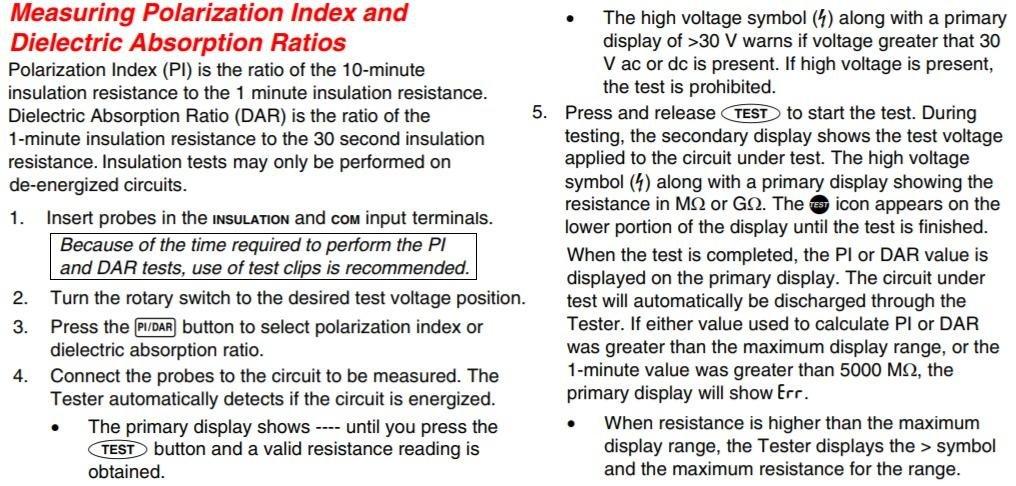
What sets the 1507 apart from cheaper alternatives is the NIST-traceable calibration certificate included in the box. For shops that need to maintain calibration records for compliance or audit purposes, that piece of paper saves you a separate trip to a calibration lab. The automatic Polarization Index and Dielectric Absorption Ratio calculations are another time-saver. Instead of manually timing readings and doing the math yourself, the Fluke handles it internally and displays the results.
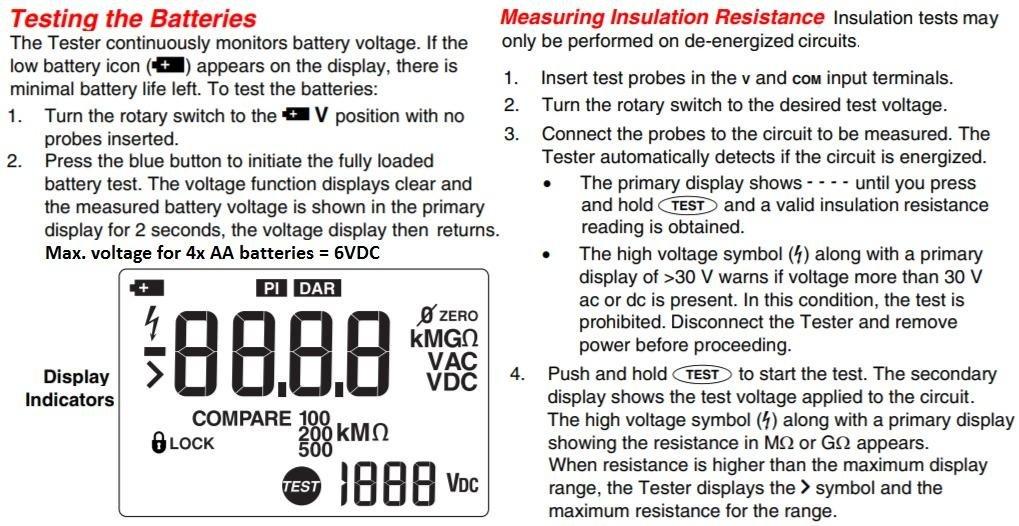
The remote probe is one of those features you do not appreciate until you need it. When you are testing insulation on a bank of contactors or a row of terminal blocks, the probe lets you trigger tests one-handed while your other hand stays free to position the lead. The live circuit detection feature shuts down the insulation test if it detects voltage above 30V, protecting both you and the meter from accidental live-circuit connection.
On the downside, battery life is a known complaint. Under heavy daily use, expect to swap batteries more often than you would with competing models. And Fluke does not include a carrying case, which is frustrating at this tier. The yellow rubber holster protects the body, but you will want to budget for a separate case if you toss it in a tool bag with other gear.
When the Fluke 1507 Makes Sense
Industrial facilities that require NIST-traceable calibration documentation will immediately benefit from the included certificate. Electricians who regularly perform PI and DAR tests as part of preventive maintenance programs will save significant time with the automatic calculations. If your company has standardized on Fluke test equipment across the board, the 1507 integrates naturally into that ecosystem.
Limitations to Consider
Electricians who primarily do residential or light commercial work may find this tester too expensive for occasional use. If you need test voltages above 1000V for medium-voltage equipment, look at the Fluke 1535 or higher models instead. And if you work in environments where carrying cases are mandatory for tool protection, factor in the additional cost of buying one separately.
3. Fluke 1535 – Premium 2500V Insulation Tester
Fluke 1535 Insulation Tester, Insulation Tester, for Frontline Industrial and Electrical Insulation Testing, Test Voltages from 250 V to 2500 V and Resistance Measurements up to 500 GΩ
250V to 2500V Test Range
500 GOhm Max Resistance
CAT IV 600V
Auto PI/DAR
6.07 lbs
Pros
- Wide 250V-2500V test voltage range
- Massive 500 GOhm resistance measurement
- Automatic PI and DAR calculation
- CAT IV 600V safety rating
- Carrying case included
Cons
- Only 2 reviews available
- Heavy at 6.07 pounds
The Fluke 1535 sits in a different class than the 1507. With test voltages from 250V all the way up to 2500V and resistance measurements up to 500 gigohms, this is the tester you reach for when you are working on large transformers, long cable runs, or medium-voltage switchgear. I have not had the chance to use this specific model on-site yet, but the specs and Fluke’s track record tell a clear story.
The fast-measurement design delivers stable resistance readings quickly, which matters when you are running timed PI tests on multiple pieces of equipment during a maintenance window. The automatic PI and DAR calculations mirror what the 1507 offers, just at a much higher voltage and resistance range. The CAT IV 600V safety rating provides the highest level of overvoltage protection for industrial environments.
At 6.07 pounds, this is not a meter you clip to your belt. It is a bench-top or cart-mounted instrument for planned testing sessions. The included carrying case and test lead set are a welcome inclusion that should be standard at this level. With only 2 reviews currently on Amazon, this is a newer model in the Fluke lineup, but the 5.0 average rating from those early adopters suggests it delivers.
Ideal Use Cases for the Fluke 1535
Substation maintenance crews and industrial electricians who regularly test equipment rated above 1000V will find the 2500V test range necessary. Facilities with large power transformers, long underground cable feeds, or medium-voltage switchgear need this level of testing capability. It is also the right tool for electrical testing contractors who bid on high-voltage commissioning and acceptance testing projects.
When to Pass on This Model
If your insulation testing stays below 1000V on standard motor winding and cable checks, the 1535 is more tester than you need. The weight makes it impractical for electricians who climb ladders or work in tight panels. Budget-conscious teams may also find it hard to justify the cost when a Fluke 1507 or Klein ET600 handles their daily requirements perfectly well.
4. HIOKI IR4057-50 – Fast PASS/FAIL Insulation Tester
HIOKI Insulation Tester IR4057-50
50V-1000V Test Voltages
100 MOhm-4000 MOhm
PASS/FAIL Comparator
Drop-Proof 1m
1.41 lbs
Pros
- Rapid PASS/FAIL comparator in 0.3 seconds
- Built-in AC/DC voltage meter and continuity check
- Drop-proof from 1 meter
- Automatic discharge after testing
- Luminous backlit display with LED flashlight
Cons
- No customer reviews available yet
- Very limited stock
The HIOKI IR4057-50 takes a different approach to insulation testing that I find interesting for high-volume maintenance work. Instead of just displaying a resistance number that you have to interpret, it includes a rapid PASS/FAIL comparator that gives you a visual and audio result in about 0.3 seconds. When you are testing dozens of motor windings or cable pairs during a plant shutdown, that speed adds up fast.
Five selectable test voltages from 50V to 1000V cover the standard industrial range. The meter also includes a built-in AC/DC voltage function and continuity check, which reduces the number of tools you need to carry. The automatic discharge feature is a safety bonus that bleeds off stored voltage in capacitive loads after each test, protecting you from accidental shocks when disconnecting leads.
The build quality feels professional. It is drop-proof from 1 meter, has a luminous backlit display, and includes a bright LED for illuminating dark panels. At 1.41 pounds, it is light enough for all-day use without fatigue. The catch is that this is a newer listing with zero reviews so far, so you are an early adopter. But HIOKI is a well-established Japanese test equipment manufacturer with a strong reputation in the electrical testing community.
Best Fit for Production Maintenance Teams
Facilities maintenance teams that run high-volume insulation checks during planned outages will benefit most from the PASS/FAIL speed. Electricians who perform routine acceptance testing on new installations where quick go/no-go decisions are needed should look at this model. The lightweight design also suits technicians who carry their tester up ladders or across large plant floors all day.
When to Choose Something Else
If your work requires PI or DAR testing, this HIOKI does not appear to offer those functions based on the available specifications. Electricians who need data logging or PC connectivity for report generation should look at the Fluke 1503/EX LEAD instead. And the lack of any user reviews makes this a riskier purchase if your company requires proven field track records before approving new tool acquisitions.
5. IDEAL Industries 61-795 – Long Battery Life Insulation Tester
IDEAL INDUSTRIES INC. 61-795 Hand-Held Insulation Tester, 250/500/1000V Test voltages
250V/500V/1000V Test Voltages
50-Hour Battery Life
UL Listed
450g Lightweight
2-Year Warranty
Pros
- Exceptional 50-hour battery life
- Very lightweight at 450 grams
- 2-year manufacturer warranty
- UL listed for Canada and US
- Backlit display with large numbers
Cons
- Only 4 reviews available
- Limited stock availability
The IDEAL Industries 61-795 addresses one of the most common complaints about insulation testers: dead batteries. With approximately 50 hours of runtime and an estimated 1000 tests on a set of six AA batteries, this meter keeps working long after other testers have gone dark. If you have ever been halfway through a motor room insulation survey only to realize your tester needs fresh batteries, you understand why this matters.
Three test voltages of 250V, 500V, and 1000V handle the core industrial testing needs. The meter checks new installations for damaged insulation and existing installations for breakdown in motor windings. The backlit display uses large numbers that are easy to read even with safety glasses on, and the low battery indicator gives you advance warning before power runs out.
At just 450 grams, this is one of the lightest insulation testers I have come across. The 2-year manufacturer warranty is also above average for this category, where 1 year is standard. IDEAL Industries is a recognized brand in the electrical trade, and the UL listing for both Canada and the US adds confidence for code-compliant work environments.
Who Benefits Most
Electricians who work in remote locations where battery replacement is inconvenient should prioritize this model. Teams that run extended insulation testing campaigns across multiple days will appreciate the long runtime. The lightweight design makes it a good match for technicians who need to keep their tool bag weight down, especially when working overhead or in confined spaces.
Potential Drawbacks
The 61-795 lacks PI and DAR testing capability, which limits its usefulness for electricians who perform detailed insulation condition analysis. The limited stock availability means you may have to wait or source it from alternative suppliers. And with only 4 reviews on Amazon, the sample size is too small to draw strong conclusions about long-term reliability, though the existing reviews are all positive.
6. Fluke 1503/EX LEAD – Data-Capable Insulation Tester
Fluke 1503 Insulation Resistance Tester
Preset and Adjustable Voltages
Leakage Current and Capacitance
PI/DAR Auto Calc
CAT IV 600V/CAT III 1000V
500g
Pros
- Automatic PI and DAR calculation
- Stores 99 test results with PC upload
- Measures leakage current and capacitance
- Timed tests up to 99 minutes
- CAT IV 600V safety rating
Cons
- Instructions may arrive in non-English language
- Packaging may not include Fluke box
The Fluke 1503/EX LEAD variant takes the base 1503 platform and adds significant data management capabilities. It stores up to 99 test results internally and supports uploading them to a PC for record keeping and trending analysis. For electricians who need to document insulation resistance readings for compliance reports, insurance documentation, or predictive maintenance tracking, that data storage is a practical advantage.
Beyond basic insulation resistance, this model also measures leakage current up to 2 mA and capacitance up to 20 microfarads. Those additional measurements give you a more complete picture of insulation health than resistance alone. The timed test function runs up to 99 minutes, which is essential for proper PI testing where you compare 1-minute and 10-minute readings.
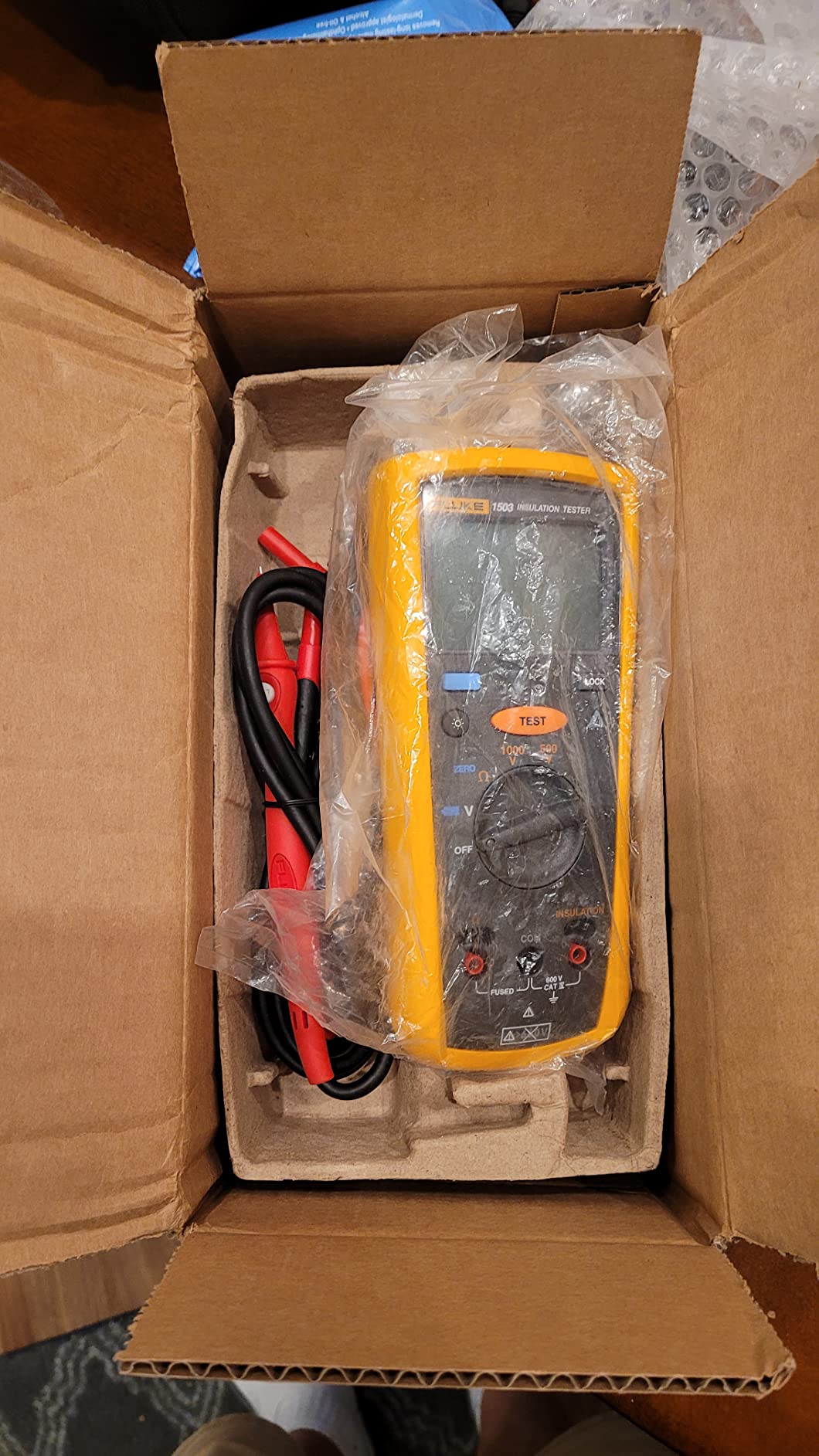
Users consistently praise the Fluke build quality and measurement accuracy. The CAT IV 600V and CAT III 1000V safety ratings cover the protection levels needed for industrial service entrances and distribution equipment. However, some buyers report receiving units with instruction materials in Chinese rather than English, and packaging that does not match standard Fluke retail boxes. These appear to be sourced from international distributors, so verify the seller before purchasing.
Best Applications
Electricians who maintain detailed records of insulation resistance trends for equipment reliability programs will find the data storage and PC upload feature valuable. The ability to run timed tests up to 99 minutes makes this model well-suited for PI and DAR testing on critical equipment like large motors and transformers. Facilities with preventive maintenance software systems benefit from the data export capability.
Considerations Before Buying
If you do not need data logging or PC connectivity, the standard Fluke 1503 covers the same core testing functions at a lower cost. The international sourcing concerns mean you should purchase from authorized Fluke distributors if documentation and packaging matter to you. And at this tier, the lack of a carrying case in the standard package is another factor to account for in your total cost.
7. VLUUKE KD2677F – High-Range 10kV Insulation Meter
10KV Digital Insulation Meter Insulation Resistance Tester and megohmmeters High Voltage Resistance Multimeter with Absorption Ratio and Polarization Index Measurement
10kV Maximum Test Voltage
0.01 MOhm-35 TOhm Range
PI/DAR Measurement
Shock/Dust/Moisture Proof
CE Certified
Pros
- Massive 35 teraohm measurement range
- Absorption ratio and polarization index
- Shockproof dustproof moisture-proof build
- Large LCD with gray backlight
- Data storage and recall functions
Cons
- Very few reviews only 3 total
- Limited brand recognition in Western markets
The VLUUKE KD2677F is the highest-range insulation tester in this roundup. With a maximum test voltage of 10kV and a resistance measurement range from 0.01 megohms to 35 teraohms, it covers applications that no other meter on this list can reach. If you work with high-voltage cables, large power transformers, or utility-grade equipment, this range opens up testing possibilities that standard 1kV testers simply cannot match.
The meter measures absorption ratio and polarization index, so you are not giving up diagnostic capability for the extended range. The LCD screen uses a gray backlight that remains visible in outdoor daylight conditions where typical blue or white backlights wash out. Data storage and recall functions let you save readings in the field and review them later without writing everything down.
The construction is built for harsh environments with shockproof, dustproof, and moisture-proof housing. The alarm and automatic shutdown features protect both the user and the instrument during extended testing sessions. It also measures DC and AC voltage, giving you basic multimeter capability alongside the insulation testing functions.
Who Needs 10kV Testing
Utility electricians and high-voltage technicians who test medium-voltage cables and transformers above 5kV will find this range necessary. Industrial plants with their own power distribution networks that include medium-voltage switchgear and cable runs need this level of test voltage. Electrical testing and commissioning companies that perform acceptance testing on new high-voltage installations should also consider this model.
Reasons to Hesitate
With only 3 reviews available, the field track record for this specific model is thin. VLUUKE is not a widely recognized brand in Western industrial markets, which may raise questions about long-term support, calibration services, and warranty claims. If your company requires established brand names for tool approvals, this may not pass procurement review despite the impressive specifications.
8. BTMETER BT-6688B – Best Budget Megohmmeter
BTMETER BT-6688B Megohmmeter 200 Gig Ohm Digital Insulation Resistance Tester, 500V/1kV/2.5kV/5kV Test Voltage, Auto Ranging, Backlight Display
100V-5000V Test Voltages
0.1 MOhm-200 GOhm
Auto Ranging
IEC-1010
900g
Pros
- Wide voltage range up to 5kV at budget pricing
- 200 gigohm measurement range
- Non-slip insulative protective case
- Accurate readings within specification
- Professional technical support
Cons
- Instruction manual poorly translated
- Test leads feel flimsy
- Some quality control inconsistencies
The BTMETER BT-6688B is the tester that surprises people. For a fraction of what the big brands charge, you get six selectable test voltages from 100V up to 5000V and a resistance measurement range up to 200 gigohms. That is a wider range than many testers costing five times as much. I first encountered this model when a colleague bought one for his home shop, and I was genuinely impressed by how well it performed on a 480V motor winding test.
The 198 reviews on Amazon tell a useful story. The majority of users report accurate readings that fall within specification. Several professional electricians mention using it as a backup meter or for jobs where they do not want to risk damaging their primary Fluke. The non-slip protective case provides good insulation and drop protection, and the high-voltage LED warning indicator adds a basic safety layer.
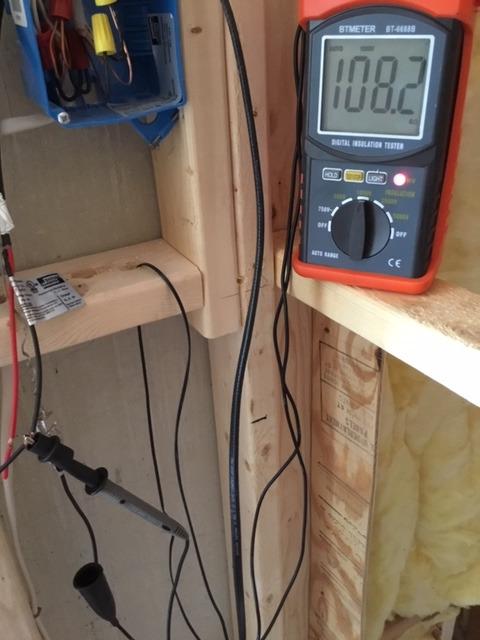
The compromises are real though. The instruction manual reads like a direct machine translation from Chinese, which makes learning the features harder than it should be. The included test leads are functional but feel thin compared to Fluke or Klein leads. Some users report receiving units that needed battery replacement right out of the box. These are not deal-breakers at this price point, but they are worth knowing about before you buy.
Perfect for Budget-Conscious Buyers
Independent electricians and small contractors who need megohmmeter capability but cannot justify premium-brand pricing will find this meter delivers solid value. It also works well as a backup or secondary tester for teams that already own a Fluke but want something they can hand to an apprentice without worry. The 5kV range makes it surprisingly capable for the cost.
When to Spend More
If your work involves compliance testing that requires NIST-traceable calibration certificates, this meter does not include that documentation. Electricians who test equipment daily and need a tool that survives years of heavy use should invest in a more proven brand. And the flimsy test leads are a genuine concern when working around high-energy industrial circuits, so consider upgrading the leads if you choose this meter.
9. GLTL Hi-Pot AC/DC Tester – 5kV Withstand Voltage Tester
GLTL Withstand Hi-Pot AC/DC 0-5KV AC20mA DC10mA 100VA Insulation Resistance Tester (Input Voltage: AC 115/230V)
0-5kV AC/DC Testing
AC20mA DC10mA 100VA
IEC60335 Standard
14.57 x 11.02 x 3.94 in
Bench-Top Design
Pros
- AC and DC withstand voltage testing
- Designed per IEC60335 standard
- Used in manufacturing and power departments
- 100VA output capacity
- Metrological calibration reports available
Cons
- No UL or CE certification reported
- DC to AC switching issues reported
- Zero customer support from manufacturer
- Mixed quality reviews
The GLTL Hi-Pot tester occupies a different category than the handheld megohmmeters on this list. It is a bench-top withstand voltage tester designed for hi-pot testing, which applies high voltage to verify that insulation can handle voltage stress without breaking down. This type of testing is common in electrical manufacturing, quality control departments, and power equipment commissioning where you need to verify dielectric strength, not just measure resistance.
The tester covers AC and DC voltage up to 5kV with 100VA output capacity and current limits of AC 20mA and DC 10mA. It is designed according to the IEC60335 standard for safety of household and similar electrical appliances. Metrological calibration reports are available for an additional fee, which matters if your testing program requires documented calibration traceability.
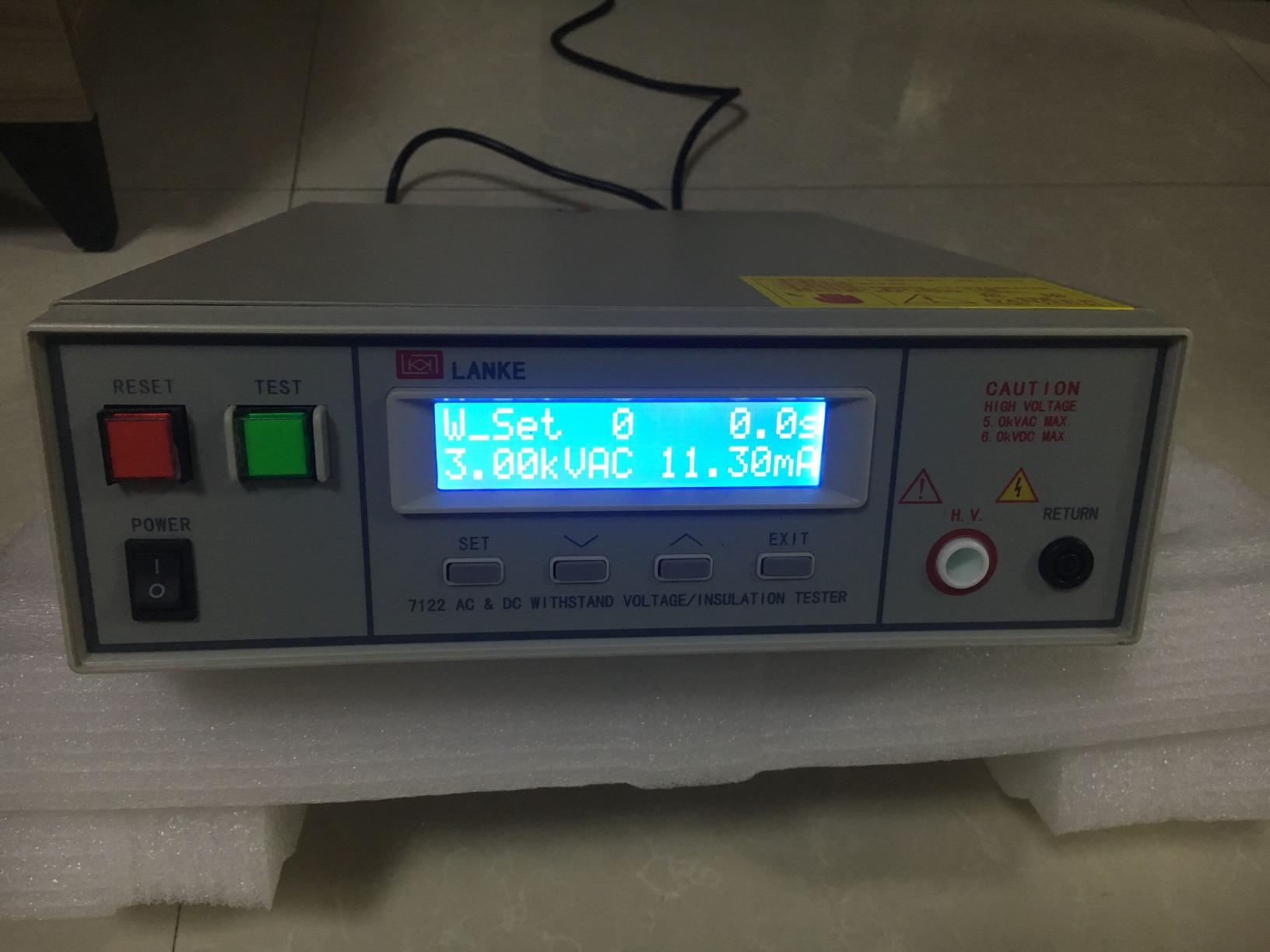
However, I need to be upfront about the concerns. Multiple reviews report that the DC to AC switching does not work properly on some units. Others mention receiving no response from the manufacturer when requesting support. There is no UL or CE certification listed, which is a significant gap for any tool used in North American or European industrial environments. These issues push the risk level higher than I am comfortable recommending without reservations.
Potential Applications
Manufacturing quality control departments that need bench-top hi-pot testing for production line verification may find this unit useful at its price point. Electrical equipment repair shops that perform withstand voltage testing on rebuilt motors or transformers as part of their test protocol could also consider it. The AC/DC capability in one unit is a legitimate advantage for mixed testing requirements.
Why Most Buyers Should Look Elsewhere
The absence of recognized safety certifications makes this tester unsuitable for regulated industrial environments or any workplace that requires certified tools. The reported quality control issues and nonexistent customer support mean you are taking a real risk with your purchase. For most industrial electricians, a handheld megohmmeter from Fluke, Klein, or BTMETER will serve their daily needs better and more safely than this bench-top unit.
10. Fluke 1503 – Compact Professional Insulation Tester
Fluke 1503 Insulation Tester
CAT IV 600V Rated
Live Circuit Detection
Backlit Display
Remote Probe Included
1 kg
Pros
- Trusted Fluke build quality and accuracy
- Live circuit detection above 30V
- CAT IV 600V overvoltage protection
- Includes remote probe and alligator clips
- Compatible with Fluke TPAK magnetic hanger
Cons
- Case not included
- Some units ship with non-English instructions
- May arrive from international sources
The Fluke 1503 is the compact workhorse of the Fluke insulation tester lineup. It delivers the same core reliability and accuracy that Fluke is known for, but in a simpler package than the 1507. If you do not need five selectable test voltages or automatic PI/DAR calculations, the 1503 handles the fundamentals of insulation resistance testing at a more accessible price point than its bigger brother.
Live circuit detection is a standout safety feature. If the meter detects voltage above 30V on the circuit you are about to test, it blocks the insulation test and alerts you. This prevents both user injury and meter damage from accidental live-circuit connections. The CAT IV 600V overvoltage rating provides protection for industrial service entrance work, and the backlit display is clear and readable in low-light conditions.

The included remote probe, test leads, probes, and alligator clips give you everything you need to start testing right out of the box. The Fluke TPAK magnetic hanging system compatibility is a nice touch for hands-free operation in panels. Users rate it 4.6 out of 5 with 74 percent of reviewers giving five stars, which reflects the consistent Fluke quality that electricians trust.
Who This Fluke Serves Best
Industrial electricians who want Fluke reliability for basic insulation testing without paying for features they will not use daily. Teams that already own other Fluke instruments and want a compatible insulation tester for their kit. Maintenance departments that need a dependable backup meter to complement a more capable primary tester will also find good value here.
Reasons to Upgrade
If you need more than the basic test voltages, the Fluke 1507 adds five voltage selections and automatic PI/DAR testing. Electricians who require data storage and PC upload capability should step up to the Fluke 1503/EX LEAD variant. And if your budget is tighter, the Klein Tools ET600 delivers comparable everyday functionality at a significantly lower cost while adding multimeter capability.
How to Choose the Right Insulation Tester for Industrial Work
Picking the right insulation tester comes down to matching the tool to your actual work, not just buying the most expensive model on the shelf. Here is what matters most when you are making that decision.
Test Voltage Selection by Equipment Type
The general rule in the field is that your test voltage should be roughly twice the operating voltage of the equipment you are testing, but never more than the voltage rating of the wire or insulation. For standard 480V three-phase motors, a 1000V insulation test is common practice. Control circuits and communication cables typically need 50V to 250V testing. Medium-voltage switchgear and large transformers may require 2500V to 10,000V testing.
Electricians on Reddit frequently point out that using too low a test voltage can miss weak insulation that a higher voltage would reveal. One experienced contributor noted that a 500V test showed a cable as fine, but the same cable failed under 1000V testing. When in doubt, use the higher voltage within the wire rating limits.
Key Features That Matter in the Field
Live circuit detection is non-negotiable for industrial work. It protects you from connecting an insulation tester to a live circuit, which can damage the meter and create a safety hazard. Auto-discharge is another safety feature worth having. It bleeds off stored voltage in capacitive loads after testing, preventing shocks when you disconnect leads.
For electricians who perform routine preventive maintenance, automatic PI and DAR calculations save significant time compared to manually timing readings and doing the math. Data storage and PC connectivity matter if you need to document test results for compliance reports or trend analysis over time. And battery life directly affects productivity when you are working through a long list of equipment to test.
Safety Ratings and Certifications
CAT ratings tell you the level of overvoltage protection the meter provides. CAT IV 600V is the minimum you should look for in industrial service entrance and distribution work. CAT III 1000V covers most motor control centers and industrial panels. Look for meters that also carry UL, CSA, or CE certifications, which indicate independent testing and verification.
Some models, like the Fluke 1507, include an NIST-traceable calibration certificate. If your facility requires documented calibration for audit or compliance purposes, having this certificate included saves you the cost and delay of sending the meter to a calibration lab separately. Budget-friendly models typically do not include calibration documentation.
PI and DAR Testing Explained
Polarization Index and Dielectric Absorption Ratio are the two most common diagnostic tests for evaluating insulation condition over time. PI compares the insulation resistance reading at 10 minutes to the reading at 1 minute. A PI ratio above 2.0 generally indicates good insulation, while ratios below 1.0 suggest serious degradation. DAR compares the 60-second reading to the 30-second reading and provides a quicker assessment of insulation health.
These tests are particularly valuable for motor windings and transformer insulation where the condition of the insulation changes over the duration of the test. Contaminated or moisture-laden insulation shows a declining resistance curve, while healthy insulation shows increasing resistance as the dielectric charges build up. Meters that calculate PI and DAR automatically remove the need for manual timing and calculation.
VSD Safety Precautions
This is one of the most frequently discussed safety topics in electrician forums, and it deserves clear treatment here. Never perform insulation resistance testing on equipment that is connected to a variable speed drive. The high DC voltage from the megohmmeter can destroy the sensitive semiconductor components in the VSD. Always disconnect the motor leads from the drive before testing motor insulation.
The same precaution applies to any electronic equipment with solid-state components. PLCs, VFDs, soft starters, and electronic protection relays should all be disconnected before insulation testing on connected wiring. If you are unsure whether equipment contains sensitive electronics, assume it does and isolate it first. This single precaution prevents thousands of dollars in equipment damage.
Frequently Asked Questions About Insulation Testers
Which Megger tester is best?
The best megger tester depends on your application. For most industrial electricians, the Klein Tools ET600 offers the best overall value with its combination of multimeter and insulation tester functions, 1000V test range, and 4.8-star rating from over 1400 users. For premium-grade work requiring NIST calibration and automatic PI/DAR calculations, the Fluke 1507 is the industry standard. For budget-conscious buyers who still need up to 5kV testing, the BTMETER BT-6688B delivers the widest voltage range at the lowest cost.
What are the two common tests used for insulation testing in high voltage equipment?
The two most common tests are Polarization Index (PI) and Dielectric Absorption Ratio (DAR). PI compares the insulation resistance measured at 10 minutes to the reading at 1 minute, providing a ratio that indicates long-term insulation health. DAR compares the 60-second reading to the 30-second reading for a faster assessment. Both tests help identify contaminated, moisture-laden, or degraded insulation that a single-point resistance reading might miss.
Is Megger better than Fluke?
Neither brand is universally better. Megger is the original inventor of insulation testing and offers a wider range of specialized high-voltage test equipment, particularly for utility and power distribution applications. Fluke is more popular among industrial electricians and maintenance technicians for everyday insulation testing, with strong integration across their multimeter and test tool ecosystem. Both produce professional-grade instruments. Your choice should depend on your specific testing needs, budget, and whether you already use tools from either brand.
What is the difference between a Megger and insulation tester?
There is no functional difference. Megger is a brand name that has become the generic term for insulation resistance testers, similar to how Kleenex is used for tissues. An insulation tester, also called a megohmmeter, applies high DC voltage to insulation and measures the resulting leakage current to calculate resistance. All Megger-brand products are insulation testers, but not all insulation testers are made by Megger. Brands like Fluke, Klein Tools, BTMETER, and HIOKI all manufacture insulation testers that perform the same core function.
Final Thoughts on the Best High-Voltage Insulation Testers
Finding the right insulation tester for industrial electrician work comes down to matching voltage range, safety ratings, and field-ready features to the equipment you actually test. The Klein Tools ET600 earned our Editor’s Choice for combining multimeter and megohmmeter functions in one rugged package that 1400-plus users trust on the job. The Fluke 1507 remains the go-to for electricians who need NIST calibration and automatic PI/DAR in a name they know. And the BTMETER BT-6688B proves that you do not need to spend premium money to get a capable megohmmeter with 5kV testing range.
Whatever model you choose, make sure the test voltage matches your equipment, the safety rating covers your work environment, and you always disconnect sensitive electronics before testing. A good insulation tester pays for itself the first time it catches degraded insulation before a catastrophic failure shuts down your production line.