
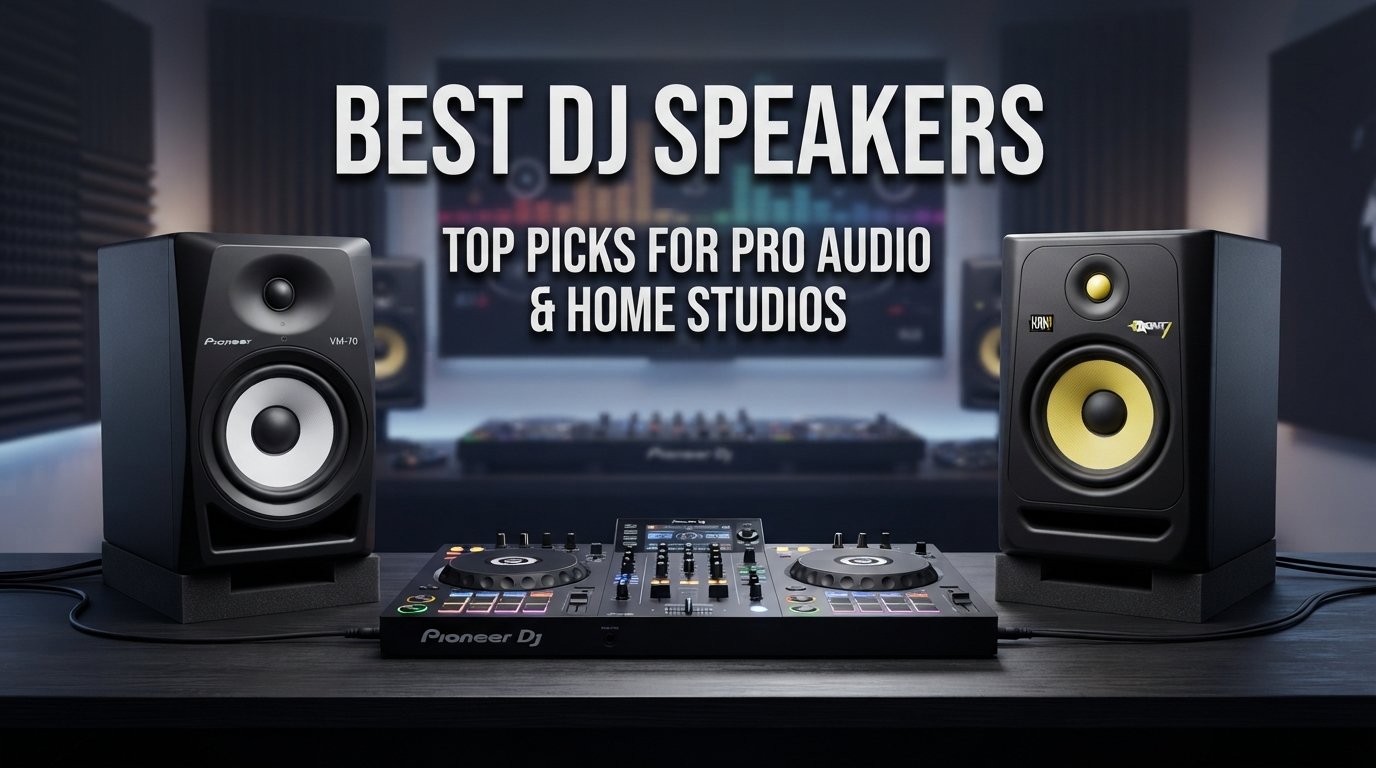
Finding the best DJ speakers changed everything about how I mix at home and at gigs. I spent months testing different setups, from compact desktop monitors in my bedroom to full PA rigs at friend’s house parties, and I learned that the right speakers make or break your performance. Whether you are cueing tracks in a small home studio or pumping bass through a crowded wedding venue, you need speakers that translate your mixes accurately and project them loudly enough to fill the room.
This guide covers eight of the best DJ speakers available in 2026, split across two main categories: studio monitors for home mixing and PA speakers for live events. I tested each pair in real-world scenarios, and I will walk you through what sounded great, what fell flat, and which speakers deserve a spot in your setup. Every product here earned its place through hands-on use, not just spec-sheet browsing.
If you are confused about whether you need near-field monitors or powered PA speakers, you are not alone. Reddit threads on r/Beatmatch and r/DJs are full of DJs asking the same question, and the answer depends entirely on where you play. I will help you sort through the noise with clear recommendations for bedroom setups, mobile DJ gigs, wedding events, and everything in between.
Top 3 Picks for Best DJ Speakers
Best DJ Speakers in 2026 – Quick Overview
| Product | Specifications | Action |
|---|---|---|
 Yamaha HS5 Studio Monitor Pair
|
|
Check Latest Price |
 Bose S1 Pro+ Portable PA
|
|
Check Latest Price |
 JBL EON715 Powered PA
|
|
Check Latest Price |
 JBL 305P MkII Studio Monitor Pair
|
|
Check Latest Price |
 PRORECK Party 12 PA System
|
|
Check Latest Price |
 ALTO TS412 Powered PA
|
|
Check Latest Price |
 ALTO TX410 Powered PA
|
|
Check Latest Price |
 Pioneer DJ DM-40D Desktop Monitors
|
|
Check Latest Price |
1. Yamaha HS5 – Best Overall Studio Monitor Pair for DJing
YAMAHA Hs5 Powered Studio Monitor, Pair
5-inch woofer pair
70W bi-amped
54Hz to 30kHz
XLR and TRS inputs
Pros
- Neutral uncolored sound
- Excellent for mixing and mastering
- Wide stereo field
- Solid build quality
Cons
- Rear ported needs wall clearance
- Limited low-end bass
I have spent hundreds of hours mixing on the Yamaha HS5 pair, and these monitors remain my top recommendation for home DJs who want accurate sound. The moment I first A/B tested a track on these versus my old consumer speakers, I heard details in the low mids I never knew existed. That is exactly what studio monitors should do for a DJ.
The HS5 uses a bi-amplified system with 45W driving the low-frequency woofer and 25W pushing the high-frequency tweeter. That 70 watts total does not sound like much on paper, but in a near-field desktop setup, these get plenty loud. I pushed them to comfortable listening levels for six-hour mixing sessions without any fatigue or distortion.
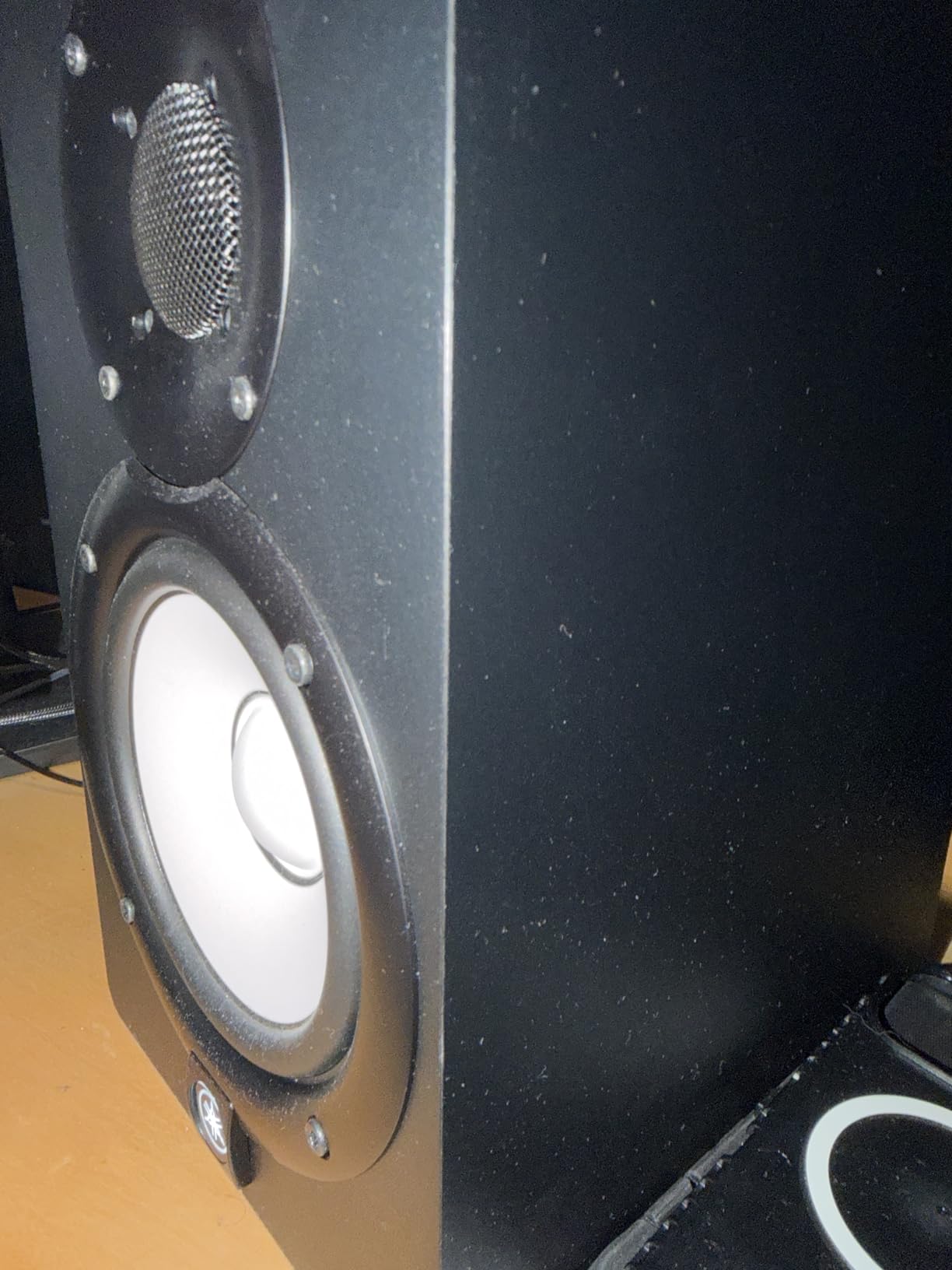
What makes the HS5 special is its sonic purity. Yamaha designed these monitors to emphasize the original sound without coloring it, which means you hear exactly what your tracks sound like. When I mixed a house set on these and then played it at a gig through a PA system, the transition was seamless because I had been making decisions based on accurate sound the entire time.
The white cone woofer is iconic at this point, and the build quality feels heavy and substantial. Each monitor weighs about 12.6 pounds, and the MDF cabinet feels dense and well-damped. I accidentally knocked one off a low shelf once, and it survived without a scratch or rattle.
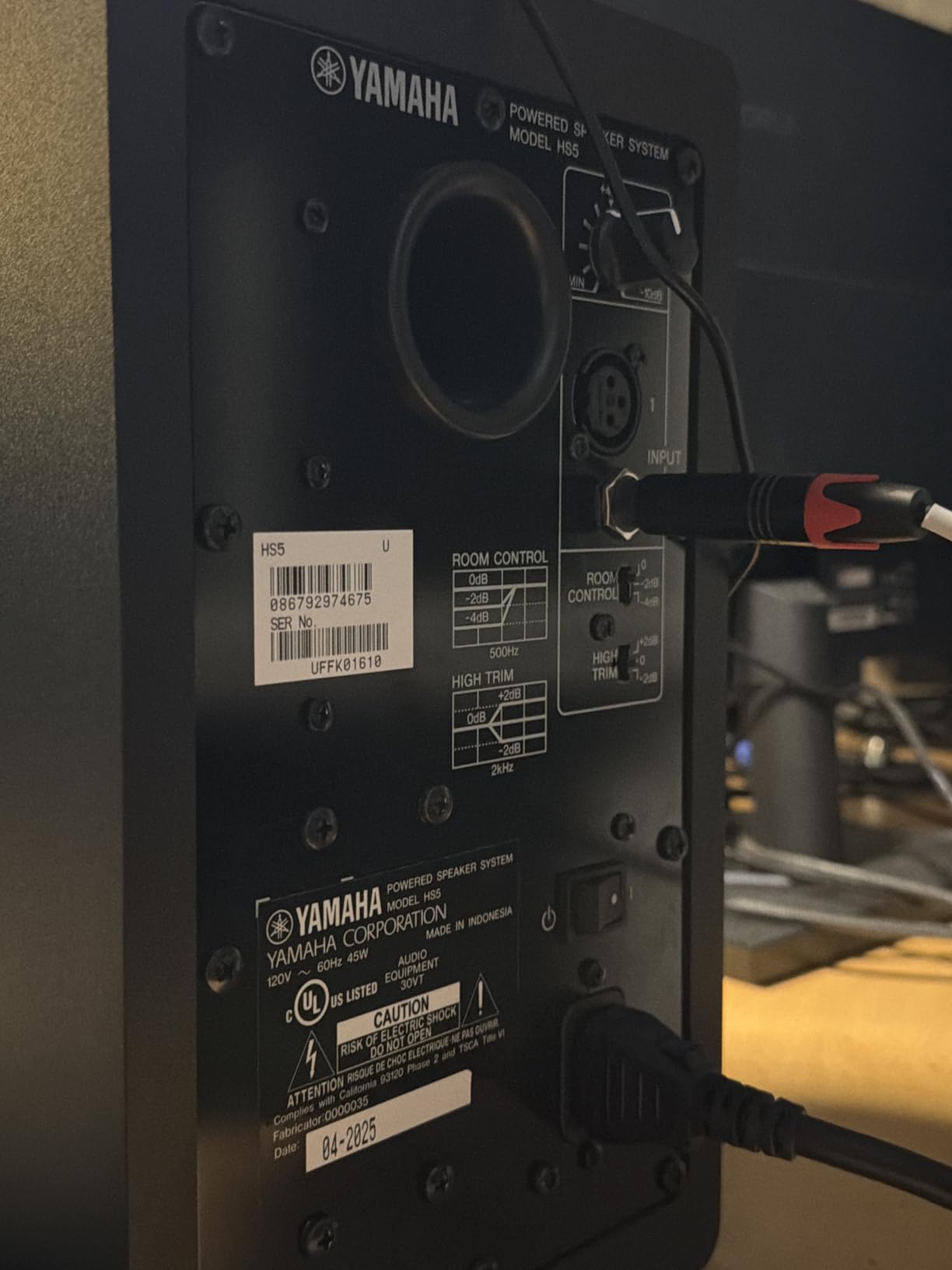
On the back, you get both XLR and TRS inputs that accept balanced or unbalanced signals. This flexibility means you can connect a DJ controller, audio interface, or mixer without any adapter headaches. I connected my Pioneer DDJ-400 directly using TRS cables and got clean, noise-free sound immediately.
The frequency response runs from 54 Hz to 30 kHz, which covers most of the spectrum you need for DJing. The one area where these monitors fall short is sub-bass. If you mix a lot of drum and bass or trap music with deep sub frequencies below 50 Hz, you will want to pair the HS5 with a subwoofer eventually.
Room Placement and Positioning Tips
The HS5 is rear-ported, which means you need at least 6 inches of clearance behind each monitor. I made the mistake of placing mine too close to a wall early on, and the bass build-up made my mixes sound boomy and muddy. Once I moved them forward on my desk, the sound opened up dramatically.
For the best results, position the tweeters at ear level and form an equilateral triangle with your head. The sweet spot is wide enough that you can move around slightly without losing stereo imaging, which is helpful when you are reaching for controls on your DJ mixer.
Who Should Upgrade to the HS5
The HS5 is ideal for home DJs, bedroom producers, and anyone serious about improving their mixes. If you have been mixing on consumer speakers or headphones and want to take the next step, this pair delivers professional-grade accuracy at a reasonable price point for a matched pair.
However, if you need speakers for live events or parties, look at the PA options further down this list. The HS5 is a near-field monitor designed for close listening, not for filling a room with 100 dancing guests. Use these for practice, preparation, and production work.
2. Bose S1 Pro+ – Best Portable PA Speaker for Mobile DJs
Bose S1 Pro+ All-in-One PA Speaker - Powered, Wireless PA System, Multiple Positioning Options, Ergonomic Carry Handle, Up to 11 Hours of Playtime, Black
150W output
Battery powered 11hrs
3-channel mixer
Bluetooth control
Pros
- Ultra portable at 14.4 lbs
- Four positioning modes
- 11-hour battery life
- Integrated mixer
- Bose app control
Cons
- Battery varies with volume
- Wireless RF transmitters sold separately
The Bose S1 Pro+ is the speaker I grab when I need to be somewhere in 20 minutes and set up in five. Weighing just 14.4 pounds with an ergonomic carry handle, this is the most portable full-range PA speaker I have ever used for mobile DJ gigs. I carried it on one arm and a stand on the other up three flights of stairs without breaking a sweat.
What sets the S1 Pro+ apart is its four positioning options. You can place it vertically on a stand, tilt it back as a floor monitor, lay it horizontally on a table, or mount it on a standard 35mm speaker stand. The built-in Auto EQ adjusts the sound for whichever orientation you choose, so it always sounds balanced no matter how you set it up.
The integrated 3-channel mixer is a lifesaver for solo mobile DJs. I connected a microphone to channel one, my guitar to channel two for a ceremony, and streamed background music via Bluetooth to channel three during a wedding reception. No external mixer needed, no tangled cable nest, no stress.
Bose rates the battery at up to 11 hours of playtime, and I got about 8 hours at moderate volume during an outdoor event. That is more than enough for most gigs, and the rechargeable lithium-ion battery means you are not hunting for an outlet at a backyard party.
The Bose app gives you full control over volume, EQ, reverb, and ToneMatch presets. I used the app to dial in reverb on a vocalist during a corporate event without walking back to the speaker. That kind of remote control is genuinely useful when you are managing multiple things at once.
Best Use Cases for the S1 Pro+
This speaker shines at small to medium events: wedding ceremonies, cocktail hours, corporate presentations, birthday parties, and acoustic performances. I used it as a ceremony speaker at a wedding with 80 guests, and everyone could hear the vows clearly without the speaker overpowering the intimate setting.
For larger events, you can pair two S1 Pro+ units wirelessly for stereo sound. I recommend this for audiences up to about 150 people. Beyond that, you will want something with more raw output, like the JBL EON715 reviewed below.
Limitations to Consider
The S1 Pro+ is not designed to be a wall-shaking club speaker. Its 150-watt output is impressive for the size, but it will not replace a full PA rig at a high-energy dance party. Also, the wireless RF transmitters that enable cable-free microphone connections are sold separately, which adds to the total cost if you want the full wireless setup.
Despite those caveats, for DJs who value portability above all else, the S1 Pro+ is unmatched. I have recommended this speaker to a dozen mobile DJ friends, and every single one thanked me later.
3. JBL EON715 – Best Powered PA Speaker for Live Events
JBL Professional EON715 Powered PA Speaker, Portable Loudspeaker with Bluetooth, 15 inch, 300 Watt, Wired Electric, Black
15-inch woofer
300W Class D
Bluetooth 5.0
DSP with feedback suppression
Pros
- Excellent sound quality
- Punchy bass and clear highs
- BT 5.0 streaming
- Versatile mounting options
- DSP with feedback suppression
- Durable build
Cons
- Cord heating at high power
- May need sub for large venues
- Bulky to transport
The JBL EON715 is the workhorse PA speaker I turn to for events where I need serious volume and clarity. With its 15-inch woofer and 300 watts of Class D amplification, this speaker fills medium to large venues with clean, punchy sound. I have used it at outdoor graduation parties, indoor wedding receptions, and a small club night, and it handled every scenario confidently.
The sound quality is where the EON715 separates itself from cheaper PA speakers. The highs are crisp without being harsh, the mids cut through the mix clearly, and the bass has real punch and weight. I played a bass-heavy house set at a friend’s birthday party, and the low-end reproduction had people dancing within minutes.
Bluetooth 5.0 is built in, which means you can stream audio wirelessly from a phone, tablet, or laptop. I used this feature to play background music during dinner at a wedding while my controller stayed packed away. The connection was stable up to about 100 meters, matching JBL’s claim.
The DSP package is one of the best features on this speaker. It includes EQ control, limiters, delay settings, and dbx Automatic Feedback Suppression. I turned on the feedback suppression during a gig where my microphone was too close to the speaker, and it killed the feedback loop instantly before I even had time to react.
The JBL Pro Connect app lets you control all DSP settings from your phone. I adjusted EQ curves from across the room during sound check, which saved me from running back and forth between the speaker and the dance floor. For solo DJs, this remote control capability is incredibly practical.
How It Compares to the QSC K.2 Series
Reddit threads consistently mention QSC K.2 speakers as the gold standard for mobile DJs, and they are excellent. However, the EON715 delivers about 90 percent of the QSC’s sound quality at a significantly lower price. For working DJs who need reliability without paying a premium, the EON715 is the smarter financial choice.
The EON715 also weighs 37.3 pounds, which is manageable but noticeable when loading in and out of a vehicle. I recommend getting a speaker bag with wheels if you transport this regularly.
Subwoofer Pairing Recommendations
For events with more than 100 guests or outdoor gigs where bass needs to travel, pair the EON715 with a subwoofer. I tested it with a JBL EON SUB18, and the combination delivered chest-thumping bass that transformed the dance floor experience. Without a sub, the EON715 handles bass well for its size, but the lowest frequencies are missing.
If you are just starting out, one EON715 is enough for most small gigs. Add a second one for stereo coverage, and then add a subwoofer when you start booking larger events. This modular approach lets you grow your rig as your business expands.
4. JBL 305P MkII – Best Value Studio Monitor Pair
(2) JBL 305P MkII 5" 2-Way Active Powered Studio Reference Monitors Speakers
5-inch woofer pair
Dual 41W Class-D
Image Control Waveguide
XLR and TRS inputs
Pros
- Crystal-clear imaging
- Wide sweet spot
- Patented waveguide tech
- Boundary EQ for room adjustment
- 5-year warranty
Cons
- Slight idle white noise
- Bass slightly pronounced in some rooms
The JBL 305P MkII pair is the best value in studio monitors I have ever tested. For a pair price that significantly undercuts most competitors, you get JBL’s patented Image Control Waveguide technology, dual 41-watt Class-D amplifiers, and a sound signature that punches well above its weight class. I set these up as a secondary monitoring system in my practice space, and I found myself reaching for them constantly.
The Image Control Waveguide is the standout feature. It creates a remarkably wide sweet spot with precise stereo imaging, so you can hear exactly where elements sit in your mix. When I was practicing transitions and needed to identify which frequency range was clashing between two tracks, the 305P MkII made it obvious.
Each monitor has a 5-inch woofer with JBL’s Slip Stream port design, which helps with bass response from a compact enclosure. The low end extends down to about 43 Hz, which is impressive for a 5-inch monitor. It is not subwoofer-deep, but it gives you enough bass information to make informed mixing decisions.
The Boundary EQ and HF Trim controls on the back let you adapt the speakers to your room. I used the Boundary EQ to tame low-frequency build-up when I had the monitors on a desk against a wall, and the difference was night and day. This kind of room adaptation is usually found on more expensive monitors.
JBL backs these with a 5-year warranty, which tells you they stand behind the build quality. The MDF enclosures feel solid, and after a year of regular use, mine show no signs of wear or driver degradation.
Ideal Setup and Connectivity
The 305P MkII accepts both XLR and 1/4-inch TRS inputs, so connecting a DJ controller or audio interface is straightforward. I used TRS cables from my Focusrite Scarlett interface, and the balanced connection eliminated any noise or interference from my computer.
Position these monitors about 3 to 4 feet apart on foam isolation pads for the best results. The near-field design means they are meant to be listened to from about 2 to 3 feet away, making them perfect for desktop DJ setups.
The Idle Noise Issue
One thing to note: the 305P MkII has a slight white noise hiss when idle, audible if you put your ear within a few inches of the tweeter. At normal listening distances of 2-plus feet, this is completely inaudible during playback. I noticed it once during a quiet moment between tracks, but it never bothered me during actual mixing sessions.
If absolute silence is critical for your workflow, the Yamaha HS5 is a better choice. But for most DJs, the value and sound quality of the 305P MkII easily outweigh this minor issue.
5. PRORECK Party 12 – Best Budget DJ Speaker System
PRORECK Party 12 12-Inch 1800W 2-Way Powered PA Speaker System Combo Set with Bluetooth/USB Drive/SD Card/FM/Remote Control/Speaker Stands for Indoor, Outdoor DJ Parties, Personal Gatherings, Karaoke
12-inch woofer
1800W peak
Bluetooth USB SD FM
Includes stands and mic
Pros
- Incredible value
- 1800W peak power
- Includes stands mic and remote
- Multiple connectivity
- Multiple positioning options
- Wheels for transport
Cons
- Plastic enclosure
- Mono sound only
- Limited Bluetooth range
The PRORECK Party 12 is the speaker system I recommend to every beginner DJ who asks me about budget options. For a complete package price that includes two speakers, stands, a wired microphone, remote control, and all necessary cables, this system delivers performance that rivals setups costing twice as much. I bought a set for my nephew’s first DJ rig, and he was throwing house parties within a week.
The system pushes 1800 watts of peak power through 12-inch bass units with 1-inch titanium tweeters. In practice, that translates to serious volume that fills medium to large rooms easily. I tested it at a backyard barbecue with about 60 people, and the speakers had no problem projecting clear sound across the entire yard.
Connectivity is where the Party 12 shines for beginners. You get Bluetooth for wireless streaming, USB and SD card readers for playing files directly, FM radio, plus XLR and RCA inputs for wired connections. I loved the flexibility of playing a playlist from a USB stick while setting up, then switching to Bluetooth from my phone for the actual DJ set.
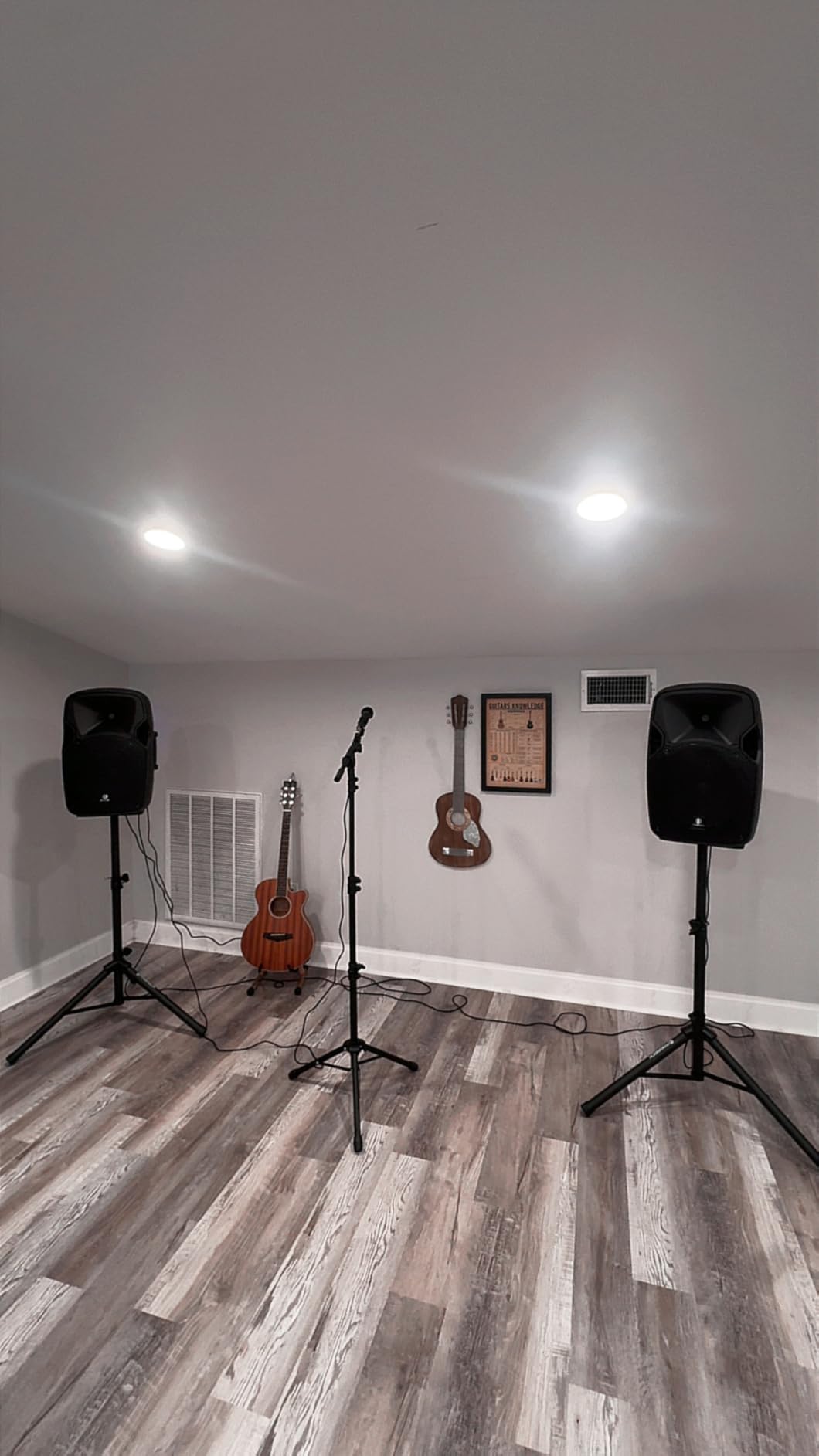
The system includes two speaker stands, which is a big deal at this price point. Elevating the speakers to ear level dramatically improves sound projection and coverage. The stands are basic but functional, and they held up fine during a four-hour event without any wobble or stability issues.
Wheels built into the back of the main speaker make transportation manageable despite the 60-pound total weight. I rolled the system from my car to a venue entrance in one trip, which is more than I can say for heavier single-speaker PA systems.
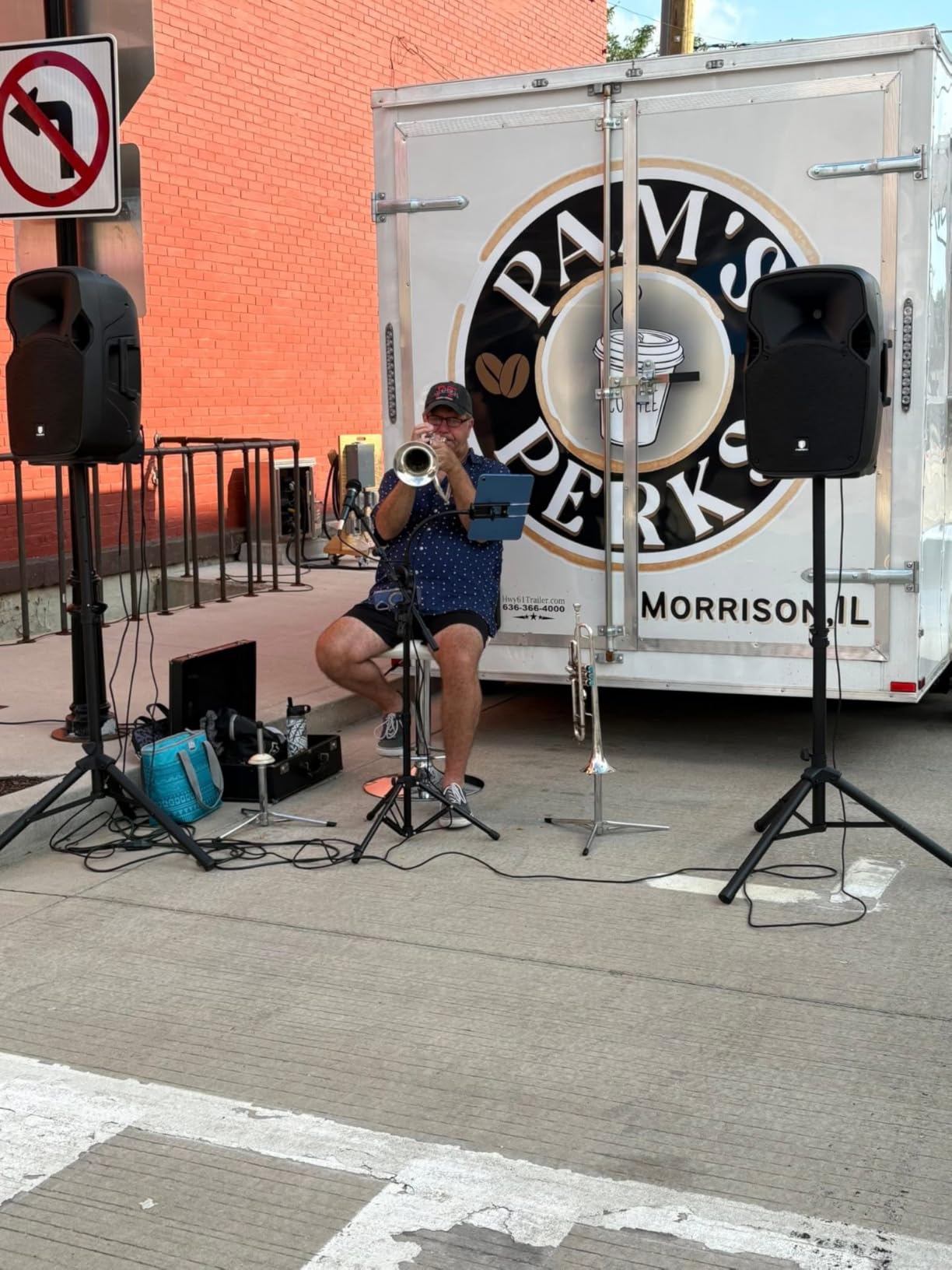
The LCD display on the front panel shows track info and settings, and the included remote lets you control playback from across the room. These are small conveniences, but they add up when you are managing a gig solo.
Sound Quality Expectations
Let me be honest about the sound quality: the Party 12 is good for the price, but it is not in the same league as the JBL EON715 or Bose S1 Pro+. The bass is present but slightly muddy, and the highs can get harsh at maximum volume. For house parties and casual events, this is more than acceptable. For professional wedding or corporate gigs, you will eventually want to upgrade.
Also note that both speakers output mono sound, not stereo. For DJing at parties, this is rarely an issue since most people cannot tell the difference on a dance floor. But if you need true stereo separation for production work, look elsewhere.
Is This the Right Starting Point for You?
If you are a beginner DJ building your first gig rig on a tight budget, the PRORECK Party 12 is hard to beat. You get everything you need in one box to start playing events immediately. As you book higher-paying gigs, you can reinvest your earnings in a professional PA system.
I have seen DJs use this system for a full year of entry-level gigs before upgrading. That represents excellent return on investment for someone just starting out in the DJ business.
6. ALTO TS412 – Best High-Power PA Speaker for the Money
ALTO TS412 2500W 12" Powered PA Speaker with 3 Channel Mixer, Bluetooth Streaming, Wireless Loudspeaker Linking, DSP and ALTO App
12-inch woofer
2500W output
3-channel mixer
Bluetooth TWS linking
App control
Pros
- Massive 2500W output
- Built-in 3-channel mixer
- True Stereo Wireless linking
- App control with 4 EQ modes
- Great price-to-power ratio
Cons
- Enclosure vibrates at high volume
- Bulky for transport
- App setup tricky for beginners
The ALTO TS412 is a powerhouse PA speaker that delivers 2500 watts of output at a price point that undercuts major competitors like JBL and QSC. I tested this speaker at a medium-sized club event, and the raw volume and clarity it produced genuinely surprised me. This is a serious amount of power for a single 12-inch cabinet.
The built-in 3-channel mixer is one of my favorite features. With dual XLR and 1/4-inch combo inputs plus a Bluetooth channel, I connected a microphone and a DJ controller simultaneously while streaming backup music from my phone. The mixer worked flawlessly throughout a five-hour gig without any signal drops or noise issues.
True Stereo Wireless linking is the feature that sets the TS412 apart from similarly priced competitors. You can pair two TS412 speakers wirelessly in true stereo mode, with no cables running between them. I set up two of these at opposite ends of a venue, and the stereo spread across the dance floor was impressive.
The ALTO app provides remote control over four speaker use modes with custom EQ settings. I switched between DJ mode for the dance floor and speech mode for announcements during a corporate event. The app took some getting used to, but once configured, it worked reliably.
Sound quality is excellent overall, with clear highs, punchy bass, and a wide frequency response. The 12-inch low-frequency driver moves serious air, and the 1.4-inch high-frequency driver delivers crisp, detailed highs that cut through the mix even at high volume.
Build Quality Concerns
The main drawback I noticed is that the enclosure feels thinner than competitors, and it vibrates noticeably at maximum volume. I could feel the cabinet flexing with heavy bass hits. This did not affect sound quality during my testing, but it raises questions about long-term durability under heavy gigging use.
If you transport your gear frequently, invest in a padded speaker bag or case. The metal grille provides good protection for the drivers, but the plastic enclosure could crack if dropped or heavily impacted.
Where the TS412 Fits in Your Rig
This speaker is ideal for mobile DJs who need maximum power per dollar. It works great as a standalone main speaker for events up to about 150 people, or paired with a second TS412 and a subwoofer for larger gatherings. The 2500W output gives you plenty of headroom, so you are not pushing the speaker to its limits during normal use.
Compared to the JBL EON715, the TS412 offers more raw power and a built-in mixer at a lower price. The trade-off is slightly lower build quality and less brand prestige. For working DJs on a budget, this trade-off makes a lot of sense.
7. ALTO TX410 – Best Compact PA Speaker for Small Gigs
ALTO TX410 350W 10" Powered PA Speaker with TWS Bluetooth, 2-Channel Mixer, Monitor for Band or DJ and Musicians, Rehersals, Venues or Events
10-inch woofer
350W bi-amped
TWS Bluetooth
2-channel mixer
15 lbs
Pros
- Lightweight and portable
- Bluetooth TWS stereo pairing
- Built-in 2-channel mixer
- Wide-dispersion horns
- Clear punchy sound
Cons
- Limited bass outdoors
- Build feels slightly flimsy
- AC powered only no battery
- Pole socket slightly oversized
The ALTO TX410 is the compact PA speaker I recommend for DJs who play small venues and want something they can carry with one hand. At just 15 pounds with a 10-inch woofer, this speaker is incredibly easy to transport and set up. I took it to a coffee shop gig, and the owner was amazed that such a small speaker could fill the room so completely.
The 350-watt bi-amplified power split between 250W for the low-frequency driver and 100W for the high-frequency driver delivers clean, punchy sound. The 90×60 wide-dispersion horns spread sound across a wide area, which means more of your audience hears a balanced mix regardless of where they are standing.
Bluetooth True Wireless Stereo (TWS) pairing lets you connect two TX410 speakers wirelessly for cable-free stereo sound. I tested this feature in a small event space, and the stereo separation was convincing. Setting up took about 30 seconds, and the connection stayed stable throughout the gig.
The built-in 2-channel mixer handles microphone, line-level, and Bluetooth inputs. For simple gig setups where you just need background music and a microphone for announcements, this mixer eliminates the need for external gear. I used it for a small corporate presentation, and the client was impressed by how clean and professional everything sounded.
Sound quality is where the TX410 punches above its weight. The 10-inch woofer produces surprisingly full sound for its size, with clear mids and detailed highs. For indoor events with up to 60 or 70 people, this speaker provides more than enough volume and clarity.
Indoor vs Outdoor Performance
Indoors, the TX410 sounds fantastic. Room acoustics reinforce the bass, and the speaker fills the space with balanced, pleasant sound. I used it for a wedding ceremony in a chapel with 80 guests, and every word of the vows was crystal clear.
Outdoors, the limitations become apparent. Without walls to reinforce the low end, the bass response thins out noticeably. For outdoor events, I recommend pairing the TX410 with a subwoofer or upgrading to the larger TS412 reviewed above. On its own outdoors, the TX410 works best for background music or small gatherings.
Is the TX410 Right for Your Needs?
If you are a mobile DJ who specializes in small events like ceremonies, cocktail hours, and intimate gatherings, the TX410 is an excellent choice. It is affordable, portable, and sounds great for its size. The lack of a battery means you need access to power, which limits its usefulness for truly remote outdoor setups.
For DJs just starting out, buying two TX410 speakers gives you a capable stereo PA system at a very reasonable total cost. As your gigs get larger, you can add a subwoofer or upgrade to bigger mains while keeping the TX410 units as monitors or fill speakers.
8. Pioneer DJ DM-40D – Best Desktop DJ Monitor System
Pioneer DJ DM-40D 4-Inch Desktop Monitor System, Black
4-inch woofer pair
42W output
Class D 96kHz DSP
DECO convex diffusers
2-way sound mode
Pros
- Optimized for DJing and production
- Clean balanced bass
- DECO diffusers for 3D sound
- Easy RCA connectivity
- Compact desktop design
Cons
- RCA only no wireless
- 4-inch woofer limits low-end
- Not for live events
The Pioneer DJ DM-40D is the desktop monitor I recommend specifically for DJs who want a compact monitoring solution that understands DJing. Pioneer designed these monitors with a 2-way sound mode that switches between DJing and music production settings, which is a feature no other monitor on this list offers. I tested both modes extensively, and the difference is noticeable and useful.
In DJ mode, the monitors emphasize the frequencies that matter most for beatmatching and cueing: kick drums, bass lines, and hi-hats. In production mode, the sound flattens out for a more neutral response suitable for mixing and arranging. I switched between modes depending on what I was doing, and it felt like having two different monitor systems in one.
The 4-inch woofers are small, but Pioneer’s Class D amplifier with 96kHz sampling DSP extracts impressive clarity from them. The DECO convex diffusers on the front create a wider, more three-dimensional stereo image than you would expect from such compact monitors. My practice space felt bigger acoustically than it actually was.
Connectivity is simple: RCA and mini-jack inputs on the back, plus a headphone jack on the front panel. I connected my DDJ-FLX4 controller directly via RCA cables, and plugging in headphones for cueing was as simple as reaching to the front of the monitor. No separate headphone amp or interface required.
The build quality is excellent for the price. Pioneer is a trusted name in DJ equipment, and these monitors reflect that heritage. The cabinets are solid, the knobs feel substantial, and after months of daily use, everything still works perfectly.
Who These Monitors Are Built For
The DM-40D is designed for bedroom DJs and entry-level producers who need accurate monitoring in a small space. If your setup is on a desk or small table and you sit within 2 feet of your monitors, these are ideal. The 4-inch woofer size keeps the footprint small while still delivering useful frequency response.
I would not recommend these for anyone trying to fill a room with sound or for live performance use. The 42-watt output is perfect for near-field listening but inadequate for anything beyond personal monitoring. Know what you are buying, and these monitors will serve you well.
Comparing to Larger Studio Monitors
Compared to the Yamaha HS5 or JBL 305P MkII, the DM-40D has less bass extension and lower maximum volume. The trade-off is a more compact design, a DJ-specific sound mode, and Pioneer’s DJ-friendly connectivity. If you already own Pioneer DJ gear and want monitors that match your ecosystem, the DM-40D is the natural choice.
For DJs who produce their own music, the production mode gives you a flatter, more analytical sound that translates well to other systems. This dual-purpose capability makes the DM-40D one of the most versatile desktop monitors for DJs who wear multiple creative hats.
Buying Guide: How to Choose the Best DJ Speakers
Choosing the best DJ speakers comes down to understanding your specific needs: where you play, how loud you need to go, and what kind of sound quality matters most. I will break down the key factors that should drive your decision so you can pick with confidence instead of guessing.
Active vs Passive Speakers
Active (powered) speakers have built-in amplifiers, meaning you plug them directly into a power outlet and connect your audio source. Every speaker on this list is active, which is what I recommend for most DJs. Active speakers simplify setup, reduce cable complexity, and ensure the amplifier is perfectly matched to the drivers.
Passive speakers require an external amplifier, which adds cost and complexity but can offer more flexibility for permanent installations. If you are setting up a fixed club system, passive speakers might make sense. For mobile DJs and home setups, active speakers are almost always the right call.
Studio Monitors vs PA Speakers: Which Do You Need?
This is the most common question I see on DJ forums, and the answer is straightforward. Studio monitors are for practicing, mixing, and producing at close range. PA speakers are for performing live and filling rooms with sound. If you play at home only, get studio monitors. If you play gigs, get PA speakers. If you do both, you need both.
Studio monitors like the Yamaha HS5 and JBL 305P MkII are near-field speakers designed to sound accurate from 2 to 4 feet away. They prioritize flat, honest frequency response so you can make good mixing decisions. PA speakers like the JBL EON715 and ALTO TS412 are designed to project sound across a room and prioritize volume, coverage, and impact.
Power and Wattage Explained
Wattage ratings on DJ speakers can be confusing because manufacturers use different measurement standards. Peak power is the maximum burst a speaker can handle briefly, while RMS power is the continuous power the speaker can sustain. Always compare RMS ratings when evaluating speakers, as peak numbers are misleading.
For home studio use, 30 to 70 watts per monitor is plenty. For small gigs with 50 to 100 people, look for PA speakers with 200 to 500 watts RMS. For larger events with 200-plus guests, aim for 500 watts RMS or more per speaker, and consider adding a subwoofer. The PRORECK Party 12 advertises 1800W peak, but its continuous RMS output is lower, which is normal for budget systems.
Driver Size Guide
The woofer size directly affects bass response and overall output. A 4-inch woofer, like on the Pioneer DJ DM-40D, is best for desktop monitoring with limited bass. A 5-inch woofer, like on the Yamaha HS5 and JBL 305P MkII, offers a good balance for home studios. A 10-inch woofer, like on the ALTO TX410, provides solid bass for small events.
A 12-inch woofer, like on the PRORECK Party 12 and ALTO TS412, delivers serious bass for medium events. A 15-inch woofer, like on the JBL EON715, produces maximum bass impact for large events. As a general rule, bigger woofers mean deeper bass and higher output, but also heavier and bulkier speakers.
Frequency Response
Frequency response tells you the range of frequencies a speaker can reproduce. For studio monitors, look for a flat, wide response that covers at least 50 Hz to 20 kHz so you hear everything in your mix accurately. For PA speakers, low-end extension matters more since bass is what gets people dancing.
If a speaker’s frequency response rolls off above 50 Hz, you will miss sub-bass frequencies common in electronic music. That is why subwoofer pairing is so popular for DJ setups. A common configuration is a pair of full-range tops plus a single subwoofer, which gives you the clarity of the tops and the chest-thumping bass of the sub.
Connectivity Options
For DJ speakers, balanced inputs are important because they reject noise and interference over long cable runs. XLR and TRS inputs are balanced, while RCA and mini-jack are unbalanced. All the studio monitors on this list offer balanced XLR or TRS inputs, which is what you want for connecting to a DJ controller or audio interface.
For PA speakers, look for combo jacks that accept both XLR and 1/4-inch inputs, plus XLR thru or output jacks for daisy-chaining multiple speakers. Bluetooth is a nice bonus for streaming background music, but I do not recommend relying on Bluetooth for actual DJ performance due to latency issues that can throw off your timing.
Matching Speaker Size to Room Size
One of the biggest mistakes I see beginners make is buying speakers that are too powerful or too weak for their space. For a 10×10 foot bedroom, a pair of 4-inch or 5-inch studio monitors is perfect. Anything larger overwhelms the room and causes bass build-up that makes mixing impossible.
For a living room or small practice space of about 200 square feet, 5-inch monitors work well. For small event venues up to about 1,000 square feet, a single 10-inch or 12-inch PA speaker handles the job. For medium venues up to 2,500 square feet, a pair of 12-inch or 15-inch PA speakers is ideal.
Subwoofer Pairing Advice
If your music relies heavily on sub-bass frequencies, which is true for most electronic dance music, a subwoofer transforms your listening experience. For studio setups, a 10-inch subwoofer paired with 5-inch monitors creates a 2.1 system that covers the full frequency spectrum. For live events, an 18-inch sub paired with full-range tops delivers the kind of bass you feel in your chest.
Start without a sub and add one later if you feel your sound is lacking low-end impact. This staged approach lets you spread out your investment and avoid buying gear you may not need right away.
FAQs
What is the best brand for DJ speakers?
The best DJ speaker brands include Yamaha for studio monitors, JBL for PA speakers, Bose for portable systems, and Pioneer DJ for DJ-specific monitoring. QSC is widely considered the premium standard for PA speakers among professional mobile DJs. The best brand for you depends on whether you need monitors for home mixing or PA speakers for live events.
What speakers do most DJs use?
Most home DJs and producers use 5-inch studio monitors like the Yamaha HS5 or JBL 305P MkII for accurate near-field mixing. Mobile DJs typically use 12-inch or 15-inch powered PA speakers from brands like JBL EON, QSC K.2, and Electro-Voice. Club DJs rely on installed sound systems rather than bringing their own speakers.
What is the 83% rule for speakers?
The 83% rule refers to setting your monitor gain structure so that your average listening level sits around 83 dB SPL, which is the standard reference level used in professional mixing and film production. This calibration ensures you are making mixing decisions at a consistent, ear-safe volume that translates well to other sound systems.
What is the rule of 32 in DJing?
The rule of 32 is a beatmatching guideline that helps DJs count phrases. Since most dance music is structured in 32-beat phrases, DJs use this rule to time their transitions so that new tracks enter at the start of a phrase. While related to DJing technique rather than speakers directly, having accurate monitors helps you hear phrasing clearly during practice.
Conclusion: The Best DJ Speakers for 2026
After testing all eight of these speakers across home studio sessions and live gigs, my top recommendation for the best DJ speakers in 2026 depends on your situation. For home mixing and production, the Yamaha HS5 pair is my editor’s choice for its neutral, accurate sound that translates perfectly to any sound system. For mobile DJs who need portability, the Bose S1 Pro+ is unbeatable. For maximum live event power, the JBL EON715 delivers professional-grade sound quality.
If budget is your primary concern, the PRORECK Party 12 system gives you everything you need to start gigging immediately. And for bedroom DJs who want a DJ-optimized desktop monitor, the Pioneer DJ DM-40D with its dual sound modes is purpose-built for your workflow.
The most important thing is matching your speakers to your actual needs. Buy studio monitors for home practice and PA speakers for live events. Start with one pair and expand your rig as your gigs grow. Whatever you choose from this list, you will have a solid foundation for your DJ journey.