
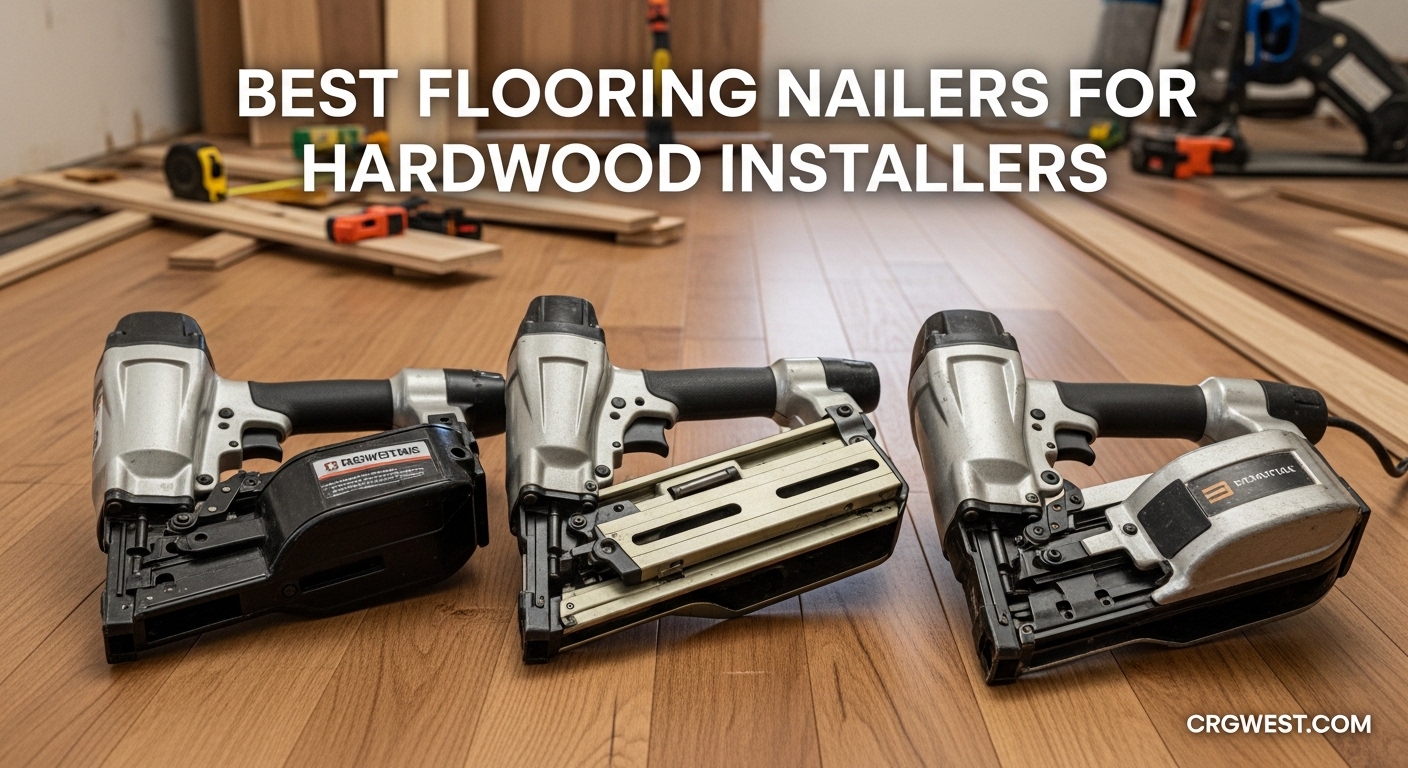
Installing hardwood flooring without the right nailer turns a rewarding project into a frustrating mess of split tongues, proud nails, and squeaky boards. After researching dozens of tools and digging through thousands of reviews from professional installers and DIYers, I put together this guide to the best flooring nailers for hardwood installers in 2026. Whether you are laying 300 square feet of oak in a single room or tackling a 1,500-square-foot whole-home installation, the right pneumatic flooring nailer makes all the difference.
I paid close attention to what professional contractors say on forums like ContractorTalk and r/Flooring. One thread that stuck with me came from a 25-year flooring veteran who said Bostitch is his go-to brand, while another installer warned about overdriving nails and splitting tongues when air pressure runs too high. That kind of real-world feedback shaped how I evaluated these tools.
This guide covers 10 flooring nailers ranging from budget-friendly options under $90 to professional-grade models with 7-year warranties. I break down the differences between cleat nails and staples, explain which gauge works for which flooring thickness, and help you figure out exactly what you need for your project.
Top 3 Flooring Nailers for Hardwood Installers in 2026

Freeman PFL618BR 3-in-1...
- 15.5ga Staples & 16ga Cleats
- 7 Year Warranty
- Aluminum Body
- Includes Case & Mallet

Bostitch BTFP12569 Flooring...
- 15.5ga & 16ga L-Cleats
- 7 Year Warranty
- Non-Marring Base Plates
- Mallet Included

3PLUS HFSNSP 2-in-1 Floorin...
- 15.5ga Staples & 16ga L-Cleats
- Interchangeable Plates
- Includes Mallet
- Great Reviews
Best Flooring Nailers for Hardwood Installers in 2026
| Product | Specs | Action |
|---|---|---|
|
Freeman PFL618BR 3-in-1
|
|
Check Latest Price |
|
Bostitch BTFP12569 2-in-1
|
|
Check Latest Price |
 DEWALT DWFP12569 2-in-1
|
|
Check Latest Price |
 NuMax SFL618 3-in-1
|
|
Check Latest Price |
 Metabo HPT N5010AC 2-in-1
|
|
Check Latest Price |
|
3PLUS HFSNSP 2-in-1
|
|
Check Latest Price |
 Powernail PALM001 Palm Nailer
|
|
Check Latest Price |
 3PLUS HFS509040SP 4-in-1
|
|
Check Latest Price |
 WEN 61741K 4-in-1
|
|
Check Latest Price |
 NuMax SFBC940 Mini 4-in-1
|
|
Check Latest Price |
1. Freeman PFL618BR – Best Overall Flooring Nailer for Hardwood Installers
Freeman PFL618BR Pneumatic 3-in-1 15.5-Gauge and 16-Gauge 2" Flooring Nailer/Stapler with Flooring Mallet, Interchangeable Base Plates, and Case
3-in-1: 15.5ga Staples & 16ga Cleats
Aluminum Body
11.46 lbs
7 Year Warranty
Pros
- 958 reviews with 83% five-star rating
- 7 year limited warranty
- Complete kit with case and mallet
- Thousands of nails without jams reported
- Works with L and T shape cleats
Cons
- Some staple shearing issues
- Not ideal for heavy commercial daily use
After going through 958 reviews, I can see why the Freeman PFL618BR sits at the top. It has the highest review count in the flooring nailer category and an 83% five-star rating that speaks for itself. Multiple users report firing thousands of cleats without a single jam, which is exactly what you want when you are halfway through a 1,000-square-foot installation.
The 3-in-1 design handles 15.5-gauge staples along with both L-cleat and T-cleat 16-gauge nails, giving you flexibility across different fastener types. Freeman includes a fiberglass mallet with a padded grip and two interchangeable base plates for flooring from 1/2 inch to 3/4 inch thick. The blow-molded carrying case keeps everything organized between jobs.
One thing that stood out from the forum discussions is how frequently this tool gets compared favorably to the Bostitch at a lower price point. A professional installer on Garage Journal mentioned using the Freeman for over 800 square feet of 3/4-inch red oak without a single misfire. The anodized aluminum magazine and heat-treated steel drive blade hold up well under regular use.
The 7-year limited warranty with a 90-day wearable parts warranty is among the best in this category. That kind of manufacturer confidence tells you something about build quality. The main downside I found is some users reporting staple shearing on particularly dense hardwoods like hickory. If you primarily use cleat nails, that is a non-issue.
Who Should Buy the Freeman PFL618BR
This is the best flooring nailer for hardwood installers who want professional-grade features without paying premium-brand pricing. It works great for both serious DIYers tackling a whole-home installation and contractors who need a reliable backup or primary tool. If you want one nailer that does it all and comes with a strong warranty, this is it.
Who Should Look Elsewhere
If you are a full-time flooring contractor running this tool 8 hours a day, 5 days a week, you might prefer the Bostitch for its slightly more refined build. Also, if your project uses mostly staples on very dense exotic hardwoods, the occasional shearing issue could be a frustration.
2. Bostitch BTFP12569 – Best Professional Flooring Nailer
Bostitch Staples Flooring Pneumatic Nailer
2-in-1: 15.5ga Staples & 16ga L-Cleats
14.7 lbs
7 Year Warranty
#1 Best Seller
Pros
- 87% five-star rating
- Highest rated in category
- Over 3000 nails without jamming
- #1 in Power Flooring Nailers
- Versatile mallet with soft and hard sides
Cons
- Heaviest tool at 14.7 lbs
- Can only reach about 12 inches from wall
The Bostitch BTFP12569 is the tool that professional installers name when you ask about reliability on forums. That 25-year flooring veteran I mentioned earlier? Bostitch is his go-to. With 695 reviews and an 87% five-star rating, it has the highest satisfaction rate of any flooring nailer I found. Users report firing over 3,000 nails without a single jam.
It drives 15.5-gauge staples and 16-gauge L-shape cleat nails from 1-1/2 to 2 inches. The non-marring base plates are interchangeable for 1/2-inch through 3/4-inch flooring, which covers the standard range for solid hardwood. The included mallet has both a soft rubber side and a wedge-shaped hard side, which is a thoughtful touch that makes tight-board installations easier.
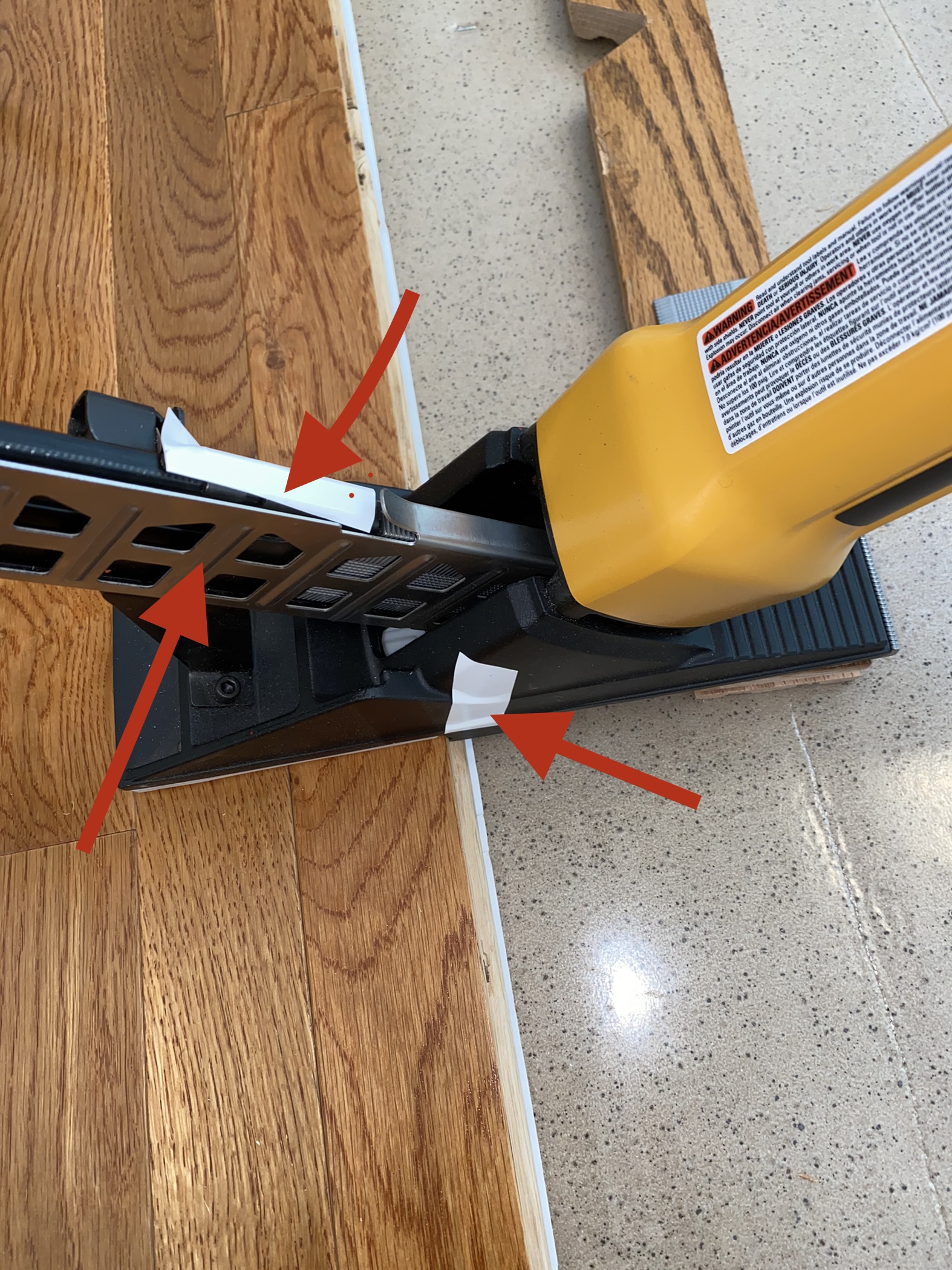
At 14.7 pounds, this is the heaviest nailer in the lineup. That weight comes from the robust internal construction that gives it such reliable performance. I noticed several users mentioning that the activation force is surprisingly low, meaning you do not need to swing the mallet hard to drive nails consistently. One user described it as almost just raising the hammer to fire, which reduces fatigue over long installation days.
The 7-year limited warranty matches the Freeman, and the tool sits at number one in the Power Flooring Nailers best-seller category on Amazon. The ergonomically designed longer handle with rubber grip makes it comfortable even during extended use.
Who Should Buy the Bostitch BTFP12569
Full-time flooring contractors who need a tool that will not let them down on job after job. If you install hardwood floors professionally and want the most trusted name in the business, the Bostitch delivers. It is also a great choice for serious DIYers willing to invest in the best reliability ratings available.
Who Should Look Elsewhere
The weight is the main concern. At nearly 15 pounds, this is noticeably heavier than the DEWALT or Freeman. If you have physical limitations or are working on a particularly large project where fatigue is a real factor, a lighter option might serve you better.
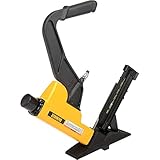
3. DEWALT DWFP12569 – Best Lightweight Flooring Nailer
DEWALT Flooring Stapler, 2-in-1 Tool (DWFP12569)
2-in-1: 15.5ga Staples & 16ga L-Cleats
10.6 lbs
Low CFM Requirements
Premium Build
Pros
- Lightest full-size option at 10.6 lbs
- Over 12000 cleats without jams
- Non-marring base plates
- Lower CFM needs for small compressors
- Quality mallet included
Cons
- Staples may crack fragile flooring at lower pressure
- Limited reach near walls at about 12 inches
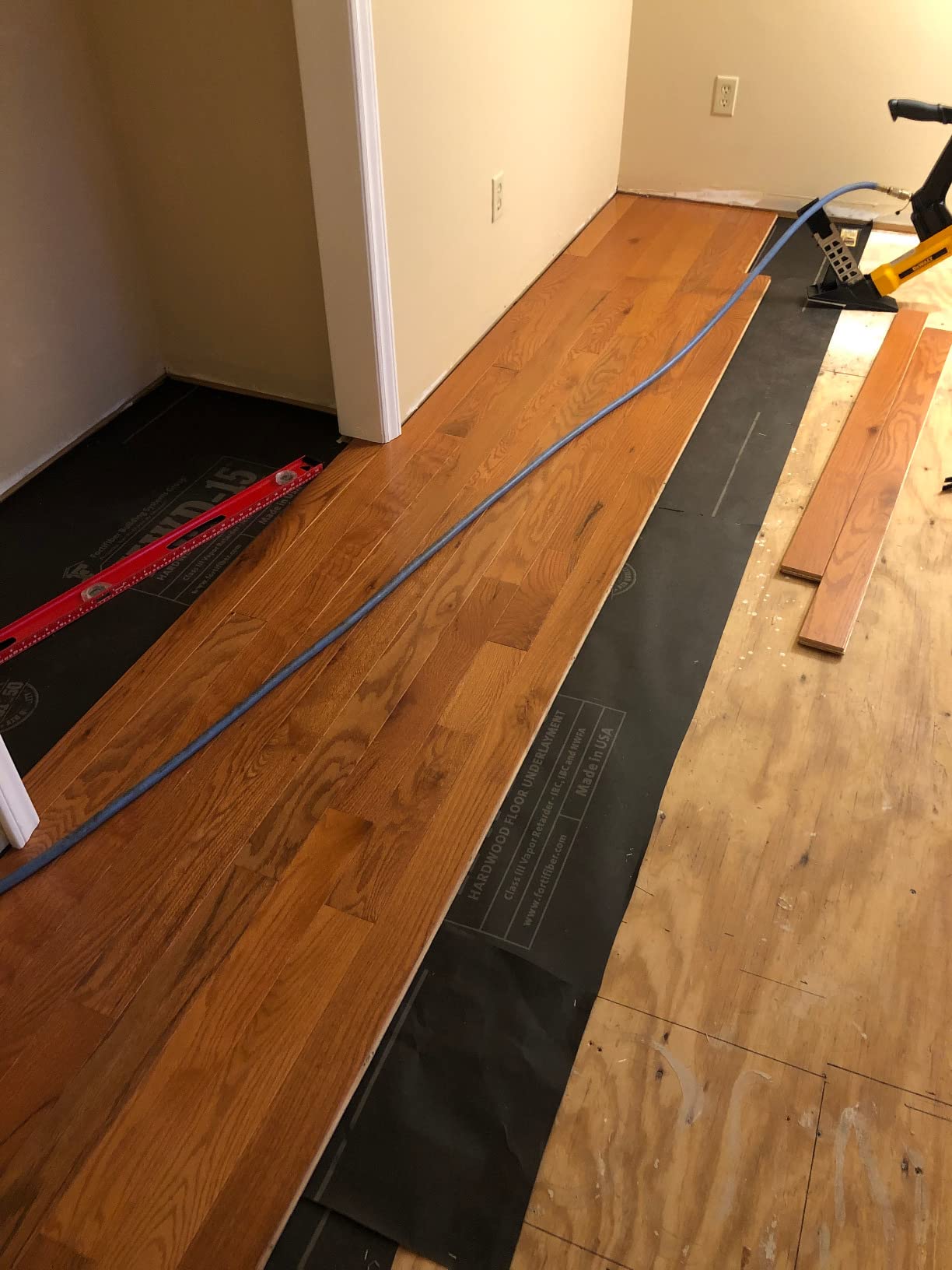
The DEWALT DWFP12569 stands out immediately for one reason: it weighs just 10.6 pounds. That is nearly 5 pounds lighter than the Bostitch and almost a pound lighter than the Freeman. For anyone who has spent a full day swinging a mallet while holding a flooring nailer, that weight savings translates directly into less fatigue and more consistent nail placement as the day goes on.
Despite the lighter weight, DEWALT did not cut corners on capability. It handles 15.5-gauge staples and 16-gauge L-cleat nails with interchangeable non-marring base plates for 1/2-inch, 5/8-inch, and 3/4-inch flooring. Users report firing over 12,000 cleats without a single jam, which is an impressive reliability statistic.
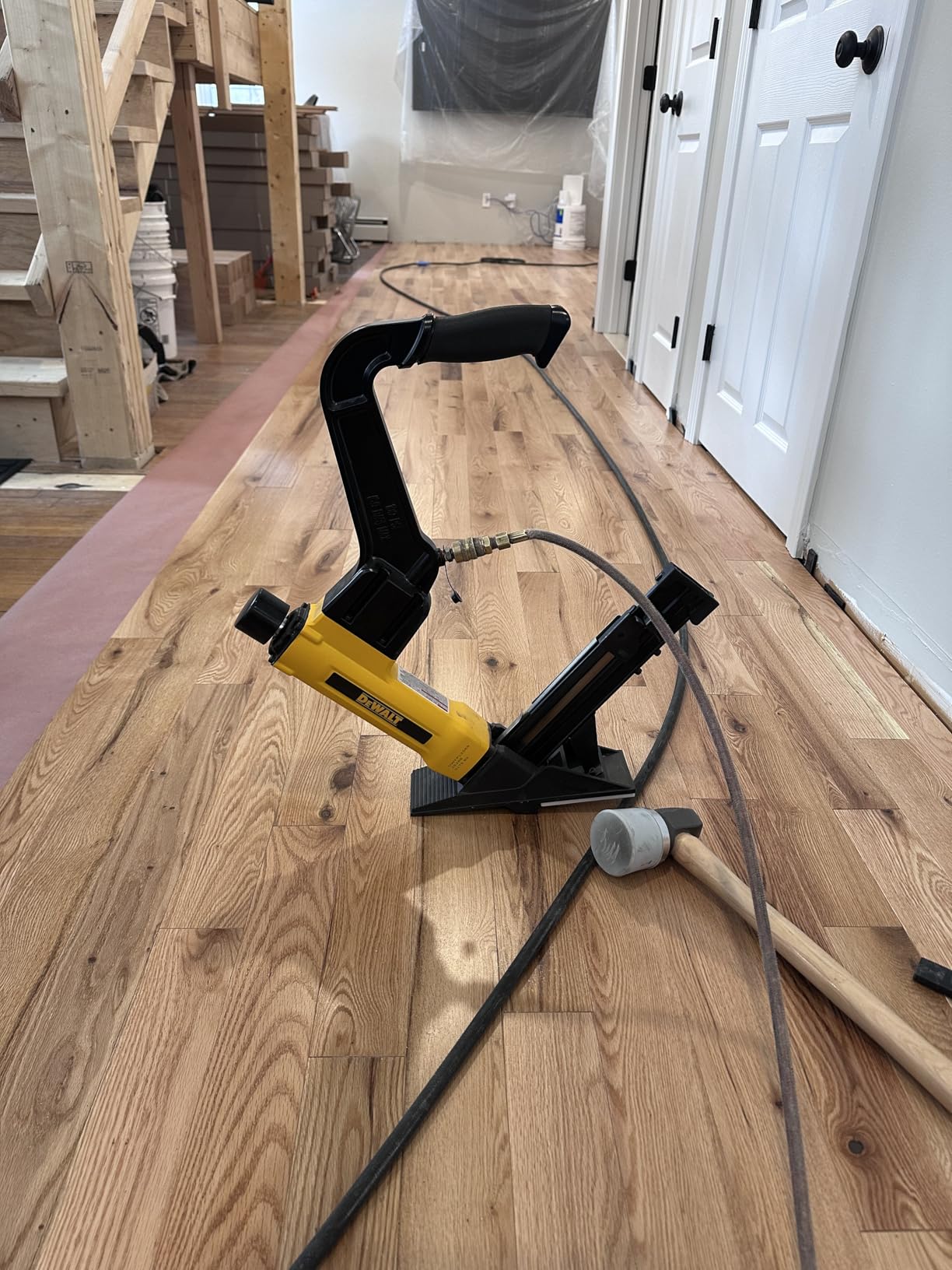
The lower CFM requirements are a practical advantage I almost overlooked. If you are working with a smaller portable air compressor rather than a full-size shop unit, this DEWALT will not keep the compressor running constantly. That matters when you are working in a home without a dedicated workshop setup.
I did find one consistent concern in the reviews: some users report that staples can crack fragile prefinished flooring when operating at lower pressures. The fix is simple enough by adjusting pressure upward, but it is worth knowing going in. Cleat nails do not have this issue.
Who Should Buy the DEWALT DWFP12569
Installers who value a lighter tool for long days on the job. It is also ideal if you are working with a smaller air compressor and need lower CFM requirements. DIYers who want a premium brand name and are willing to pay for the weight savings will find this tool hits the sweet spot.
Who Should Look Elsewhere
If you plan to use primarily staples on prefinished or engineered flooring with a delicate finish, the occasional cracking issue at lower pressures might concern you. In that case, the Bostitch or Freeman with cleat nails would be safer choices.
4. NuMax SFL618 – Best Value 3-in-1 Flooring Nailer
NuMax SFL618 Pneumatic 3-in-1 15.5-Gauge and 16-Gauge 2" Flooring Nailer / Stapler with Flooring Mallet and Interchangeable Base Plates
3-in-1: 15.5ga Staples, 16ga T & L-Cleats
8.8 lbs
120-Nail Magazine
Fiberglass Mallet
Pros
- 2049 reviews with 79% five-star
- Proven on 1000+ sq ft projects
- Complete kit with mallet and plates
- Lowest priced 3-in-1 option
- Works on oak bamboo and engineered
Cons
- Mallet steel end can scar drywall
- Requires firm consistent strikes
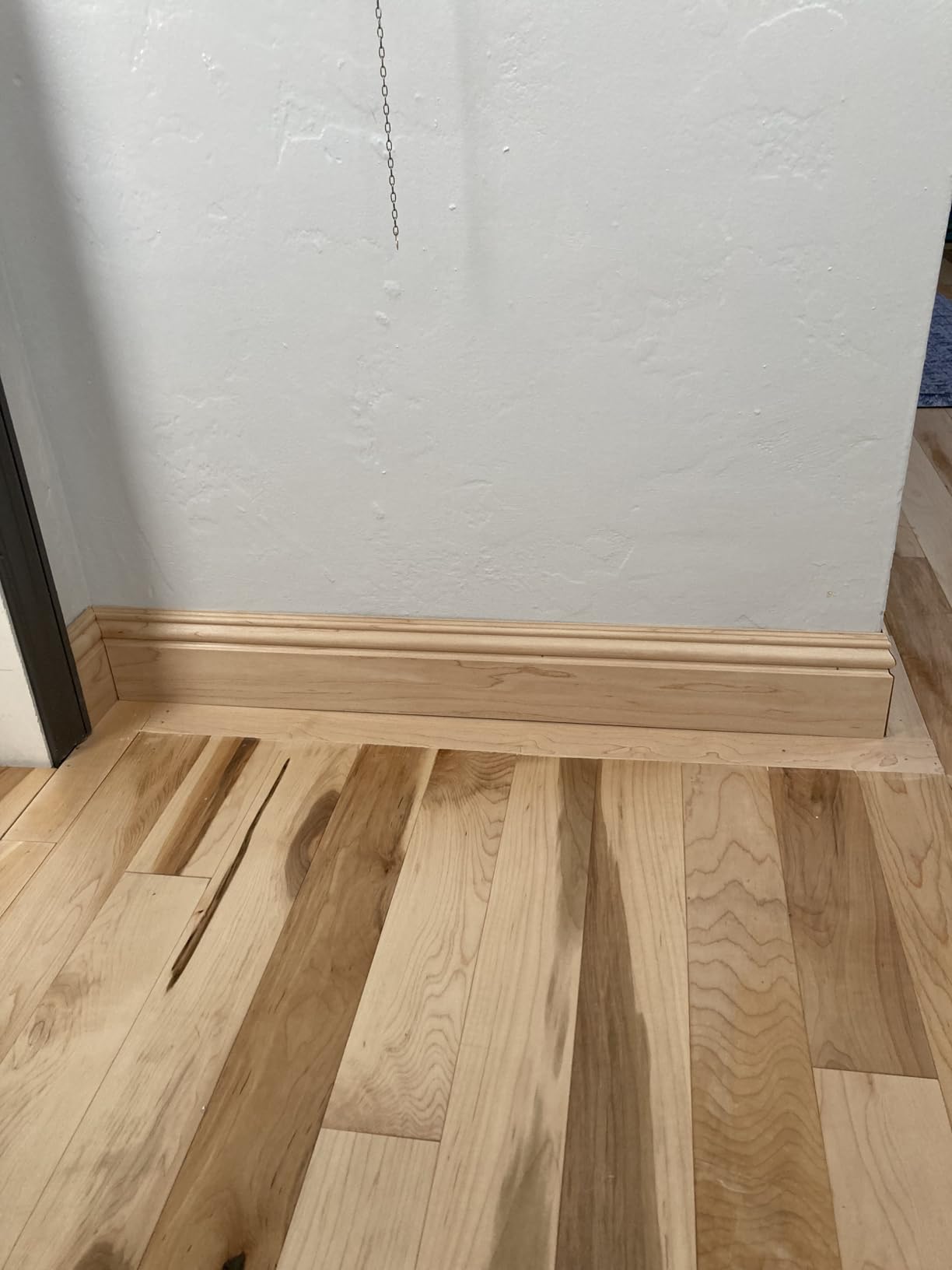
The NuMax SFL618 has something no other flooring nailer on this list can claim: over 2,000 user reviews. That massive feedback pool gives you a very clear picture of what to expect. Users have completed projects ranging from 300 to over 1,300 square feet of hardwood flooring with this tool, and 79% of them gave it five stars.
As a 3-in-1 nailer, it accepts 15.5-gauge staples, 16-gauge T-cleats, and 16-gauge L-cleats. That covers every common fastener type for solid and engineered hardwood. The die-cast aluminum body keeps the weight reasonable at 8.8 pounds, and the heat-treated steel drive blade holds up to regular use. A 120-nail magazine capacity means fewer reload interruptions.
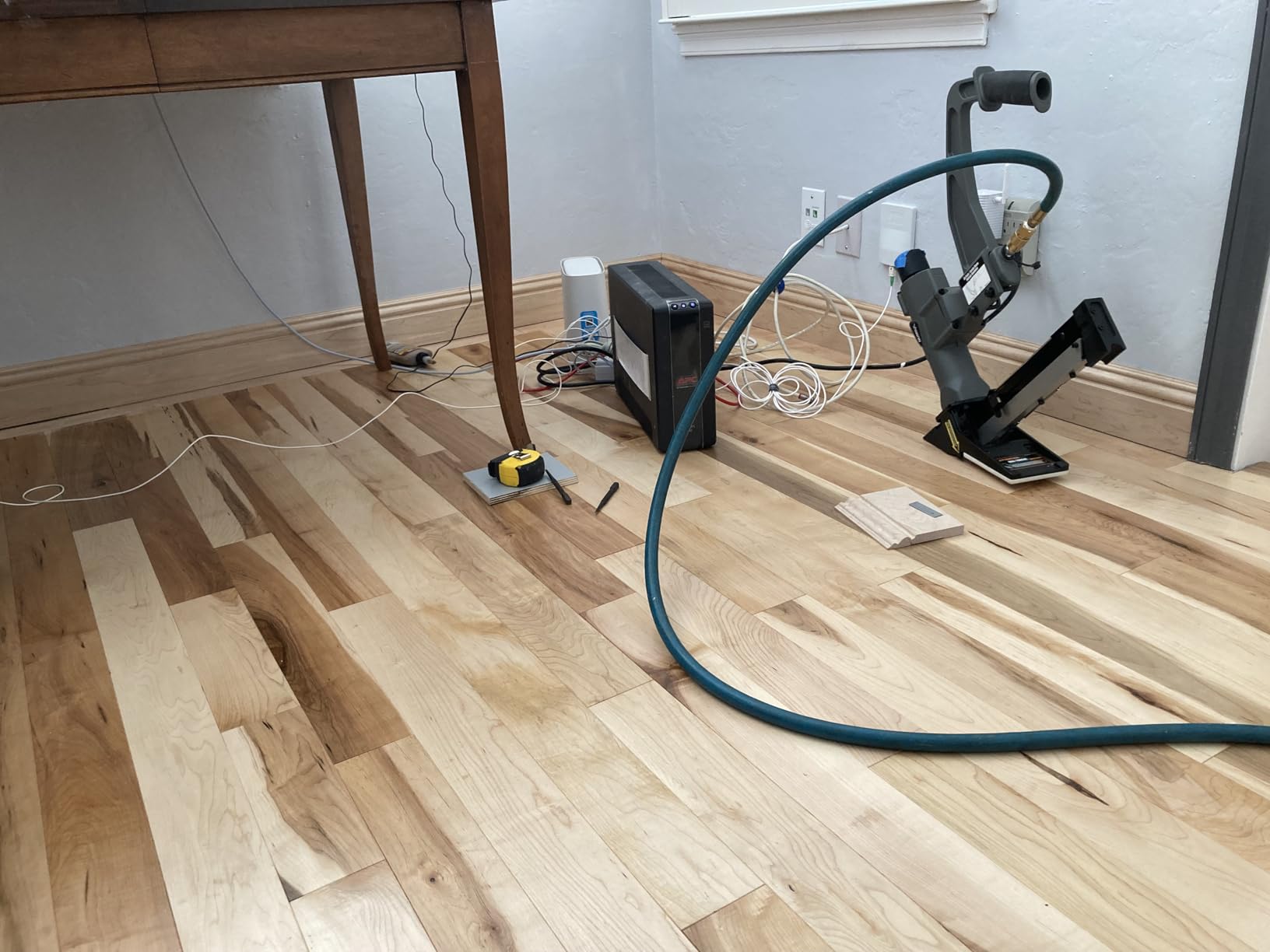
Forum discussions repeatedly mention the NuMax as the go-to value pick. One installer on Reddit shared that they purchased it for about $105 on Amazon and used it on 500 square feet of prefinished 3/4-inch oak without any issues. The included fiberglass mallet with padded grip and two interchangeable no-mar base plates round out the package.
The main complaint I found is about the mallet itself. One end is steel rather than rubber, which can mark up drywall when you are working close to walls. It is a minor issue but something to be aware of. The 1-year limited warranty with a 30-day wearable parts warranty is shorter than the Freeman or Bostitch offerings.
Who Should Buy the NuMax SFL618
Anyone who wants a proven 3-in-1 flooring nailer at the most competitive price point. With over 2,000 reviews backing it up, this is the safest bet if you want maximum value. First-time hardwood installers and experienced pros looking for a reliable backup tool both find the NuMax delivers.
Who Should Look Elsewhere
If you need the longest warranty coverage, the Freeman and Bostitch both offer 7 years versus the NuMax 1-year warranty. Full-time contractors who use a flooring nailer daily might prefer a tool with more robust long-term warranty support.
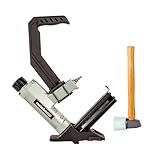
5. Metabo HPT N5010AC – Best Warranty Coverage
Metabo HPT 2-in-1 Flooring Nailer & Stapler, Accepts 16-Gauge L-Shaped Cleat Nails &15.5-Gauge 1/2-Inch Crown Flooring Staples, Mallet Actuated Pneumatic Operation, N5010AC
2-in-1: 16ga L-Cleats & 15.5ga Staples
11.2 lbs
5 Year Warranty
Tool-less Depth Adjust
Pros
- 92% five-star rating highest in category
- 5 year limited warranty
- Tool-less depth adjustment
- Aluminum magazine for durability
- Competitively priced alternative
Cons
- Only 44 reviews so far
- Less long-term durability data as newer model
The Metabo HPT N5010AC (formerly Hitachi) has the highest raw rating in the entire group at 4.9 out of 5 stars, with 92% of users giving it five stars. It is the newest model on this list, which explains the lower review count of 44, but the early feedback is overwhelmingly positive.
This 2-in-1 nailer accepts 16-gauge L-shaped cleat nails and 15.5-gauge 1/2-inch crown flooring staples up to 2 inches long. The tool-less depth adjustment and adjustable base plate for 1/2-inch to 3/4-inch flooring make setup quick. The top-loading aluminum magazine is built for durability and allows fast reloads when you are in a rhythm.
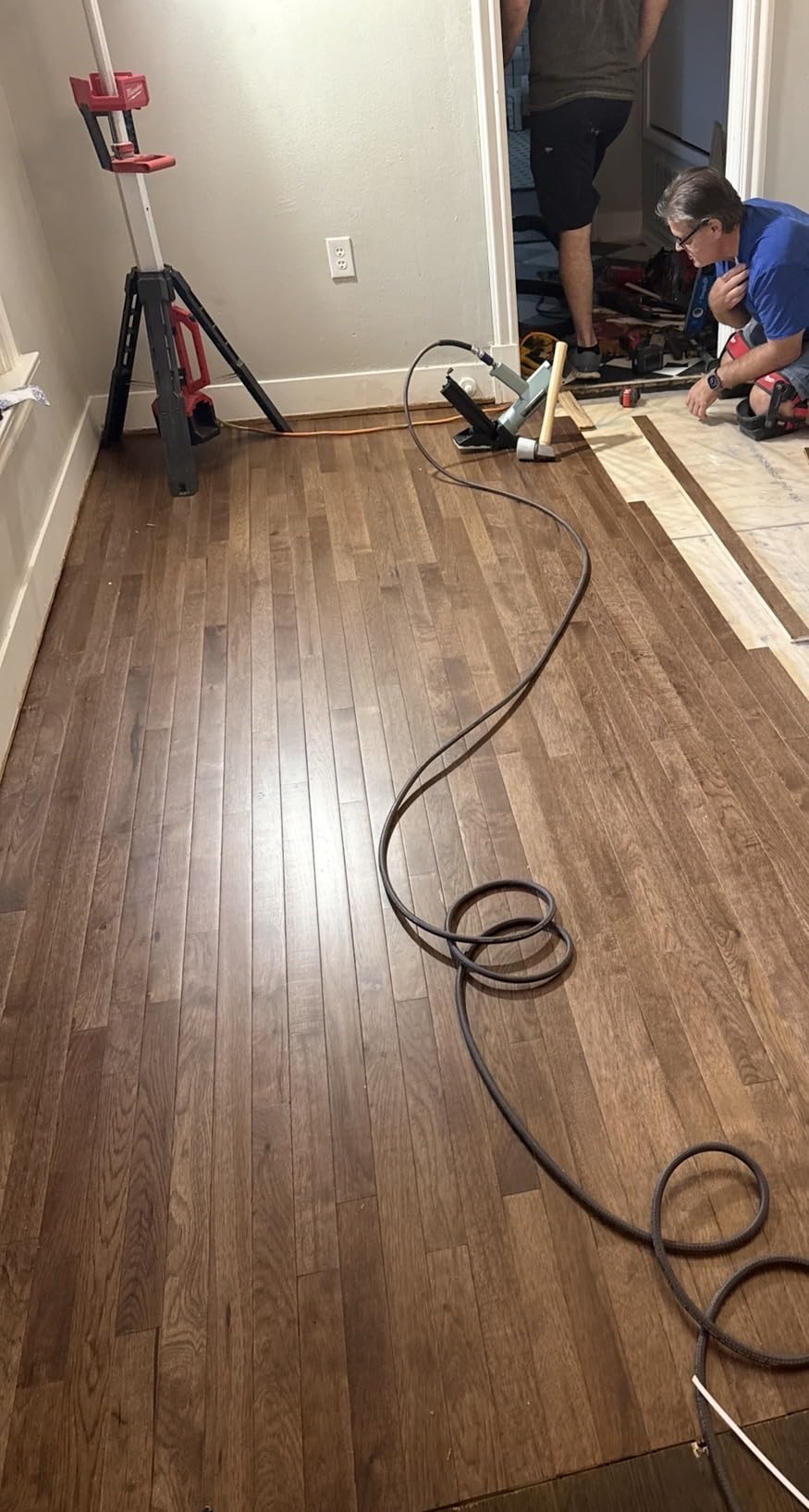
What really sets the Metabo HPT apart is the 5-year limited warranty. That falls between the NuMax 1-year and the Freeman/Bostitch 7-year warranties, but the tool costs roughly the same as those options. Several professionals on forums praised it as an excellent alternative to the more expensive Stanley Bostitch models, noting the great feel and action of the tool.
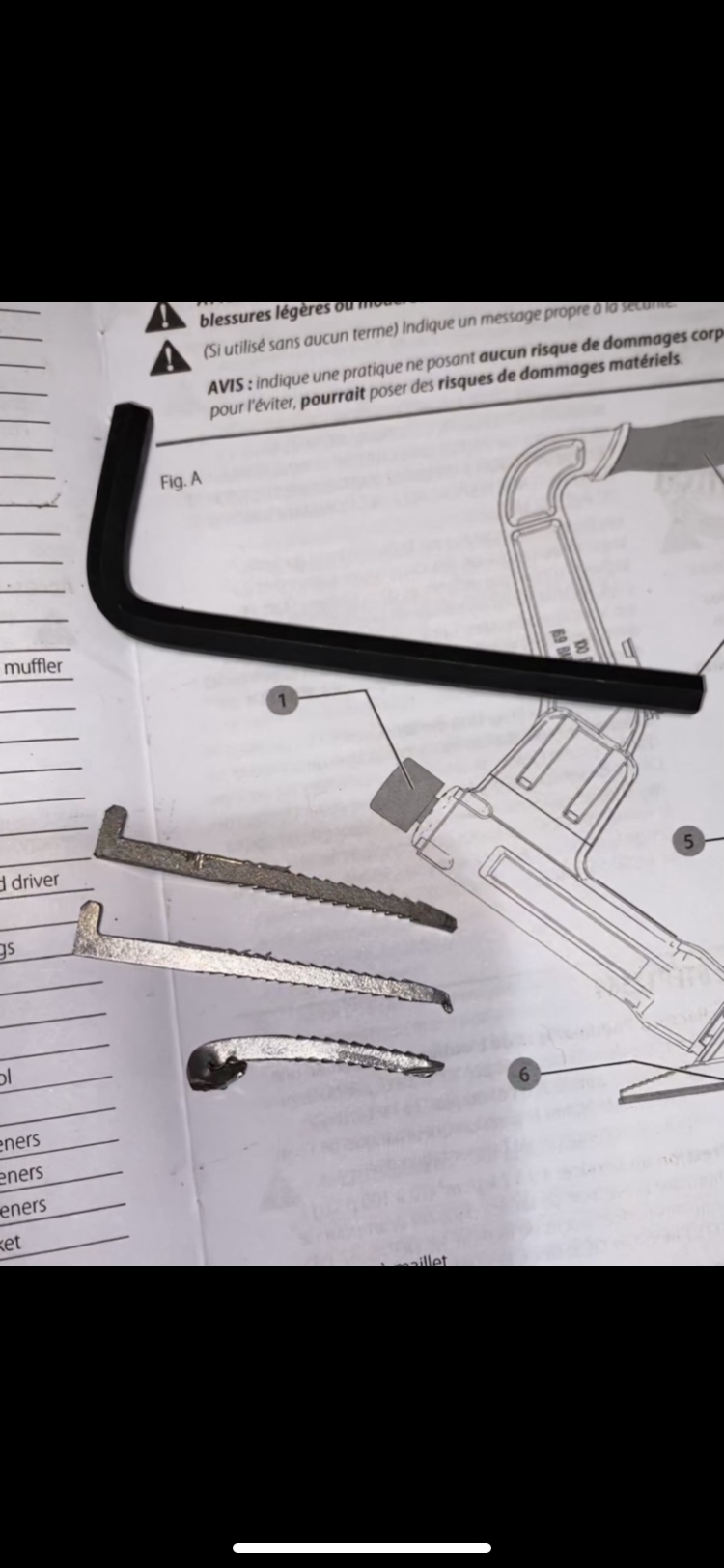
The kit includes a mallet, safety glasses, and hex wrench, so you have what you need to start working right out of the box. The main risk with this tool is simply the limited track record. With only 44 reviews, there is less long-term durability data compared to the NuMax or Freeman.
Who Should Buy the Metabo HPT N5010AC
Installers who want a modern tool with strong warranty coverage and excellent initial reviews. If you like the idea of buying from a heritage brand (Hitachi) with proven engineering and you appreciate tool-less adjustments, this is a compelling option at a competitive price.
Who Should Look Elsewhere
If having extensive long-term user feedback matters to you, the lower review count means you are taking a bit of a chance. There are some reports of occasional jams when the tool hits subfloor nails, which could be a concern if you are working over an older subfloor with hidden fasteners.
6. 3PLUS HFSNSP – Best Mid-Range Flooring Nailer
3PLUS HFSNSP 2-in-1 Pneumatic Flooring Nailer/Stapler
2-in-1: 15.5ga Staples & 16ga L-Cleats
7.2 lbs
Interchangeable Plates
Includes Mallet
Pros
- 477 reviews with 80% five-star
- Lightweight at 7.2 lbs
- Excellent value vs renting
- No jams or misfires reported
- Works on engineered and solid hardwood
Cons
- Jam clearing requires removing 4 bolts
- No low magazine indicator
The 3PLUS HFSNSP hits a sweet spot in the mid-range price tier with 477 reviews and an 80% five-star rating. Users consistently praise it as cheaper than renting a flooring nailer for a single project, which makes it an easy decision for a one-time installation.
This 2-in-1 tool handles 15.5-gauge staples and 16-gauge L-cleat nails from 1-1/2 to 2 inches. The interchangeable flooring plates accommodate different thicknesses, and the removable long-reach handle helps when working close to walls. The included rubber mallet with white rubber is gentle on the tool body.
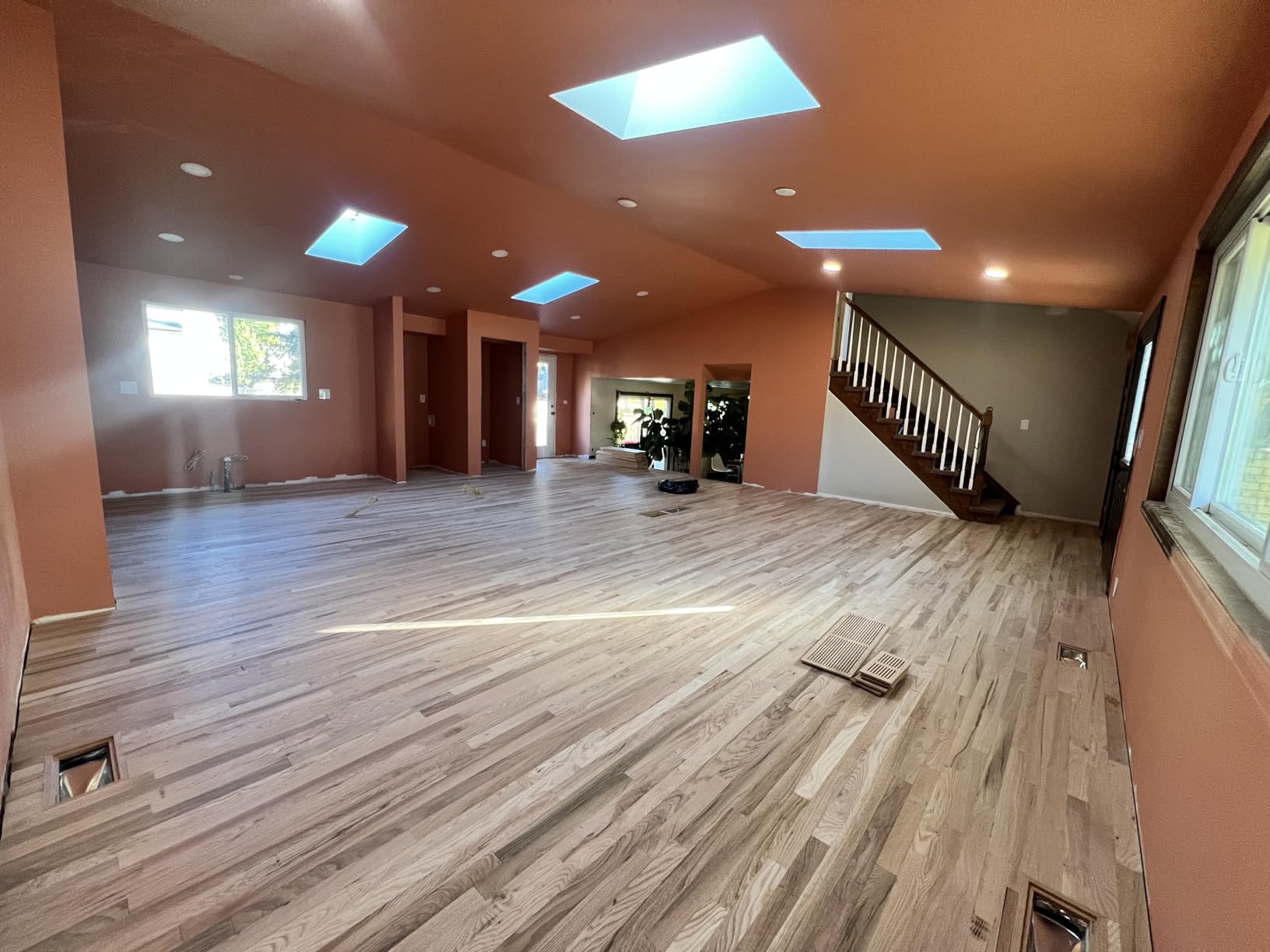
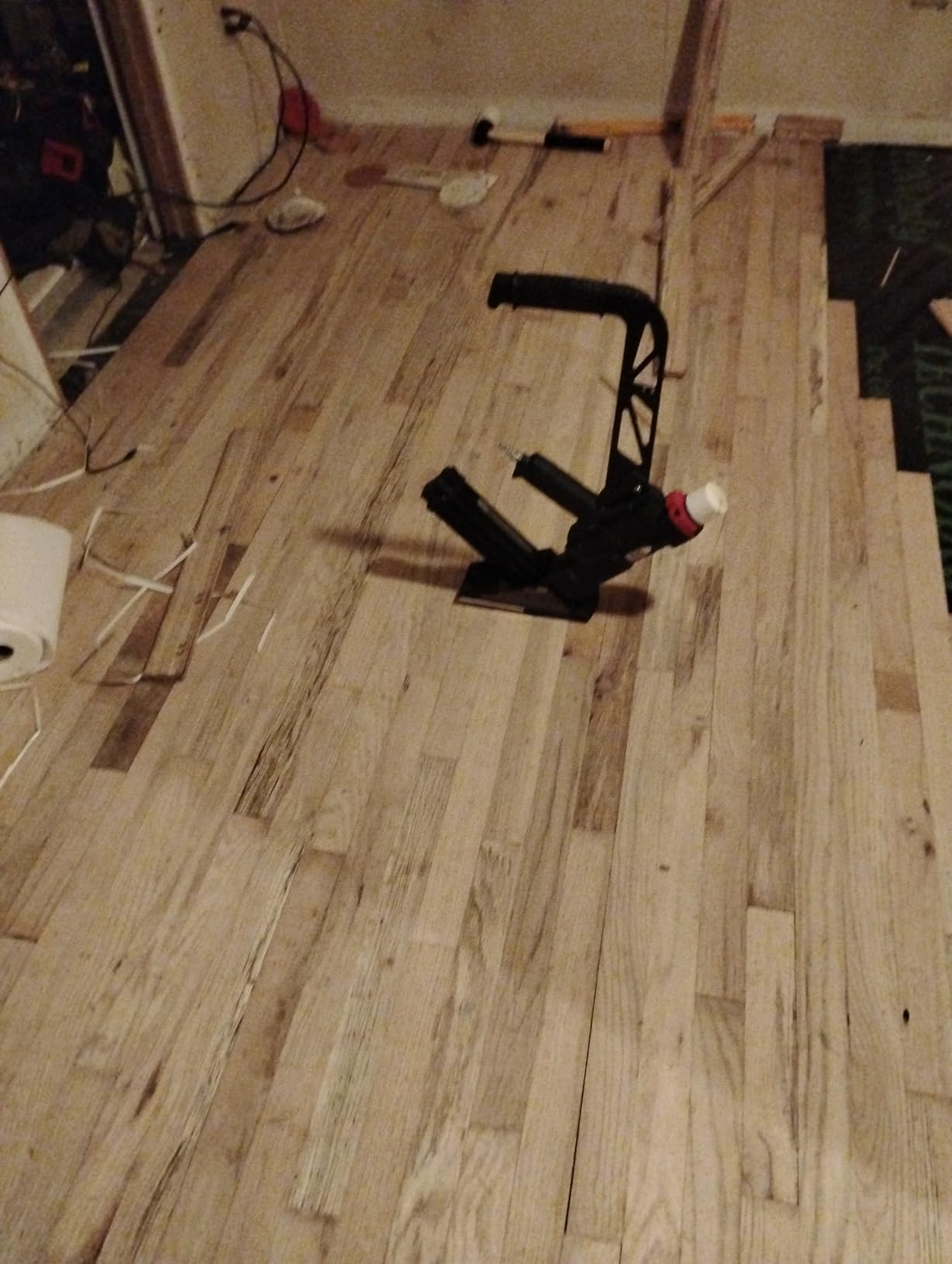
I found multiple users who said this tool worked flawlessly on engineered hardwood installations. One reviewer mentioned laying over 600 square feet without a single jam or misfire. The pneumatic driving action is consistent when your air compressor maintains proper pressure between 70 and 100 PSI.
The build quality uses alloy steel, aluminum, and rubber in a combination that keeps weight down to about 7.2 pounds. That is noticeably lighter than the professional-grade tools above it. The main frustration reported is that clearing a jam requires removing four bolts, which takes more time than the quick-release mechanisms on higher-end models.
Who Should Buy the 3PLUS HFSNSP
DIYers and occasional installers who want a reliable tool without spending top dollar. If the cost of renting a nailer for your project approaches the price of this tool, buying it is the obvious choice. It also works well as a starter flooring nailer for someone getting into hardwood installation.
Who Should Look Elsewhere
If you are a professional who needs to clear jams quickly on the job site, the four-bolt jam-clearing process will slow you down. Also, the lack of a low-magazine indicator means you need to keep a close eye on your fastener count to avoid dry-firing.
7. Powernail PALM001 PowerPalm – Best for Tight Spaces
Powernail PALM001 PowerPalm 16/18 Gauge Flooring Cleat Nailer
Palm Nailer: 16ga & 18ga L & T-Cleats
1 lb
Pressure Activated
Magnetic Tip
Pros
- Eliminates need for top nailing
- Fits in palm for tight spaces
- Works with 16ga and 18ga cleats
- Magnetic tip holds cleats securely
- Countersinks unset cleats
Cons
- Higher price for specialty tool
- Some units report air leakage on arrival
The Powernail PALM001 PowerPalm is a different kind of flooring nailer. Instead of a mallet-actuated design, this is a palm-sized, pressure-activated tool that fits in your hand. It drives both 16-gauge and 18-gauge L-style and T-style cleats, making it incredibly versatile for flooring work in tight spaces.
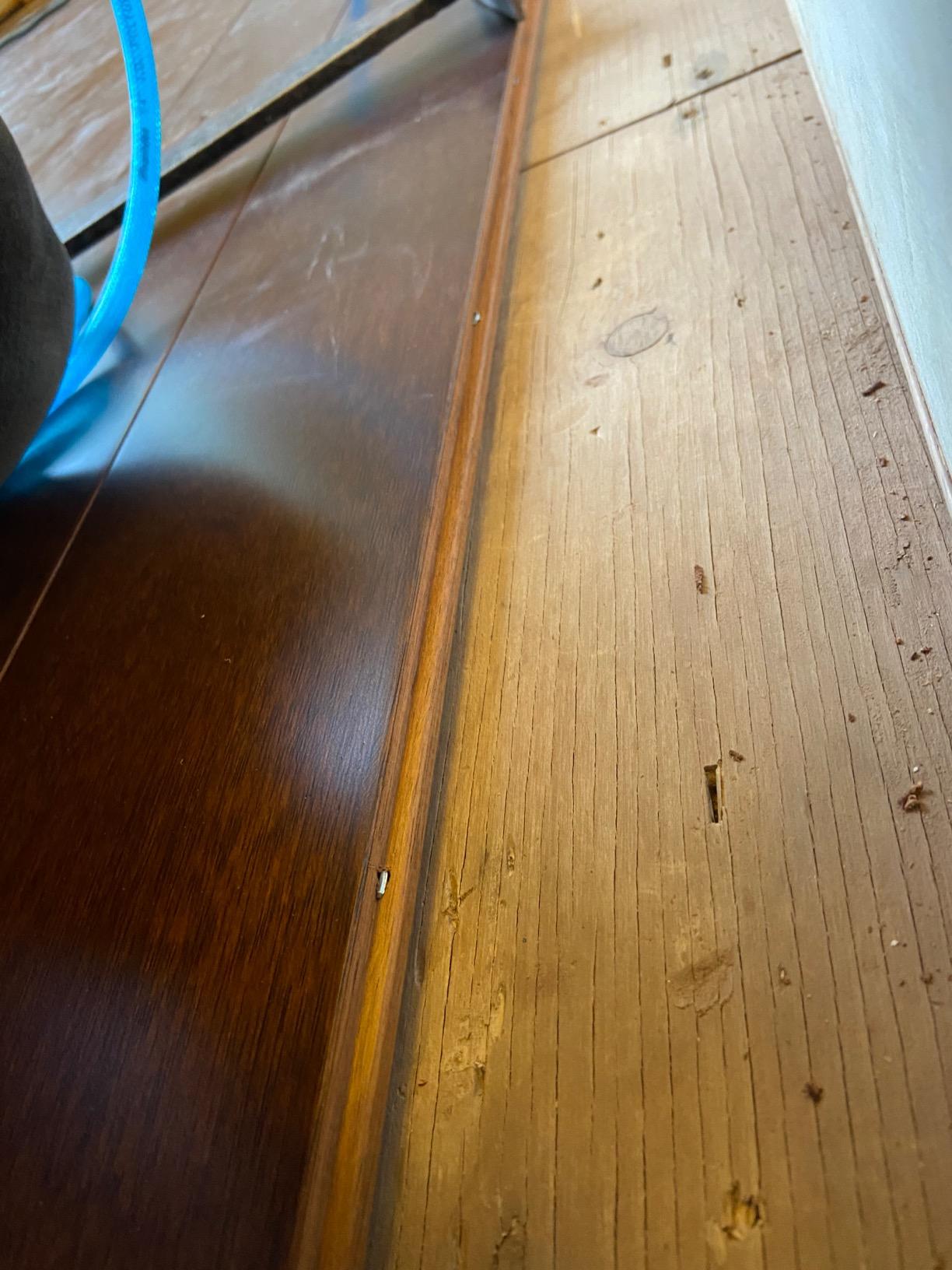
Where this tool really shines is at the beginning and end of a flooring installation. Standard flooring nailers cannot reach within about 12 inches of a wall, which means you either face-nail those rows or use a palm nailer. The PowerPalm virtually eliminates the need for top nailing because it can blind-nail starting rows, final rows, and work in corners where full-size nailers simply will not fit.
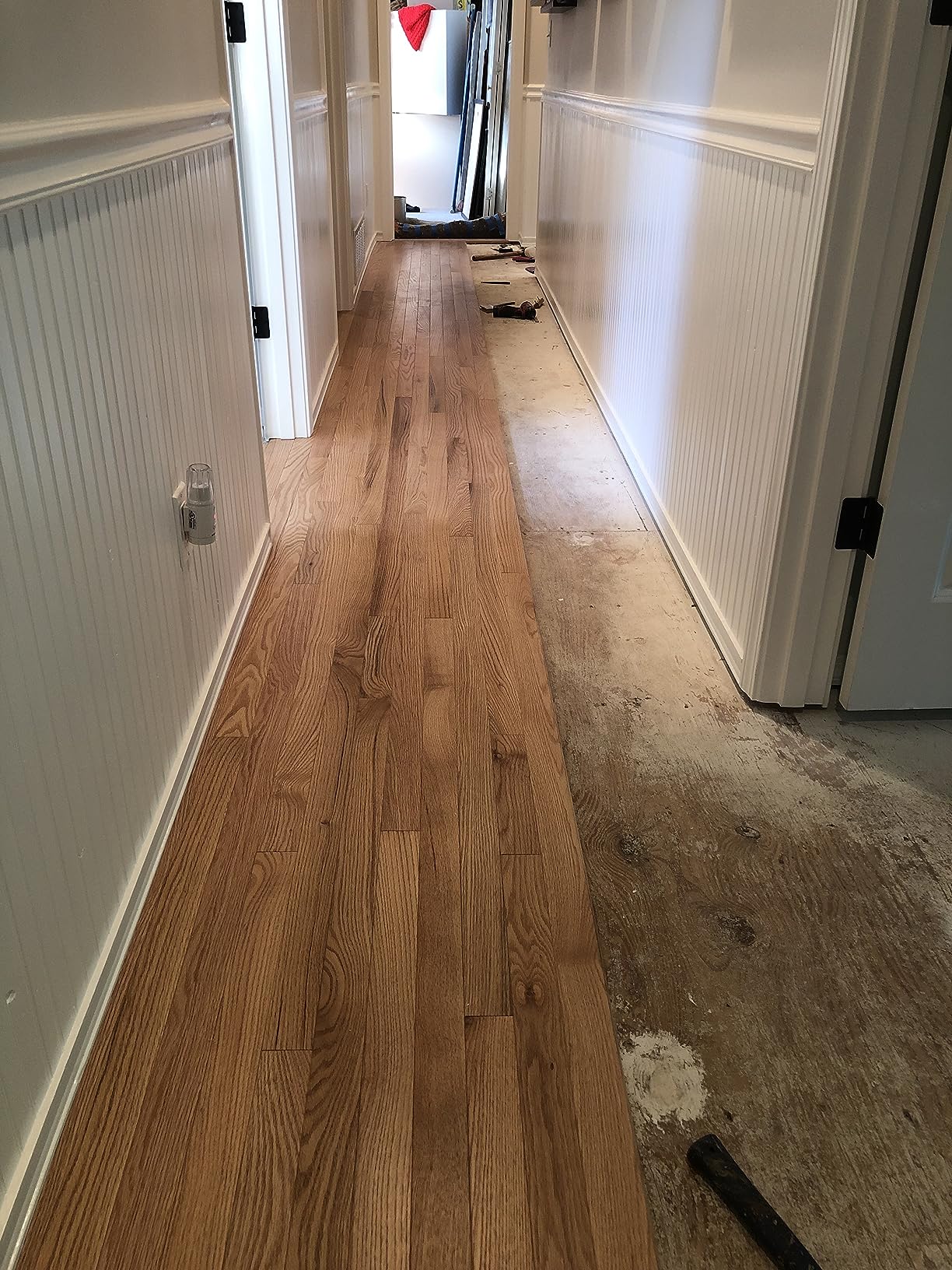
The specially designed angled tip is magnetic, holding cleats securely in place while you position the tool in the nail pocket. At just 1 pound, there is zero fatigue factor. The rotating tip adjusts to fit into awkward angles and tight corners. I noticed several professional installers on SawmillCreek saying they keep a PowerPalm in their kit specifically for those first and last few rows.
It also doubles as a tool to countersink cleat nails that did not drive fully. If your main nailer leaves a fastener slightly proud, a quick tap with the PowerPalm sets it flush without damaging the surrounding wood. With 368 reviews and a 4.4 rating, the feedback is solid.
Who Should Buy the Powernail PALM001
Professional installers who need a companion tool for tight spaces, starting rows, and finishing rows. It is also valuable for anyone doing repair work on existing hardwood floors where you need to drive individual cleats without removing a full-size nailer from storage.
Who Should Look Elsewhere
This is a specialty companion tool, not a primary flooring nailer. If you only plan to buy one tool for your project, choose a full-size flooring nailer instead. The PowerPalm is for filling in the gaps that a standard nailer cannot reach.
8. 3PLUS HFS509040SP – Best Budget 4-in-1 Flooring Nailer
3PLUS HFS509040SP 4-in-1 Pneumatic 18 Gauge Flooring Stapler/Nailer
4-in-1: 18ga Brad Nails & Staples
3.5 lbs
For 1/4-5/8 in Flooring
Tool-free Depth Control
Pros
- Reliable with no misfires or jams
- Lightweight at 3.5 lbs
- Easy to adjust for different flooring
- Cheaper than renting a nailer
- Good value for the price
Cons
- Plastic nose can pop off under pressure
- Depth may vary with air pressure changes
The 3PLUS HFS509040SP is the most affordable tool on this list, and with 378 reviews and a 4.5 rating, it punches well above its price tag. This is a true 4-in-1 tool that works as a flooring stapler, brad nailer, and combination tool with easy conversion between modes.
It uses 18-gauge brad nails from 3/4 to 2 inches and 18-gauge narrow crown staples from 5/8 to 1-1/2 inches. The tool-free adjustable depth control and quick-clear jam release make it user-friendly for first-timers. At just 3.5 pounds, it is the lightest option in the entire lineup by a wide margin.
Keep in mind that this nailer is designed for thinner flooring, specifically 1/4-inch to 5/8-inch engineered or solid hardwood. If you are installing standard 3/4-inch solid hardwood, this is not the right tool. But for thinner engineered products, bamboo, or laminate with a wood-look, the 18-gauge fasteners work well.
The multi-directional exhaust cover rotates 360 degrees so you can direct air blast away from your face. Users consistently mention that buying this tool costs less than renting a flooring nailer for a weekend project, which makes it an easy sell for one-time installations.
Who Should Buy the 3PLUS HFS509040SP
Budget-conscious DIYers installing thinner engineered hardwood, bamboo, or laminate flooring. If your project involves flooring between 1/4 and 5/8 inch thick and you want to spend less than you would on a rental, this tool makes financial sense and performs reliably.
Who Should Look Elsewhere
If you are installing 3/4-inch solid hardwood, this tool does not support that thickness. The 18-gauge fasteners also have less holding power than the 15.5-gauge or 16-gauge options in full-size nailers. For standard solid hardwood installations, look at the Freeman, Bostitch, or NuMax instead.
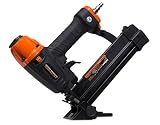
9. WEN 61741K – Best Budget 18-Gauge Option
WEN 61741K 4-in-1 18-Gauge Pneumatic Flooring Nailer and Stapler
4-in-1: 18ga Brad Nails & Staples
7.4 lbs
100-Nail Magazine
Carrying Case Included
Pros
- No jams through 3000 staples reported
- Includes case and accessories
- Spring-loaded 45 degree flooring shoe
- Excellent value for engineered hardwood
- Adjustable air exhaust
Cons
- Plastic nose durability concerns
- Instructions for depth adjustment unclear
The WEN 61741K brings a familiar orange color and a solid 4.6-star rating to the 18-gauge flooring nailer category. Like the 3PLUS above, it is a 4-in-1 tool that handles brad nails, staples, flooring nailing, and finish work. The removable spring-loaded flooring shoe angles fasteners at 45 degrees for proper tongue-and-groove installation.
It drives 18-gauge brad nails from 5/8 to 2 inches and 1/4-inch narrow crown staples from 1/2 to 1-5/8 inches. The 100-nail magazine capacity is generous for an 18-gauge tool. WEN includes a carrying case, two hex keys, a removable non-mar tip, and oil, giving you a complete package out of the box.
One reviewer fired over 3,000 staples through this tool without a single jam, which is impressive at this price point. The quick-release nose makes jam clearing straightforward when it does happen. Users report it works especially well on engineered hardwood flooring installations.
The main concerns center around the plastic nose durability. A few users mentioned the plastic component can develop issues under heavy use, and the depth adjustment instructions could be clearer. With 68 reviews, the feedback pool is smaller than some competitors, but the 75% five-star rate is encouraging.
Who Should Buy the WEN 61741K
DIYers looking for a well-priced 18-gauge flooring nailer with a carrying case and full accessory kit. If you are installing engineered hardwood up to 5/8 inch thick and want a reliable tool from a recognized brand, the WEN delivers good value.
Who Should Look Elsewhere
If you need a tool for 3/4-inch solid hardwood or plan to use it on multiple large projects, the plastic nose concerns and limited review count suggest looking at the 15.5-gauge/16-gauge options like the NuMax SFL618 or Freeman PFL618BR instead.
10. NuMax SFBC940 – Best Mini Flooring Nailer
NuMax SFBC940 Pneumatic 4-in-1 18-Gauge 1-5/8" Mini Flooring Nailer/Stapler with Bag
4-in-1: 18ga Brad Nails & Staples
3.4 lbs
For 3/8-1/2 in Flooring
Canvas Bag Included
Pros
- Never jammed or stalled during use
- Compact for tight areas
- Canvas carry bag included
- Great value vs renting
- Comfort grip handle
Cons
- Cannot load full rack of staples easily
- Limited to smaller flooring projects
- Some firing mechanism failures reported
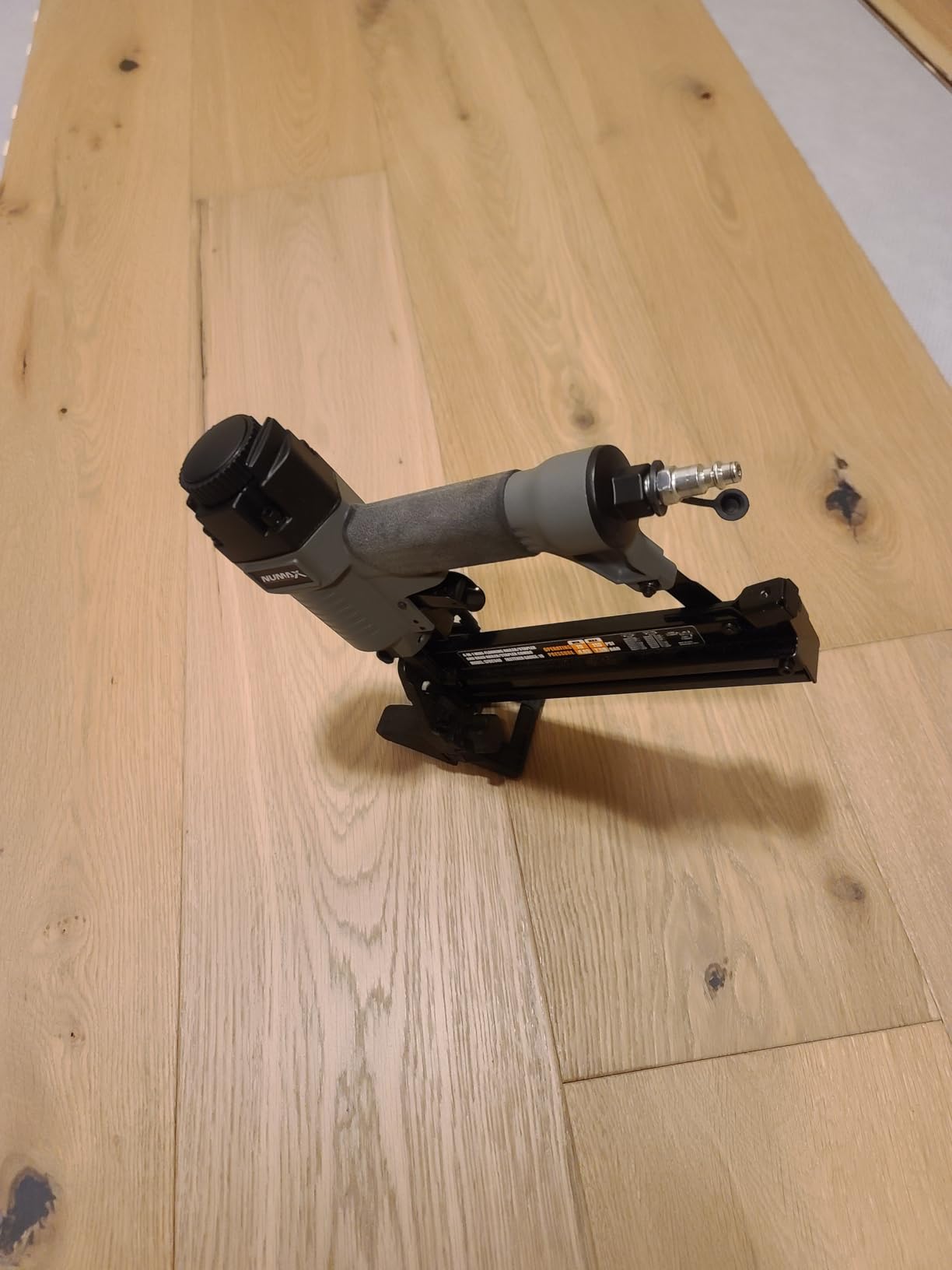
The NuMax SFBC940 is a compact 4-in-1 mini flooring nailer designed specifically for thinner flooring installations. At just 3.4 pounds, it is one of the lightest tools on this list and ideal for smaller jobs where maneuverability matters more than magazine capacity.
This tool handles 3/8-inch to 1/2-inch engineered hardwood flooring using 18-gauge brad nails from 5/8 to 1-5/8 inches and 18-gauge 1/4-inch narrow crown staples over the same length range. The one-piece hardened steel drive blade and die-cast aluminum body keep it durable despite the small size. A comfort grip handle and 360-degree adjustable exhaust round out the features.
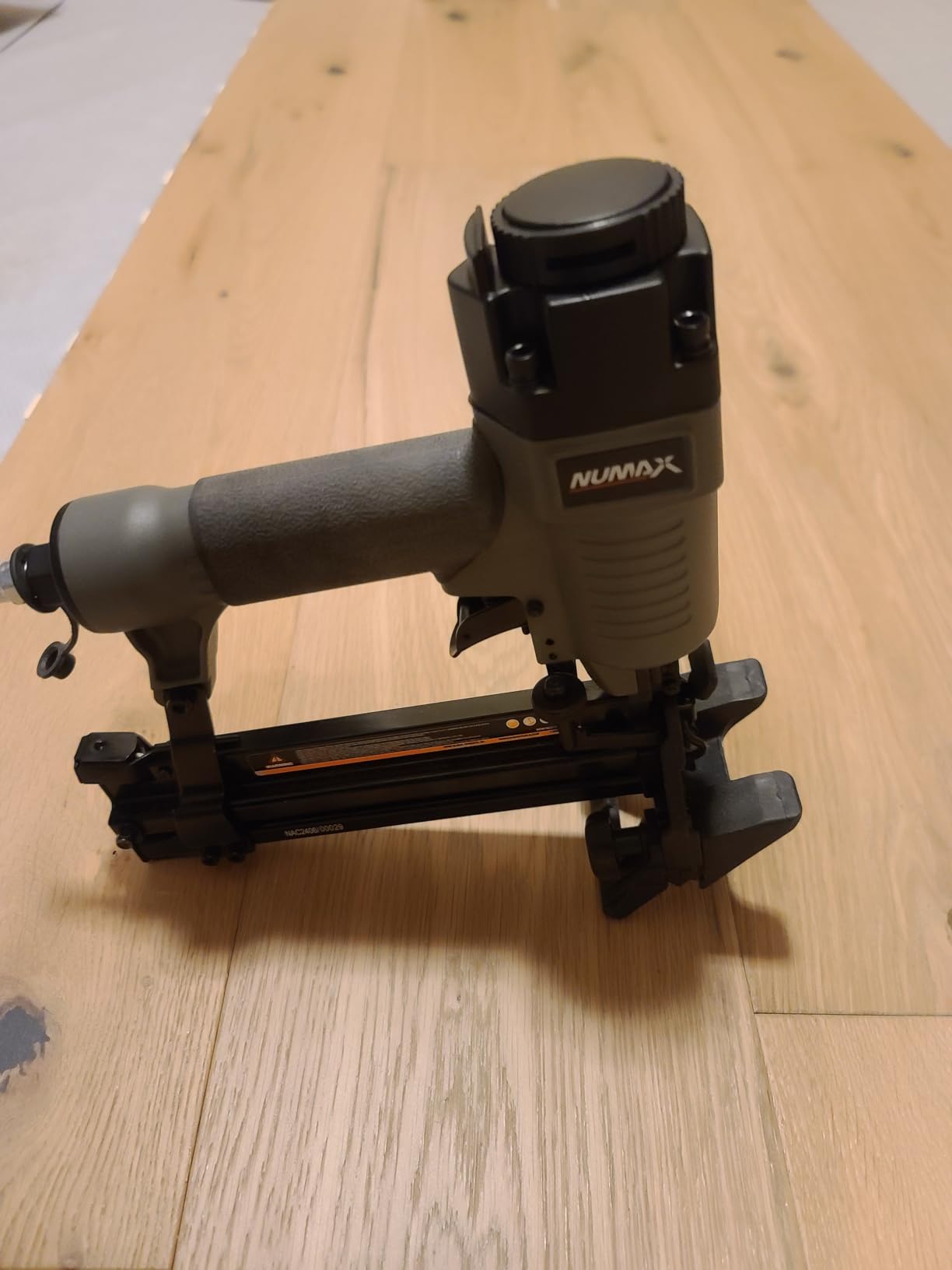
The tool-free depth adjustment wheel and quick jam release make it accessible for less experienced users. Users praise it as an excellent flooring nailer for engineered hardwood installations in tighter spaces. The included 45-degree angle flooring attachment and canvas carry bag add value to the package.
However, the limitations are real. You cannot easily load a full rack of staples, and the tool is best suited for smaller projects rather than whole-home installations. A few users reported firing mechanism failures, though the 68% five-star rating suggests these are isolated incidents rather than widespread problems.
Who Should Buy the NuMax SFBC940
Installers working on smaller rooms or tighter spaces with thinner engineered hardwood flooring. If you are doing a single room of 3/8-inch or 1/2-inch engineered flooring and want a compact, affordable tool, the SFBC940 fits the bill.
Who Should Look Elsewhere
For larger installations or 3/4-inch solid hardwood, you need a full-size flooring nailer with 15.5-gauge or 16-gauge capacity. The loading difficulty and limited capacity also make this a poor choice for professional contractors who need speed and efficiency on large projects.
How to Choose the Right Flooring Nailer
Picking the right flooring nailer comes down to matching the tool to your flooring type, project size, and budget. Here are the key factors to consider before making a decision.
Cleat Nails vs Staples
This is the biggest decision you will make when choosing a flooring nailer. Cleat nails, whether L-cleats or T-cleats, have more holding power and are the preferred choice for professional installers. They create less stress on the wood tongue and are less likely to cause splitting. The forum consensus from experienced installers is clear: use cleat nails for solid hardwood.
Staples drive faster and are slightly cheaper per fastener, but they apply more lateral pressure on the tongue. For softer woods or engineered flooring, staples work fine. For dense hardwoods like hickory or exotic species, cleats are the safer choice. One forum installer specifically warned that staples can crack tongues on 3/4-inch oak if air pressure runs too high.
Gauge and Fastener Size
For 3/4-inch solid hardwood, you want a nailer that handles 15.5-gauge staples or 16-gauge cleat nails in 1-1/2 to 2-inch lengths. The 18-gauge tools in this guide are designed for thinner flooring between 3/8 and 5/8 inch. Using the wrong gauge or length fastener leads to poor holding power or nails that poke through the surface of your flooring.
Air Pressure Requirements
Most pneumatic flooring nailers operate between 70 and 100 PSI. You need an air compressor that can maintain consistent pressure in this range. The DEWALT DWFP12569 has lower CFM requirements, which makes it more compatible with smaller portable compressors. Higher-pressure settings drive nails deeper but increase the risk of splitting tongues on dense wood.
Weight and Ergonomics
After a full day of installation, every pound matters. The palm nailer weighs 1 pound, the 18-gauge tools weigh 3 to 4 pounds, and the full-size 15.5/16-gauge nailers range from 8 to 15 pounds. Consider how long you plan to work and choose accordingly.
Warranty and Support
Freeman and Bostitch both offer 7-year limited warranties. Metabo HPT provides 5 years. NuMax covers 1 year. Longer warranties indicate manufacturer confidence and protect your investment if something goes wrong during a project.
Frequently Asked Questions About Flooring Nailers
What nailer to use for hardwood flooring?
For 3/4-inch solid hardwood flooring, use a pneumatic flooring nailer that drives 16-gauge cleat nails or 15.5-gauge staples. Models like the Freeman PFL618BR, Bostitch BTFP12569, and DEWALT DWFP12569 are designed specifically for this application. For thinner engineered hardwood between 3/8 and 5/8 inch, an 18-gauge flooring nailer like the 3PLUS HFS509040SP or WEN 61741K works well.
What nails do you use to install hardwood flooring?
For 3/4-inch solid hardwood, use 16-gauge L-cleats or T-cleats in 1-1/2 to 2-inch lengths. For engineered hardwood between 3/8 and 5/8 inch thick, use 18-gauge cleats or staples. Professional installers typically prefer cleat nails over staples for solid hardwood because they provide better holding power with less risk of splitting the tongue.
What PSI should a nailer be for hardwood floors?
Most pneumatic flooring nailers operate best between 70 and 100 PSI. Start at around 80 PSI and test on a scrap piece of flooring. If nails are not driving flush, increase pressure in small increments. Going above 100 PSI increases the risk of splitting tongues and overdriving nails. Always follow the manufacturer’s recommended PSI range for your specific tool.
Should I use staples or cleat nails for hardwood flooring?
Cleat nails are generally preferred for solid hardwood because they provide stronger holding power and put less stress on the wood tongue. They are the professional standard for 3/4-inch oak, maple, and hickory. Staples work well for softer woods and engineered flooring where speed matters. Cleats cost slightly more per fastener but offer better long-term floor stability.
Do I need anything more to install hardwood flooring beside a flooring nailer?
Yes. Beyond a flooring nailer, you need an air compressor capable of maintaining 70-100 PSI, a rubber mallet (usually included with the nailer), fasteners (cleats or staples), a moisture meter to check subfloor conditions, spacers for expansion gaps, a tapping block, a pry bar for tight areas, safety glasses, and air hose with fittings. For the first and last rows near walls, you may also need a palm nailer or a finish nailer.
Final Thoughts on the Best Flooring Nailers for 2026
Finding the best flooring nailer for hardwood installers comes down to matching the tool to your project. For most people installing standard 3/4-inch solid hardwood, the Freeman PFL618BR gives you the best balance of reliability, features, and value. The Bostitch BTFP12569 is the professional standard if you want the highest-rated tool with a 7-year warranty. And if weight matters, the DEWALT DWFP12569 delivers the same performance at nearly 5 pounds less.
For budget-conscious DIYers working with thinner flooring, the 3PLUS HFS509040SP and WEN 61741K offer solid performance at a fraction of the cost of renting. And do not forget the Powernail PALM001 for those tight spaces where a full-size nailer cannot reach. Whatever your project demands, one of these 10 tools will get your hardwood floor installed right.