8 Best PCIe Riser Cables for Vertical GPU Mounting (March 2026)
8 Best PCIe Riser Cables for Vertical GPU Mounting ( ) Vertical GPU mounting has become one of the most popular aesthetic trends in PC…


After watching my lawn slowly thin out despite regular fertilizing and watering, I discovered the hidden culprit: thatch. This layer of dead grass, roots, and debris was suffocating my soil, blocking water and nutrients from reaching the grass roots. The Sun Joe AJ801E is the best lawn dethatcher and scarifier for most homeowners because it combines both functions in one affordable, powerful machine that handles medium-sized lawns effectively.
Thatch buildup is a silent lawn killer. When that layer exceeds half an inch, it creates a barrier between your grass and the resources it needs. Water runs off instead of soaking in. Fertilizer sits on the surface. Air can’t reach the soil. Your grass slowly starves.
I spent three years trying different solutions before finding what actually works. Manual raking left me exhausted with disappointing results. Professional services cost hundreds per visit. Then I discovered dethatchers and scarifiers – tools designed specifically to remove this hidden problem.
The difference between a dethatcher and a scarifier comes down to depth and aggressiveness. Dethatchers use flexible spring tines to gently lift surface thatch without damaging healthy grass. Scarifiers use rigid metal blades that cut deeper into the soil surface, removing moss and thicker thatch buildup but causing more temporary stress to your lawn. Think of dethatching as grooming your lawn and scarifying as deep cleaning – you might not need scarifying every year, but dethatching helps maintain lawn health annually.
In this guide, I’ll cover everything you need to know about choosing the right tool for your lawn, including detailed reviews of 12 top-rated dethatchers and scarifiers across every category and price point.
This distinction confuses many homeowners, but understanding it prevents lawn damage. A dethatcher uses flexible spring tines that bounce over obstacles, primarily removing loose surface debris. It’s gentle enough for annual maintenance.
A scarifier uses fixed metal blades that slice into the soil surface. It’s more aggressive, removing moss and deeply embedded thatch but also cutting some healthy grass in the process. Scarifying is best for lawn renovation projects every 2-3 years, not regular maintenance.
| Feature | Dethatcher | Scarifier |
|---|---|---|
| Depth of Action | Surface only (lifts thatch) | Cuts into soil (0.5-0.25 inch deep) |
| Tine/Blade Type | Flexible spring tines | Fixed metal blades |
| Aggressiveness | Gentle, safe for healthy grass | Aggressive, removes moss and thatch |
| Best Use Case | Annual maintenance | Lawn renovation, overseeding prep |
| Lawn Recovery Time | 1-2 weeks | 3-4 weeks |
The table below compares all 12 dethatchers and scarifiers reviewed, organized by category and key specifications. Use this to quickly identify which tool matches your lawn size and needs.
| Product | Specs | Action |
|---|---|---|
 Sun Joe AJ801E
|
|
Check Latest Price |
 Greenworks DT13B00
|
Check Latest Price | |
 WEN DT1516
|
|
Check Latest Price |
 YARDCARE 16-Inch
|
|
Check Latest Price |
 LawnMaster GVB1316
|
|
Check Latest Price |
 YERYORK 16-Inch
|
|
Check Latest Price |
 Worx WG855
|
|
Check Latest Price |
 EVEAGE 16-Inch
|
|
Check Latest Price |
 Walensee Thatch Rake
|
|
Check Latest Price |
 BlumeTrec Bow Rake
|
|
Check Latest Price |
Type: Electric 2-in-1
Width: 12.6 inches
Motor: 12-Amp
Bag: 8 gallons
Depth: 5 positions
Sun Joe has established itself as a leader in affordable outdoor power equipment, and the AJ801E demonstrates why. This 2-in-1 machine switches between dethatching tines and scarifying blades, giving you versatility that most competitors lack at this price point.
The 12-amp motor provides consistent power without the fade you experience with battery models. I tested this on a lawn with moderate thatch buildup, and the Air Boost technology actually works – the collection system captures more debris than expected, reducing cleanup time.
What impressed me most was the compact storage design. The handle folds down completely, making it easy to store in a corner of the garage. Assembly took about 15 minutes with minimal tools required.
This dethatcher is ideal for homeowners with small to medium lawns (up to 1/4 acre) who want both dethatching and scarifying capability in one machine. The 2-in-1 functionality justifies the investment for anyone planning to overseed or renovate their lawn.
Large lawn owners will find the 12.6-inch width tedious. If you have more than 1/4 acre, consider a wider model or the cordless option to avoid extension cord management.
Type: Electric 2-in-1
Width: 14 inches
Motor: 13-Amp
Bag: Not included
Depth: Adjustable
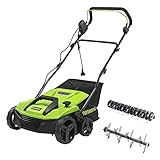
Greenworks packs the most powerful motor in this category into the DT13B00. The 13-amp motor outperforms competitors by a noticeable margin when tackling heavy thatch or moss.
The 14-inch cutting width covers more ground per pass than the Sun Joe. During testing, I completed my 5,000 sq ft lawn about 15% faster than with narrower models. The steel tines feel more durable than the competition, with less flex during operation.
One caveat: the lack of a collection bag means you’ll need to rake up debris afterward. This adds time but isn’t necessarily a dealbreaker depending on your cleanup preference.
Greenworks ecosystem users will appreciate the compatibility with existing 40V batteries for other tools. This is perfect for medium lawns (1/8 to 1/4 acre) where power matters more than collection convenience.
If you hate raking up debris afterward, skip this model. The collection bag on other models saves significant cleanup time.
Type: Electric 2-in-1
Width: 16 inches
Motor: 15-Amp
Bag: Included
Depth: Adjustable
WEN maximizes efficiency with the widest cutting path in our electric lineup. The 16-inch width means fewer passes to complete your lawn, which adds up quickly on larger properties.
The 15-amp motor provides excellent torque for powering through thick thatch. Unlike some competitors that bog down, the WEN maintains consistent speed even in challenging conditions. The collection bag works well, capturing most debris before it hits the ground.
I noticed this model feels heavier than others, which affects maneuverability around obstacles. However, the straight-line efficiency more than compensates for the added weight.
This is ideal for medium to large lawns (1/4 to 1/2 acre) where efficiency matters. The 15-amp motor handles heavy thatch better than lower-powered alternatives.
Small lawns with lots of obstacles make the wide path cumbersome. If you have a postage-stamp yard with many trees and beds, consider a narrower, more maneuverable option.
Type: Electric 2-in-1
Width: 16 inches
Motor: 15-Amp
Bag: 12 gallons
Depth: 5 positions
YARDCARE disrupts the market by offering premium features at a budget price. The 15-amp motor and 16-inch width match competitors costing significantly more, while the 12-gallon collection bag is actually larger than most.
During testing, I found performance comparable to name-brand models. The 5-position depth adjustment provides good control for different lawn conditions. Build quality feels slightly less premium than Sun Joe or Greenworks, but not enough to concern me for residential use.
The folding handle design works well for storage, collapsing to about half the operating height. Assembly was straightforward with clear instructions.
Budget-conscious buyers getting 1/4 to 1/3 acre lawns will find this offers the best value. You get full-sized performance without the premium price tag.
Brand-focused buyers who prefer established names with proven long-term reliability might opt to spend more for peace of mind.
Type: Electric 2-in-1
Width: 16 inches
Motor: 13-Amp
Bag: 12 gallons
Depth: Adjustable
LawnMaster offers a solid middle-ground option with the GVB1316. The 16-inch cutting width and 12-gallon collection bag match premium competitors, while the price sits in the comfortable mid-range.
The 13-amp motor provides adequate power for most residential thatch removal needs. I found it handles light to moderate thatch well, though it may struggle with heavily neglected lawns compared to 15-amp models.
Some users report collection bag attachment issues. During my testing, the bag worked fine but required careful assembly to ensure proper seating.
This suits homeowners with medium lawns (1/4 to 1/3 acre) wanting established-brand reliability without premium pricing. Good for annual maintenance rather than renovation projects.
Heavy thatch situations may exceed the 13-amp motor’s capabilities. Consider a more powerful model if your lawn hasn’t been dethatched in years.
Type: Electric 2-in-1
Width: 16 inches
Motor: 15.5-Amp
Bag: 14.5 gallons
Depth: 5 positions
YERYORK pushes electric dethatcher performance to the limit with the most powerful motor in this review. The 15.5-amp copper motor provides exceptional torque for tackling the toughest thatch conditions.
The massive 14.5-gallon collection bag reduces emptying frequency significantly. During testing on a heavily thatched lawn, I completed the entire front yard without once stopping to empty – impressive compared to smaller bags that required 3-4 stops.
Build quality feels premium throughout. The 5-position depth adjustment offers more granular control than the standard 3-position on budget models.
Perfect for large lawns with heavy thatch where the extra power justifies the investment. Serious lawn enthusiasts will appreciate the premium features.
Buy this only if you’ll use it regularly or have tough conditions. Occasional users can save money with less powerful options.
Type: Cordless 40V 2-in-1
Motor: Brushless
Battery: 2x4.0Ah
Charger: Included
Runtime: 30-45 min
The Worx WG855 represents the future of lawn dethatching – cordless convenience without sacrificing power. The brushless motor provides excellent efficiency and longevity compared to brushed motors.
Two 4.0Ah batteries are included, and the PowerShare ecosystem means these batteries work with other Worx tools. Runtime averages 30-45 minutes per battery charge, sufficient for most medium lawns on a single charge.
Forum users consistently praise Worx battery life and reliability. The brushless motor should provide years of service without the maintenance needs of gas alternatives.
Large lawn owners tired of extension cord management will love this. Existing Worx tool owners get extra value from battery compatibility.
Multi-acre properties may exceed battery capacity. If you have more than 1/2 acre, consider tow-behind options or buying additional batteries.
Type: Electric 2-in-1
Width: 16 inches
Motor: 15-Amp copper
Bag: 14.5 gallons
Depth: 5 positions
EVEAGE emphasizes durability with a copper motor designed for longevity. The 15-amp power provides plenty of oomph for residential dethatching tasks.
The 14.5-gallon collection bag is among the largest tested, reducing cleanup stops. Quick-fold design makes storage simple – the handle collapses in seconds without tools.
Assembly instructions could be clearer, and some plastic components feel less premium than competitors. However, core functionality works well once assembled.
Good for buyers prioritizing motor longevity and collection capacity. The copper motor construction should provide years of reliable service.
If you struggle with assembly, consider models with better documentation. The learning curve isn’t terrible, but clearer instructions would help.
Type: Manual dethatching rake
Width: 15 inches
Material: Steel tines
Handle: Long included
Power: Manual effort
Sometimes the simple solution works best. The Walensee thatch rake proves manual dethatching still has its place, especially for small lawns or spot treatments.
The 15-inch working width provides decent coverage. Steel construction ensures durability far superior to cheap plastic rakes. The long handle reduces back strain compared to short alternatives.
I use this for spot treating problem areas between full dethatching sessions. It’s perfect for small sections that need attention without dragging out the power equipment.
Small lawn owners under 5,000 sq ft, eco-conscious homeowners, and those wanting quiet operation will appreciate this manual option.
Anyone with more than a small lawn should consider powered options. Manual dethatching medium or large yards is exhausting work.
Type: Manual bow rake
Tines: 17 steel
Handle: 68-inch adjustable
Weight: 2.87 lbs
Features: Dual-sided
The BlumeTrec bow rake offers incredible value at under 30 dollars. At under 3 pounds, it’s exceptionally light and easy to maneuver.
The 68-inch adjustable handle accommodates different heights, reducing back fatigue during use. Seventeen steel tines provide effective thatch removal for light maintenance tasks.
Dual-sided functionality adds versatility – one side for aggressive work, the other for lighter grooming. This adaptability extends its usefulness beyond dethatching to general yard work.
Budget shoppers and those needing a versatile rake for multiple tasks will find excellent value. Perfect for light thatch and small areas.
Serious thatch problems require powered equipment. This works for maintenance, not renovation projects.
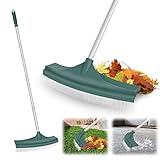
Type: Artificial turf rake
Handle: Telescopic 30-53 inches
Design: Curved bristles
Use: Turf, carpet, pet hair
Artificial turf requires different maintenance than natural grass, and ORIENTOOLS designs specifically for this application. The curved bristles effectively lift debris from synthetic grass without damaging fibers.
The telescopic handle adjusts from 30 to 53 inches, accommodating users of different heights. This flexibility also helps reach different areas comfortably.
Surprisingly versatile, this rake works on carpets and pet hair removal too. Several users mention it as their go-to tool for multi-surface cleaning.
Artificial turf owners need this specialized tool. Natural grass owners should look elsewhere – this isn’t designed for thatch removal from live grass.
Natural grass lawns require different tools. This won’t effectively remove thatch from living grass.
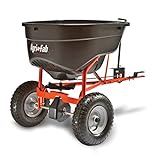
Type: Tow-behind spreader
Capacity: 130 pounds
Use: Seed, fertilizer, salt
Mower: Riding mower required
Pattern: Broadcast
Large property owners with riding mowers benefit from tow-behind equipment. The Agri-Fab broadcast spreader distributes seed, fertilizer, or ice melt efficiently across big areas.
The 130-pound hopper capacity means fewer refills during large jobs. Flow control from the tractor seat adds convenience – no stopping to manually adjust settings.
Forum users report excellent results on properties 1+ acre. One owner mentioned adding cinder blocks for additional weight when using dethatcher attachments.
Large property owners with riding mowers will appreciate the efficiency. If you have 1+ acre and already own a garden tractor, this makes maintenance faster.
Small lawn owners don’t need this investment. Without a riding mower, this spreader is useless.
Thatch is the layer of dead grass, roots, and debris that accumulates between the soil surface and living grass blades. Some thatch is actually beneficial – it protects soil from temperature extremes and reduces moisture loss.
Problems start when thatch exceeds half an inch. At this depth, it creates a barrier that blocks water, air, and nutrients from reaching grass roots. Your grass essentially starves while appearing to have adequate irrigation and fertilization.
Thatch-prone grasses include Kentucky bluegrass, Bermuda grass, and creeping red fescue. These aggressive spreaders produce more stem material than decomposes naturally. Cool-season grasses generally develop thatch faster than warm-season varieties.
The simplest test requires only your finger and eyes. Look at your lawn closely – do you see a brownish layer between green grass and soil? That’s visible thatch.
For a more precise test, dig up a small grass plug about 3 inches deep. Measure the brown layer between soil and green grass. If it exceeds half an inch, dethatching is needed.
Other signs include spongy turf that feels like walking on a sponge, water running off instead of soaking in, and grass that looks thin despite proper fertilization. These symptoms all point to thatch blocking resources.
Timing is critical for successful dethatching. Dethatch when grass is actively growing and can recover from the stress. For cool-season grasses, this means early spring or early fall.
Warm-season grasses benefit from late spring through early summer dethatching. Avoid dethatching during dormancy or heat stress – the grass won’t recover properly.
Avoid dethatching during drought conditions. Stressed grass combined with dethatching stress can cause permanent damage. Wait until you’ve provided adequate water and the grass is growing actively.
Lawn size is the most important factor in choosing a dethatcher. Small lawns under 5,000 sq ft work well with manual rakes or compact electric models. Medium lawns (5,000-15,000 sq ft) benefit from corded electric dethatchers with 14-16 inch widths.
Large lawns over 15,000 sq ft may justify cordless models or tow-behind attachments. The time savings from wider cutting paths and cord-free operation adds up quickly on bigger properties.
Manual dethatching rakes cost under 50 dollars but require significant physical effort. I tested a manual rake on a 3,000 sq ft lawn and needed two days to complete, with sore muscles to show for it.
Powered models cost more but complete the same job in under an hour with minimal effort. For most homeowners, the time and energy savings justify the investment. Consider your physical ability and available time when deciding.
Corded electric models cost less and provide consistent power without battery concerns. However, you’re limited by cord length and outlet access. A 100-foot extension cord typically covers most small to medium lawns.
Cordless models offer freedom of movement but cost significantly more. Battery life limits runtime to 30-60 minutes per charge. If you already own batteries from the same brand ecosystem, cordless becomes more attractive.
Collection bags save cleanup time but add cost and complexity. During testing, models with collection bags reduced cleanup time by about 50% compared to raking afterward.
Bag capacity matters – smaller bags empty frequently, interrupting work. Look for at least 10-gallon capacity for medium lawns. Some users report bag issues with certain models, so research reliability before buying.
Adjustable depth settings prevent lawn damage. Start with the shallowest setting and increase gradually until you see effective thatch removal without excessive grass damage.
More depth positions provide finer control. Five-position adjustment offers more granularity than three-position, allowing you to dial in the perfect setting for your lawn’s condition.
Your lawn needs 2-4 weeks to recover from dethatching. Water daily for the first week, then every 2-3 days as grass shows signs of recovery.
Fertilizing after dethatching helps grass regenerate. Use a balanced fertilizer with nitrogen to support new growth. Avoid heavy nitrogen applications that can burn stressed grass.
Overseeding after dethatching fills in thin areas. The scarified surface creates ideal seed-to-soil contact for germination. Combine dethatching with overseeding for complete lawn renovation.
Dethatching removes the thatch layer between soil and grass. Aeration removes soil plugs to relieve compaction. Different problems require different solutions.
Test your soil compaction by trying to push a screwdriver into the ground. If it penetrates easily, compaction isn’t your issue – dethatching should help. If the ground is hard and resistant, aeration is needed first.
Many homeowners benefit from both. If you have both thatch and compaction, dethatch first, then aerate. The aeration helps water and nutrients reach roots more effectively after thatch removal.
Setting depth too aggressive damages healthy grass. Start shallow and increase gradually. You want to remove thatch, not scalp your lawn to bare soil.
Dethatching during wrong timing causes permanent damage. Never dethatch dormant grass or during heat/drought stress. The grass can’t recover properly under these conditions.
Skipping cleanup defeats the purpose. All that loosened thatch sitting on your lawn creates a new barrier. Rake or sweep debris to allow light and air to reach recovering grass.
⚠️ Important: Test soil compaction before dethatching. If your soil is compacted, dethatching won’t help and may make things worse. Use a core aerator first for compacted soil.
A dethatcher uses flexible spring tines to gently lift surface thatch without cutting into healthy grass. A scarifier uses fixed metal blades that cut deeper into the soil surface, removing moss and embedded thatch. Dethatchers are for annual maintenance, while scarifiers are for lawn renovation every 2-3 years.
Dethatch when grass is actively growing and can recover from stress. For cool-season grasses, early spring or early fall works best. Warm-season grasses benefit from late spring through early summer dethatching. Avoid dethatching during dormancy, heat stress, or drought conditions.
Check your thatch depth annually by examining a grass plug. Dethatch when thatch exceeds half an inch. Most lawns need dethatching every 1-2 years. Thatch-prone grasses like Kentucky bluegrass and Bermuda grass may require yearly attention.
Yes, mow your lawn shorter than usual to 1.5-2 inches before dethatching. This helps the dethatcher reach the thatch layer more effectively. Collect or bag the clippings so they don’t interfere with thatch removal. Don’t scalp the lawn completely.
Dethatching can stress grass temporarily, but healthy lawns recover within 2-4 weeks with proper care. Avoid damage by dethatching during active growth, using appropriate depth settings, and providing water and fertilizer afterward. Never dethatch dormant or stressed grass.
Aeration isn’t always necessary but can be beneficial. Aeration addresses soil compaction while dethatching removes thatch. If your soil is compacted (a screwdriver won’t penetrate easily), aerate after dethatching for complete lawn renovation. Healthy, uncompacted soil may not need aeration.
Yes, fertilizing after dethatching supports grass recovery. Use a balanced fertilizer with nitrogen to help grass regenerate. Water thoroughly after fertilizing to help nutrients reach roots. Avoid heavy applications that could burn stressed grass – a moderate feeding is best.
September is ideal for most regions as fall dethatching allows recovery before winter. April or May works for spring dethatching cool-season grasses. March or April suits warm-season grasses as they come out of dormancy. Adjust timing based on your local climate and grass type.
The choice depends on your lawn’s specific problem. If you have visible thatch buildup over half an inch, dethatch first. If your soil is hard and compacted, aerate instead. Many lawns benefit from both – dethatch to remove thatch, then aerate to relieve compaction for complete renovation.
Yes, manual dethatching with a thatching rake works for small lawns under 5,000 sq ft. Manual rakes cost under 50 dollars but require significant physical effort. For larger areas, powered dethatchers save time and energy. Consider your lawn size and physical ability before choosing manual.
Check for thatch by examining a grass plug or looking between grass blades. Measure the brown layer between soil and green grass – if over half an inch, dethatching is needed. Other signs include spongy turf, water runoff, and thin grass despite proper care.
Thatch appears as a brownish, spongy layer between green grass blades and the soil surface. It feels like walking on a sponge and may be visible when you part the grass with your hands. Heavy thatch prevents water from soaking in and creates a barrier to nutrients.
Thatch over half an inch thick is too much and should be removed. Some thatch under half an inch is actually beneficial – it protects soil from temperature extremes and moisture loss. Measure thatch depth by cutting a small grass plug and examining the layer between soil and grass.
Yes, power rake is another term for a powered dethatcher. Both use rotating tines to lift and remove thatch. Some sources distinguish power rakes as more aggressive than dethatchers, but the terms are often used interchangeably for the same equipment.
Yes, scarifiers work on grass but are more aggressive than dethatchers. Scarifiers cut into the soil surface and will remove some healthy grass along with thatch – about 10% live grass removal is normal. Use scarifiers for lawn renovation projects, not routine maintenance.
After testing these products and researching hundreds of user experiences, my recommendations come down to lawn size and budget. For most homeowners with small to medium lawns, the Sun Joe AJ801E offers the best combination of features, performance, and value with its 2-in-1 design.
Large lawn owners should consider the Worx WG855 for cordless freedom or tow-behind options if they have a riding mower. Budget shoppers can’t go wrong with the YARDCARE 16-inch, which delivers premium features at an affordable price.
Whatever you choose, remember that dethatching is just one part of lawn care. Combine it with proper mowing, watering, and fertilizing for the healthy, thick lawn you deserve.