
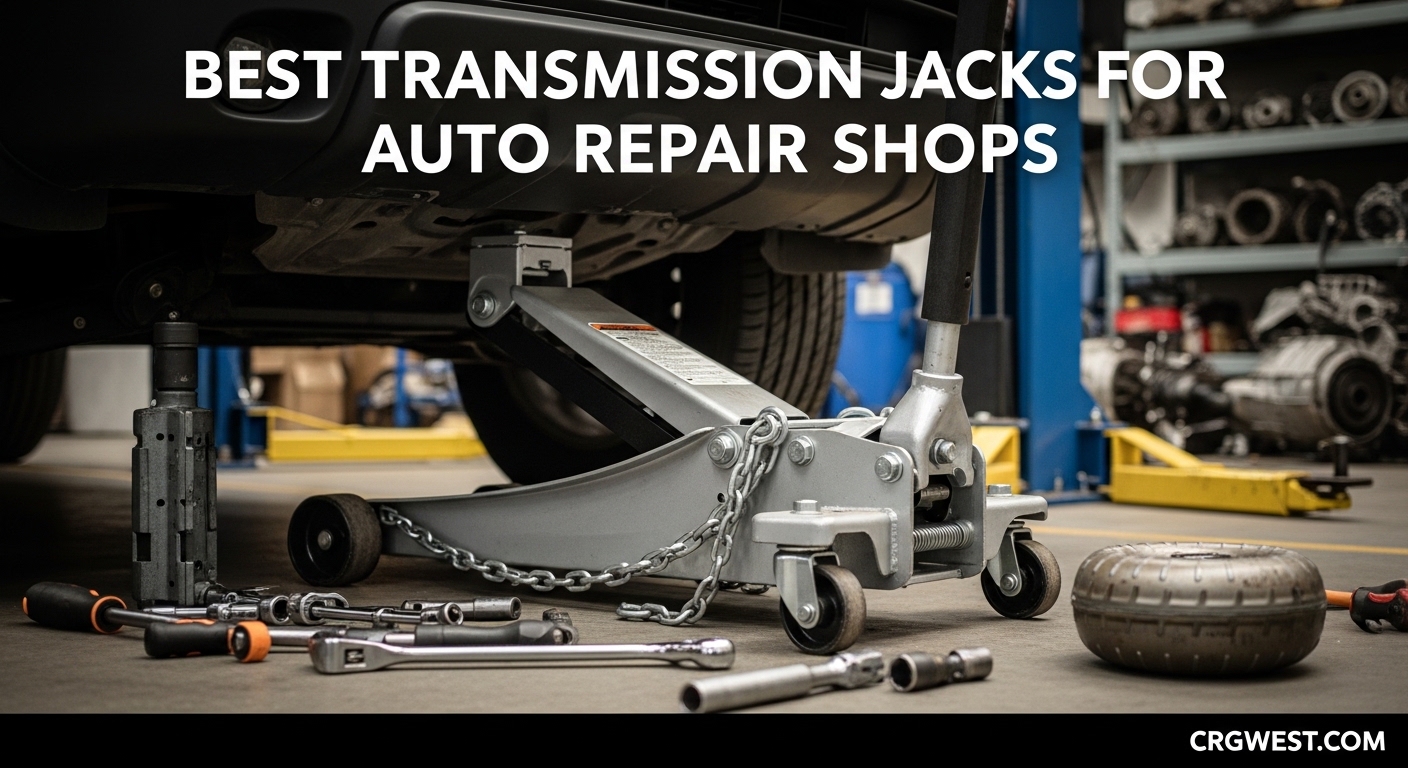
Removing a transmission without the right jack is one of the most dangerous jobs in any auto repair shop. I have seen mechanics struggle with floor jacks, wooden blocks, and makeshift rigs that put both the technician and the vehicle at risk. Transmissions weigh anywhere from 150 pounds for a compact car to over 800 pounds for heavy diesel trucks, and trying to muscle one of those into place without proper equipment is a recipe for disaster.
If you run an auto repair shop or work as a professional mechanic, a dedicated hydraulic transmission jack is not a luxury item. It is essential safety equipment. The best transmission jacks for auto repair shops give you hands-free lifting with foot pedals, adjustable saddles that tilt and rotate for precise alignment, and safety chains that keep the load locked in place during the entire removal and installation process.
Our team spent weeks comparing transmission jacks across every category that matters to shop owners: load capacity, lift range, hydraulic system quality, caster performance, safety features, and real-world durability. We looked at budget-friendly models for small shops and premium air-hydraulic units for high-volume transmission specialty operations. Below you will find our top 8 picks, each one tested and reviewed with honest feedback on what works and what does not.
Top 3 Transmission Jacks for Auto Repair Shops

Sunex 7793B Telescopic...
- 1000 lb Capacity
- Foot Pump Operated
- 74 in Max Height
- Overload Valve

VEVOR 1322 lbs Telescoping...
- 1322 lb Capacity
- Foot Pedal
- 68.5 in Max Height
- 360 Degree Swivel

JEGS Low Profile Transmissi...
- 1000 lb Capacity
- 8.5-23 in Lift Range
- 360 Degree Handle
- Swivel Casters
Best Transmission Jacks for Auto Repair Shops in 2026
| Product | Specs | Action |
|---|---|---|
|
Sunex 7793B Telescopic Jack
|
|
Check Latest Price |
 Sunex 7796 Air/Hydraulic Jack
|
|
Check Latest Price |
|
VEVOR 1322 lbs Telescoping Jack
|
|
Check Latest Price |
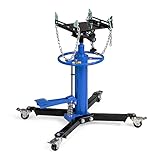
 VEVOR 1100 lbs 2-Stage Jack
|
|
Check Latest Price |
 TUFFIOM 1660 lbs Hydraulic Jack
|
|
Check Latest Price |
|
JEGS Low Profile Floor Jack
|
|
Check Latest Price |
 MOTOOS 1100 lbs Low Profile Jack
|
|
Check Latest Price |
 AFF Manual Transmission Jack
|
|
Check Latest Price |
1. Sunex 7793B – Best Overall Professional Transmission Jack
Sunex Tools 7793B 1,000 lb Telescopic Transmission Jack, Hydraulic, Foot Pump Operated, Tilt Saddle with Chain Tie-Down, 74.2 in Max Height
1000 lb Capacity
35-74 in Lift Range
Foot Pump Operated
163 lb Weight
Pros
- Heavy duty solid construction
- Fast 2-stage pumping
- Head tilts in all directions
- Easy one-man assembly
- Pregreased no leaks
Cons
- Lowering knob position is low
- Chain could be sturdier
- Heavy wooden crate delivery
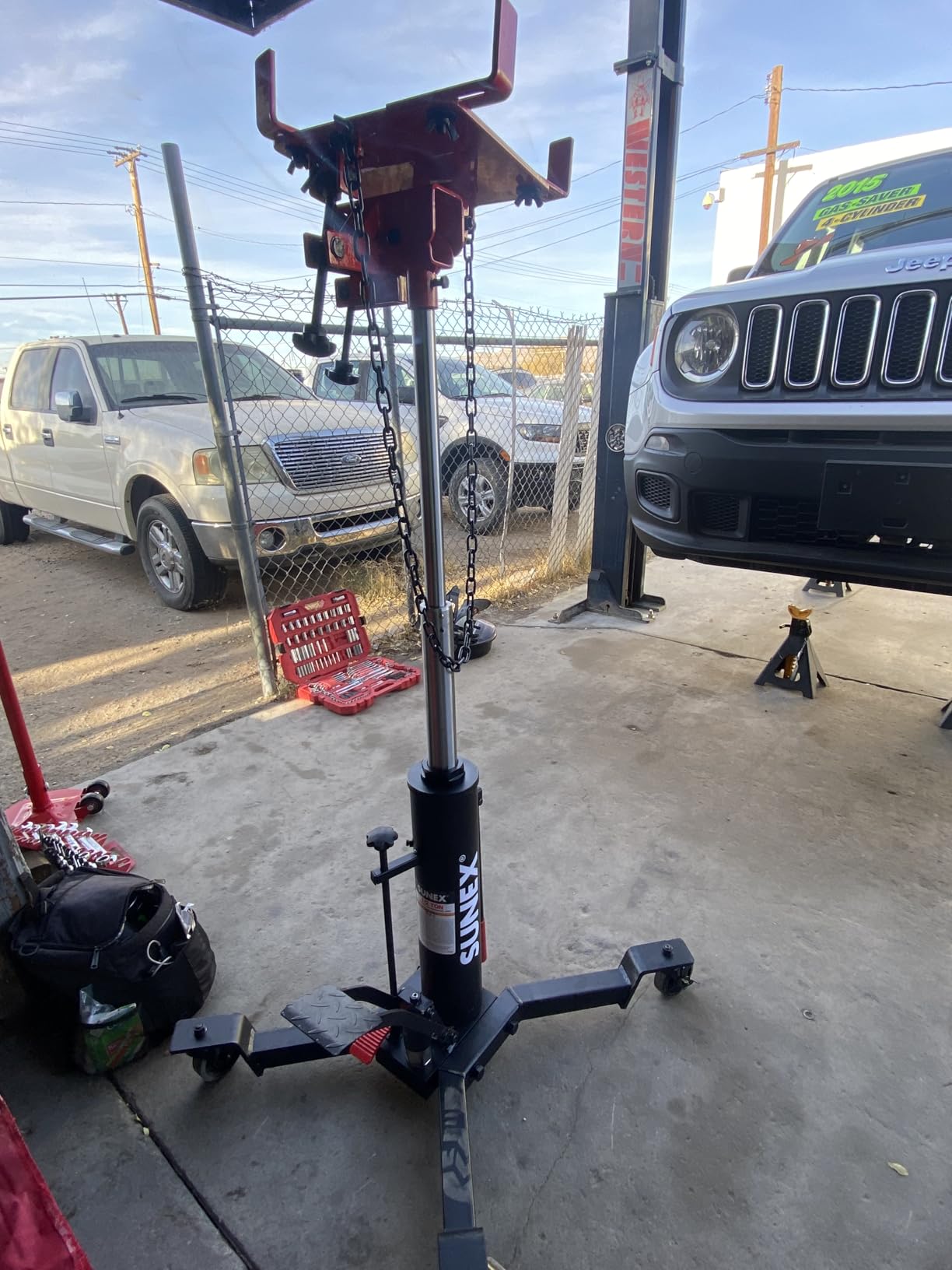
I have used the Sunex 7793B on several transmission jobs, and it is the kind of tool that makes you wonder how you ever managed without it. The two-stage telescoping ram pumps up fast, and the foot pedal means both my hands stay free to guide the transmission into position. That alone saves a tremendous amount of time and frustration when you are lying on your back trying to line up bellhousing bolts.
The saddle tilts in every direction, which matters more than you might think. Transmissions do not come out straight. They angle down on one side, tip forward as you clear the input shaft, and shift around during the whole process. Having a saddle that follows those movements keeps the load stable instead of fighting against you.
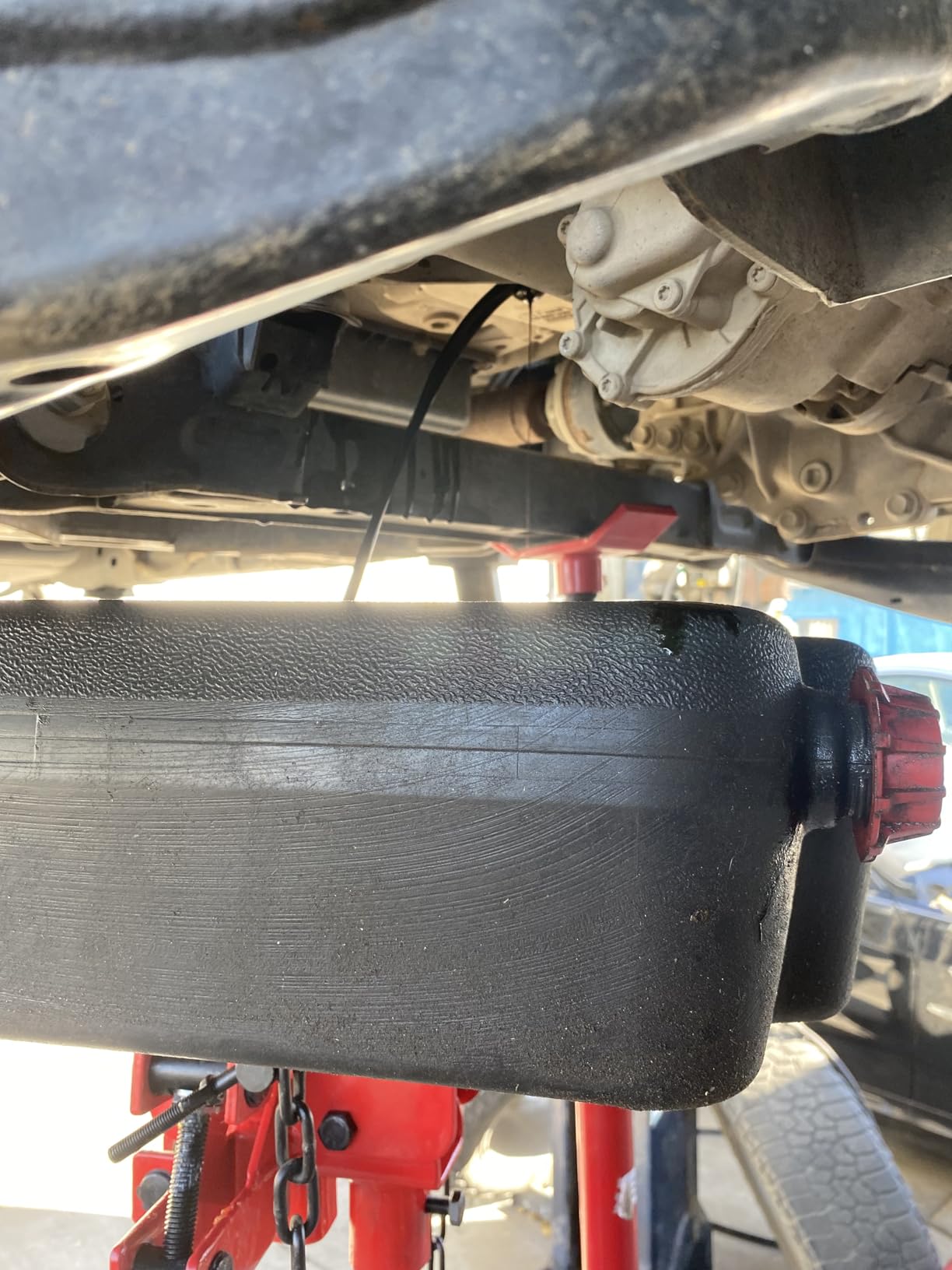
At 163 pounds, this is a substantial piece of equipment. It arrives mostly assembled in a heavy wooden crate, and mine was pre-greased with zero hydraulic leaks right out of the box. The base sits absolutely solid on the floor with no wobble even when fully extended to the 74-inch maximum height. That stability at full extension is something cheaper jacks simply cannot match.
The overload valve is a critical safety feature that prevents you from exceeding the 1,000-pound rated capacity. I also appreciate the nylon strap tie-down that keeps the transmission secured to the saddle. Some users mention the lowering knob sits too low and requires crouching, which is a valid complaint but a minor one given the overall build quality.
Who Should Buy the Sunex 7793B
This is the jack I recommend for professional auto repair shops that handle transmission work regularly. It is built for daily abuse and holds up over years of service. The two-stage pump lets you raise the saddle quickly through the first stage and then fine-tune with the second stage for precise positioning. Shops that work on passenger cars, light trucks, and SUVs will find the 35-to-74-inch lift range covers almost every vehicle that rolls through the bay.
If you are a shop owner investing in equipment that technicians will actually want to use, the Sunex 7793B delivers professional-grade performance at a price that makes sense for a working shop. It carries a 4.7-star rating from over 200 reviews, and many of those reviewers are professional mechanics who have put hundreds of hours on this jack.
Where the Sunex 7793B Falls Short
The 1,000-pound capacity covers most passenger vehicles and light trucks, but it will not handle heavy diesel truck transmissions. Shops that specialize in heavy-duty truck work need to look at higher-capacity options. Also, at 163 pounds, moving this jack between bays requires some effort. It is not something you toss in the back of a truck for mobile jobs. The lowering knob position is an annoyance but not a dealbreaker for most users.
2. Sunex 7796 – Air/Hydraulic Power for High-Volume Shops
SUNEX Tools 1,000 lb. Air and Hydraulic Telescopic Transmission Jack with Adjustable Saddle Arms, 35.5 in. to 73.5 in. Lift Range, Model 7796
1000 lb Capacity
35-73.5 in Lift Range
Air-Hydraulic Operation
160 lb Weight
Pros
- Air-activated first stage
- Four ratcheting saddle arms
- Fine-tune pump for precision
- Tough for everyday pro use
Cons
- Air only works on large ram
- Some shipping damage reports
- Adapter compatibility issues
The Sunex 7796 takes everything great about the 7793B and adds air power to the first stage. That air-activated primary ram is a genuine time-saver in a busy shop. Connect your shop air line at 100 PSI, step on the foot pedal, and the first stage rises quickly without any manual pumping. Then the hydraulic second stage gives you fine control for positioning. This dual-system approach is what separates professional-grade equipment from entry-level models.
The four ratcheting saddle arms are another step up from the standard fixed-saddle design. These arms adjust independently to grip the transmission oil pan mounting flange from multiple points. That provides a much more secure hold than a flat saddle with a chain, especially on oddly shaped transmission pans. I found the arms easy to position and they lock firmly in place with no slipping.
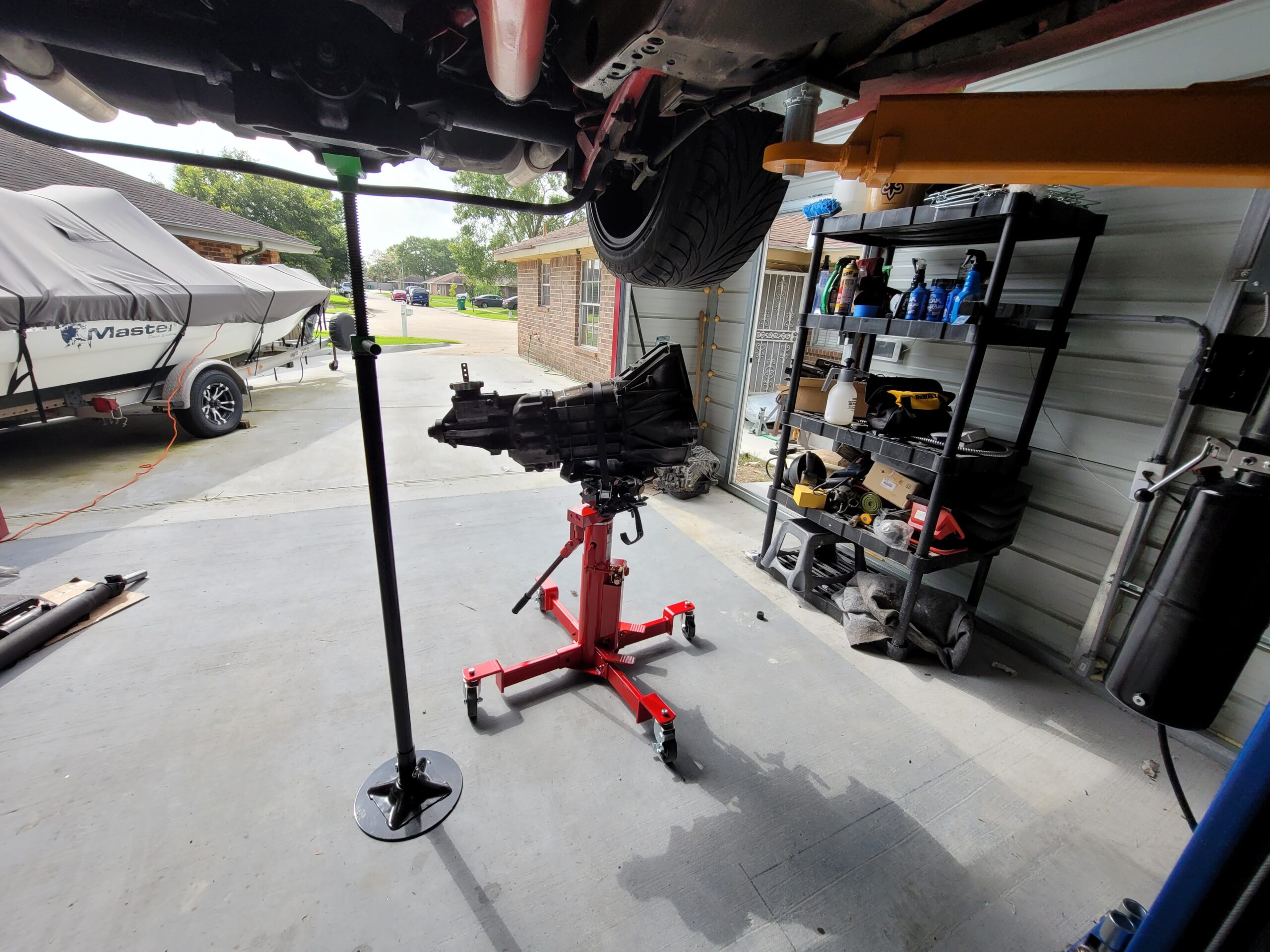
The tilt range on this jack is impressive. The saddle tilts 37 degrees forward, 26 degrees backward, and 12 degrees left and right. That is significantly more adjustment than most competitors offer, and it makes a real difference when you are trying to align a transmission that is hanging at an awkward angle. The 30.25-inch square base keeps everything stable, and the locking swivel casters hold position on smooth shop floors.
One thing to keep in mind: the air function only operates the large primary ram. You still need to manually pump the smaller secondary ram. Some reviewers expected full air operation for both stages, which is not how this jack is designed. However, the fine-tune hydraulic pump on the second stage is actually a benefit because it gives you precise control that air alone cannot provide.
Ideal Shop Applications for the Sunex 7796
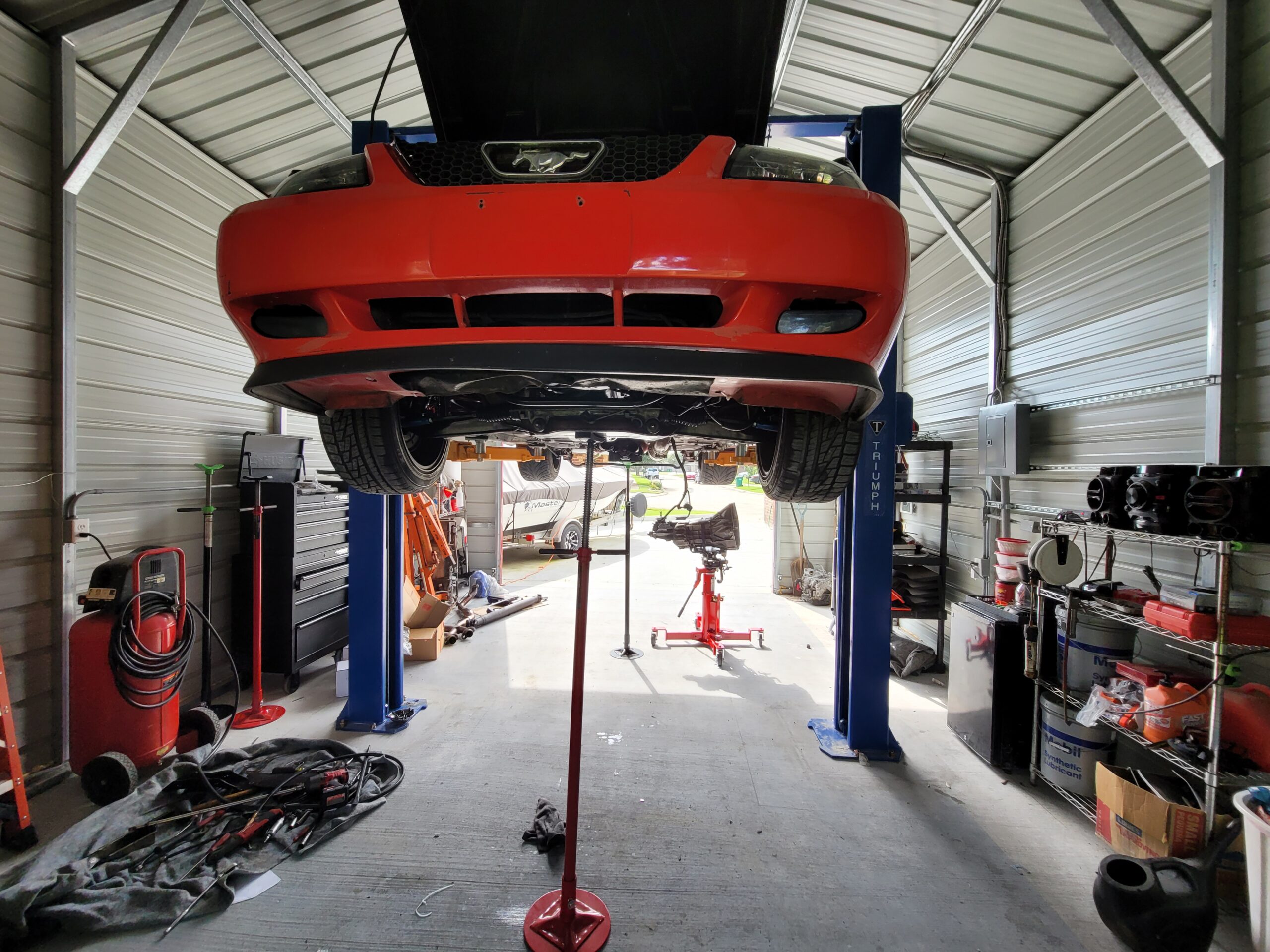
This is the right choice for high-volume transmission shops that do five or more transmission jobs per week. The air-powered first stage saves roughly 30 seconds to a minute per raise-and-lower cycle, which adds up fast when you are raising and lowering multiple times during a single job. Shops with compressed air systems already in place can take full advantage of this feature immediately.
The ratcheting saddle arms make this jack particularly good for shops that work on a wide variety of vehicles. Instead of relying on a universal flat saddle and hoping the transmission stays centered, the arms conform to each specific transmission pan shape. This versatility pays off when your shop handles everything from compact cars to full-size trucks.
Things to Consider Before Buying
You need a shop air compressor running at 100 PSI to get the most out of this jack. Without compressed air, you lose the primary advantage over the less expensive 7793B model. Some users report shipping damage, so inspect the package carefully on delivery. The adapters can also be tricky to fit on certain transmission types and may require drilling new holes for a proper match.
3. VEVOR 1322 lbs Telescoping Transmission Jack – Best Value Pick
VEVOR Transmission Jack, 1322 LBS Hydraulic Telescoping Transmission Jack, 32"-67" High Lift Transmission Jack Stand with Foot Pedal, 360° Swivel Wheel
1322 lb Capacity
34.3-68.5 in Lift Range
Foot Pedal Operation
96 lb Weight
Pros
- 1322 lb super bearing capacity
- Foot pedal hands-free lifting
- Best seller rank 1 in category
- Extended lift range
Cons
- May require purging air before first use
- Some low oil reports
- Occasional missing parts
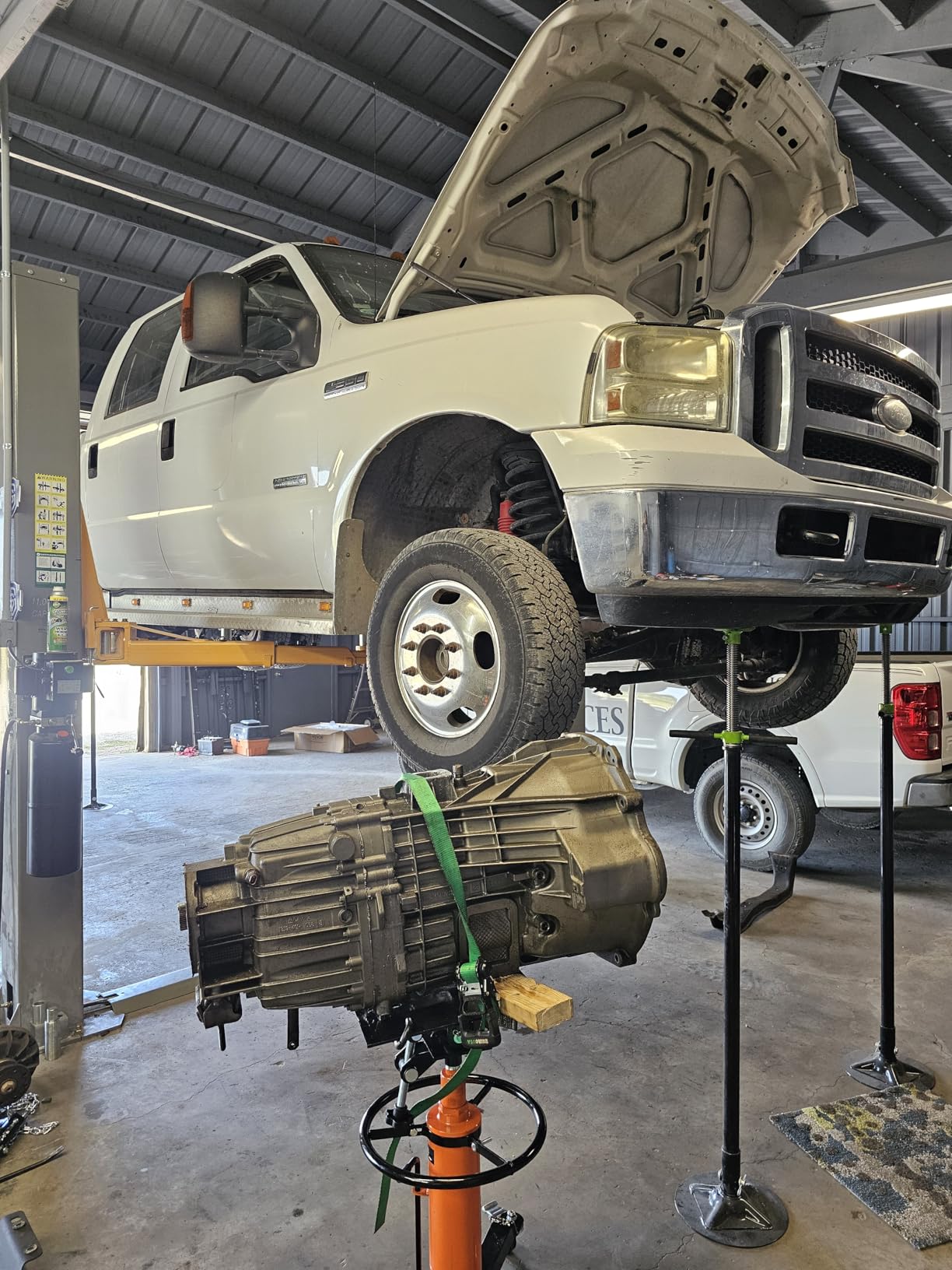
The VEVOR 1322-pound transmission jack currently holds the number one best-seller spot in its Amazon category, and for good reason. It offers more lifting capacity than the Sunex models at a fraction of the cost. The 1,322-pound capacity means it can handle heavier transmissions that would push a 1,000-pound jack to its limit, giving you a larger safety margin on every job.
I like the foot pedal operation on this jack. It provides smooth hydraulic lifting from 34.3 inches up to 68.5 inches, which covers the height range needed for most vehicles on a lift or jack stands. The saddle tilts up to 30 degrees and the upgraded adjustment screws hold their position without backing off under load. That tilt function is essential when you need to angle the transmission to clear crossmembers or exhaust components.
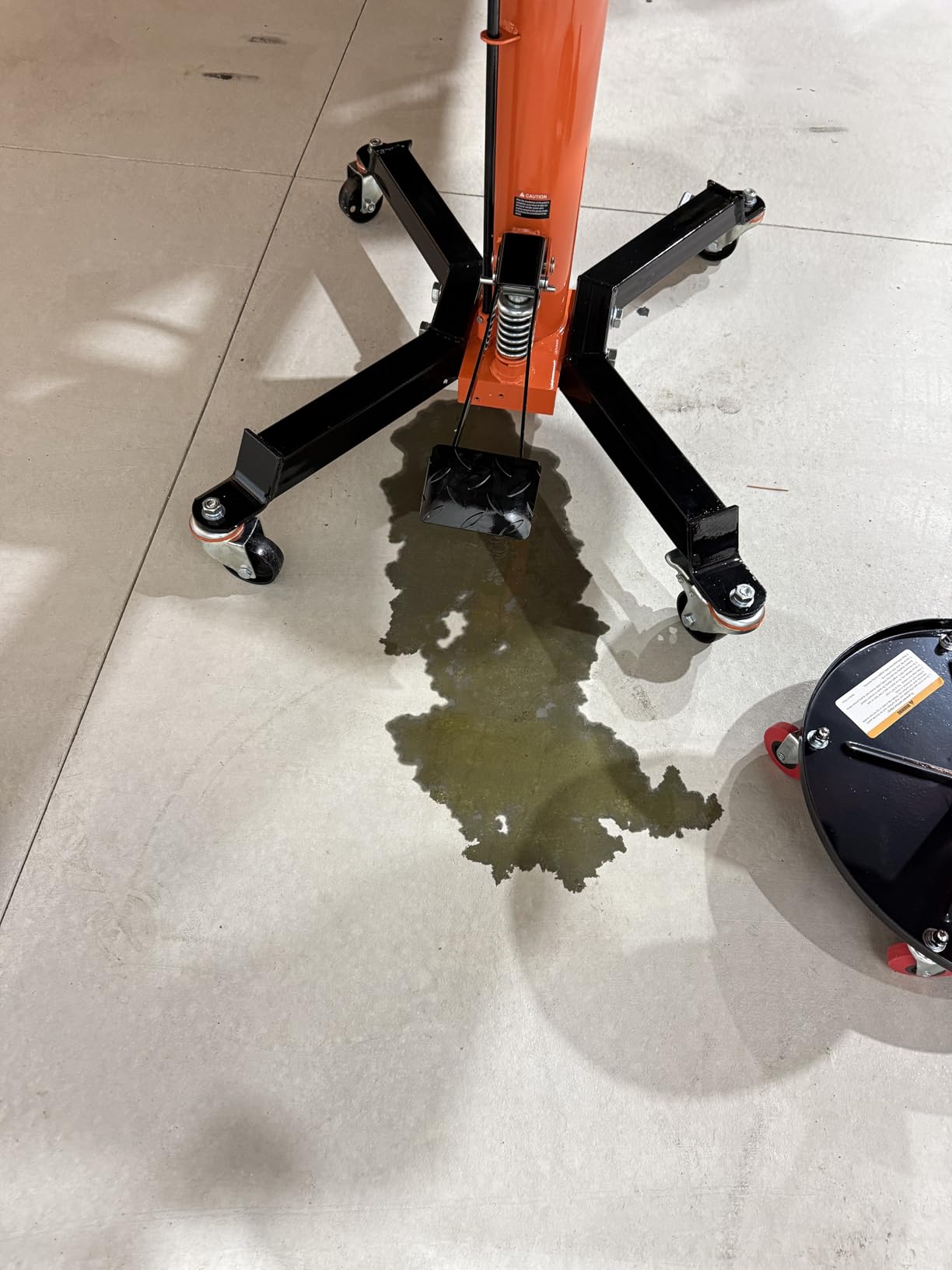
The central auxiliary ring around the column is a thoughtful design touch. It gives you a convenient handle to push or pull the jack into position without grabbing the hydraulic column or the saddle. Four wheels with two brakes provide decent mobility around the shop floor, though the casters are not as smooth as the ones on premium models.
The steel construction feels solid for the price point. At 96 pounds, it is manageable enough to move between bays without straining, yet heavy enough to stay planted during use. One thing I noticed is that some units ship with air in the hydraulic system. You may need to purge the air by loosening the bleed valve and pumping a few cycles before the jack operates smoothly. This takes about five minutes and is not a big deal, but it is worth knowing upfront.
Best Use Cases for the VEVOR 1322
Small to mid-size auto repair shops looking for the best balance of capacity, features, and cost will find this jack hard to beat. The 1,322-pound capacity covers everything from compact car transmissions to full-size truck units. If your shop does a mix of vehicle types and you need one jack that can handle all of them, this is a strong contender.
Home garage mechanics who want professional-grade capacity without the professional-grade price tag also gravitate toward this model. The best-seller ranking confirms that thousands of buyers have chosen this jack and the 4.4-star rating shows most of them are satisfied with the performance.
Potential Drawbacks to Know About
Quality control is not at the same level as Sunex or other premium brands. Some users report receiving units with low hydraulic fluid or missing hardware. The assembly instructions are mediocre at best. If you are comfortable doing basic troubleshooting like purging air from the hydraulic system and checking fluid levels, these issues are easily resolved. But if you want something that works perfectly out of the crate with zero tinkering, you may want to spend more on a premium model.
4. VEVOR 1100 lbs 2-Stage Hydraulic Transmission Jack – Budget Pick
VEVOR Transmission Jack, 33"-67" High Lift, 1100 lbs Hydraulic Telescoping Transmission Jack, 2-Stage Transmission Stand 1/2 Ton Capacity with Foot Pedal, 360° Swivel Wheel, Garage/Shop Lift Hoist
1100 lb Capacity
33.5-67 in Lift Range
2-Stage Hydraulic
96 lb Weight
Pros
- 1100 lb capacity for most transmissions
- Two safety anchor chains included
- Foot pedal operation
- 2-stage hydraulic telescoping
Cons
- Poorly written instructions
- Some hardware mismatches
- Low-strength fasteners may need replacing
For shops on a tight equipment budget, the VEVOR 1100-pound 2-stage transmission jack offers a capable hydraulic telescoping jack at one of the lowest prices in its class. The 1,100-pound capacity handles the vast majority of passenger car and light truck transmissions. The 2-stage hydraulic ram gives you both a quick-lift first stage and a precision second stage, which is a feature usually found on more expensive models.
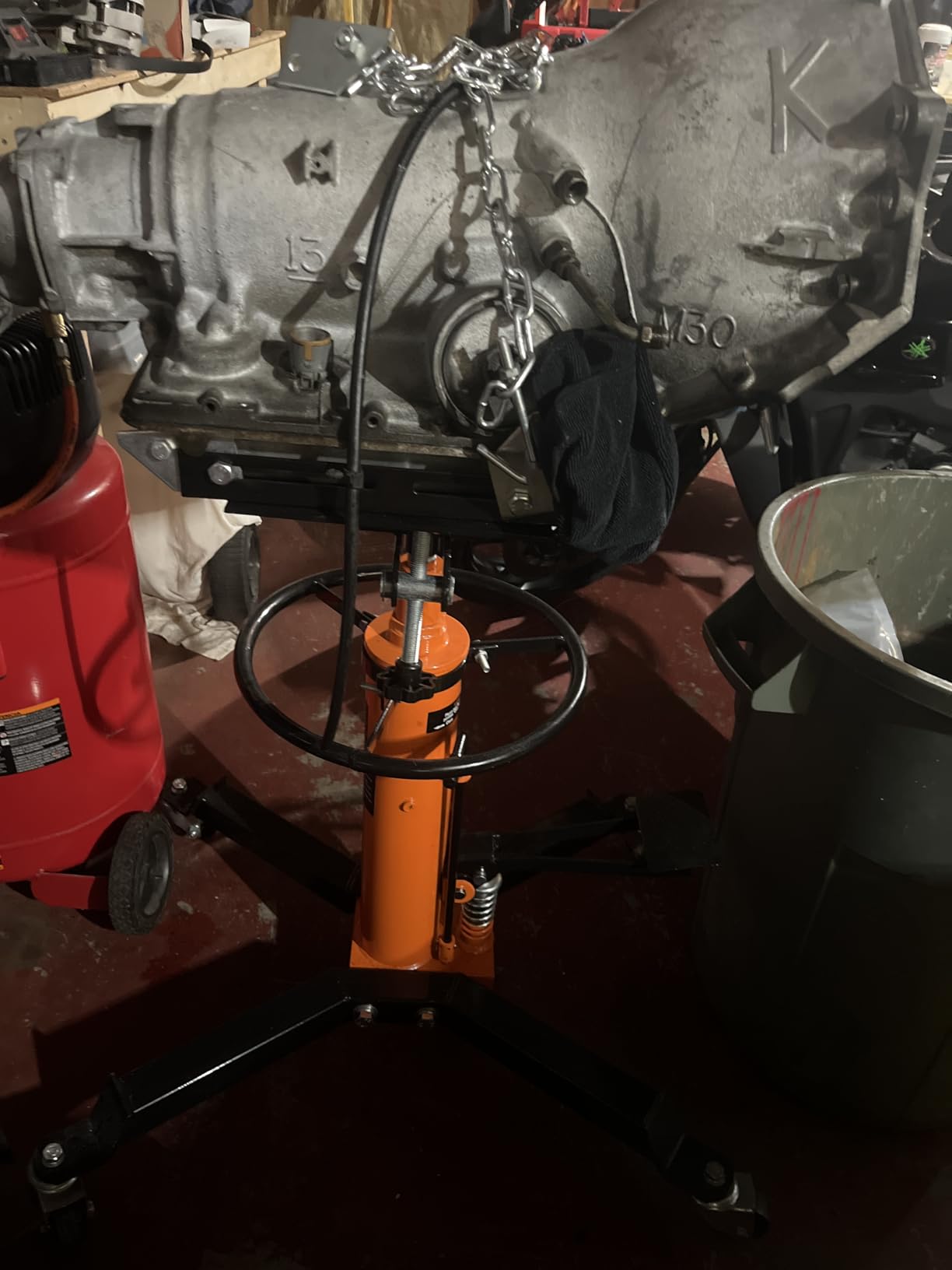
The lift range spans from 33.5 inches to 67 inches, covering the typical working heights needed for most vehicles on a two-post lift. The adjustable saddle tilts 30 degrees for angle adjustments, and two heavy-duty safety anchor chains come included. Having two chains instead of one gives you more secure load retention, which is especially important when you are working with heavier transmissions near the jack’s capacity limit.
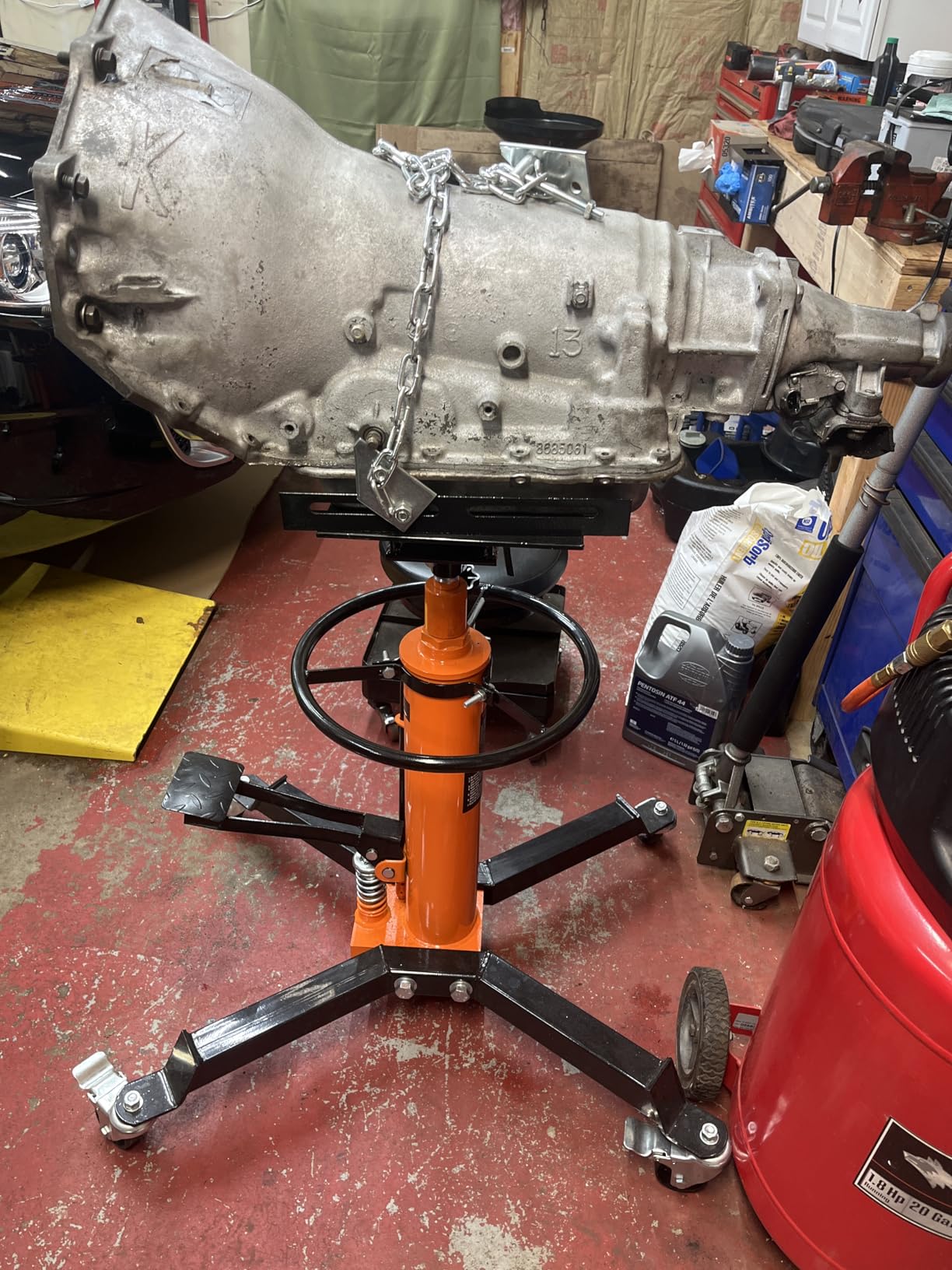
Four swivel casters with brakes provide the mobility you need to roll the jack under a vehicle and lock it in position. The foot pedal frees up your hands for guiding the transmission during alignment. At 96 pounds, this jack is reasonably portable between work bays.
The main area where this jack shows its budget nature is in the details. Assembly instructions are confusing and sometimes incorrect, which several reviewers mention. Some units ship with hardware that does not match the instructions, and the included fasteners are not the highest quality. I recommend checking all bolts during assembly and replacing any that feel soft or strip easily. Once properly assembled with good hardware, the jack performs well for the price.
When the VEVOR 1100 Makes Sense
This is a solid choice for small independent shops that need a hydraulic transmission jack but cannot justify spending premium money. The 2-stage hydraulic system and included safety chains give you the essential features for safe transmission work. With 339 reviews and a 4.3-star average, there is plenty of real-world feedback confirming this jack gets the job done for typical passenger vehicle transmissions.
Shops that primarily work on standard cars and light trucks will find the 1,100-pound capacity sufficient for daily operations. The 33.5-inch minimum height works with most two-post lifts, and the 67-inch maximum handles taller truck frames.
What You Sacrifice at This Price
Build quality is not at the same level as the Sunex models. The fasteners, caster quality, and overall fit-and-finish reflect the lower price. You may need to spend an extra 30 minutes during assembly sorting out hardware and tightening everything properly. The hydraulic system works but is not as smooth as premium units. For a shop doing one or two transmission jobs a week, this jack will serve you well. For daily heavy use, I would invest in a higher-end model.
5. TUFFIOM 1660 lbs Hydraulic 2-Stage Transmission Jack
TUFFIOM Transmission Jack, 1660 lbs 3/4-Ton Hydraulic 2-Stage High Lift Vertical Telescoping Floor Jack Stand, 34" to 68" Lifting Range, w/Pedal, 360° Swivel Wheels, Garage/Shop Lift Hoist, Blue
1660 lb Capacity
33.5-67 in Lift Range
2-Stage Hydraulic
99 lb Weight
Pros
- Highest capacity in its class
- Sturdy steel construction
- 360 degree rotating saddle
- Four cast-iron casters with brakes
Cons
- Wheels struggle on dirty floors
- Vague assembly instructions
- Some missing bolts reported
The TUFFIOM 1660-pound transmission jack offers the highest load capacity among the jacks we reviewed, and that extra capacity makes a real difference when you are working with heavier transmissions. At 1,660 pounds, this jack handles almost anything a general auto repair shop encounters, including heavier SUV and light truck transmissions that would push smaller jacks to their limits.
The 2-stage hydraulic system with foot pedal operation works smoothly once properly set up. The saddle rotates 360 degrees and tilts 30 degrees in any direction, giving you full control over transmission positioning. I found the rotating saddle particularly useful when aligning transmissions that need to be rotated slightly to engage the input shaft splines. The foot pedal provides steady, controllable lift speed, and both hands stay free for guiding the load.
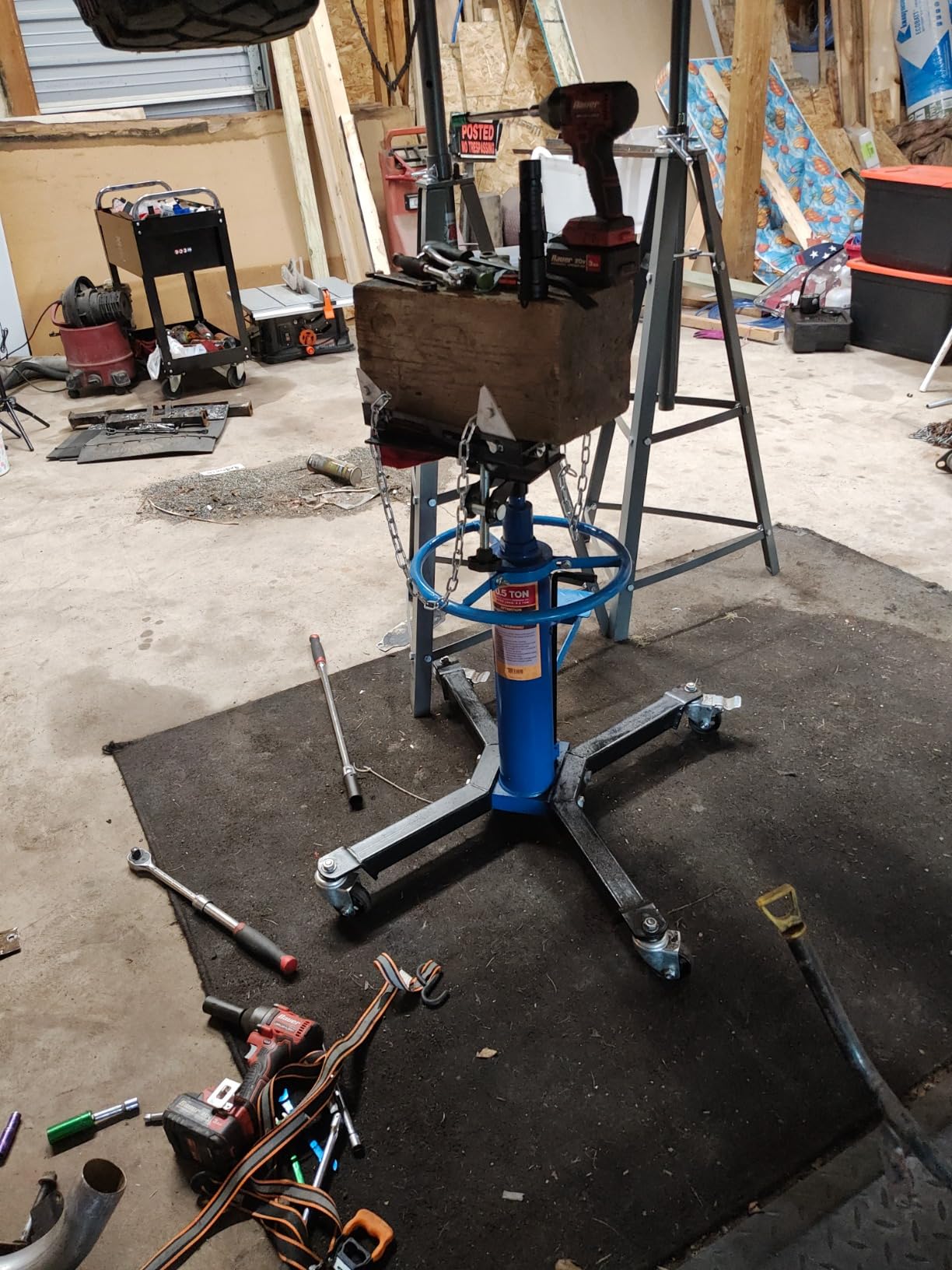
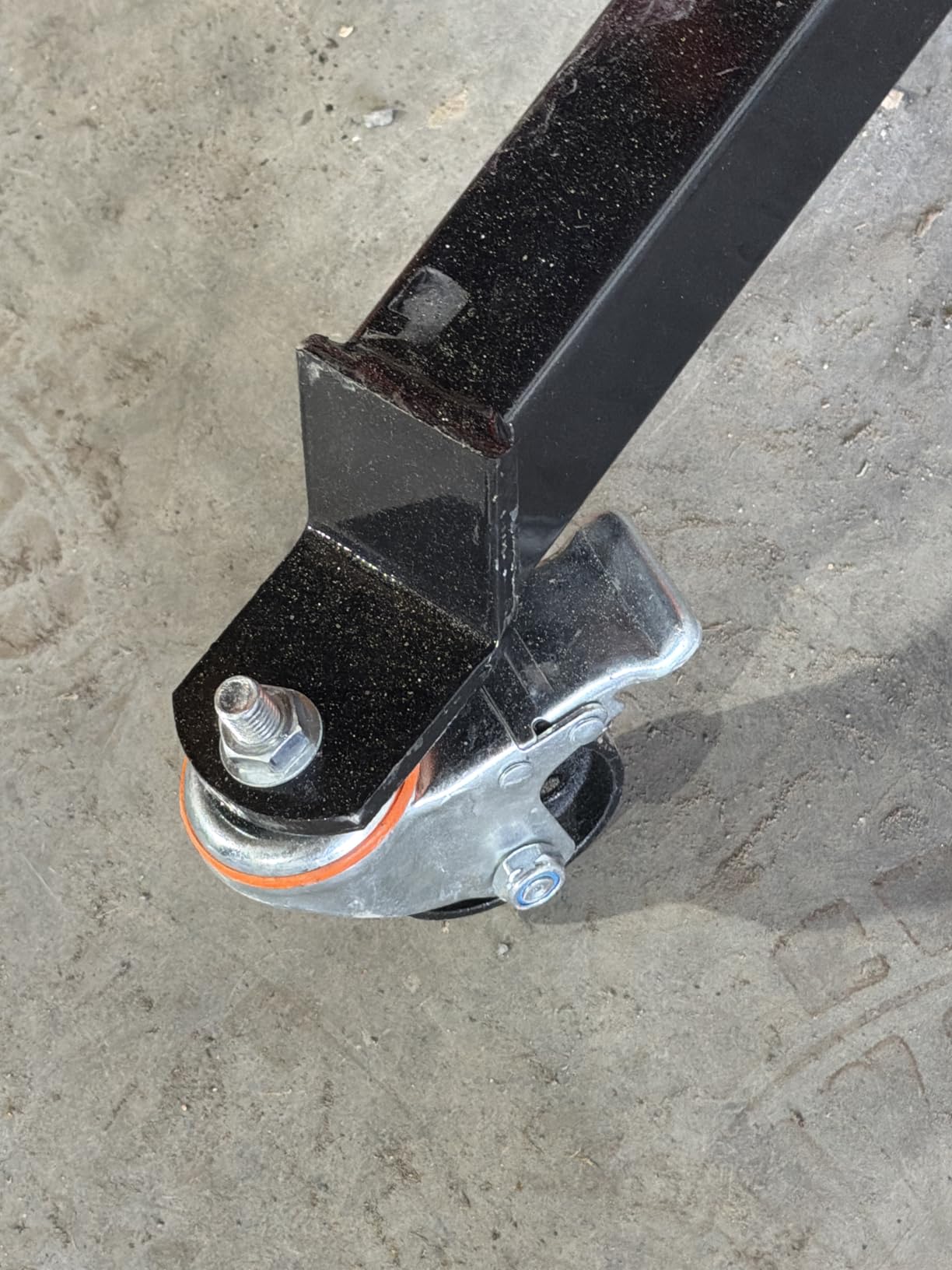
Four cast-iron swivel casters with individual brakes are standard equipment. The cast-iron construction is more durable than the plastic or composite casters found on some budget jacks, and each caster has its own brake lever. However, these casters do not roll smoothly on floors with debris, which is a common complaint. If your shop floor tends to accumulate hardware, wire scraps, or other debris, you may want to sweep before positioning this jack.
The steel construction feels sturdy and the safety chains are adequate for securing loads. At 99 pounds, the jack is portable enough to move between bays but heavy enough to stay stable during use. The 33.5-to-67-inch lift range matches what most telescoping jacks in this price range offer.
Who Benefits Most from the TUFFIOM 1660
Shops that work on a mix of passenger vehicles and heavier SUVs or light trucks benefit from the extra capacity. Even if your typical transmission weighs well under 1,660 pounds, having that safety margin means the jack operates well below its maximum, which translates to smoother operation and less strain on the hydraulic system. General repair shops that want one jack to cover everything from compact cars to heavy SUVs will appreciate this versatility.
The 4.5-star rating with 100 reviews confirms this is a reliable performer. Users consistently praise the construction quality and the foot pedal operation for making transmission replacement a manageable one-person job.
What to Watch Out For
Assembly instructions are the biggest complaint. Multiple reviewers describe them as vague or incomplete, and some report missing bolts in the packaging. I recommend laying out all parts and hardware before starting assembly, and having a set of replacement bolts on hand just in case. Once assembled correctly, the jack works well, but the initial setup process requires patience and mechanical aptitude.
6. JEGS Low Profile Transmission Floor Jack
JEGS Low Profile Transmission Floor Jack - 1,000 LBS Lift Capacity - Lift Range 8.5" to 23" - 360 Degrees Pump Handle Rotation & Adjustable Load Support Arms - Yellow or Black Steel Frame
1000 lb Capacity
8.5-23 in Lift Range
Low Profile Design
82 lb Weight
Pros
- Ultra-low 8.5 inch minimum height
- 1000 lb capacity
- 360 degree pump handle rotation
- Safety overload system
Cons
- Reports of bent adjustment screws
- Low quality chain and hook
- 82 lb weight for a compact jack
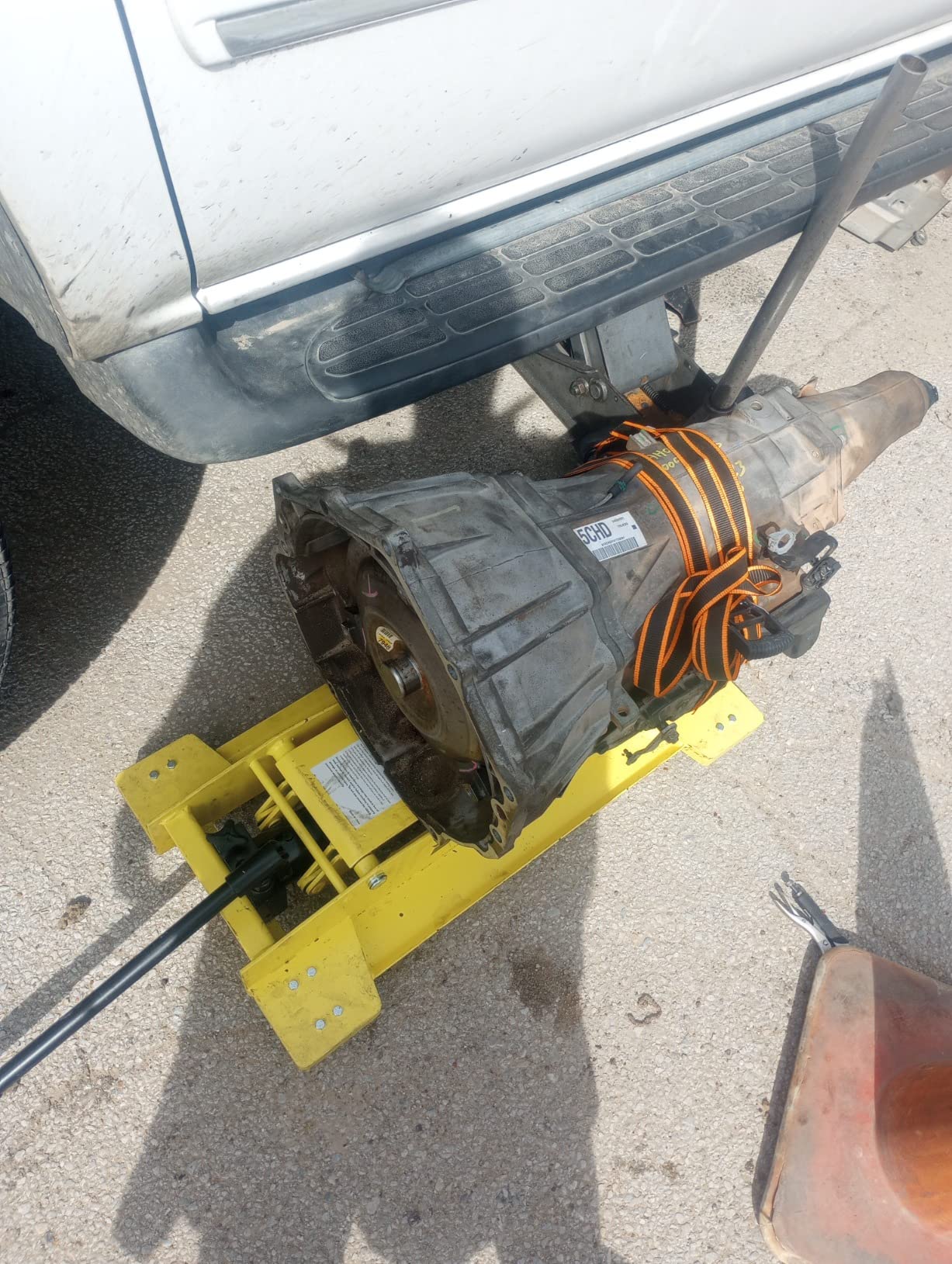
The JEGS low profile transmission jack is designed for a specific problem that many auto repair shops face: getting under vehicles with minimal ground clearance. With a minimum height of just 8.5 inches, this jack slides under lowered cars, sports cars, and other vehicles that standard telescoping jacks cannot reach. That 8.5-inch starting point is dramatically lower than the 33-to-35-inch minimum of full-size telescoping models.
I have used this jack on several lowered imports that would have required driving up on ramps just to get a standard transmission jack underneath. The low profile design eliminates that extra step, saving time and reducing the risk of damaging low-hanging body kits or ground effects. The 1,000-pound capacity handles most passenger car transmissions with room to spare.
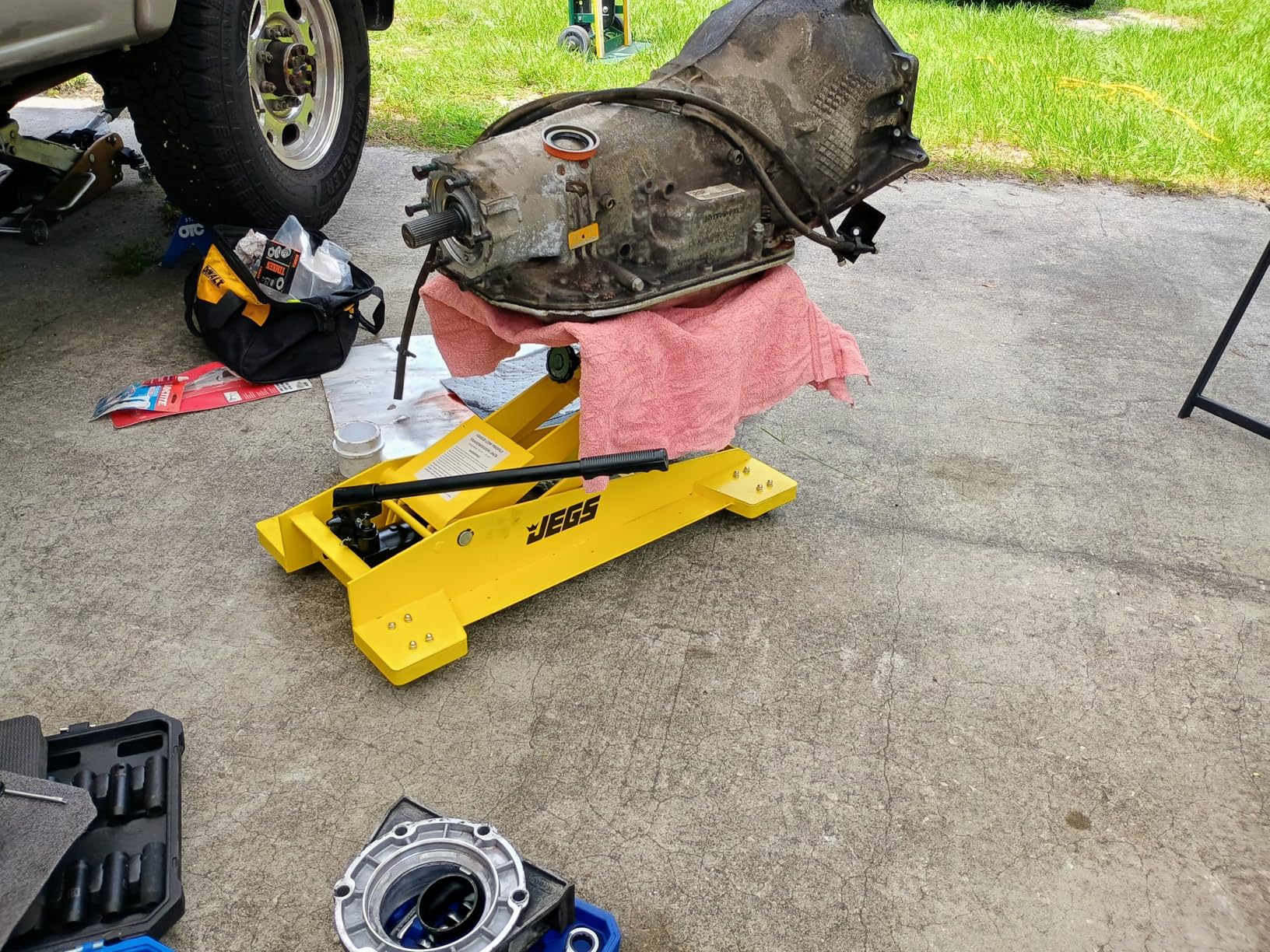
The 360-degree rotating pump handle is a smart feature for tight spaces. You can pump the jack from any angle, which matters when you are working in a cramped bay with limited access to the sides of the vehicle. Four swivel ball-bearing casters provide smooth rolling on clean shop floors, and the safety overload system prevents you from exceeding the rated capacity.
However, this jack has a split personality. With 358 reviews and a 4.2-star rating, there are plenty of satisfied users, but also a consistent pattern of quality control complaints. Some users report bent adjustment screws straight out of the box, and the included chain and hook for securing loads are described as low quality. The jack itself works well when everything arrives in good condition, but the quality control is inconsistent.
When the JEGS Low Profile is the Right Choice
Shops that specialize in lowered vehicles, imports, sports cars, or any vehicle with limited ground clearance need this jack or something similar. The 8.5-to-23-inch lift range is not enough to reach a transmission on a two-post lift, but for ground-level transmission removal on vehicles sitting on jack stands or a drive-on lift, it is exactly what you need. It also works well for gas tank removal and other low-clearance jobs.
DIY mechanics and smaller shops that primarily work on passenger cars will find the capacity and lift range appropriate for most of their needs. The 1,000-pound rating covers the vast majority of car transmissions.
Limitations to Keep in Mind
This is not a replacement for a full-size telescoping transmission jack. The 23-inch maximum height means you cannot use it with a two-post lift. The quality control issues mean you should inspect the jack carefully upon delivery and contact the seller immediately if any parts are bent or missing. The 30-day warranty is shorter than most competitors, so do not wait to test the jack after receiving it.
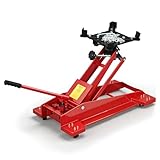
7. MOTOOS 1100 lbs Low Profile Transmission Jack
MOTOOS Adjustable Transmission Jack 1/2 Ton (1100 LBS) Capacity, 7.68"-24.8" Low Profile Transmission Lift Floor Jacks with 360° Swivel Casters, Heavy Duty Steel Jack for Automotive Garage Repair
1100 lb Capacity
7.68-24.8 in Lift Range
Heavy Duty Steel
99.1 lb Weight
Pros
- Lowest minimum height at 7.68 inches
- 1100 lb capacity for trucks
- Universal adjustable saddle
- Smooth 360 degree casters
Cons
- Limited lift height compared to telescoping models
- Lower review count and market presence
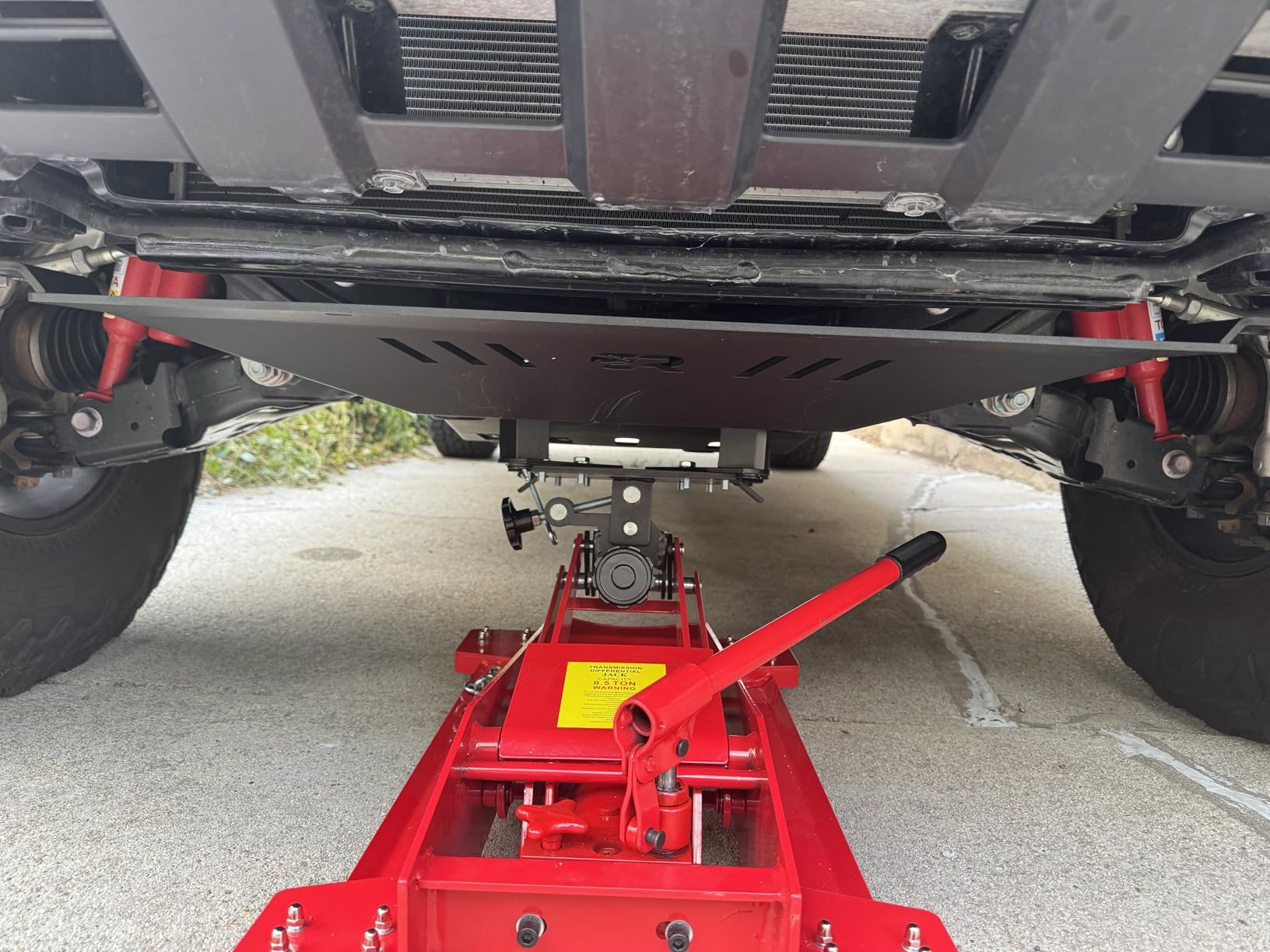
The MOTOOS low profile transmission jack sits lower than any other jack on our list at just 7.68 inches. That sub-8-inch minimum height means you can slide this jack under practically any vehicle, including severely lowered cars and trucks with low-hanging front ends. Despite the compact footprint, it still carries a 1,100-pound load capacity, which is enough for most car and light truck transmissions.
Using this jack feels different from the telescoping models. The lift range goes from 7.68 inches up to 24.8 inches, so it is purely a ground-level tool. You cannot use it with a two-post lift. But for what it does, it does it well. The universal adjustable saddle tilts forward and backward for positioning, and the heavy-duty steel frame feels rigid with no flex under load.
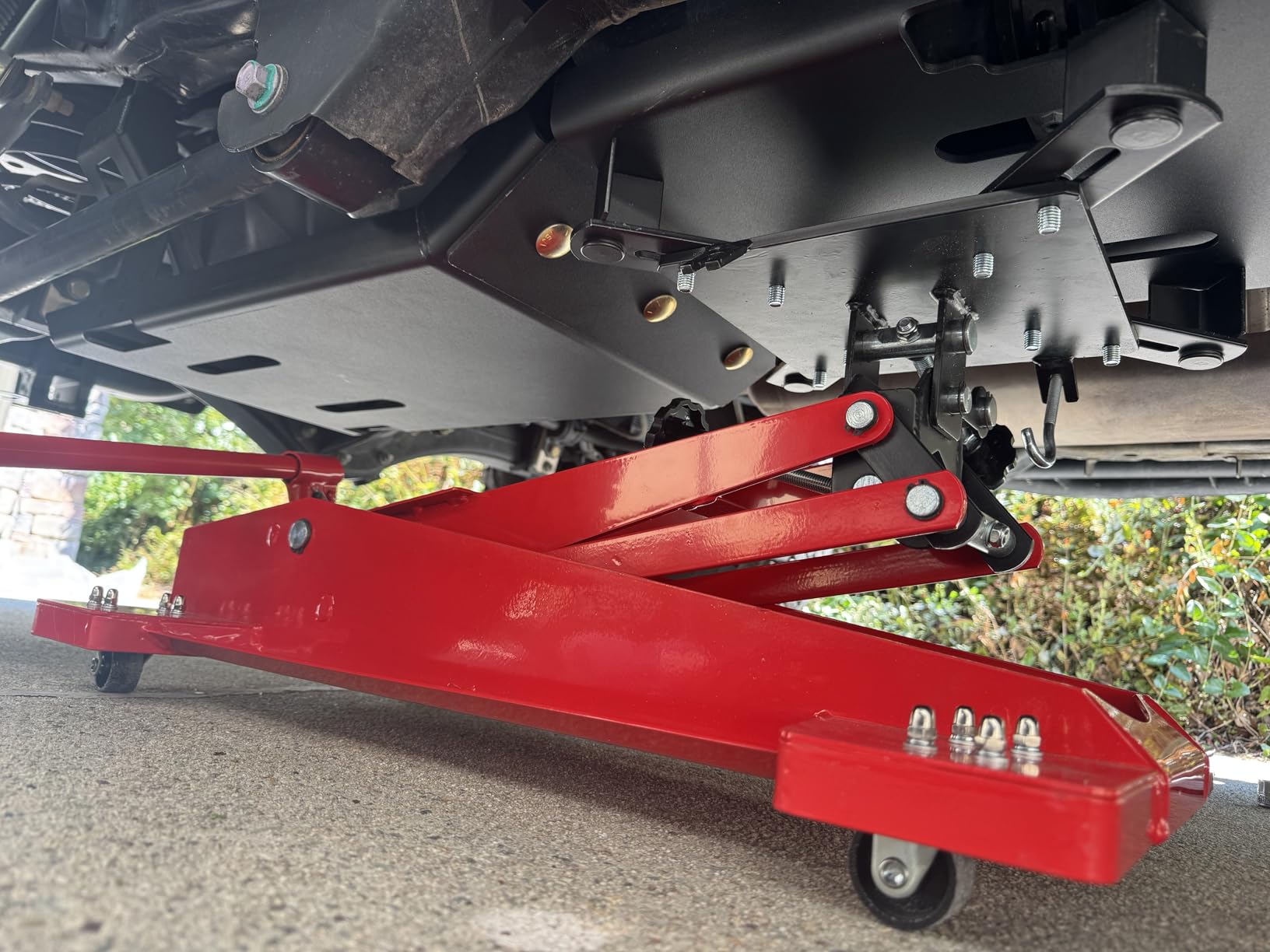
The four 360-degree swivel casters roll smoothly on clean surfaces. I found the maneuverability to be good for positioning the jack under a vehicle, though the 99-pound weight means you are not going to slide it around one-handed. The adjustable saddle with tilt function provides enough range to angle the transmission during removal without fighting the jack.
With 62 reviews and a 4.4-star rating, this jack has a smaller user base but strong satisfaction among owners. Most users report it works well for the price and appreciate the extremely low profile. The main trade-off is the limited 24.8-inch maximum height, which restricts this jack to ground-level work on vehicles sitting on jack stands or flat on the ground.
Best Applications for the MOTOOS 1100
Shops that regularly work on lowered vehicles, sports cars, or any application where ground clearance is tight will benefit from the 7.68-inch minimum height. This jack reaches under vehicles that even the JEGS low profile model cannot clear. The 1,100-pound capacity also makes it suitable for light truck work, unlike some smaller low-profile jacks that max out at 450 to 500 pounds.
Shops that want a dedicated low-clearance jack to complement a full-size telescoping model will find this is a smart addition. Use the telescoping jack for standard lift work and keep this one handy for the low-clearance jobs that come through.
Things to Consider
The 24.8-inch maximum height is a hard limitation. This jack is for ground-level work only. If you need a transmission jack that works with a two-post lift, this is not it. The lower review count means there is less long-term durability data compared to more established brands. However, at its price point and with the unique ultra-low profile, it fills a specific need that few other jacks address.
8. AFF 450 lbs Manual Transmission Jack
AFF Manual Transmission Jack - Use 1/2" Drive Ratchet to Operate - for Transmissions & Gas Tanks on Smaller Vehicles - 450 lbs Capacity
450 lb Capacity
7.25-22.5 in Lift Range
Ratchet Operated
41.2 lb Weight
Pros
- Lightweight at 41.2 pounds
- Simple ratchet operation
- No hydraulic system to maintain
- Nylon safety strap included
Cons
- Not stable under heavier loads
- Cheaper metals used
- Scissor mechanism can bind
- 450 lb capacity limits use
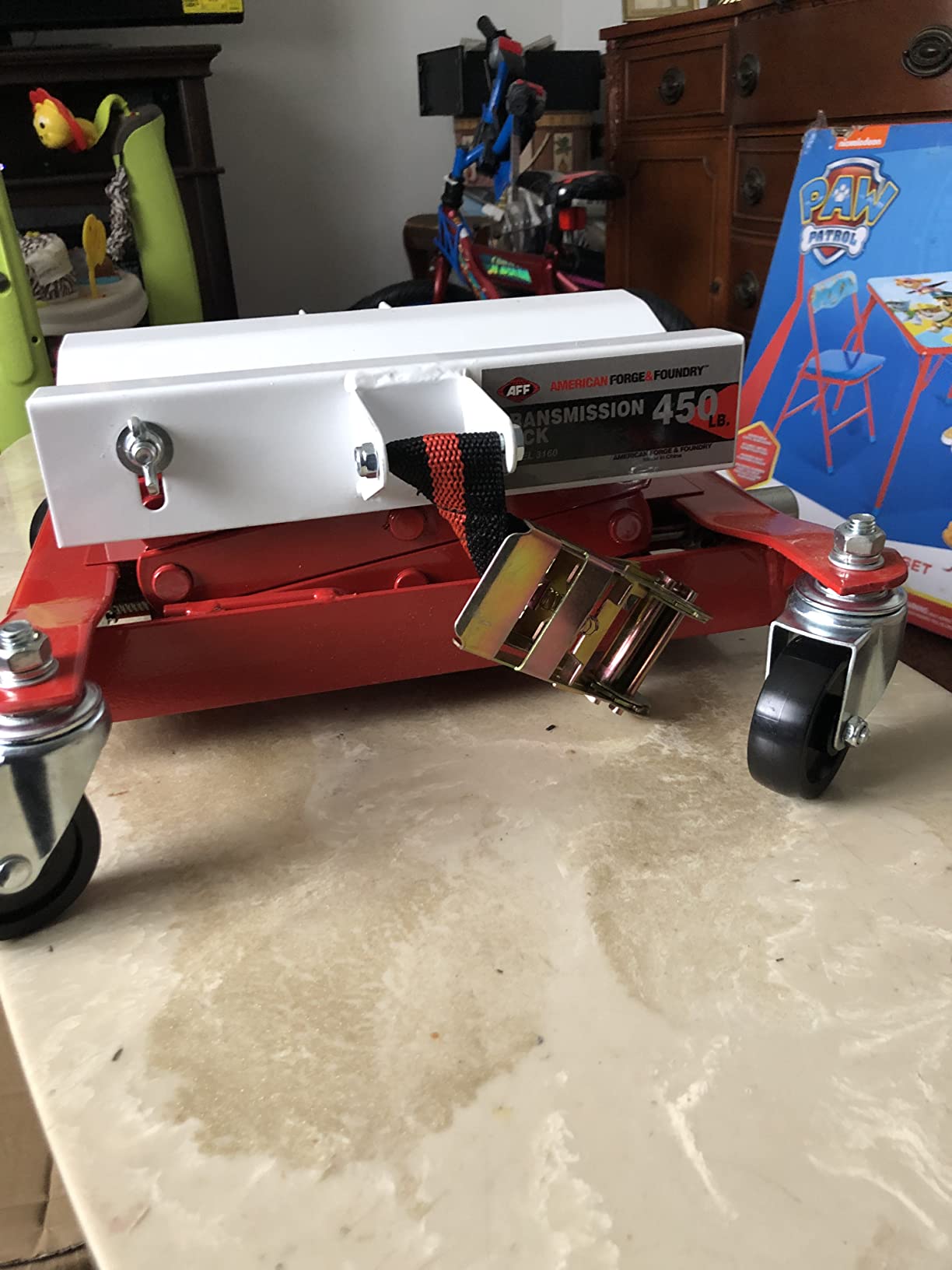
The AFF manual transmission jack is the simplest and lightest jack in our lineup. At just 41.2 pounds, it is less than half the weight of most hydraulic models. You operate it with a standard 1/2-inch drive ratchet, which means no hydraulic system to maintain, no fluid to check, and no air lines needed. For small shops or DIY mechanics who need something basic for occasional transmission work, this jack fills that niche.
The scissor lift design raises from 7.25 inches to 22.5 inches, making it suitable for ground-level work on smaller vehicles. The angled saddle is designed specifically to hold transmission bell housings, and I found it grips that shape better than a flat universal saddle would. The adjustable saddle tilts for positioning, and four ball-bearing swivel casters provide decent mobility despite the compact size.
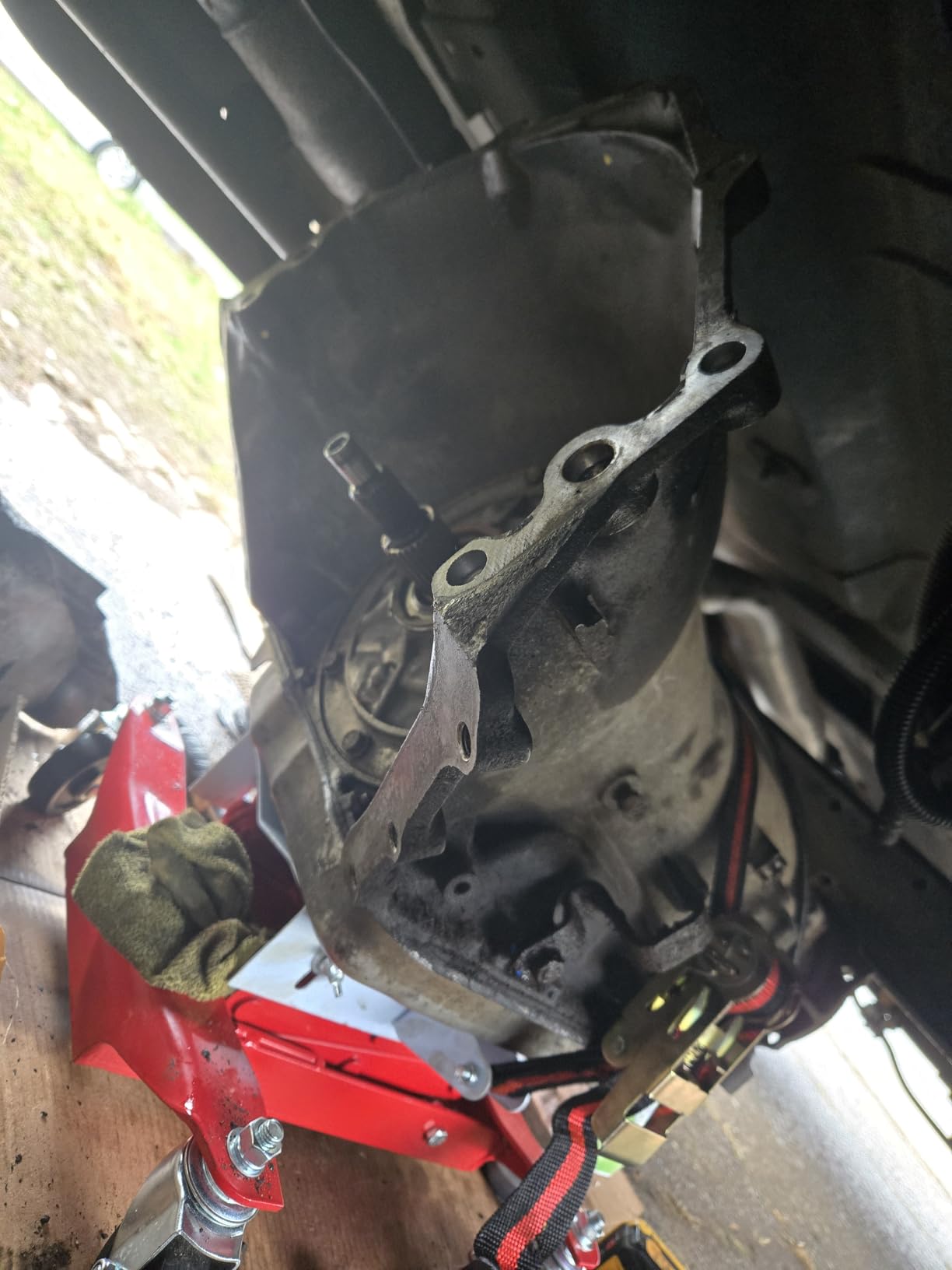
Using a ratchet to raise and lower the jack is slower than hydraulic operation, but it gives you very precise control over the height. Each click of the ratchet moves the jack a small amount, which can be helpful for fine adjustments during alignment. The nylon safety strap secures the load, though some users report the strap mechanism does not always function properly out of the box.
The biggest concern with this jack is stability. Several reviewers mention the jack can sway side to side under load, especially with heavier transmissions near the 450-pound limit. The narrower base and lighter weight contribute to this instability. I would not want to use this jack with a transmission anywhere near its maximum capacity.
Who the AFF Manual Jack Works For
This jack makes sense for DIY mechanics and small independent shops that only do occasional transmission work on compact and mid-size cars. The 450-pound capacity covers small car transmissions, and the lightweight design makes it easy to store when not in use. At its price point, it is an accessible entry into transmission jacking for mechanics who cannot justify the cost of a hydraulic model.
The simplicity of the ratchet operation is also a benefit for mechanics who prefer mechanical systems over hydraulic ones. There is nothing to leak, nothing to purge, and no seals to fail. A 1/2-inch drive ratchet is a tool most mechanics already own.
Serious Limitations to Understand
The 450-pound capacity rules out most truck transmissions and many larger car transmissions. The build quality reflects the lower price point, with cheaper metals that some reviewers say do not hold up under regular use. The scissor mechanism can bind, and the overall stability is not confidence-inspiring with heavier loads. This is a tool for light-duty, occasional use, not for a professional shop doing daily transmission work.
How to Choose the Right Transmission Jack for Your Shop
Picking the right transmission jack comes down to matching the tool to your shop’s specific workload, vehicle mix, and budget. I have broken down the key decision factors below based on what actually matters in daily shop operations.
Load Capacity: Match Your Vehicle Mix
The capacity you need depends entirely on the vehicles you service. Compact car transmissions typically weigh 150 to 250 pounds. Full-size car and SUV transmissions run 250 to 400 pounds. Light truck transmissions can push 400 to 600 pounds, and heavy diesel truck transmissions exceed 600 pounds. I recommend choosing a jack rated for at least double the heaviest transmission you plan to service. That safety margin keeps the jack operating well below its limit, which means smoother operation and longer hydraulic life.
For shops handling passenger cars and light trucks, a 1,000 to 1,100-pound jack is sufficient. Shops that see heavier SUVs and larger trucks should look at 1,300 to 1,660-pound capacity. Dedicated diesel truck shops need industrial-grade jacks rated for 2,000 pounds or more, which are beyond the scope of this review.
Lift Range: Ground Level vs Two-Post Lift
This is one of the most important distinctions. Low-profile transmission jacks have a lift range of roughly 7 to 24 inches and are designed for ground-level work on vehicles sitting on jack stands. Telescoping transmission jacks have a range of approximately 33 to 74 inches and are designed for use with two-post lifts or vehicles raised on tall jack stands. If your shop uses two-post lifts, you need a telescoping model. If you work on the ground, a low-profile model is the right choice.
Some shops benefit from owning both types. Use the telescoping jack for standard lift-based transmission work and keep a low-profile jack for the lowered vehicles and special cases that the telescoping jack cannot reach.
Hydraulic vs Manual Operation
Hydraulic jacks with foot pedals are the standard for professional shops. The foot pedal frees both hands to guide the transmission, which is a significant safety and efficiency advantage. Air-hydraulic models like the Sunex 7796 add compressed air power to the first stage for faster lifting, which benefits high-volume shops doing multiple transmission jobs per day.
Manual jacks like the AFF use a ratchet mechanism instead of hydraulics. They are simpler, lighter, and have no hydraulic system to maintain, but they are slower and less suited to professional use. Manual jacks work fine for occasional DIY work but are not ideal for a professional shop environment.
Safety Features That Matter
Look for jacks with overload valves that prevent operation beyond rated capacity, safety chains or straps to secure the transmission to the saddle, and locking casters to prevent the jack from rolling during use. These three features are non-negotiable for professional shop safety. The Sunex models include all three and also feature wide bases for stability at full extension.
Saddle adjustment is another safety factor. A saddle that tilts in multiple directions allows the jack to follow the natural movement of the transmission during removal, reducing the chance of the load shifting unexpectedly. Models with 360-degree rotation and 30-degree tilt capability offer the best control.
Caster Quality and Shop Floor Performance
One of the most common complaints across all transmission jack brands is caster performance. Many jacks ship with casters that do not roll smoothly on dirty or uneven shop floors. If your shop floor accumulates debris, hardware, or fluid spills, look for jacks with larger casters made from durable materials. Cast-iron casters like those on the TUFFIOM are more durable than nylon or composite alternatives. Premium models from Sunex tend to have better caster quality overall.
Construction and Build Quality
Powder-coated steel frames resist corrosion from shop fluids and last longer than painted finishes. Chrome-plated hydraulic rams resist rust and operate more smoothly than unfinished rams. The weight of the jack is also an indicator: heavier jacks generally have thicker steel and wider bases, both of which contribute to stability. The Sunex 7793B at 163 pounds and the Sunex 7796 at 160 pounds are noticeably more substantial than the 96-pound VEVOR and TUFFIOM models, and that extra weight translates directly to stability during use.
FAQs
How much weight can a transmission jack hold?
Transmission jack capacities range from 450 pounds for manual scissor-style jacks up to 2,000+ pounds for heavy-duty industrial models. Most professional hydraulic transmission jacks for auto repair shops fall in the 1,000 to 1,660-pound range. For reference, compact car transmissions weigh 150-250 pounds, full-size car transmissions weigh 250-400 pounds, and light truck transmissions can reach 400-600 pounds. Always choose a jack rated for at least double the weight of the heaviest transmission you service.
Is a transmission jack necessary for auto repair shops?
Yes, a dedicated transmission jack is necessary for any shop performing transmission removal or installation. Transmissions weigh 150-800 pounds and require precise positioning during alignment. Using a floor jack with an adapter is unstable and dangerous by comparison. A proper transmission jack provides adjustable tilt, safety chains, hands-free lifting via foot pedal, and stable support that no improvised solution can match.
What are common problems with transmission jacks?
The most common problems include casters that do not roll smoothly on dirty floors, hydraulic systems that arrive with air trapped inside requiring purging before first use, unclear assembly instructions, missing hardware in packaging, and occasional shipping damage due to the heavy weight of these units. Premium brands like Sunex tend to have fewer issues with assembly and quality control. Checking the hydraulic fluid level and purging air from the system before first use resolves many initial complaints.
Do I need a 3-ton or 4-ton jack?
A 3-ton (6,000-pound) floor jack is sufficient for most passenger vehicles and light trucks. A 4-ton (8,000-pound) jack is better for heavier trucks, full-size SUVs, and commercial vehicles. However, floor jack capacity is different from transmission jack capacity. Transmission jacks are rated separately, and most auto shops need a 1,000 to 1,500-pound transmission jack for standard transmission work. The 3-ton vs 4-ton question applies to your floor jack, not your transmission jack.
How does a hydraulic transmission jack work?
A hydraulic transmission jack uses a foot-activated hydraulic pump to pressurize fluid that raises a telescoping steel ram. The ram lifts a flat saddle platform that supports the transmission. The operator places the jack under the vehicle, pumps the foot pedal to raise the saddle to the transmission, secures it with safety chains, then raises or lowers the transmission as needed. The saddle tilts and rotates to allow precise angular alignment during installation. A release valve controls the lowering speed for safe descent.
Final Thoughts on Transmission Jacks for Your Shop
Choosing the best transmission jacks for auto repair shops comes down to matching the tool to your workload and vehicle mix. For most professional shops, the Sunex 7793B delivers the best combination of build quality, stability, and professional-grade features at a reasonable investment. High-volume transmission shops with shop air should step up to the Sunex 7796 for the air-powered first stage and ratcheting saddle arms.
Shops that want maximum capacity without premium pricing will find the VEVOR 1322-pound and TUFFIOM 1660-pound models offer excellent value. And for shops that work on lowered vehicles, the JEGS and MOTOOS low-profile jacks provide the ground clearance access that standard telescoping jacks simply cannot match. Whatever your shop needs, investing in a proper transmission jack pays for itself in safety, efficiency, and the confidence that comes from using the right tool for the job.