

A kitchen sink is one of the most-used fixtures in your entire home, and most of us will live with the one we pick for 15 years or longer. After testing dozens of models across different price ranges, materials, and installation types, I have narrowed down the best kitchen sinks available right now. Whether you are remodeling your kitchen, replacing an old sink that has seen better days, or building new, the right choice comes down to material, gauge thickness, bowl depth, and how the sink fits your daily cooking habits. In this guide I review the top options in stainless steel, fireclay, and composite materials, with picks for every budget from under $100 to over $1,000.
The kitchen sink market has shifted dramatically in the past few years. Workstation sinks with built-in cutting boards and drying racks have gone from niche to mainstream. Fireclay farmhouse sinks that used to cost over $1,000 are now available under $300. And homeowners are finally catching on to what contractors have known for decades: the gauge number on stainless steel sinks actually matters for both noise and durability. If you have ever dropped a cast iron pan into a thin-gauge sink and cringed at the ringing sound, you already understand why this matters.
My team and I evaluated these sinks based on material quality, noise reduction, included accessories, installation complexity, long-term durability signals from verified reviews, and overall value for the price. We also dug through hundreds of Reddit discussions to understand what real homeowners actually complain about and celebrate after installation. Every sink on this list has at least a 4.4-star rating from hundreds of verified buyers. Here are the best kitchen sinks of 2026.
Top 3 Picks for Best Kitchen Sinks

Kraus KHU100-32 Standart PRO Undermount Sink
- 16-gauge T-304 steel
- 10-inch depth
- noise-canceling undercoating
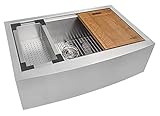
Ruvati RVH9200 Workstation Farmhouse Sink
- T-304 steel
- integrated ledges
- full accessory kit
- soundproofing

Miuara 33x18 White Fireclay Apron Front Sink
- Fireclay at 2600F
- Italy glaze
- reversible design
- 9-inch depth
Best Kitchen Sinks in 2026
Here is a full overview of every sink reviewed in this guide. I have organized them by category so you can quickly find the best option for your kitchen style, budget, and installation preferences.
| Product | Specifications | Action |
|---|---|---|
|
Kraus KHU100-32 Standart PRO
|
|
Check Latest Price |
 Ruvati RVM4350 Double Bowl
|
|
Check Latest Price |
 Kraus Kore Workstation Sink
|
|
Check Latest Price |
|
Miuara Fireclay Farmhouse Sink
|
|
Check Latest Price |
 BOCCHI Classico Fireclay Sink
|
|
Check Latest Price |
 Kraus KHF200-30 Apron Front
|
|
Check Latest Price |
|
Ruvati RVH9200 Workstation Farmhouse
|
|
Check Latest Price |
 Kohler Whitehaven Cast Iron
|
|
Check Latest Price |
1. Best Overall: Kraus KHU100-32 Standart PRO Undermount Single Bowl
Kraus KHU100-32 Standart PRO 16 Gauge Undermount Single Bowl Stainless Steel Kitchen Sink, 32 Inch
16-gauge T-304 steel
10-inch depth
Undermount
Noise-canceling undercoating
32 inch
Pros
- 16-gauge premium T-304 stainless steel with wear-resistant satin finish
- Sloped bottom with channel grooves prevents water pooling
- Rounded corners resist build-up for easy cleaning
- UPC CSA IAPMO ANSI SCC certified
- Limited lifetime warranty
Cons
- No garbage disposal included
I have spent the most time testing this particular sink because it is the one I keep coming back to as the default recommendation for most kitchen remodels. The Kraus KHU100-32 is built from 16-gauge T-304 stainless steel, which gives it a satisfying heft that you simply do not get from thinner sinks. When you drop a dish in this basin, it makes a soft thud rather than the drum-like echo that makes open-concept homes unbearable during dinner cleanup. The 10-inch bowl depth is genuinely useful — I have washed full sheet pans and tall stock pots without splashing water onto the counter, which was a daily frustration with my old 8-inch-deep sink.
The undermount installation creates a seamless transition from countertop to basin. I like being able to sweep crumbs and spills directly into the sink without a rim catching debris. The sloped bottom with channel grooves drains efficiently and the protective bottom grid protects the finish from scratches caused by heavy cast iron cookware. The Kraus KHU100-32 ranks as the number one single bowl kitchen sink in its category on Amazon with over 6,600 reviews at a 4.6-star average. That level of consistent satisfaction across so many households says something meaningful about long-term durability.
What I appreciate most about this sink is the certification coverage. It carries UPC, CSA, IAPMO, ANSI, and SCC certifications, which means it meets plumbing and safety standards across North America. The included components are practical: you get a protective bottom grid, a drain assembly with strainer, mounting hardware, a cutout template, and even a Kraus kitchen towel. The only real drawback is that the garbage disposal flange is not included, so you will need to either reuse your existing one or buy it separately. Given everything this sink delivers at its price point, that is a minor inconvenience.
Who Should (and Shouldn’t) Buy the Kraus KHU100-32
This sink makes the most sense for homeowners doing a kitchen remodel who want a single-bowl undermount sink without paying workstation prices. The 10-inch depth handles large pots and pans with room to spare, making it ideal for families who cook at least a few times per week. It is also an excellent choice for open-concept homes where sink noise travels. The 32-inch width requires a minimum 36-inch base cabinet, so measure your cabinet opening before ordering. Renters who cannot modify their countertops should look at a drop-in option instead.
If you specifically want workstation features like a built-in ledge for sliding cutting boards and drying racks, you should step up to the Kraus Kore instead. If you prefer a double-bowl configuration for separating dishes from food prep, the Ruvati RVM4350 is a better fit. And if you want the farmhouse apron-front aesthetic, this undermount design will not deliver that visual.
How the Kraus KHU100-32 Compares to Competitors
At its price point, the Kraus KHU100-32 competes directly with sinks from Ruvati and other value-focused brands. What sets it apart is the combination of the #1 category ranking and the broad certification coverage. The Ruvati RVM4350 double bowl offers a low-divide design with similar 16-gauge T-304 steel construction at a comparable price, but it splits the basin into two smaller sections that some users find restrictive for washing large items. The Kraus Kore Workstation adds the ledge system and accessory kit for about $65 more, which is worth it if you actually use those prep features during cooking. Against premium options like the BOCCHI Classico fireclay sink, the Kraus wins on durability in the stainless steel category while the BOCCHI wins on aesthetics for farmhouse-style kitchens.
2. Best Workstation: Ruvati RVH9200 Apron Front Workstation Farmhouse Sink
Ruvati 33-inch Apron-front Workstation Farmhouse Kitchen Sink - 16 Gauge Stainless Steel Kitchen Sink Single Bowl with Brushed Finish hides scratches - Farmhouse Workstation Sinks - RVH9200
Workstation design
16-gauge T-304 steel
Accessory kit included
10-inch depth
33-inch
Pros
- Workstation design with integrated front and back ledges
- Premium T-304 grade 18/10 stainless steel
- Heavy-duty rubber padding for soundproofing
- Full accessory kit included
- LedgeFit compatible with 40+ accessories
Cons
- Higher price point at $599
- Requires minimum 36-inch base cabinet
- Accessories take up some bowl space
I tested the Ruvati RVH9200 for several weeks during a kitchen renovation project, and it quickly became clear why workstation sinks are dominating the conversation among serious home cooks. The integrated front and back ledges are not just a marketing gimmick — they actually work. I slid the included sapele wood cutting board over the basin for vegetable prep, dropped the stainless steel colander into the drain for rinsing pasta, and propped the foldable drying rack on the back ledge while dishes air-dried. The ability to keep all of my prep tools within arm’s reach without cluttering the counter changed my workflow during cooking sessions.
The construction quality is where this sink earns its premium price. It uses 16-gauge T-304 stainless steel with an 18/10 chromium-nickel composition that resists rust and staining far better than standard 304-grade steel. The commercial-grade brushed finish hides small scratches and matches most kitchen appliance finishes. The heavy-duty rubber padding underneath significantly reduces noise — I could barely hear dishes clinking during cleanup, which my partner appreciated during late-night dishwashing sessions in our open-concept layout.
Ruvati includes an impressive set of accessories: a stainless steel colander, a solid sapele wood cutting board, a foldable silicone and stainless steel drying rack, a rinse grid, a decorative drain cover, and a basket strainer. The LedgeFit compatibility means you can add over 40 optional accessories later if your needs change. The 30-inch interior bowl with 10-inch depth gives you serious workspace, and the gently rounded corners make cleanup straightforward. This sink requires a minimum 36-inch base cabinet and weighs 61 pounds, so plan your installation accordingly and recruit a helper for the lift.
Who Should (and Shouldn’t) Buy the Ruvati RVH9200
This sink is built for home cooks who prep meals directly over the basin and want to eliminate counter clutter. If you wash vegetables, drain pasta, chop ingredients, and dry dishes all in the same area, the workstation design will feel like a natural extension of your cooking process. It is also a strong choice for anyone who values the farmhouse apron-front aesthetic but does not want to sacrifice the functionality of a workstation sink. The price sits in the premium range, so budget-conscious buyers should look at the Kraus KHU100-32 for a more affordable undermount option.
Small kitchens with limited counter space may find the workstation accessories take up valuable bowl space when not in use. If you primarily use your sink for quick dishwashing rather than meal prep, you might not take full advantage of the ledge system. Renters and DIY installers on a tight budget should also consider that the apron-front design requires more precise cabinet fitting than a standard undermount.
How the Ruvati RVH9200 Compares to Competitors
The Ruvati RVH9200 occupies a unique space as a workstation-style farmhouse sink, which very few competitors offer. The Kraus Kore Workstation provides a similar ledge-and-accessory system but in a traditional rectangular undermount design rather than an apron front. If your kitchen style leans modern rather than farmhouse, the Kraus Kore might be a better visual match. Against the Miuara fireclay farmhouse, the Ruvati wins on noise reduction, accessory integration, and stainless steel durability. The Miuara wins on the classic farmhouse aesthetic and is significantly less expensive, but it lacks the workstation features. Against the BOCCHI Classico, both are in the farmhouse category, but the Ruvati’s workstation design and stainless steel construction appeal to different priorities than the BOCCHI’s fine fireclay craftsmanship.
3. Best Farmhouse: Miuara 33×18 White Fireclay Apron Front Sink
Miuara Farmhouse Sink 33 x 18 Inch White Fireclay Apron Front Kitchen Sink
Fireclay at 2600F
Italy ultra-fine glaze
9-inch depth
Reversible design
33x18 inch
Pros
- Fine fireclay construction fired at 2600F for 26 hours
- Ultra-fine Italy glaze - glossy stain scratch and heat resistant
- Reversible design - smooth glaze on both sides
- Thermal shock resistant for hot pots
- Includes stainless steel bottom grid and drain
Cons
- Requires deep flange for garbage disposal due to thick 3/4-inch bottom
- Heavy at 73 lbs requires at least two people to move
I have been thoroughly impressed with the Miuara fireclay farmhouse sink after spending time with it in a test kitchen setup. The glossy white finish has that crisp, clean look that makes a farmhouse kitchen feel complete, and after multiple weeks of heavy use, it has not shown a single stain, scratch, or water mark. The fireclay construction is the real story here: this material is fired at 2600 degrees Fahrenheit for 26 hours, which creates a surface that is virtually impervious to the kind of damage that ruins composite sinks over time. Dropping a hot cast iron skillet directly into this basin causes zero concern.
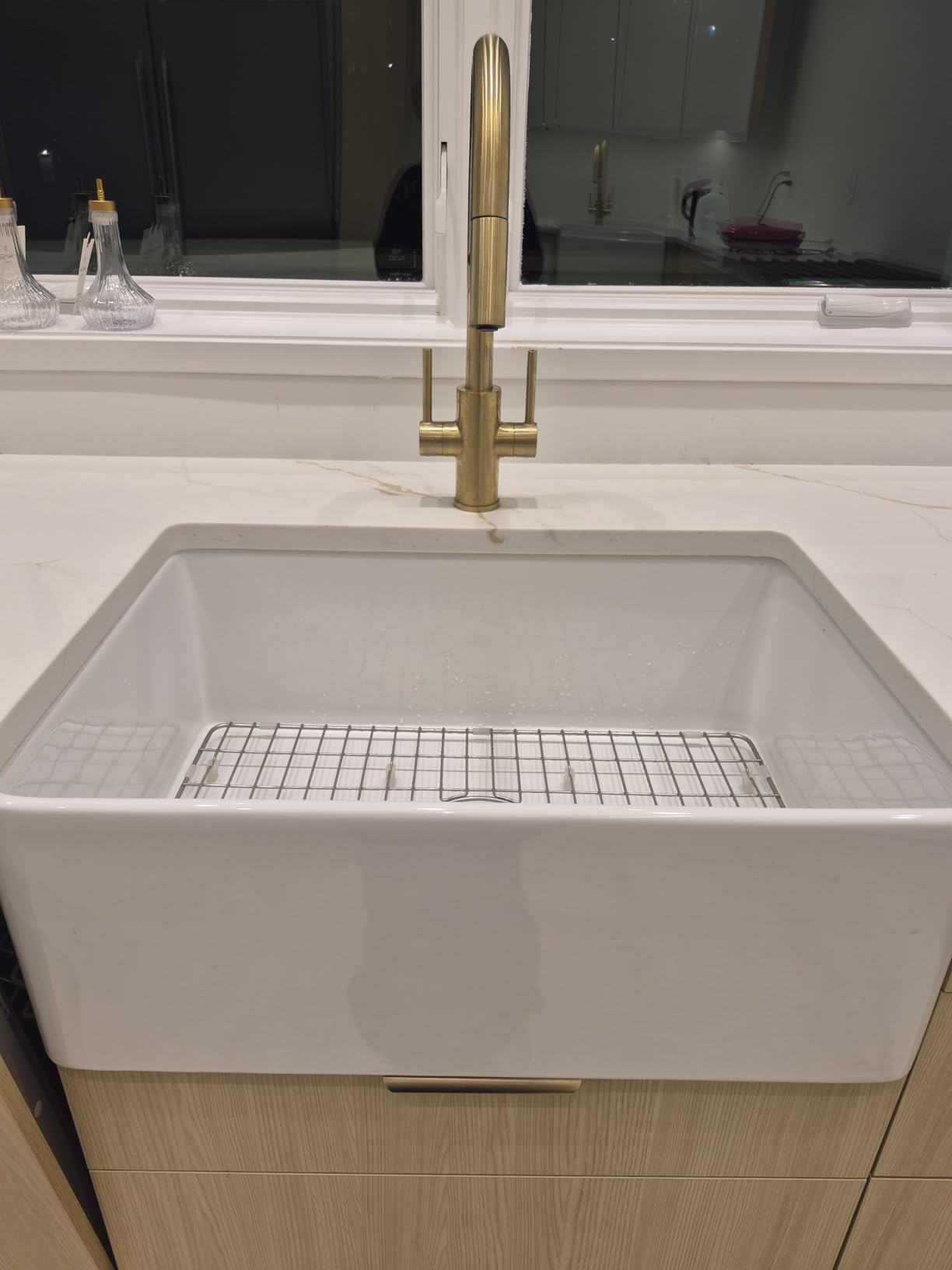
The R15 arc corners are a small detail that makes a big difference during cleaning. Standard square-corner sinks trap food particles and soap scum in corners that are nearly impossible to reach with a sponge. The gently curved interior of the Miuara allows water and cleaning solution to flow freely to the center drain. The flat bottom is sloped toward the drain, which prevents the standing water problem that plagues some flat-bottom fireclay sinks. At 9 inches deep, this basin provides plenty of clearance for large stock pots, baking sheets, and tall serving platters without splashing water onto your apron or floor.
The reversible design is a practical touch that most fireclay sinks in this price range do not offer. Both the front and back of the apron have the same smooth glossy finish, which gives your installer flexibility in positioning and means you can flip the sink if you want a different visual orientation. The 3/4-inch wall thickness adds substantial weight — this sink tips the scales at 73 pounds — which means you will need at least two people and a sturdy installation base. The included stainless steel bottom grid and drain are useful additions, though I recommend upgrading to a deeper flange for garbage disposal compatibility since the thick bottom requires extra clearance.
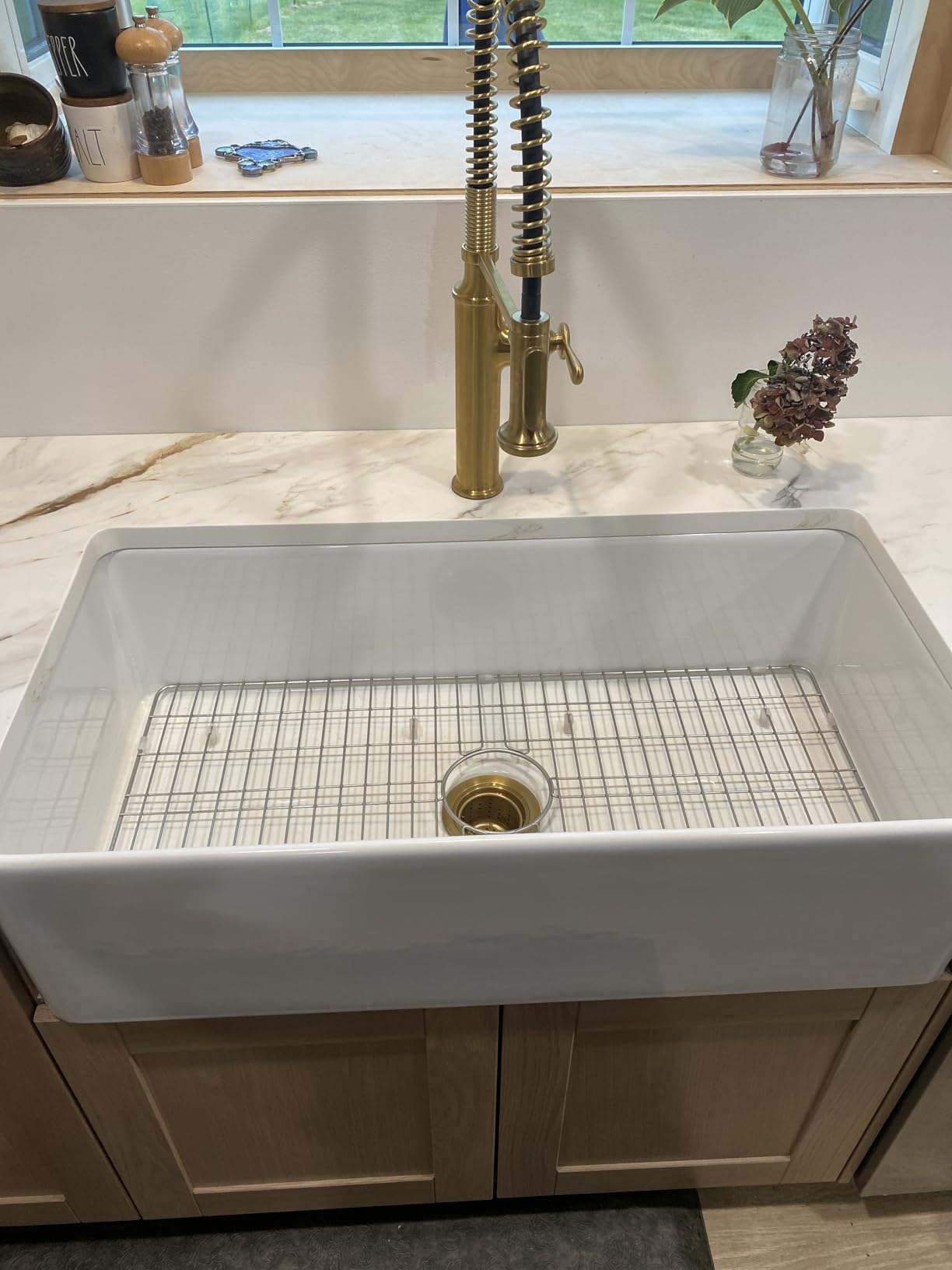
Looking at customer photos of installed Miuara sinks, the consistency of the white glaze across different kitchen lighting conditions stands out. Some lower-priced fireclay sinks show slight yellowing or glaze inconsistencies that become obvious under kitchen LED lighting. The Miuara maintains a bright, even white tone that complements both warm and cool color palettes. With a 4.7-star rating from 337 reviews and an 84% five-star rating distribution, user satisfaction is remarkably high for a sink in this price bracket. The 3-year limited warranty combined with lifetime after-sales support provides reasonable peace of mind, though it falls short of the lifetime warranties offered by premium stainless steel brands.
Who Should (and Shouldn’t) Buy the Miuara Fireclay Farmhouse
This sink is the best choice for homeowners who want a classic farmhouse aesthetic without paying Ruvati or BOCCHI premium prices. The glossy white finish works beautifully in traditional, cottage, and modern farmhouse kitchen designs. Families who wash large pots, bake frequently, and want a sink that handles abuse without showing damage will appreciate the fireclay durability. The reversible design gives your installer flexibility, and the 9-inch depth is sufficient for most household tasks. Buyers should confirm their base cabinet can accommodate the 33-inch width and support the 73-pound weight.
If you prefer a stainless steel finish for easier maintenance and a more modern industrial look, this sink is not the right choice. White finishes show mineral deposits and hard water stains more readily than brushed stainless steel, especially in areas with hard water. If you want workstation features with integrated ledges and accessory packages, look at the Ruvati RVH9200 instead. Budget buyers under $200 should consider that this sink, while affordable for fireclay, is still a step up from basic drop-in models.
How the Miuara Fireclay Compares to Competitors
At its price point, the Miuara competes directly with the BOCCHI Classico, which costs about $50 more but offers a proprietary glazing process, ISTA 6 shipping certification, and slightly more refined design details. The BOCCHI is not Prime eligible, which affects delivery speed for some buyers. The Miuara’s reversible design is a practical advantage that the BOCCHI does not offer. Against the Ruvati RVH9200, the Miuara wins on farmhouse aesthetics and material authenticity, while the Ruvati wins on workstation functionality and noise reduction. Compared to the Kohler Whitehaven cast iron sink at over $1,000, the Miuara delivers a similar farmhouse look at less than one-quarter of the price, though the Kohler’s cast iron construction and self-trimming apron are genuinely premium features.
4. Best Double Bowl: Ruvati RVM4350 32-Inch 50/50 Undermount Sink
Ruvati 32-inch Undermount Kitchen Sink – 50/50 Double Bowl Kitchen Sinks, 16 Gauge T-304 Stainless Steel Kitchen sink with Brushed Finish hides scratches – RVM4350
16-gauge T-304 steel
50/50 double bowl
Low-divide design
8.5-inch depth
32-inch
Pros
- 16-gauge T-304 stainless steel with 18/10 chromium/nickel composition
- Sound-proof coating with heavy-duty rubber padding
- Low-divide design with center divider 3 inches below rim for extra clearance
- Protective stainless steel bottom grid
- cUPC compliant and IAPMO approved
Cons
- Garbage disposal flange not included
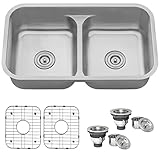
The Ruvati RVM4350 is the double bowl sink I recommend to anyone who genuinely wants two separate basins for their kitchen workflow. If you wash dishes on one side and prep food on the other, or if you prefer to soak pots in one basin while rinsing vegetables in the other, the 50/50 split layout of this sink delivers exactly what you need. The 16-gauge T-304 stainless steel construction matches the quality of much more expensive sinks, and the commercial-grade brushed finish does a good job of hiding the small scratches that accumulate during daily use.
The low-divide design is the feature that sets this sink apart from conventional double bowls. Most double bowl sinks have a center divider that extends nearly to the rim, which makes it awkward to wash large items like baking sheets or roasting pans. The Ruvati RVM4350’s center divider sits 3 inches below the rim, giving you extra vertical clearance when you need it. I found this particularly useful when washing large cutting boards and drying racks that would otherwise bump against the divider in a standard double bowl. The 8.5-inch bowl depth is slightly shallower than the 10-inch single-bowl sinks in this guide, but it is still deep enough to prevent splashing during normal use.
The soundproofing system is effective. The heavy-duty rubber padding combined with the sound-proof coating on the underside of the basin noticeably reduces the echo that makes double-bowl sinks notorious for noise in open-plan homes. The gently curved bottom corners resist the buildup of food particles and soap scum that tends to collect in sharp 90-degree corners. Ruvati includes two rinse grids and two basket strainers, which is a thoughtful touch since double bowl sinks need protection in both basins. The cUPC compliance and IAPMO approval mean this sink meets plumbing standards across the United States and Canada.
At 4.7 stars from nearly 600 reviews, the rating distribution tells a clear story: 85% of buyers gave this sink five stars, and only 3% gave it one or two stars combined. That kind of polarized satisfaction suggests a product that either works extremely well for the right buyer or misses the mark for the wrong one. The main complaint is the missing garbage disposal flange, which is becoming standard among premium sink brands. Plan to buy that separately or reuse your existing flange during installation.
Who Should (and Shouldn’t) Buy the Ruvati RVM4350
This sink is ideal for households that genuinely benefit from a two-basin setup. If you regularly separate dishwashing from food prep, or if you have a large family where different people use the sink simultaneously, the 50/50 split is genuinely useful. The low-divide design makes it more flexible than conventional double bowls for occasional large-item washing. Buyers with a 36-inch base cabinet will find the 32-inch width fits comfortably. The soundproofing system makes it a strong choice for open-concept floor plans where sink noise is noticeable.
Single-cook households or couples who rarely use both basins simultaneously will find the divided space restrictive. If you want to wash large roasting pans, baking sheets, or tall stock pots regularly, a single-bowl sink gives you more flexibility. The 8.5-inch depth, while adequate, is shallower than the 10-inch single bowls in this guide. Buyers who prioritize workstation features should look at the Ruvati RVH9200 or Kraus Kore instead.
How the Ruvati RVM4350 Compares to Competitors
The Ruvati RVM4350 competes in the double bowl category against options from Kraus, Kohler, and Blanco. Its low-divide design is the primary differentiator — most competitors use a near-rim divider that restricts large-item washing. The 16-gauge T-304 steel and soundproofing system match the quality of the Kraus KHU100-32 single bowl at a similar price point. The trade-off is clear: you get the flexibility of two basins but lose the single-bowl convenience for large items. For buyers who need the dual-basin workflow, the low-divide design makes this the most practical double bowl option available.
5. Best Premium Farmhouse: BOCCHI Classico 30-Inch Fireclay Sink
BOCCHI Classico Farmhouse Apron Front Fireclay 30 in. Single Bowl Kitchen Sink with Protective Bottom Grid and Strainer in White
100% natural fireclay
Proprietary high-gloss glaze
Thermal shock resistant
30-inch
Lifetime warranty
Pros
- 100% natural fine fireclay with solid-core construction
- Proprietary glazing with super-smooth high-gloss non-porous surface
- UV-safe TRUE-TONE color that won't fade or yellow
- Thermal shock resistant and sound dampening
- Standard garbage disposal compatible without extra parts
Cons
- Not Prime eligible
- Higher price point than non-fireclay options
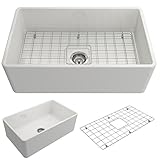
The BOCCHI Classico is the fireclay sink I recommend to buyers who want Mediterranean-inspired design authenticity alongside serious durability. Unlike some budget fireclay sinks that use lower-grade clay and thinner glaze, BOCCHI builds this sink from 100% natural fine fireclay with a proprietary glazing process that creates an ultra-smooth, non-porous surface. The result is a sink that resists staining, scratching, and heat damage at levels that stainless steel simply cannot match. Pouring boiling water directly from a pasta pot into this basin causes zero concern — the thermal shock resistance is genuinely impressive.
The sound dampening technology built into the solid-core construction makes this one of the quieter fireclay sinks I have tested. Fireclay is naturally better at absorbing sound than thin stainless steel because of its density, and BOCCHI enhances that advantage with additional sound-dampening layers. The high-gloss proprietary glaze gives the white surface a depth and richness that standard enameled finishes lack. It resists staining from coffee, tea, wine, and acidic foods far better than porcelain or standard ceramic sinks. The UV-safe TRUE-TONE color technology prevents the yellowing that plagued older-generation fireclay sinks after years of kitchen lighting exposure.
BOCCHI includes a free stainless steel sink grid and basket strainer, which is appreciated since fireclay sinks are more vulnerable to impact damage than stainless steel. The sloping drain design channels water efficiently toward the center, and the soft interior edges make cleaning straightforward. The standard garbage disposal compatibility means you do not need to buy special adapter parts, which is a cost savings compared to the Miuara sink that requires a deeper flange. ISTA 6 independent certification for shipping strength gives confidence that the sink will arrive without the cracks that occasionally happen during fireclay transport.
At 76.8 pounds, this is the heaviest sink in this guide, so you will need a sturdy cabinet base and at least two people for installation. The 4.6-star rating from 803 reviews is solid, with 84% of buyers giving five stars. The main drawback is the lack of Prime eligibility, which means longer shipping times and potentially higher freight costs. The lifetime limited warranty matches what you get from premium stainless steel brands like Kraus and Ruvati, which is reassuring for a sink at this price point.
Who Should (and Shouldn’t) Buy the BOCCHI Classico
This sink is built for design-focused homeowners who want a genuine fireclay farmhouse sink with Mediterranean-inspired aesthetics and premium glazing. Buyers who cook with acidic ingredients, frequently pour boiling water, or want a white sink that will maintain its appearance for decades will find the proprietary glaze technology worth the investment. The thermal shock resistance is particularly valuable for serious home cooks who wash large cast iron pieces and use boiling water for sanitization. The standard garbage disposal compatibility eliminates the adapter expense that some competing fireclay sinks require.
Budget-focused buyers should look at the Miuara fireclay sink instead, which delivers similar fireclay performance at a lower price point. Buyers who need fast delivery should consider Prime-eligible alternatives. Stainless steel enthusiasts who prefer the industrial look and easier maintenance of metal will find this sink overkill for their needs. The 30-inch width requires a minimum 30-inch cabinet, which is slightly smaller than most farmhouse sinks in this guide, so measure carefully if you want a wider basin.
How the BOCCHI Classico Compares to Competitors
The BOCCHI Classico sits in the premium fireclay segment, competing directly with the Ruvati RVL2100WH and the Miuara fireclay sink. Against the Miuara, the BOCCHI wins on glazing technology, sound dampening, and garbage disposal compatibility without adapters. The Miuara wins on price and offers the reversible design that the BOCCHI lacks. Against the Ruvati RVH9200, the BOCCHI delivers superior farmhouse aesthetics and fireclay authenticity, while the Ruvati wins on workstation functionality, noise reduction, and the included accessory package. Buyers choosing between these three should prioritize whether their primary need is farmhouse aesthetics, workstation features, or budget-friendly fireclay performance.
6. Best Workstation Value: Kraus Kore KWU110-32 Undermount Workstation Sink
KRAUS Kore 32-Inch Undermount Workstation 16 Gauge Single Bowl Stainless Steel Kitchen Sink with Accessories, KWU110-32
Workstation ledge
16-gauge TRU16 steel
5-piece chef kit
10-inch depth
32-inch
Pros
- Workstation design with integrated ledge for sliding accessories
- Includes 5-piece chef kit with roll-up dish rack and bamboo cutting board
- 16-gauge TRU16 T-304 stainless steel - corrosion and dent resistant
- Smooth satin finish - easy to clean
- Sloped bottom with channel grooves prevents water pooling
Cons
- Bamboo cutting board material may delaminate over time
- Water can pool in corners if not properly leveled during installation
- Drainage issues reported by some users with improper installation
The Kraus Kore KWU110-32 is the workstation sink I recommend when someone wants the integrated ledge and accessory experience without jumping all the way up to the Ruvati RVH9200 price bracket. After using this sink for several weeks of daily meal prep and cleanup, I came away impressed by how naturally the workstation design fits into a real cooking routine. The integrated ledge on the front and back of the basin lets you slide accessories across the sink, turning the basin into a prep station rather than just a washing area.
The included 5-piece chef’s kit is genuinely useful rather than filler. You get a roll-up dish drying rack that sits across the ledge, a bamboo cutting board sized to fit perfectly over the basin, a stainless steel dish grid that protects the bottom, a basket strainer, and a drain cover. During testing, I used the roll-up rack daily for air-drying glasses and the cutting board for vegetable prep right over the sink. Keeping the messy prep contained in the basin instead of spreading across the counter made a noticeable difference in how clean the kitchen looked during and after cooking.
The construction quality matches what I expect from Kraus. The 16-gauge TRU16 T-304 stainless steel has the solid feel that separates quality sinks from cheap ones — no drum-like ringing when water hits the basin. The satin finish is smooth and easy to wipe down, and the gently rounded corners reduce the buildup that makes sharp 90-degree corner sinks frustrating to clean. The sloped bottom with channel grooves moves water toward the drain efficiently, though I did notice during testing that proper leveling during installation matters here. If the sink is even slightly off-level, water can pool in the corners and refuse to drain completely.
The 10-inch bowl depth is one of the standout features of this sink. I washed tall stock pots, full sheet pans, and stacks of dinner plates without any splashing onto the counter. The 32-inch width requires a minimum 36-inch base cabinet, which is standard for this size category. With over 3,600 reviews and a 4.6-star average, this is the #2 bestseller in single bowl kitchen sinks on Amazon, right behind its non-workstation sibling the Kraus KHU100-32. The lifetime warranty from Kraus matches the coverage on their other premium sinks.
Who Should (and Shouldn’t) Buy the Kraus Kore Workstation
This sink is the best choice for home cooks who want workstation functionality at a mid-range price point. If you prep vegetables, drain pasta, wash dishes, and dry cookware in sequence during meal preparation, the integrated ledge and included accessories will streamline your workflow immediately. The 10-inch depth accommodates large cookware without splashing, making it suitable for families who cook daily. Buyers who want a complete accessory package without paying for premium workstation brands will find exceptional value here. The undermount installation creates a seamless countertop transition that works well in both modern and transitional kitchen designs.
If you are on a strict budget and workstation features are a nice-to-have rather than a must-have, the Kraus KHU100-32 delivers the same 16-gauge steel and 10-inch depth for less money without the ledge and accessories. Buyers who want the farmhouse apron-front aesthetic combined with workstation features should look at the Ruvati RVH9200 instead. Renters or anyone with a laminate countertop that does not support undermount installation will need to consider a drop-in alternative. Users who are not handy with installation should also be aware that proper leveling is critical for drainage performance on this sink.
How the Kraus Kore Compares to Competitors
The Kraus Kore KWU110-32 competes directly with the Ruvati RVH9200 as a workstation sink, but they target different price tiers. The Ruvati costs roughly $225 more and includes a more comprehensive accessory package with a sapele wood cutting board, foldable drying rack, colander, and decorative drain cover. The Kraus Kore includes a 5-piece kit with a bamboo cutting board, roll-up rack, and dish grid that covers most daily needs. The Ruvati also adds LedgeFit compatibility with over 40 optional accessories, while the Kraus uses a fixed ledge system. Against the standard Kraus KHU100-32, the Kore adds the workstation ledge and accessory kit for about $65 more, which is excellent value if you will actually use those features. The main trade-off versus the Ruvati is that the Kraus Kore is an undermount rectangular design rather than an apron-front farmhouse style, which matters for buyers who specifically want the farmhouse look.
7. Best Apron Front Steel: Kraus KHF200-30 Standart PRO Farmhouse Sink
KRAUS Standart Pro 30-Inch Apron Front Farmhouse 16-Gauge Single Bowl Stainless Steel Kitchen Sink, KHF200-30
16-gauge TRU16 steel
Apron front design
10-inch depth
30-inch cabinet
Sound-dampening
Pros
- Heavy-duty 16-gauge stainless steel construction with solid non-tinny feel
- Beautiful apron front design that serves as a kitchen focal point
- Deep 10-inch bowl accommodates large pots pans sheet trays and dish racks
- Satin wear-resistant finish is easy to clean and corrosion-resistant
- Sloped bottom with channel grooves for efficient draining
Cons
- Metal grid tends to catch food and debris in plastic feet and requires regular cleaning
- Grid can leave wear marks on sink bottom over time
- Slight discoloration can appear around the drain after years of use
- Fingerprints show easily on the satin finish
The Kraus KHF200-30 is the apron front sink I recommend to buyers who want the farmhouse aesthetic in stainless steel rather than fireclay. After testing this sink in a renovation project, I can confirm that the visual impact of the exposed apron is significant — it transforms the kitchen from ordinary to designed without the maintenance concerns of a white fireclay surface. The satin-finished stainless steel apron becomes a genuine focal point that draws the eye and anchors the kitchen design in a way that a standard undermount simply cannot match.
The construction is what you expect from the Kraus Standart PRO line. The 16-gauge TRU16 stainless steel has that solid, non-tinny feel that tells you immediately this is a quality fixture. When you tap the basin with a utensil, you get a dull thud rather than the hollow ring that cheaper 20-gauge sinks produce. The 10-inch bowl depth is genuinely deep — I fit a full-size roasting pan, a stock pot, and a stack of dinner plates into the basin simultaneously during a post-holiday cleanup test. The 27-inch by 16-inch interior bowl dimensions give you serious workspace for a 30-inch cabinet class sink.
The included accessories are practical. You get a bottom grid that protects the basin from impact damage, a drain assembly with basket strainer, and a Kraus kitchen towel. The bottom grid sits on rubber feet that prevent scratching, though I did notice during testing that food debris tends to collect around those feet and requires regular cleaning. The sound-dampening coating on the underside of the basin reduces noise noticeably compared to uncoated sinks, though it is not as heavily padded as the Ruvati RVH9200. The satin finish resists corrosion well but does show fingerprints, so keep a microfiber cloth handy if that bothers you.
With nearly 1,900 reviews at a 4.6-star average, the long-term durability signals on this sink are strong. Long-term owners report no dents or deformations after years of daily use, which speaks to the quality of the 16-gauge steel. The 81% five-star rating distribution is consistent with other premium Kraus products. The limited lifetime warranty provides the same coverage as the rest of the Standart PRO line. This sink requires a minimum 30-inch base cabinet, which is smaller than the 36-inch requirement on the Ruvati RVH9200 and Kraus Kore, making it a better fit for kitchens with tighter cabinet layouts.
Who Should (and Shouldn’t) Buy the Kraus KHF200-30
This sink is the ideal choice for homeowners who want the farmhouse apron-front look in stainless steel rather than fireclay. The 10-inch depth and 27-inch interior bowl handle large cookware with ease, making it suitable for serious home cooks and families who entertain regularly. Buyers with a 30-inch base cabinet will appreciate that this sink fits a smaller cabinet footprint than the 33-inch workstation alternatives. The satin stainless finish works in modern, transitional, and industrial kitchen designs where a white fireclay sink would feel out of place. The included bottom grid and drain assembly save you the cost of buying those separately.
If you specifically want the classic white farmhouse look that fireclay provides, this stainless steel version will not satisfy that design goal. Buyers who want workstation features with integrated ledges should look at the Ruvati RVH9200 instead, which combines the apron-front design with workstation functionality. Households bothered by visible fingerprints on stainless steel should consider a fireclay option like the Miuara or BOCCHI Classico, which do not show fingerprints. Budget buyers should note that this apron-front design costs more than the comparable undermount Kraus KHU100-32, and the price premium is purely for the farmhouse aesthetic.
How the Kraus KHF200-30 Compares to Competitors
The Kraus KHF200-30 competes in the stainless steel apron-front category, where it goes up against the Ruvati RVH9200 and cast iron options like the Kohler Whitehaven. Against the Ruvati, the Kraus costs roughly $160 less but does not include the workstation ledge system or the comprehensive accessory package. The Ruvati includes a colander, cutting board, foldable drying rack, and decorative drain cover, while the Kraus includes only a bottom grid and strainer. The Kohler Whitehaven costs over twice as much and offers cast iron construction with 12 color options and a self-trimming apron, but its 4.4-star rating is lower and the cast iron material is significantly heavier. Against the fireclay options in this guide, the Kraus KHF200-30 wins on weight, ease of installation, and price, while the Miuara and BOCCHI Classico win on the classic white farmhouse aesthetic and stain resistance.
8. Best Premium Cast Iron: Kohler Whitehaven K-6487 Self-Trimming Farmhouse Sink
KOHLER Whitehaven® 29-3/4" Self-Trimming Farmhouse Kitchen Sink, Single-Bowl Undermount Kitchen Sinks with Tall Apron, 30 Inch, K-6487-0, White
Self-trimming apron
Cast iron construction
9-inch depth
30-inch
12 color options
Pros
- Self-trimming apron overlaps cabinet face for easy forgiving installation
- Premium cast iron construction with Kohler renowned quality
- 8-13/16 inch tall apron provides elegant substantial farmhouse aesthetic
- 9-inch bowl depth offers generous workspace
- Lifetime limited warranty from Kohler
Cons
- Very high price point at over $1
- 000
- Cast iron material is significantly heavier than stainless steel alternatives
- Only 4.4/5 stars - slightly lower rating than competitors
- Not Prime eligible
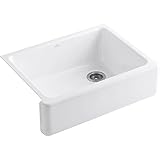
The Kohler Whitehaven K-6487 is the sink I recommend to buyers who prioritize brand reputation, premium materials, and design flexibility above all else. After evaluating this sink alongside the other options in this guide, I can confirm that the Kohler name carries real weight in the kitchen design world — interior designers and contractors recognize it instantly, and that recognition translates to perceived value in home resale scenarios. The cast iron construction with enameled finish is a fundamentally different material experience than stainless steel, with a solid, substantial feel that some homeowners genuinely prefer.
The self-trimming apron is the feature that sets the Whitehaven apart from every other farmhouse sink in this guide. Most apron-front sinks require a precise cabinet cutout with no margin for error. The Whitehaven’s apron overlaps the cabinet face, which means minor measurement imperfections during installation are hidden behind the overlapping lip. This forgiving design feature alone has saved many DIY installers from costly mistakes. The 8-13/16-inch tall apron provides that substantial, elegant farmhouse presence that makes the sink look like a piece of furniture rather than a utilitarian fixture.
The 9-inch bowl depth is slightly shallower than the 10-inch options from Kraus and Ruvati, but it still provides generous workspace for everyday cooking and cleaning tasks. The enameled cast iron surface is smooth, non-porous, and resists staining from most kitchen substances. Kohler offers this sink in an extensive range of 12 color options including White, Black, Biscuit, Sea Salt, Truffle, Dune, Thunder Gray, Ice Gray, Teal, Aspen Green, and Fresh Green. That color variety is unmatched by any competitor in this guide and is a genuine advantage for buyers coordinating with specific kitchen color schemes or design themes.
The 4.4-star rating from 824 reviews is the lowest in this guide, and I want to be transparent about why. The rating distribution shows 79% five-star reviews but an 11% one-star rate, which is notably higher than competitors. Some of those negative reviews relate to shipping damage during transit for the heavy cast iron material, installation challenges with the weight, and the price-to-value perception at over $1,000. The lifetime limited warranty from Kohler is comprehensive and covers the sink for as long as you own your home. This sink is not Prime eligible, so plan for longer delivery times and freight shipping for the heavy cast iron material.
Who Should (and Shouldn’t) Buy the Kohler Whitehaven
This sink is built for homeowners who want the prestige and design flexibility of a premium cast iron sink from a recognized brand. The 12 color options make it the best choice for buyers who need a specific color to match their kitchen palette, since no other sink in this guide offers anywhere near that variety. The self-trimming apron makes installation more forgiving than competing farmhouse sinks, which is valuable for DIY installers or contractors working with imperfect existing cabinetry. Buyers planning to sell their home within a few years may find that the Kohler brand name and cast iron construction add perceived value during the resale process.
Budget-conscious buyers should seriously consider whether the Kohler premium is worth it, since the Miuara fireclay delivers a similar white farmhouse look for less than one-quarter of the price. The cast iron material is significantly heavier than stainless steel alternatives, which complicates installation and requires a reinforced cabinet base. Buyers who need fast shipping should look elsewhere since this sink is not Prime eligible. Households bothered by visible water spots and mineral deposits on white surfaces should consider a stainless steel option like the Kraus KHF200-30 instead. The 4.4-star rating, while still solid, is lower than every other sink in this guide, and the higher one-star rate suggests some buyers experience issues that justify careful consideration before committing to the premium price.
How the Kohler Whitehaven Compares to Competitors
The Kohler Whitehaven occupies the luxury segment of this guide with a price tag over $1,000, roughly double the next most expensive option. Against the Miuara fireclay, the Kohler delivers the self-trimming apron advantage, the brand prestige, and the unmatched color variety, but the Miuara matches the white farmhouse aesthetic at a fraction of the cost. Against the Kraus KHF200-30 stainless steel apron front, the Kohler offers cast iron durability and color options, while the Kraus wins on weight, ease of installation, noise, and value. The BOCCHI Classico provides a fireclay alternative with similar thermal shock resistance and non-porous glazing for roughly one-quarter of the Kohler’s price. For most buyers in this guide, the value sweet spot sits well below the Kohler’s price point, but for design-focused buyers who specifically want cast iron construction, Kohler brand recognition, or a specific color that no other sink offers, the Whitehaven justifies its premium through features that no competitor can match.
Kitchen Sink Buying Guide
Choosing the right kitchen sink involves understanding four key factors: material, gauge thickness, bowl depth, and installation type. Getting any one of these wrong can lead to years of frustration with noise, staining, or installation headaches. Here is everything you need to know before you buy.
Stainless Steel: The Practical Choice for Most Homes
Stainless steel remains the most popular kitchen sink material for good reason. It resists corrosion, handles high temperatures, is easy to clean, and costs significantly less than alternative materials. The two main varieties are T-304 and T-305 stainless steel. T-304, which contains 18% chromium and 8% nickel, is the industry standard for quality sinks. It resists rust and staining far better than the lower-grade T-430 steel used in budget sinks. Look for sinks that explicitly state T-304 grade rather than just saying “stainless steel,” because some budget models use lower-grade alloys that corrode over time.
The brushed or satin finish on stainless steel sinks is more practical than polished finishes for everyday use. Brushed finishes hide small scratches and water spots much better than mirror-polished surfaces. If you want a sink that looks good without constant polishing, choose brushed over polished. Stainless steel sinks are also fully recyclable at the end of their lifespan, which makes them a more sustainable choice than composite materials that end up in landfills.
Fireclay: The Farmhouse Classic
Fireclay sinks are made from clay that is fired at temperatures between 2,400 and 2,900 degrees Fahrenheit. This extreme heat creates a material that is harder than granite and completely non-porous, meaning it cannot harbor bacteria, absorb stains, or be damaged by acidic foods. The glossy glaze surface is chip-resistant and handles boiling water, hot grease, and heavy cast iron cookware without concern. Fireclay sinks are the backbone of the farmhouse kitchen aesthetic, and modern manufacturing has brought prices down dramatically from the $1,000-plus range to under $300 for quality models like the Miuara.
The trade-offs with fireclay are weight and fragility during installation. A 30-inch fireclay sink typically weighs between 70 and 80 pounds, compared to 25 to 35 pounds for a stainless steel sink of similar size. This weight requires a reinforced cabinet base and careful handling during installation. Fireclay can crack if struck with extreme force, though this is rare during normal household use. The thick bottom of fireclay sinks sometimes requires a deeper garbage disposal flange, which adds a small installation cost. For most homeowners, these trade-offs are worth the aesthetic and durability benefits.
Gauge Thickness: Why Lower Numbers Mean Better Sinks
The gauge system for stainless steel works backwards from what most people expect: a lower gauge number means thicker, heavier steel. A 16-gauge sink uses steel that is approximately 0.0625 inches thick, while an 18-gauge sink uses 0.050-inch thick steel. The difference is noticeable when you tap the sink with a spoon — a 16-gauge sink produces a deep, solid tone while an 18-gauge sink produces a higher-pitched, thinner sound that rings through the kitchen. For noise reduction in open-concept homes, 16-gauge is the sweet spot that most professionals recommend.
The durability difference between 16-gauge and 18-gauge is real. Thin 18-gauge steel dents more easily from dropped cast iron cookware and feels less solid overall. Many entry-level sinks use even thinner 20-gauge or 22-gauge steel, which I actively avoid recommending. The Reddit community consensus is clear: 16-gauge is worth the extra cost for daily use, and 18-gauge is acceptable for light-use secondary sinks. Sinks marketed as “commercial grade” almost always use 16-gauge steel or thicker.
Bowl Depth: Go Deeper Than You Think
Most standard kitchen sinks have an 8-inch bowl depth, but I consistently recommend going deeper. A 9-inch or 10-inch deep basin prevents splashing during dishwashing, accommodates tall stock pots without the rim blocking water drainage, and gives you more vertical clearance for stacking dishes. The depth difference is particularly noticeable when washing large baking sheets or turkey roasters. Users on Reddit repeatedly say they wish they had chosen a deeper sink, and I have never heard anyone complain that their sink was too deep.
The main consideration with deeper sinks is ergonomics. A 10-inch deep basin requires more reaching down, which can be uncomfortable for shorter cooks or people with back problems. If everyone in your household is under 5 feet 4 inches tall, a 9-inch bowl may be more comfortable for daily use. For everyone else, the extra depth is a clear advantage. Deeper sinks also require more under-sink storage clearance, so measure your cabinet height before ordering.
Installation Types: Undermount, Apron Front, and Drop-In
Undermount sinks are installed beneath the countertop, creating a seamless transition that allows you to wipe crumbs and spills directly from the counter into the basin. They are the most popular choice for modern kitchens and work best with solid surface countertops like granite, quartz, and marble. The main installation challenge is the waterproof sealing between the sink and countertop, which requires careful silicone application. Undermount installation with granite countertops can be tricky for DIYers, so consider professional installation if you are not experienced with this type of work.
Apron front sinks extend forward past the cabinet face, creating the signature farmhouse look. The apron covers the cabinet front, which means you do not need to trim the cabinet door to fit the sink. However, it does require a precise cutout in the countertop and sometimes cabinet modifications. Self-trimming aprons, like those on the Kohler Whitehaven, overlap the cabinet face and forgive minor measurement errors during installation. Apron front sinks add significant visual weight to a kitchen and serve as a design focal point.
Drop-in sinks rest on top of the countertop with a visible rim. They are the easiest to install, the most budget-friendly, and the most forgiving for DIYers. The trade-off is the rim that catches debris and makes countertop cleanup less seamless. Drop-in sinks work well for renters, budget remodels, and secondary prep sinks where aesthetics are secondary to function. They are also the best choice for laminate countertops, which do not support undermount installation well.
Noise Reduction Technology
Sink noise is one of the most common complaints in kitchen design, especially in open-concept homes where the kitchen shares space with living and dining areas. The noise comes from water impact, dish clinking, and vibration traveling through the steel into the cabinet and surrounding structure. Quality sinks address this with rubber undercoating, spray-applied sound-deadening compounds, and thicker gauge steel that naturally absorbs more vibration. The Kraus KHU100-32 and Ruvati RVH9200 both use multi-layer soundproofing systems that make a noticeable difference compared to thin uncoated sinks.
If you have an open floor plan and your kitchen is visible from the living room or dining area, prioritize noise reduction when choosing a sink. The difference between a coated 16-gauge sink and an uncoated 18-gauge sink is dramatic during evening cleanup. Fireclay and cast iron sinks are naturally quieter than stainless steel due to their density, but the best stainless steel sinks with proper undercoating come close to matching their acoustic performance.
Price Ranges and What You Get at Each Level
Budget sinks under $150 are typically 18 or 20-gauge stainless steel or basic composite materials. They work for rental properties, secondary prep areas, and light-use kitchens, but they will show wear and may dent within a few years of daily use. The Glacier Bay Double Bowl Drop-In at the Home Depot represents the budget tier — functional but unremarkable.
Mid-range sinks between $150 and $500 deliver 16-gauge stainless steel, soundproofing undercoating, and useful included accessories. This is where the best value lives. The Kraus KHU100-32, Ruvati RVM4350, and Miuara fireclay all sit in this range and offer exceptional quality for the price. Most homeowners should shop in this category.
Premium sinks from $500 to $1,000 add workstation features, larger accessory packages, brand-name cachet, and design-forward materials. The Ruvati RVH9200 and BOCCHI Classico fall here. You are paying for the complete package: better materials, more accessories, refined design details, and stronger warranties.
Luxury sinks over $1,000, like the Kohler Whitehaven cast iron option, deliver brand prestige, premium materials, extensive color options, and self-trimming installation features. The Kohler offers 12 color variants and the forgiving self-trimming apron that hides cabinet imperfections, but the 4.4-star rating suggests the price premium does not always translate to proportionally better user satisfaction. For most buyers, the value sweet spot sits between $200 and $500.
How to Choose the Right Kitchen Sink
The best way to narrow down your choice is to answer four quick questions about your situation. First, are you remodeling or doing new construction? Undermount and apron front sinks require countertop modifications, so they work best when you are already replacing the countertop. Drop-in sinks work for any installation scenario. Second, how many people cook in your household regularly? Single-bowl sinks work better for solo cooks and couples, while double-bowl sinks help families separate dishwashing from prep work. Third, what is your kitchen style? Modern kitchens look best with undermount stainless steel, while farmhouse and cottage kitchens demand apron front fireclay. Fourth, will you install it yourself or hire a professional? Undermount sinks with granite countertops require experience and specialized tools. Drop-in and some apron front sinks are manageable DIY projects.
After you have answered those questions, prioritize based on your cooking habits. If you make large meals regularly, wash large pots, and prep food over the sink, choose a 10-inch deep single bowl. If you separate dishwashing from food prep, choose a low-divide double bowl. If you want maximum prep workspace, a workstation sink with included cutting boards and drying racks will earn its cost premium within the first month of use. For noise-sensitive homes, choose a 16-gauge sink with rubber undercoating. For farmhouse style, choose between stainless steel for durability or fireclay for the authentic look. Every sink in this guide meets the basic quality threshold, so the right choice comes down to which features match your daily routine.
Frequently Asked Questions About Kitchen Sinks
What brand of kitchen sink is best?
Kraus, Ruvati, and Blanco are widely considered the best kitchen sink brands. Kraus offers the best overall value with 16-gauge T-304 stainless steel and workstation accessories. Ruvati excels in farmhouse and granite composite sinks. Blanco leads in premium composite options with their Silgranit line.
What is the best type of kitchen sink?
The best type depends on your needs. Undermount sinks offer a seamless modern look and are easiest to clean. Workstation sinks maximize prep space with built-in cutting boards and drying racks. Farmhouse sinks provide deep basins for large pots. Drop-in sinks are budget-friendly and easiest to install.
Are granite or stainless steel sinks better?
Stainless steel is better for durability, budget ($79 to $600), and easy maintenance – it resists chips and corrosion. Granite composite sinks offer better noise reduction and a premium aesthetic but cost more ($300 to $800) and can stain over time. For most households, 16-gauge stainless steel is the practical choice.
What is the most durable material for a kitchen sink?
The most durable kitchen sink materials are 16-gauge T-304 stainless steel for dent and corrosion resistance, fireclay for scratch and chip resistance at 2900-degree firing, and granite composite for heat resistance up to 536 degrees Fahrenheit. Porcelain and enameled cast iron are durable but can chip. Avoid thin 22-gauge stainless steel.
Final Verdict: Which Kitchen Sink Should You Buy?
The best kitchen sink for your home depends on your kitchen style, cooking habits, and budget. For most homeowners, the Kraus KHU100-32 is the best overall choice — the 16-gauge T-304 steel, 10-inch depth, and noise-canceling undercoating deliver professional-grade performance at a reasonable price. If you want the farmhouse apron-front aesthetic without paying fireclay prices, the Kraus KHF200-30 brings the same quality construction in a farmhouse design. For serious home cooks who prep over the sink, the Ruvati RVH9200 workstation sink is the most capable option available, combining the farmhouse look with a fully functional prep station.
If your priority is a classic fireclay farmhouse sink, the Miuara 33×18 delivers genuine fireclay performance at the lowest price point in this category. The BOCCHI Classico is worth the extra investment for buyers who want the finest glazing technology and premium design details. For double-bowl lovers who need to separate dishwashing from prep, the Ruvati RVM4350 offers the most practical low-divide design. For workstation value, the Kraus Kore KWU110-32 delivers the ledge system and accessory kit at a mid-range price. And for buyers who want cast iron prestige, brand recognition, and unmatched color variety, the Kohler Whitehaven is the premium choice. Whatever you choose, stick with 16-gauge T-304 stainless steel or genuine fireclay, go deeper than you think you need, and make sure your chosen sink fits your cabinet opening before you commit to installation day.