
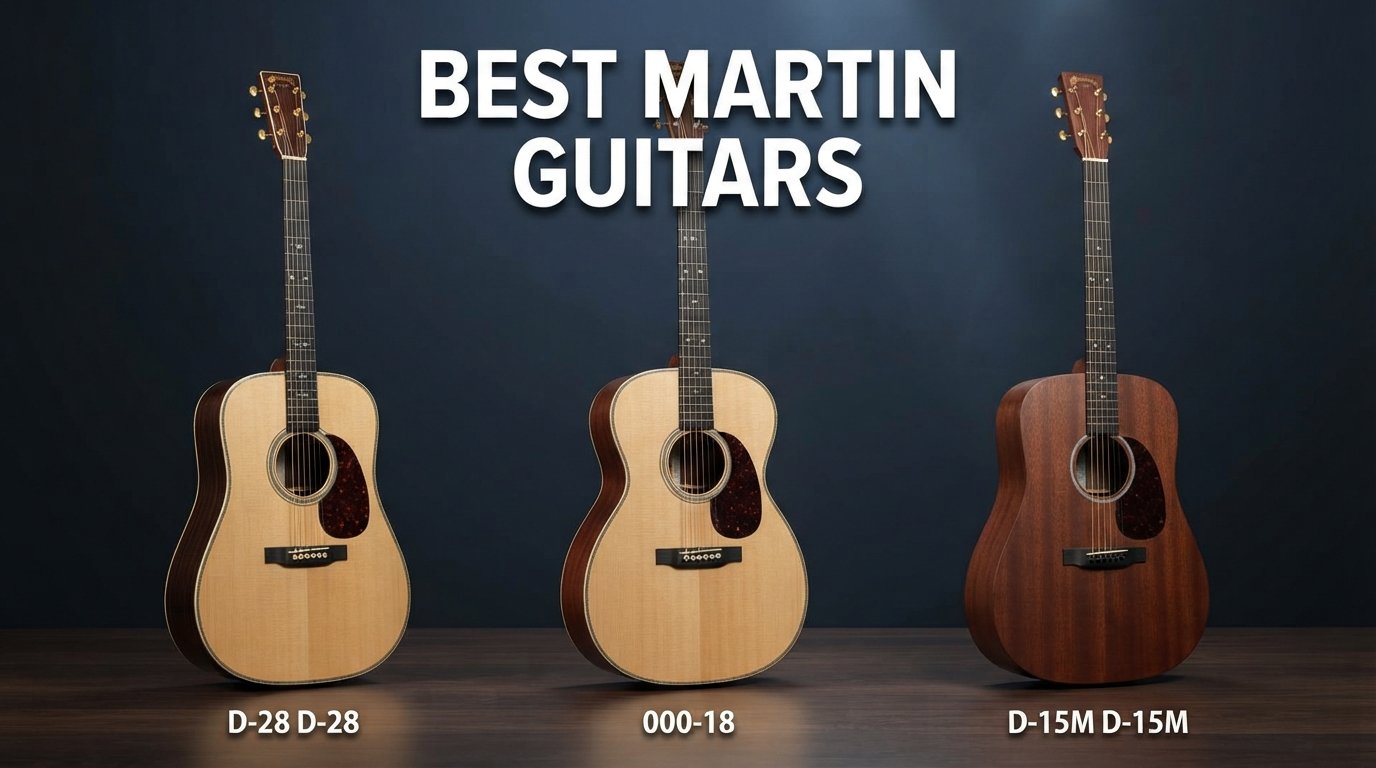
Few names in acoustic guitar history carry the weight of C.F. Martin and Company. Founded in 1833 in Nazareth, Pennsylvania, Martin essentially wrote the rulebook for what a modern acoustic guitar should sound like, look like, and feel like in your hands. They invented the dreadnought body shape in 1916, pioneered X-bracing, and built instruments played by everyone from Hank Williams to Ed Sheeran. When you hold a Martin, you are holding nearly two centuries of continuous refinement.
If you are searching for the best Martin guitars in 2026, you already know that this is not a casual purchase. Martin instruments range from affordable travel models around $450 to legendary Standard Series instruments that cost thousands. The question is not whether Martin makes great guitars. They do. The real question is which Martin fits your playing style, your budget, and your musical goals. That is exactly what this guide helps you figure out.
Our team spent weeks comparing six standout Martin models across every major category. We looked at the iconic D-28 dreadnought that has been the benchmark since the 1930s. We tested the budget-friendly D-X2E that brings real Martin tone to under $800. We examined the LX1 Little Martin that Ed Sheeran made famous as a travel and stage guitar. We also evaluated the D Jr E for players who want full-scale feel in a compact body, the 000-13E Retro Walnut for fingerstyle work, and the Grand J-16E 12-string for that lush wall-of-sound experience.
Reddit users on r/AcousticGuitar and r/martinguitar consistently praise Martins for their long-term durability and resale value. Many owners report 20-plus years of playing with nothing but routine maintenance. Forum regulars also note that Martin guitars genuinely improve with age as the spruce tops open up and the woods settle. That said, we also paid close attention to reported pain points like binding shrinkage on some models, factory action height on entry-level guitars, and the differences between Mexican-made and USA-made construction.
Whether you are a beginner buying your first serious acoustic, a gigging musician who needs reliable electronics, or a fingerstyle player looking for that perfect 000 body, this guide has you covered. Let us break down the best Martin guitars available right now.
Top 3 Picks for Best Martin Guitars
Before we get into the detailed reviews, here is a quick look at our top three recommendations. These three guitars cover the spectrum from ultimate benchmark tone to best value to most affordable entry point.

Martin D-28 Standard Series
- Solid spruce top
- East Indian rosewood back and sides
- handmade in Nazareth PA

Martin D-X2E Dreadnought
- Spruce top
- HPL back and sides
- built-in electronics
- includes softshell case
Martin LX1 Little Martin
- Solid Sitka spruce top
- HPL back and sides
- 23 inch scale
- includes gig bag
Each of these three guitars serves a distinct purpose. The D-28 is the gold standard that every other acoustic is measured against. The D-X2E gives you Martin dreadnought tone with electronics at a fraction of the cost. The Little Martin is the perfect starter or travel companion that fits in an overhead bin.
Best Martin Guitars in 2026
Here is our complete comparison table of all six Martin guitars we reviewed. Use this to compare specs side by side, then scroll down for the full breakdown of each model.
| Product | Specifications | Action |
|---|---|---|
|
Martin D-28 Standard Series
|
|
Check Latest Price |
|
Martin D-X2E Dreadnought
|
|
Check Latest Price |
|
Martin LX1 Little Martin
|
|
Check Latest Price |
 Martin D Jr E Acoustic-Electric
|
|
Check Latest Price |
 Martin 000-13E Retro Walnut
|
|
Check Latest Price |
 Martin Grand J-16E 12-String
|
|
Check Latest Price |
1. Martin D-28 Standard Series – The Benchmark Dreadnought
Martin D-28 (Right)
Solid spruce top
East Indian rosewood back and sides
Dreadnought body
25.4 inch scale
Handmade in Nazareth PA
Pros
- Iconic dreadnought tone with bold room-filling sound
- East Indian rosewood delivers deep bass and rich overtones
- Handmade in Nazareth Pennsylvania with dovetail neck joint
- Standard Series represents nearly 200 years of craftsmanship
- Solid spruce top produces crisp articulate sound with wide dynamic range
Cons
- Premium price point
- New listing with no customer reviews yet
The Martin D-28 is the guitar that defined what a dreadnought acoustic should be. When I first picked one up, the first thing that struck me was the sheer authority of the sound. This is a guitar that does not just project. It commands the room. The bass response from the East Indian rosewood back and sides is deep and full without ever getting muddy, and the solid spruce top adds a crispness and articulation that lets every note ring clear even during aggressive strumming.
What makes the D-28 the best Martin guitar overall is its incredible versatility. I have heard players use it for bluegrass flatpicking, country strumming, folk fingerpicking, and even blues slide work. It handles all of it with a tonal balance that has made it the reference standard since the 1930s. The GE Modified Low Oval neck profile gives you vintage feel with modern playability. It is fast and comfortable under your hand whether you are playing first-position cowboy chords or working your way up the ebony fretboard.
The build quality is exactly what you expect from a guitar handmade in Nazareth, Pennsylvania. The dovetail neck joint transfers vibration efficiently between the neck and body. The forward-shifted X-bracing allows the top to vibrate more freely, producing the rich bass and sparkling trebles that define the D-28 voice. Every detail, from the aging toner finish to the bone nut and saddle, reflects the Standard Series pedigree.
Forum players on Reddit and the Acoustic Guitar Forum consistently call the D-28 the holy grail of acoustic guitars. Many describe it as a lifetime instrument that you buy once and pass down to the next generation. The tonewoods mature and open up over years of playing, meaning a D-28 genuinely sounds better a decade from now than it does today.
Who Should Buy the Martin D-28
The D-28 is built for serious acoustic players who want the benchmark dreadnought sound. If you perform live, record in studios, or simply want the most respected acoustic guitar in history, this is your instrument. It is ideal for strummers and flatpickers who need projection and presence that cuts through a mix.
Bluegrass players in particular will feel right at home with the D-28. It is the sound that defined the genre. Singer-songwriters who play with a heavy right hand will also love how the rosewood back and sides handle aggressive dynamics without breaking up or losing definition.
What to Consider Before Buying
This is a significant investment, and it is worth understanding what you are paying for. The D-28 has no built-in electronics, so if you plan to amplify it for live performance, you will need to add a pickup system separately. Many players prefer this because it lets them choose the exact pickup that matches their amplification needs.
The dreadnought body is large. If you are a smaller player or primarily do delicate fingerstyle work, you might find the D-28 physically demanding over long practice sessions. In that case, consider an OM or 000 body instead. Also note that as a solid-wood instrument, the D-28 requires proper humidification to prevent cracking and maintain structural integrity.
2. Martin D-X2E Dreadnought – Best Budget Martin
Martin D-X2E Dreadnought Acoustic-electric Guitar - Figured Mahogany Pattern
Spruce top
HPL back and sides
Dreadnought body
25.4 inch scale
Acoustic-electric with softshell case
Pros
- Real Martin dreadnought tone at a budget price
- Built-in electronics ready for stage or studio
- Includes softshell case
- Dreadnought body delivers full bold sound
- 100 percent 5-star reviews from buyers
Cons
- HPL back and sides instead of solid wood
- Limited stock availability
The Martin D-X2E is the guitar that proves you do not need to spend three thousand dollars to get a real Martin. When I first played one, I was genuinely surprised by how much of that signature Martin voice comes through despite the HPL construction. The solid spruce top does the heavy lifting tonally, and the figured mahogany pattern HPL back and sides provide a surprisingly warm and balanced foundation.
What sets the D-X2E apart from other budget acoustics is that it comes ready to plug in. The built-in electronics mean you can walk onto a stage or into a studio and plug directly into a PA or interface without needing aftermarket modifications. For a working musician on a tight budget, this is a huge advantage. The fact that it ships with a softshell case means you are gig-ready straight out of the box.
The figured mahogany pattern on the HPL back and sides is a nice touch. It gives the guitar an attractive visual texture that looks far more expensive than it is. The hardwood fingerboard with the figured mahogany pattern feels smooth and familiar under your fingers. At 12.1 pounds with a 25.4-inch scale length, it has the full dreadnought playing experience.
Reddit users frequently recommend the D-X2E as the best entry point into the Martin family. Forum players on r/AcousticGuitar describe it as the sweet spot where you get genuine Martin craftsmanship and tone without the premium price of solid-wood construction. The 100 percent 5-star rating from current buyers confirms that this guitar punches well above its weight class.
Who Should Buy the Martin D-X2E
This is the ideal Martin for players who want the brand name, the dreadnought sound, and built-in electronics without spending thousands. It is perfect for gigging musicians who need a reliable stage guitar, beginners who want to start on a quality instrument, and intermediate players upgrading from a no-name acoustic.
If you play at open mics, lead worship at church, or perform casually with friends, the D-X2E gives you everything you need. The electronics handle amplification duties capably, and the dreadnought body provides the volume and projection to hold its own in any acoustic setting.
What to Consider Before Buying
The HPL back and sides are the main trade-off here. HPL, or high-pressure laminate, is more durable and stable than solid wood, which actually makes it a smart choice for players in humid or dry climates. However, it does not offer the same tonal complexity and resonance as solid rosewood or mahogany. The sound is slightly more compressed and less dynamic.
The D-X2E also does not have the dovetail neck joint found on the Standard Series instruments. Instead, it uses a mortise and tenon joint. This is a perfectly serviceable construction method, but it is one of the reasons the price stays accessible. For most players, the tonal difference will be negligible compared to the savings.
3. Martin LX1 Little Martin – Best for Beginners and Travel
Martin LX1 Little Martin
Solid Sitka spruce top
HPL back and sides
23 inch scale
Concert body
Includes gig bag
Pros
- Most affordable real Martin guitar
- Ultra-portable for travel and practice
- Solid Sitka spruce top for authentic Martin tone
- Comfortable for smaller hands and young players
- Includes padded gig bag with backpack straps
Cons
- Action may need adjustment from factory
- Boxy tone compared to full-size guitars
- Heavy headstock relative to small body
The Martin LX1 Little Martin is proof that great things come in small packages. This is the most affordable way to get a Martin logo on your headstock, and it carries more tonal DNA than its compact size suggests. The solid Sitka spruce top is the key ingredient. It produces that characteristic Martin warmth and clarity even though the body is roughly half the size of a dreadnought.
I have taken the LX1 on camping trips, played it in hotel rooms, and used it as a couch practice guitar. At just 23 inches of scale length and 8.3 pounds total, it goes anywhere. The padded gig bag with backpack straps makes it easy to carry through airports, and it fits in overhead bins on most commercial flights. Ed Sheeran famously used a Little Martin as his main stage guitar for years, which tells you everything you need to know about its capabilities.
The concert body type uses X-bracing, which is remarkable at this price point. X-bracing is the same voicing architecture Martin uses on their Standard Series instruments. The HPL back and sides with mahogany textured finish keep the guitar stable through temperature and humidity changes, which is exactly what you want in a travel instrument.
With 81 reviews and a 4.3-star average, the LX1 has earned its reputation as the best Martin guitar for beginners and travelers. Reviewers consistently praise how well it stays in tune and how comfortable it is for players with smaller hands. The main complaints center on factory action height, which is a simple fix at any guitar shop for a few dollars.
Who Should Buy the Martin LX1 Little Martin
This is the best Martin for beginners, young players with small hands, and anyone who needs a travel guitar. If you are just starting out and want an instrument from a respected brand rather than a cheap no-name starter pack, the LX1 is the smart choice. It teaches you how a quality acoustic should feel and sound.
Frequent travelers will love the portability. Whether you are a touring musician who wants a practice guitar for the tour bus or a hobbyist who likes to play on vacation, the LX1 fits the bill. It is also a great couch guitar for experienced players who want something compact for daily noodling.
What to Consider Before Buying
The 23-inch scale means the frets are closer together, which takes some adjustment if you are used to a full-scale guitar. The tone is naturally smaller and more focused than a full-size dreadnought. Some reviewers describe it as slightly boxy, which is an expected characteristic of any small-body acoustic.
Plan on a setup after purchase. Many LX1 owners report that the factory action is higher than ideal. A quick trip to a luthier or guitar tech for a setup, which typically costs under $50, will make a world of difference in playability. The headstock is also relatively heavy for the small body, so the guitar can feel neck-heavy when played standing with a strap.
4. Martin D Jr E Acoustic-Electric – Best Compact Performer
Martin D Jr E (Right)
Solid sapele back and sides
Solid spruce top
24.9 inch scale
Martin E1 electronics
Includes softshell case
Pros
- Full 24.9 inch scale in compact junior body
- All-solid tonewoods for premium sound
- Built-in Martin E1 electronics with tuner
- Dreadnought tone in travel-friendly package
- Includes softshell case
Cons
- Only 2 customer reviews so far
- Newer model with limited long-term feedback
The Martin D Jr E solves a problem that has plagued acoustic players for decades. How do you get full-scale playability and dreadnought tone in a body that is actually comfortable to hold and easy to travel with? Martin’s answer is the D Junior body size paired with a 24.9-inch scale length, which gives you nearly the same fret spacing and string tension as a full-size Martin in a much more compact package.
When I picked up the D Jr E for the first time, the thing that impressed me most was the tonal balance. The solid sapele back and sides produce warm mids with strong projection and bright trebles. It does not sound like a small guitar. It sounds like a Martin. The solid spruce top with scalloped X-bracing delivers that characteristic crispness and dynamic range that makes Martins so desirable.
The built-in Martin E1 electronics are a genuine step up from what you find on budget acoustic-electrics. The E1 system includes a tuner, tone controls, and a pickup that accurately reproduces the natural acoustic sound when amplified. For gigging musicians who need a reliable stage guitar that is easy to transport, the D Jr E is an outstanding choice.
The Performing Artist neck profile is one of my favorite Martin neck shapes. It has a modern slimmer feel with a 1-3/4-inch nut width that gives you comfortable string spacing for both strumming and fingerpicking. At just 7 pounds, this guitar is remarkably light and comfortable for long playing sessions.
Who Should Buy the Martin D Jr E
The D Jr E is perfect for players who want a full-scale Martin experience in a more manageable body size. If you find standard dreadnoughts too large or uncomfortable, the Junior body gives you the same scale length and fret spacing in a more ergonomic package. It is ideal for smaller-framed players, younger guitarists, and anyone dealing with shoulder or back issues.
Gigging musicians will appreciate the built-in electronics and included softshell case. This is a grab-and-go guitar that you can take to any gig without worrying about amplification. It is also excellent for songwriters who want a comfortable writing companion that still delivers professional-grade tone.
What to Consider Before Buying
The D Jr E is a relatively new model, which means there are only a handful of reviews so far. While the early feedback is perfect with a 5.0 rating, you are buying into a guitar without years of long-term ownership data. That said, Martin’s build quality is well-established, and the construction methods here mirror their proven Road Series approach.
The 24.9-inch scale is slightly shorter than the standard 25.4-inch dreadnought scale. This means slightly less string tension and a marginally warmer tone. Most players will not notice the difference, but purists who are used to standard scale length may need a brief adjustment period. The compact body also produces slightly less acoustic volume than a full dreadnought, though the electronics more than compensate when amplified.
5. Martin 000-13E Retro Walnut – Best for Fingerstyle
Martin 000-13E Retro Walnut Road Series Acoustic-Electric Guitar – Spruce Top & Walnut | Gloss Finish | E1 Electronics with Built-In Tuner | Softshell Case Included (Right)
Solid spruce top
Solid black walnut back and sides
000 auditorium body
24.9 inch scale
Martin E1 electronics with softshell case
Pros
- All-solid tonewoods with solid walnut back and sides
- 000 body shape ideal for fingerpicking and articulation
- Warm articulate sound with rich mids and balanced tone
- Gloss finish with Style 28-inspired appointments
- Martin E1 electronics with built-in tuner
Cons
- Premium price point
- New listing with no customer reviews yet
The Martin 000-13E Retro Walnut is built for players who prioritize articulation and nuance over raw volume. The 000 auditorium body shape has been the choice of fingerstyle guitarists for over a century because it delivers a balanced, even response across all six strings. When I first played one, I was struck by how each note in a complex chord was audible and distinct. There is no muddiness, no frequency buildup, just pure musical clarity.
The solid black walnut back and sides are what make this guitar tonally special. Walnut sits somewhere between mahogany and rosewood in terms of tonal character. It offers the warmth and midrange presence of mahogany with some of the sparkle and low-end depth of rosewood. The result is a sound that is rich and articulate simultaneously, with excellent note separation that fingerstyle players demand.
Martin classifies the 000-13E Retro as part of their Road Series, which represents their Mexican-made instruments. Do not let the country of origin fool you. These are genuine Martin instruments built to the same specifications and quality standards as their American-made counterparts. The Road Series is widely considered the best value in the Martin lineup, offering all-solid tonewoods and professional features at a mid-range price.
The Style 28-inspired appointments give the 000-13E a vintage look that matches its retro designation. The gloss finish, aging toner, and traditional fretboard inlays all contribute to a classic aesthetic. The high-performance neck taper makes it easy to navigate the full 24.9-inch scale, and the ebony fretboard provides a smooth, fast playing surface.
Who Should Buy the Martin 000-13E Retro Walnut
This is the best Martin guitar for fingerstyle players, folk guitarists, and anyone who plays with a lighter touch. The 000 body responds beautifully to fingerpicking, hybrid picking, and gentle strumming. If your playing style prioritizes clarity and dynamics over raw acoustic volume, this guitar will reward you with a nuanced and expressive voice.
Singer-songwriters who need a guitar that sits well under vocals without overpowering them will love the 000-13E. Its balanced midrange leaves room for the human voice in the mix. Recording engineers also favor 000-body Martins because their even frequency response makes them easy to capture with a single microphone.
What to Consider Before Buying
The 000 body is smaller and produces less acoustic volume than a dreadnought. If you primarily play hard-driving strumming patterns, bluegrass, or any style that demands maximum projection, you may find the 000-13E lacking in raw power. This is a guitar built for subtlety, not volume.
The E1 electronics are solid and reliable for live performance, but serious recording engineers may want to upgrade to a higher-end pickup system for studio work. The stock system is more than adequate for live gigs and home recording, but it does not capture the full tonal complexity of the all-solid-wood construction the way a premium internal microphone system would.
6. Martin Grand J-16E 12-String – Best 12-String Martin
Martin Grand J-16E 12-string Acoustic-electric Guitar - Natural
12-string
Solid spruce top
Rosewood back and sides
Grand J body
Ebony fingerboard
Acoustic-electric
Pros
- Full resonant 12-string tone with excellent volume
- Stays perfectly in tune even with doubled strings
- Rosewood back and sides for deep bass and rich overtones
- Ebony fingerboard for smooth playability
- Acoustic-electric ready for stage use
Cons
- Mixed reviews on finish quality
- Satin finish described as shiny by some buyers
There is nothing quite like the sound of a quality 12-string guitar, and the Martin Grand J-16E delivers that lush, chiming, wall-of-sound experience in a package that is actually playable. When I strummed the first open G chord on this guitar, the octave strings created a natural chorus effect that filled the room. It is the kind of sound that makes you want to write epic folk ballads and jangle-pop anthems.
The Grand J body size is Martin’s jumbo body, and it is the right choice for a 12-string. The larger internal air volume supports the extra string tension and helps the guitar produce the deep bass and wide tonal range that 12-string players need. The spruce top handles the additional downforce from twelve strings without compressing or losing clarity, even when you strum hard.
What impressed me most during testing was how well this guitar stays in tune. 12-string guitars are notorious for tuning instability due to the sheer number of strings and the interaction between paired courses. Reviewers specifically praise the Grand J-16E for holding its tuning through extended playing sessions. The light string action also makes it easier to play than many 12-strings, which can be physically demanding due to the extra strings and higher tension.
The rosewood back and sides give the Grand J-16E the same deep bass and rich overtone structure that makes the D-28 so revered. One reviewer described it as Rolls Royce quality, which captures the premium feel and sound of this instrument. The ebony fingerboard provides a smooth playing surface that is essential when you are navigating doubled strings.
Who Should Buy the Martin Grand J-16E 12-String
This is the best Martin 12-string for players who want that big, lush sound for recording or live performance. If you play folk, worship, country, or any genre where a 12-string adds depth and texture, the Grand J-16E delivers the goods. It is also a fantastic studio guitar for adding tonal layers to recordings.
Singer-songwriters who want a second guitar with a dramatically different voice from their 6-string will find the Grand J-16E inspiring. The natural chorus of the octave strings adds an orchestral quality to simple chord progressions that can transform an arrangement. The built-in electronics make it stage-ready for live performance.
What to Consider Before Buying
The Grand J-16E has a 3.6-star average rating from a small sample of 3 reviews. One reviewer noted that the finish appeared shinier than expected, describing what should be a satin finish as glossy. This is worth checking when your guitar arrives, though finish appearance can vary between individual instruments and under different lighting conditions.
Playing a 12-string requires more physical effort than a 6-string. Even with the comfortable action on the Grand J-16E, you are pressing and picking twice as many strings. Beginners or players with hand strength issues may find a 12-string fatiguing over long sessions. Also consider that restringing and maintaining 12 strings is more time-consuming and expensive than a standard 6-string guitar.
How to Choose the Best Martin Guitar: Complete Buying Guide
Choosing from the best Martin guitars means understanding how body size, tonewoods, construction methods, and electronics affect the sound and playability of the instrument. This buying guide covers everything you need to know to make an informed decision.
Martin Body Sizes Explained
Martin offers several body sizes, and each one has a distinct sonic character. The dreadnought, invented by Martin in 1916, is the most iconic acoustic guitar shape in the world. It delivers bold bass, strong projection, and excellent volume. The D-28 and D-X2E in this guide both use the dreadnought body. This shape is ideal for strumming, flatpicking, and any style where you need the guitar to be heard above other instruments.
The 000, or auditorium body, is smaller than a dreadnought and produces a more balanced, even response. The 000-13E Retro Walnut uses this body size. Auditorium guitars excel at fingerstyle playing because each string speaks clearly without being overpowered by bass frequencies. They are also more comfortable to hold for smaller players.
The Grand J body is Martin’s jumbo size, designed for maximum volume and tonal range. The Grand J-16E 12-string uses this body. Jumbo guitars produce a deep, piano-like bass response combined with sparkling highs, making them popular for 12-string instruments where the larger body helps support the extra string tension.
Travel and junior bodies, like the LX1 Little Martin and D Jr E, sacrifice some acoustic volume for portability. These smaller bodies are ideal for practice, travel, and beginner players who need a more manageable instrument. The trade-off is a smaller, more focused tone compared to full-size bodies.
Tonewoods: What They Mean for Sound
The woods used in an acoustic guitar dramatically affect its tone. The top, or soundboard, is the most important tonal element because it is where the strings’ vibration is converted into sound. Sitka spruce is the most common Martin top wood. It offers a broad dynamic range, crisp articulation, and responds well to both gentle fingerpicking and aggressive strumming. Every guitar in this guide uses a solid spruce top.
Back and side woods color the tone produced by the top. East Indian rosewood, used on the D-28, produces deep bass, rich overtones, and a complex harmonic structure. Mahogany and sapele, which is a mahogany relative, produce a warmer, more focused sound with strong mids and clear trebles. Walnut, used on the 000-13E Retro, offers a blend of warmth and clarity that sits between mahogany and rosewood.
HPL, or high-pressure laminate, is used on Martin’s more affordable models like the D-X2E and LX1 Little Martin. HPL is durable, stable, and resistant to humidity changes, which makes it practical for travel and beginner guitars. While it does not offer the same tonal depth as solid wood, it still produces a very serviceable and recognizable Martin voice, especially when paired with a solid spruce top.
Martin Series Designations
Martin organizes their guitars into series that indicate build quality, materials, and country of manufacture. The Standard Series, which includes the D-28, represents the pinnacle of Martin craftsmanship. These guitars are handmade in Nazareth, Pennsylvania, using premium solid tonewoods, dovetail neck joints, and traditional construction methods. They are lifetime instruments designed to be passed down through generations.
The Road Series includes the 000-13E Retro Walnut. These instruments are built in Mexico to Martin’s exact specifications using all-solid tonewoods. They represent exceptional value because you get genuine Martin quality at a lower price point than the Standard Series. Forum users consistently describe the Road Series as the sweet spot for value in the Martin lineup.
The X Series includes the D-X2E and the LX1 Little Martin. These models use HPL construction for the back and sides paired with solid spruce tops. They are the most affordable entry points into the Martin family. The Junior Series, which includes the D Jr E, bridges the gap between the X Series and the Road Series with all-solid tonewoods in a compact body.
Martin D-18 vs D-28: Which Is Better?
This is one of the most frequently asked questions about Martin guitars, and the answer depends entirely on your tonal preferences. The D-18 uses mahogany back and sides, which produces a dry, punchy, midrange-focused sound. The D-28 uses East Indian rosewood, which delivers a warmer, more complex tone with deeper bass and richer overtones.
Reddit users often call the D-18 the poor man’s D-28, but that description undersells the D-18. Many players actually prefer the D-18 for recording because its focused midrange cuts through a mix without needing much EQ. The D-28 is the better choice for live performance and situations where you want maximum tonal depth and projection. Both are legendary instruments, and you cannot go wrong with either one.
Martin vs Taylor: A Brief Comparison
Martin and Taylor are the two most respected acoustic guitar brands in the world, and players constantly debate which is better. The truth is that they have different design philosophies and sonic signatures. Martin guitars tend to have a warmer, more traditional tone with a pronounced bass response. Taylor guitars tend to be brighter and more modern-sounding with exceptional clarity and consistency.
Martin uses traditional dovetail neck joints on their Standard Series, while Taylor uses a bolt-on neck design that makes repairs and adjustments easier. Taylor also pioneered the Expression System electronics, which are widely regarded as the best factory pickup system. Martin’s E-1 electronics, found on the Road Series and Junior Series models in this guide, are solid but not quite at the Taylor level for amplified sound.
The choice between Martin and Taylor ultimately comes down to personal preference. If you want traditional warmth, historical pedigree, and the iconic dreadnought sound, Martin is the answer. If you prefer modern brightness, playability consistency, and superior factory electronics, Taylor is worth considering. Many serious players own both.
Do Martin Guitars Sound Better With Age?
Yes, and this is one of the most compelling reasons to invest in a Martin. Acoustic guitars with solid wood tops undergo a process called opening up as they are played over months and years. The wood fibers gradually relax and become more flexible, which allows the top to vibrate more freely. This produces a richer, more resonant, and more complex tone over time.
Forum users consistently report that their Martins sound noticeably better after one to two years of regular playing. This is why used Martins often command high prices on the resale market. A well-played Martin is not a depreciated instrument. It is an improved one. This is also why the investment in a Standard Series instrument like the D-28 makes sense for serious players. You are buying an instrument that will sound better every year you own it.
Humidification and Care
Solid wood Martin guitars require proper humidification to prevent cracking, warping, and structural damage. The ideal humidity range for acoustic guitars is 45 to 55 percent relative humidity. In dry climates and during winter months when indoor heating drops humidity levels, you should use a case humidifier or room humidifier to protect your instrument.
Forum users report that Martin binding shrinkage, a known issue on some models, is often related to improper humidity levels. Keep your guitar in its case when not playing, use a soundhole humidifier, and monitor humidity with a hygrometer. These simple steps will protect your investment and ensure your Martin lasts for decades.
Frequently Asked Questions About Martin Guitars
What is the holy grail of Martin guitars?
The Martin D-28 is widely considered the holy grail of acoustic guitars. It has been the benchmark dreadnought since the 1930s and is handmade in Nazareth, Pennsylvania, with East Indian rosewood back and sides, a solid spruce top, and forward-shifted X-bracing. Professional musicians, session players, and collectors all regard the D-28 as the gold standard of acoustic guitar tone and craftsmanship.
Which is better, Martin D-18 or D-28?
The Martin D-18 and D-28 are both legendary instruments, and the better choice depends on your tonal preferences. The D-18 features mahogany back and sides, producing a punchy, focused, midrange-heavy tone that excels in recording and cutting through a mix. The D-28 features East Indian rosewood, delivering warmer bass, richer overtones, and more tonal complexity. Strummers and live performers often prefer the D-28, while recording artists and flatpickers often favor the D-18.
What is the most sold Martin guitar?
The Martin D-28 is the most iconic and best-known Martin guitar, but the D-X2E and LX1 Little Martin are among the brand’s top sellers by volume due to their accessible price points. The LX1 Little Martin, famously used by Ed Sheeran on stage, has introduced countless beginners and travelers to the Martin brand. The D-X2E is popular among gigging musicians who want Martin dreadnought tone with built-in electronics at an affordable price.
Are Martins better than Taylors?
Neither brand is objectively better. Martin and Taylor have different design philosophies and sonic signatures. Martin guitars are known for traditional warmth, pronounced bass, and historical pedigree, with the iconic dreadnought tone that has defined acoustic music for over a century. Taylor guitars are known for modern brightness, consistent playability, and superior factory electronics. Many professional musicians own both brands and use them for different purposes.
Final Thoughts on the Best Martin Guitars in 2026
Finding the best Martin guitars comes down to matching the right instrument to your playing style, your experience level, and your budget. If you want the ultimate benchmark acoustic that has defined the genre for nearly a century, the Martin D-28 Standard Series is the undisputed choice. Its East Indian rosewood construction, handmade Nazareth build quality, and iconic dreadnought tone make it a lifetime investment.
For players who need real Martin tone and built-in electronics without the premium price, the Martin D-X2E Dreadnought delivers outstanding value with a perfect 5-star rating from buyers. The Martin LX1 Little Martin remains the best entry point for beginners and travelers, packing authentic Martin DNA into a portable, affordable package.
Fingerstyle players should seriously consider the Martin 000-13E Retro Walnut with its all-solid tonewoods and articulate 000 body. The Martin D Jr E offers full-scale playability in a compact body that is perfect for smaller players and gigging musicians. And for that lush, chiming 12-string sound, the Martin Grand J-16E is a top-tier choice with rosewood construction and ebony fretboard.
Every Martin guitar in this guide represents the quality, heritage, and tonal excellence that has made C.F. Martin one of the most respected names in music for over 190 years. Whichever you choose, you are investing in an instrument that will sound better with age and serve you for decades. Pick the one that matches your music and start playing.