
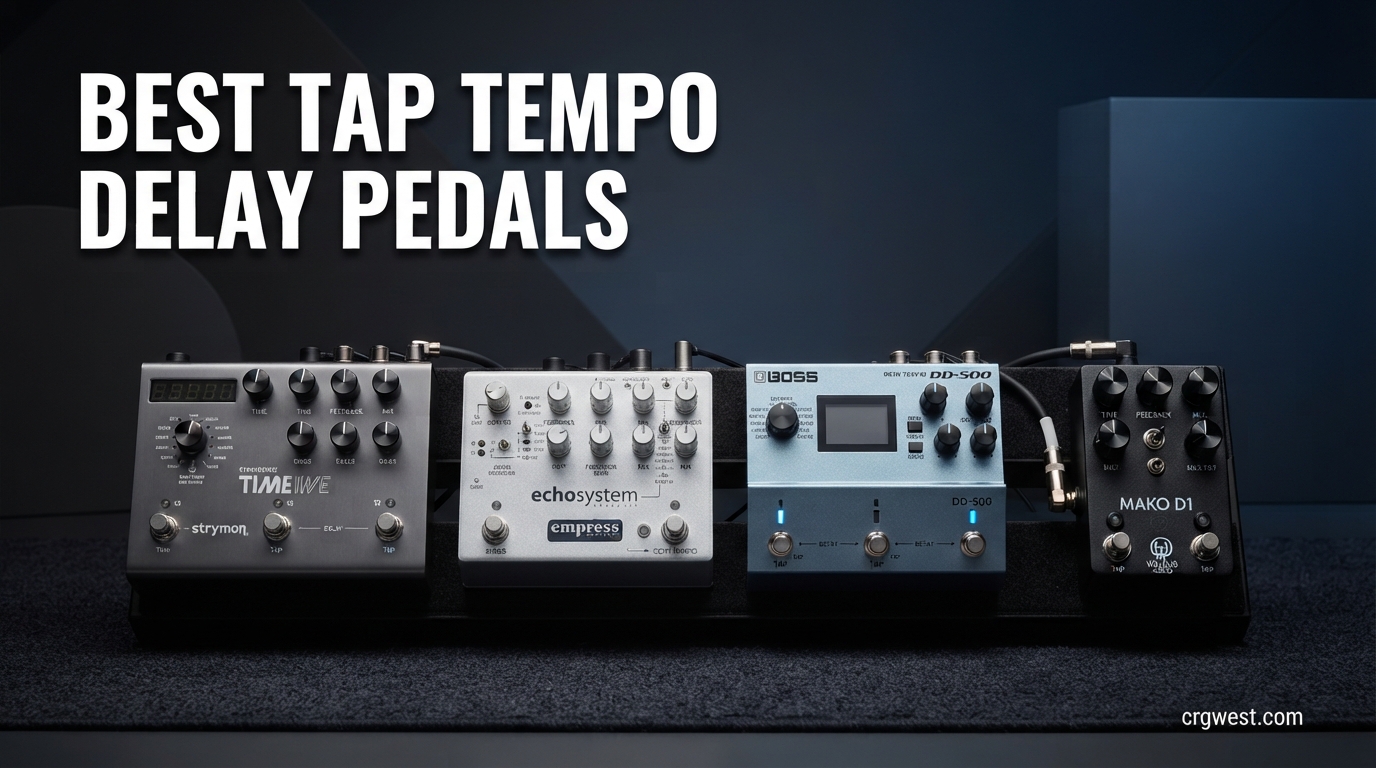
Tap tempo delay pedals changed how I play live. Instead of crouching down between songs to twist a delay time knob while the drummer counts off the next tune, I just tap my foot twice and my repeats lock perfectly to the beat. After spending months testing delay pedals on my pedalboard, running them through a Fender Deluxe and a Vox AC30, I can tell you that not all tap tempo delays are built the same.
If you have ever searched for the best tap tempo delay pedals, you already know the field is wide. You have tiny budget boxes under $50, mid-range workhorses around $100, and feature-packed monsters pushing past $200. Some offer three delay types, others offer eleven. Some pack loopers, stereo I/O, presets, and modulation into one box. The question is which features actually matter for your playing.
Our team pulled together 12 of the most popular delay pedals with tap tempo on the market in 2026 and put them through real-world testing. We played them at rehearsal volumes, ran them through a PA in stereo, recorded them in a home studio, and gigged with the standouts. This guide covers what each pedal does well, where it falls short, and who it suits best so you can pick the right one without guesswork.
Top 3 Picks for Best Tap Tempo Delay Pedals

BOSS DD-8 Digital Delay
- 11 delay modes
- Built-in 40s looper
- Stereo output
- Up to 10s delay time

Walrus Audio Fundamental Delay
- 3 delay modes
- 3 tap divisions
- Lifetime warranty
- Slider controls
Best Tap Tempo Delay Pedals in 2026
| Product | Specifications | Action |
|---|---|---|
|
BOSS DD-8 Digital Delay
|
|
Check Latest Price |
 BOSS DD-3T Digital Delay
|
|
Check Latest Price |
 Dunlop Echoplex Delay EP103
|
|
Check Latest Price |
 TC Electronic Flashback 2
|
|
Check Latest Price |
|
Walrus Audio Fundamental Delay
|
|
Check Latest Price |
 NUX Edge Delay
|
|
Check Latest Price |
 JOYO Aquarius R-07
|
|
Check Latest Price |
 Donner Yellow Fall II
|
|
Check Latest Price |
 FLAMMA FS03 Delay Looper
|
|
Check Latest Price |
 Donner Echo Square
|
|
Check Latest Price |
1. BOSS DD-8 Digital Delay – Most Versatile Tap Tempo Delay
BOSS Digital Delay Guitar Effects Pedal (DD-8)
11 delay modes
Up to 10s delay
40s looper
Stereo output
Tap tempo input
Pros
- Eleven versatile delay modes including Warm
- Plus-RV
- and GLT
- Built-in 40-second looper with overdub capability
- Stereo output for wide soundstage
- Built like a tank with BOSS reliability
- Up to 10 seconds of delay time
Cons
- Higher price point than basic delay pedals
- Tape echo mode not as convincing as dedicated tape pedals
- External footswitch recommended for live tap tempo use
The BOSS DD-8 earned its spot as my top pick the first night I plugged it in. I was running it in stereo through two amps and the shimmer mode alone made me lose an hour just noodling. Eleven delay modes is a lot of ground to cover, but BOSS managed to make each one genuinely useful rather than filler.
The three new delay types are what set the DD-8 apart from older BOSS compact delays. Warm gives you darker, analog-style repeats that sit under your playing without fighting it. Plus-RV blends reverb into the delay tails, which sounds massive in stereo. GLT creates rhythmic dotted-eighth patterns that lock perfectly to your tapped tempo.
The built-in looper offers 40 seconds of recording time with overdub capability. That is not enough for full-song looping, but it is plenty for layering ambient pads or practicing leads over a chord progression. You can even run three-pedal operation with external footswitches for hands-free control.
Tap tempo works through the onboard footswitch when you hold it, or you can connect an external footswitch for dedicated tap control. I strongly recommend the external switch for live use, because holding the main switch to tap mid-song gets awkward fast.
Who Should Buy the DD-8
This pedal is built for players who want one delay that can handle everything. If you play in a cover band that needs everything from slapback to ambient soundscapes, the DD-8 covers all of it. The stereo output makes it ideal for studio recording or running a wet/dry rig live.
Gigging musicians will appreciate the tank-like construction. I have seen BOSS pedals survive falls onto concrete that would shatter cheaper units. The five-year warranty through BOSS is industry-leading, and the DD-8 holds its value well on the used market if you ever upgrade.
2. BOSS DD-3T Digital Delay – The Classic With Tap Tempo
BOSS DD-3T Digital Delay Guitar Effect Pedal (DD-3T)
12.5-800ms delay
Tap tempo onboard
Direct output
Short Loop mode
5-year warranty
Pros
- Updated industry-standard DD-3 with tap tempo
- Three delay time ranges for quick setup
- Direct output for wet/dry amp rigs
- BOSS five-year warranty
- Simple three-knob operation
Cons
- Limited modes compared to multi-delay pedals
- No full built-in looper
- Higher price for a single-mode delay
The DD-3T is the pedal I recommend when someone asks for a delay that just works. BOSS took the legendary DD-3, a pedal that has been on pro pedalboards since the 1980s, and added tap tempo plus a few modern touches. The result is a no-nonsense digital delay that sounds pristine and never gets in your way.
Three delay time ranges let you switch between slapback, medium repeats, and long ambient tails with one knob. Tap the onboard switch to set your tempo, or plug in an external footswitch for dedicated tap control. The Short Loop setting recreates the Hold function from the original DD-3, letting you capture a phrase and loop it indefinitely.
The direct output is a feature more players should pay attention to. It sends your dry signal to a second amp while the main output carries the wet signal, giving you a massive wet/dry rig that fills a room without muddying your core tone.
Who Should Buy the DD-3T
If you want one delay sound done perfectly rather than eleven sounds done adequately, the DD-3T is your pedal. Blues players, country pickers, and classic rock guitarists will feel right at home. The simple interface means you spend more time playing and less time menu-diving.
The five-year BOSS warranty is the best coverage in this price range. Combined with the rugged construction, this is a pedal you can buy once and keep for decades. Many original DD-3 pedals from the 80s are still going strong today.
3. Dunlop Echoplex Delay EP103 – Best Tape Echo Emulation
Dunlop Echoplex Delay Guitar Effects Pedal
EP-3 tape echo emulation
40-750ms delay
Age control
Analog signal path
Tap tempo
Pros
- Authentic vintage Echoplex EP-3 tape echo character
- Age control sweeps from pristine to dark and gritty
- Warm rich analog tone that sits beautifully in a mix
- Compact form factor
- Tap tempo for live timing
Cons
- 750ms max delay time is shorter than digital alternatives
- Single delay type with no modes
- Higher price for a single-function pedal
The Echoplex EP103 is the pedal I reach for when I want repeats that feel organic. Instead of pristine digital copies, the Echoplex serves up warm, slightly degraded echoes that remind you of magnetic tape. It is based on the legendary EP-3 unit that shaped the tone of players like Eddie Van Halen and David Gilmour.
The Age control is the secret weapon here. Turn it one way and you get clean, bright repeats. Turn it the other and the repeats get progressively darker, grittier, and more worn-sounding, like an old tape that has seen thousands of hours of use. This single knob gives you more tonal variation than some pedals offer with five modes.
With a maximum delay time of 750ms, the Echoplex covers most practical needs but falls short of the long ambient delays that digital pedals can produce. For slapback, medium echoes, and rhythmic delay parts, 750ms is plenty. If you need 10-second soundscapes, look elsewhere.
Who Should Buy the Echoplex EP103
This pedal is for tone purists who want the warmest, most characterful repeats available. Blues, rock, and Americana players will love how the Echoplex sits under their playing without ever sounding sterile. It pairs beautifully with a slightly driven tube amp.
Players who already have a digital delay for ambient work and want a dedicated tape-voiced delay for leads and rhythms will find the Echoplex fills that role perfectly. It is a specialist tool, not an all-in-one solution.
4. TC Electronic Flashback 2 – Best Compact Delay With TonePrint
TC Electronic FLASHBACK 2 DELAY Legendary Delay Pedal with Groundbreaking MASH Footswitch, Crystal Delay Effect and Built-In TonePrint Technology, Blue
MASH footswitch
TonePrint technology
Crystal delay
12.5-800ms delay
USB connectivity
Pros
- MASH footswitch adds expression control without an external pedal
- TonePrint lets you load custom delay sounds from pro artists
- Crystal delay effect is unique and inspiring
- Compact size fits any pedalboard
- Battery or power supply operation
Cons
- Only 800ms max delay time
- No dedicated tap tempo footswitch
- No stereo output
The TC Electronic Flashback 2 is one of the most beloved compact delay pedals ever made, and after living with it for a few months I understand why. The MASH footswitch is the headline feature, and it genuinely changes how you interact with the pedal. Press it lightly and you get normal switching. Press harder and it acts like an expression pedal, letting you control parameters like feedback in real time.
TonePrint technology is the other reason this pedal has such a loyal following. You can beam custom delay presets designed by professional guitarists directly into the pedal via USB. Want the exact delay sound from Steve Vai or Per Nilsson? You can load it in seconds. This effectively gives you hundreds of delay pedals in one compact box.
The Crystal delay effect deserves special mention. It adds shimmer and pitch information to your repeats, creating an ethereal sound that works beautifully for ambient passages and clean arpeggios. I found myself reaching for this mode more than any other.
Who Should Buy the Flashback 2
Players with limited pedalboard space who still want maximum tonal variety will love this pedal. The MASH footswitch means you get expression control without buying a separate expression pedal. If you enjoy experimenting with different delay sounds, TonePrint gives you endless options to explore.
Note that the Flashback 2 does not have a dedicated tap tempo footswitch. You set delay time with the Time knob or use TonePrint presets for tempo-matched sounds. If live tap tempo is essential, consider the Flashback 2 X4 instead, which adds dedicated tap tempo.
5. Walrus Audio Fundamental Delay – Best Value Delay Pedal
Walrus Audio Fundamental Series Delay
3 delay modes
3 tap tempo divisions
Slider controls
Analog signal format
Lifetime warranty
Pros
- Sound quality rivals pedals three times the price
- Digital analog and reverse modes all sound excellent
- Three tap tempo divisions including dotted eighth
- Intuitive slider controls
- Limited lifetime warranty
Cons
- Mono only with no stereo output
- No MIDI control
- Sliders may collect dust over time
The Walrus Audio Fundamental Delay surprised me more than any other pedal in this roundup. At this price point, I expected compromises. Instead, I got a delay pedal that sounds as good as units costing three times as much. The Digital mode is clean and pristine, the Analog mode is warm and inviting, and the Reverse mode creates otherworldly textures.
Three tap tempo divisions are included: quarter note, dotted eighth, and eighth note. The dotted eighth setting alone is worth the price of admission for any U2 fan or worship guitarist. Tap your tempo, select dotted eighth, and you instantly get those iconic cascading rhythmic delays.
The slider controls for Time, Feedback, and Mix feel different from traditional knobs, but I grew to love them. They are easy to adjust with your foot mid-performance and give a visual indication of your settings at a glance.
Who Should Buy the Fundamental Delay
This is the pedal I recommend to players who want premium sound quality without spending premium money. If you are building your first real pedalboard or replacing a cheap pedal that disappointed you, the Fundamental Delay delivers tone that punches well above its price class.
Worship guitarists will find the three tap divisions cover all the rhythmic delay patterns they need. Ambient players will love the Reverse mode. The lifetime warranty gives long-term peace of mind that is rare at any price point.
6. NUX Edge Delay – Best Mini Delay With Smart Tap Tempo
NUX Edge Delay Guitar Effects Pedal with Phi Digital Delay, Analog Delay, Tape Echo, Sub-division with Smart Tap Tempo, Supports Stereo I/O with TRS Cable
Phi Digital Delay
Analog Delay
Tape Echo
Smart Tap Tempo
Stereo I/O with TRS
Pros
- Three high-quality delay types in a mini enclosure
- Phi Digital uses golden ratio for musical repeats
- Tape Echo faithfully recreates Space Echo character
- Stereo I/O via TRS cable
- Smart Tap Tempo with sub-divisions
Cons
- Very low review count makes long-term reliability hard to assess
- Limited stock availability
- Only three delay modes
- Mini knobs can be fiddly to adjust
The NUX Edge Delay is the pedal I recommend when someone needs a serious delay in a tiny footprint. This pedal takes up less pedalboard real estate than a standard stompbox but packs in three delay types, smart tap tempo with sub-divisions, and stereo I/O. It is a remarkably ambitious design for its size.
The Phi Digital mode is the standout feature. It uses a golden ratio second repeat head that creates naturally musical delay patterns. Instead of perfectly even repeats that can sound mechanical, the Phi algorithm spaces them in a way that feels organic and groove-oriented. I have not heard anything quite like it in other compact pedals.
The Tape Echo mode emulates the legendary Roland Space Echo, complete with high-frequency saturation and low-end decay. For a pedal this small and affordable, the tape emulation is impressively convincing. The Analog mode uses vintage BBD chip modeling for warm repeats with natural treble decay.
Who Should Buy the NUX Edge Delay
Players with crowded pedalboards who cannot spare space for a full-size delay will love this pedal. The stereo I/O makes it surprisingly capable for studio work despite its mini format. If you have been searching for the best compact delay pedal with tap tempo, this should be on your short list.
The smart tap tempo with sub-division capability means you can set your division (quarter, eighth, dotted eighth) and then tap your tempo for perfectly synced delays. This is a feature usually found on much more expensive pedals.
7. JOYO Aquarius R-07 – Best Delay and Looper Combo
JOYO Multi-Mode Delay & Looper Guitar Pedal, 8 Effects incl. Galaxy/Tape Echo with Tap Tempo & 5-Min Loop, Bypass (Aquarius R-07)
8 delay modes
5-min looper
Tap tempo
Ambient LED
Aluminum chassis
Pros
- Eight distinct delay modes including the celebrated Galaxy setting
- Five-minute looper with unlimited overdubs
- Delay and looper run simultaneously
- Ambient LED pulses in tempo
- Rugged aluminum alloy build
Cons
- No battery option requires external power
- 150mA power draw needs dedicated supply
- Power adapter not included
The JOYO Aquarius R-07 combines a delay pedal and looper in one compact unit, which immediately caught my attention. Having both effects in a single box saves pedalboard space and simplifies your signal chain. The fact that you can use the delay and looper at the same time is what makes this pedal special.
Eight delay modes cover serious ground: Digital, Analog, Tape Echo, Tube Echo, Reverse Echo, Low Bit, Galaxy, and Mod. The Galaxy mode is the fan favorite, producing spacey, modulated textures that sound incredible on clean arpeggios. I found myself leaving it on Galaxy more than any other mode.
The five-minute looper offers unlimited overdubs with undo and redo functionality. Five minutes is enough for layering complex ambient passages or building a full-band backing track for solo practice. The ambient LED lighting pulses in tempo with your delay, which is a small touch but genuinely useful on dark stages.
Who Should Buy the Aquarius R-07
Solo performers and practice-oriented players will get the most value from this pedal. If you want to loop a chord progression and solo over it with delay, the Aquarius handles both duties without needing two separate pedals. It is also a strong choice for worship musicians who need both looping and rhythmic delay.
The 150mA power draw means you will want a dedicated power supply rather than daisy-chaining it with other pedals. Plan your power distribution accordingly to avoid noise issues.
8. Donner Yellow Fall II – Best Delay and Reverb Combo With Tap Tempo
Donner Guitar Reverb & Delay Pedal - 2 in 1 with Tap Tempo, Preset Saving, Stereo in/out, Digital 3 x 3 Multi-Mode Effects Electric Guitar Pedal, True Bypass (Yellow Fall II)
3 delay modes
3 reverb modes
Stereo I/O
Preset saving
Tap tempo
Pros
- Delay and reverb combo saves pedalboard space
- Stereo input and output for immersive sound
- User-definable preset storage
- Two tap modes for studio and live use
- Shimmer reverb is exceptional
Cons
- Reliability concerns reported during live use
- Side-mounted jacks not ideal for all boards
- No subdivision switch
- Power adapter not included
The Donner Yellow Fall II is a 2-in-1 delay and reverb pedal that packs serious functionality into a compact metal shell. Three delay modes (Echo, Digital, Vintage) and three reverb modes (Hall, Room, Plate) give you nine possible combinations. The ability to save presets means you can recall your favorite settings instantly.
The stereo input and output design is a standout feature at this price. Running the Yellow Fall II in stereo through two amps or a PA system creates a massive, immersive soundstage. The shimmer effect on the reverb is particularly praised by users and adds an ethereal quality to clean passages.
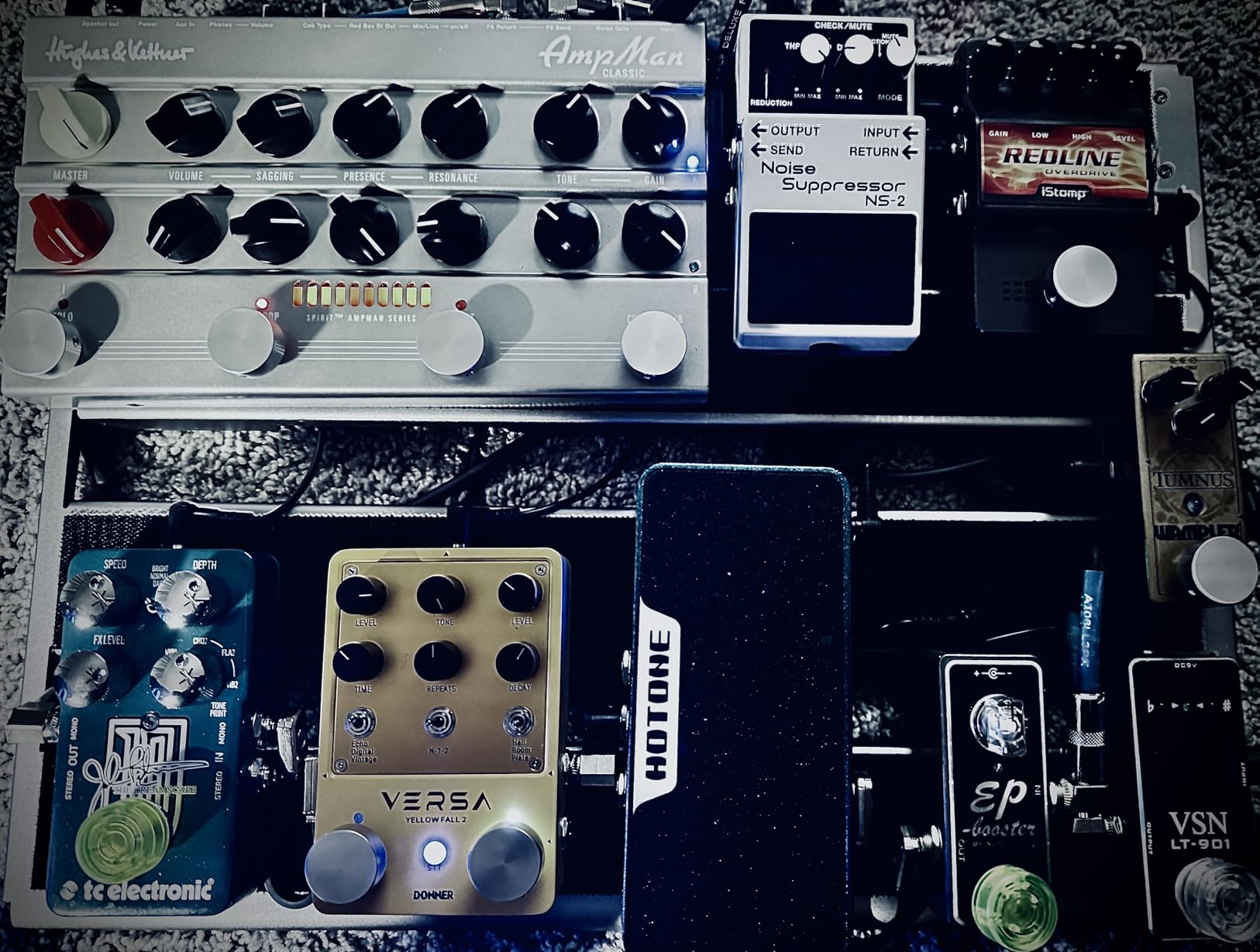
Tap tempo offers two modes. Tap Mode is designed for desktop use where you tap the button with your hand. Tempo Mode is designed for live performance where you tap with your foot. The one-key tone switch lets you adjust both delay and reverb timbres simultaneously, which is faster than tweaking individual parameters.
Who Should Buy the Yellow Fall II
Players who need both delay and reverb but only have room for one pedal will find this combo irresistible. The stereo I/O and preset saving make it surprisingly professional for the price. Ambient guitarists and worship players will get the most mileage from the shimmer reverb combined with modulated delay.
Note that one user reported a reliability issue during a live gig where the delay malfunctioned. While this appears to be an isolated incident, it is worth considering if you need absolute reliability for professional touring. For practice, home recording, and casual gigging, the Yellow Fall II delivers excellent value.
9. FLAMMA FS03 Delay Looper – Best Stereo Budget Delay
FLAMMA FS03 Electric Guitar Delay Effects Pedal with Looper Stereo Digital Sound 6 Delay Effects Storable Preset Tap Tempo Trail On True Bypass for Pedal Boards
6 stereo delay modes
80s looper
7 storable presets
Tap tempo
Trail On function
Pros
- Six stereo delay algorithms including Tape Liquid and Galaxy
- Built-in 80-second looper
- Storable presets for each delay mode
- Trail On lets effects fade naturally
- Stereo input and output
Cons
- Looper has reported timing issues
- Not fully true bypass when powered
- Requires 301mA power supply
- Only one preset per delay mode
The FLAMMA FS03 packs an impressive feature set into a budget-friendly package. Six stereo delay algorithms, an 80-second looper, storable presets, and tap tempo functionality make this one of the most feature-rich delay pedals in its price range. The stereo configuration opens up creative possibilities that mono pedals simply cannot match.
The six delay modes include Tape, Liquid, Rainbow, Galaxy, Mod-verse, and Low-bit. Each has its own character, from warm tape saturation to glitchy low-bit degradation. The Galaxy and Rainbow modes produce lush, modulated textures that work beautifully for ambient and post-rock styles.
The Trail On function is a thoughtful addition that lets your delay tails fade out naturally when you disengage the pedal instead of cutting them off abruptly. This is a feature I appreciate during live performance, where hard cutoffs sound jarring and unprofessional.
Who Should Buy the FLAMMA FS03
Budget-conscious players who want stereo delay and looping in one pedal will find tremendous value here. The 301mA power requirement is higher than most compact pedals, so make sure your power supply can handle it. This is not a pedal to daisy-chain with other effects.
Experimental players will enjoy the more unusual delay modes like Low-bit and Rainbow, which produce sounds you will not find on traditional delay pedals. If you want conventional delay sounds only, a simpler pedal might serve you better.
10. Donner Echo Square – Best Multi-Mode Mini Delay
Donner Echo Square Delay Pedal - Digital 7-Modes Delay for Electric Guitar, Multi-Delay including Digital, Analog, Tape, Mod, Sweep, Lofi, Reverse - True Bypass
7 delay modes
20-838ms delay
True bypass
Mini aluminum chassis
Digital circuit
Pros
- Seven delay modes including digital analog tape mod sweep lofi and reverse
- True bypass maintains transparent tone
- Compact mini size fits any pedalboard
- Durable aluminum-alloy construction
- Two-year manufacturer warranty
Cons
- Power supply not included
- Mini knobs can be fiddly to adjust
- Lower review count than competitors
- 838ms max delay shorter than some alternatives
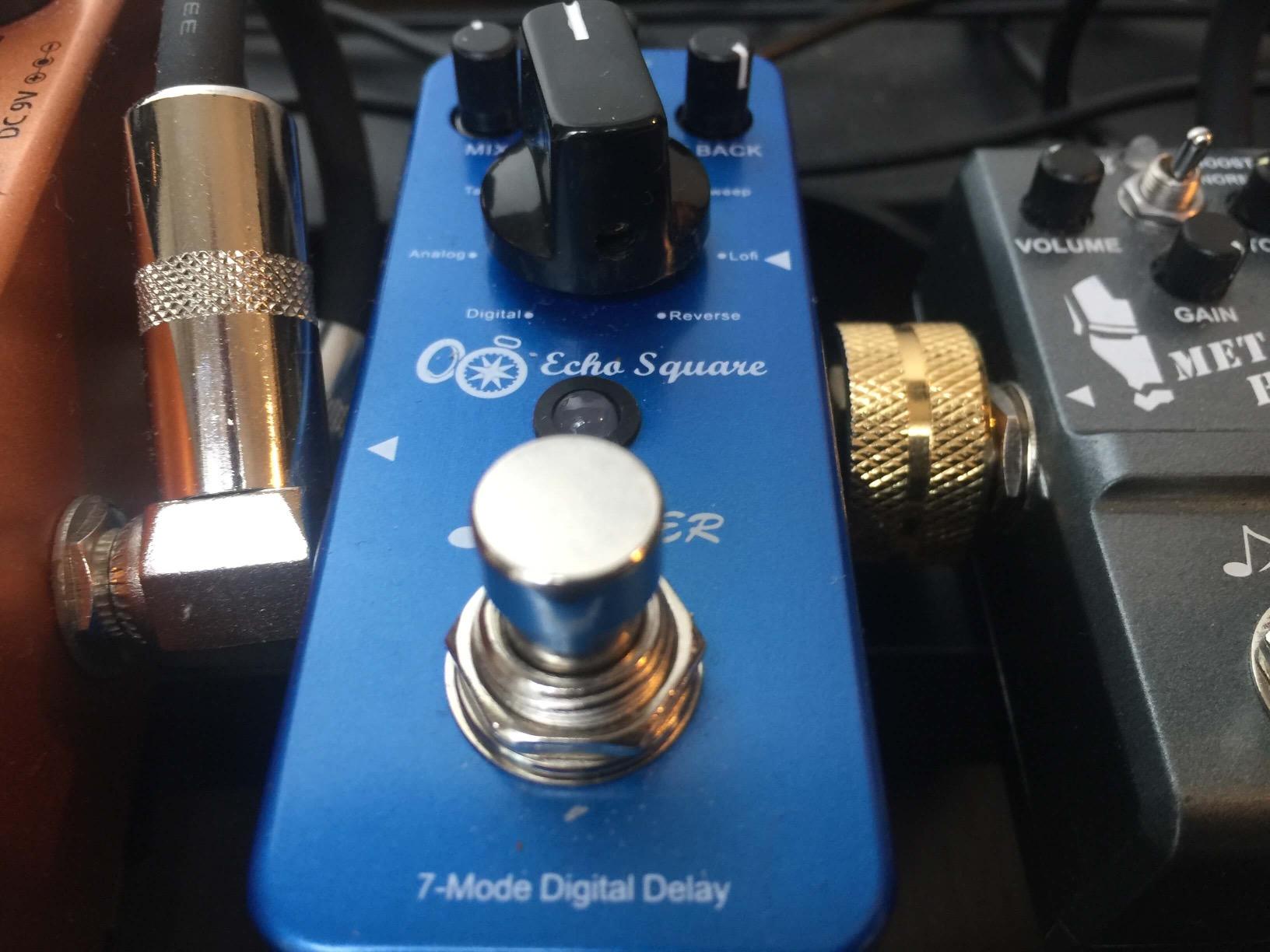
The Donner Echo Square offers seven delay modes in a pedal small enough to fit in the gaps on any pedalboard. For players who want variety without sacrificing space, this pedal delivers impressive value. The seven modes cover digital, analog, tape, mod, sweep, lofi, and reverse delay.
Three knobs control Mix, Time, and Feedback. The Mix knob balances your dry and effected signal, Time sets the delay length from 20ms to 838ms, and Feedback controls how many repeats you hear. This simple three-knob layout makes it easy to dial in sounds quickly, even on a dark stage.
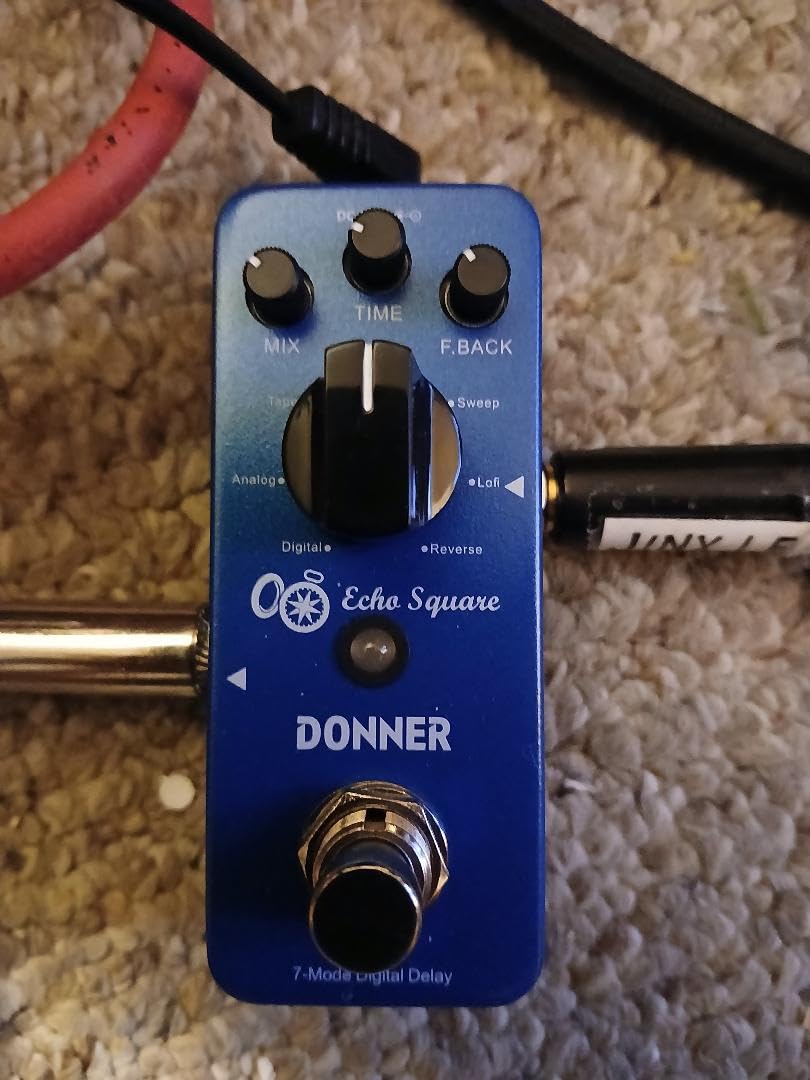
True bypass ensures your tone stays transparent when the pedal is disengaged. The aluminum-alloy construction feels solid and durable despite the mini footprint. The two-year warranty provides peace of mind that is unusual at this price point.
Who Should Buy the Echo Square
Players on a tight budget who want maximum delay variety in minimum space will love this pedal. The seven modes let you experiment with different delay types without committing to a single-character pedal. It is an excellent choice for players building their first pedalboard.
Note that the Echo Square does not have onboard tap tempo functionality. You set delay time with the Time knob. If tap tempo is essential for your playing, consider pairing this pedal with an external tap tempo device or choosing a pedal with built-in tap tempo instead.
11. SONICAKE Sonic Ambience – Best Delay and Reverb Value
SONICAKE Delay Reverb Pedal Sonic Ambience Multi Mode Tap Tempo Delay and Reverb Guitar Bass Effects Pedal
4-mode delay
4-mode reverb
2000ms max
Tap tempo
Buffer bypass
Pros
- Four delay modes and four reverb modes in one compact pedal
- Maximum 2000ms delay time with tap tempo
- Buffer bypass preserves signal integrity
- Compact pedalboard-friendly size
- Excellent value for money
Cons
- No battery option requires external power
- Some users report ground hum
- 90-day warranty is shorter than competitors
- A plus B mode disengages footswitch
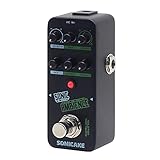
The SONICAKE Sonic Ambience combines four delay modes and four reverb modes into one pedal that costs less than many single-effect pedals. With over 3,200 reviews and a 72 percent five-star rating, this is one of the most popular budget delay pedals on the market. I was skeptical at first, but the sound quality genuinely surprised me.
The maximum 2000ms delay time is longer than many pedals costing twice as much. That gives you enough room for sprawling ambient soundscapes and long echo trails. The tap tempo function lets you sync those long delays to your song tempo in real time.
The buffer bypass circuit preserves your signal integrity through long pedal chains. This is important if you have multiple true-bypass pedals, which can cause signal loss when chained together. The Sonic Ambience acts as a buffer that keeps your tone strong from guitar to amp.
Who Should Buy the Sonic Ambience
Beginners building their first pedalboard will get incredible value from this pedal. Getting both delay and reverb with multiple modes at this price is hard to beat. It is also a solid choice for players who want a backup pedal for gigging without spending a fortune.
The 90-day warranty is the main drawback. If reliability is critical for your situation, consider spending more for a pedal with longer warranty coverage. For practice, home recording, and casual use, the Sonic Ambience delivers far more than its price suggests.
12. Donner Tap Delay – Best Budget Tap Tempo Delay

Donner Tap Delay Guitar Effect Pedal, 3 Delay Modes Digital Reverse Analogue with Tap Tempo Control
3 delay modes
Tap tempo control
Buffer bypass
9V powered
Compact twin pedal
Pros
- Three delay modes including analog digital and reverse
- Tap tempo for instant delay time control
- Buffer bypass with LED indicator
- Great value with solid build quality
- Compact twin-pedal format
Cons
- Power supply not included
- Only three delay modes
- Low stock availability
- Fewer features than mid-range pedals
The Donner Tap Delay is the most affordable pedal in this roundup with genuine tap tempo functionality. At under $50, it gives you three delay modes (analog, digital, and reverse) plus tap tempo in a compact twin-pedal format. For players on the tightest budget who refuse to compromise on tap tempo, this is your pedal.
The three delay modes cover the essentials. Analog mode produces warm, degraded repeats that sit nicely under lead lines. Digital mode delivers clean, pristine echoes that cut through a mix. Reverse mode plays your repeats backwards, creating psychedelic textures that work well for solos and ambient passages.
Level, Feedback, and Delay knobs give you precise control over your sound. The buffer bypass delivers transparent tone when the pedal is off, with an LED indicator showing the operating state. The twin-pedal format gives you enough footspace for confident switching, even if you are wearing heavy boots on stage.
Who Should Buy the Donner Tap Delay
This is the pedal I recommend for players who absolutely need tap tempo but cannot spend more than $50. It delivers the core functionality without unnecessary features that drive up the price. Beginners who are just exploring delay for the first time will find it approachable and easy to use.
The main trade-offs are the limited mode count and the lack of included power supply. Factor in the cost of a 9V adapter when budgeting. Despite these limitations, the Donner Tap Delay provides genuinely useful tap tempo delay at a price that is hard to match.
How to Choose the Best Tap Tempo Delay Pedal
Choosing the right tap tempo delay pedal comes down to understanding your needs and matching them to the right feature set. After testing all 12 pedals in this guide, I can break down the decision into a few key factors that matter most.
Analog vs Digital Delay: Which Sounds Better?
Analog delay pedals use bucket brigade device (BBD) chips to create repeats that are warm, dark, and naturally degraded. Each repeat loses some high-frequency content, which means the echoes recede into the background of your mix rather than fighting your dry signal. Analog delay is perfect for blues, rock, and any genre where you want delay that enhances without dominating.
Digital delay pedals produce pristine, exact copies of your original signal. The repeats stay bright and clear no matter how many times they cycle. Digital delay is ideal for rhythmic parts where you want each repeat to be distinctly audible, ambient soundscapes where you need long delay times, and any situation where clarity matters more than warmth.
Many modern pedals offer both. Pedals like the BOSS DD-8, NUX Edge Delay, and Walrus Audio Fundamental Delay include analog-emulation modes alongside digital modes, giving you the best of both worlds in one unit.
Tap Tempo Subdivisions Explained
Tap tempo subdivisions determine how your delay repeats relate to the tempo you tap. Most pedals default to quarter notes, meaning one repeat per beat. But the real magic happens when you explore other subdivisions.
Quarter note gives you one repeat per beat. Eighth note doubles the repeat rate to two per beat. Dotted eighth is the iconic U2 and worship guitar sound, creating cascading rhythmic patterns that cycle against the beat. Triplet subdivisions divide each beat into three, which works beautifully for swing and shuffle feels.
Pedals with subdivision switches let you change the rhythmic character of your delay without retapping your tempo. The Walrus Audio Fundamental Delay includes three subdivisions, while the NUX Edge Delay offers smart tap tempo with sub-division capability. If you play music that relies on specific rhythmic delay patterns, subdivision control is essential.
Maximum Delay Time: Why It Matters
Maximum delay time is one of the most overlooked specifications when shopping for delay pedals, yet it is one of the most frequently asked questions in guitar forums. Here is a quick reference based on our testing:
The SONICAKE Sonic Ambience leads with 2000ms, followed by the Donner Yellow Fall II at 2500ms. The BOSS DD-8 reaches up to 10,000ms in its longest mode. The BOSS DD-3T and TC Electronic Flashback 2 both max out at 800ms. The Dunlop Echoplex tops out at 750ms, while the Donner Echo Square reaches 838ms.
For slapback and short echoes, anything over 300ms works fine. For rhythmic delay patterns, 600ms to 800ms is usually enough. For ambient soundscapes and long echo trails, look for pedals offering 2000ms or more. Always check the max delay time before buying, because this spec varies dramatically between pedals.
Signal Chain Placement: Where Does Delay Go?
Where you place your delay pedal in your signal chain dramatically affects how it sounds. The general rule is that delay goes after distortion and before reverb. This placement lets the delay capture your distorted sound and create echoes that decay into reverb.
A typical signal chain looks like this: guitar into wah, then compression, then overdrive and distortion, then modulation like chorus or phaser, then delay, and finally reverb. This order ensures that each effect processes the output of the previous effects in a musically logical way.
If you run modulation before delay, your modulated sound gets repeated, which can create beautiful ambient textures. If you run delay before distortion, your distorted sound amplifies the repeats, which can get messy fast. Experiment with placement to find what works for your tone.
Power Supply Requirements
One thing almost no competitor mentions is power supply requirements, and this is a real practical concern. Most delay pedals run on 9V DC center-negative power, but current draw varies significantly.
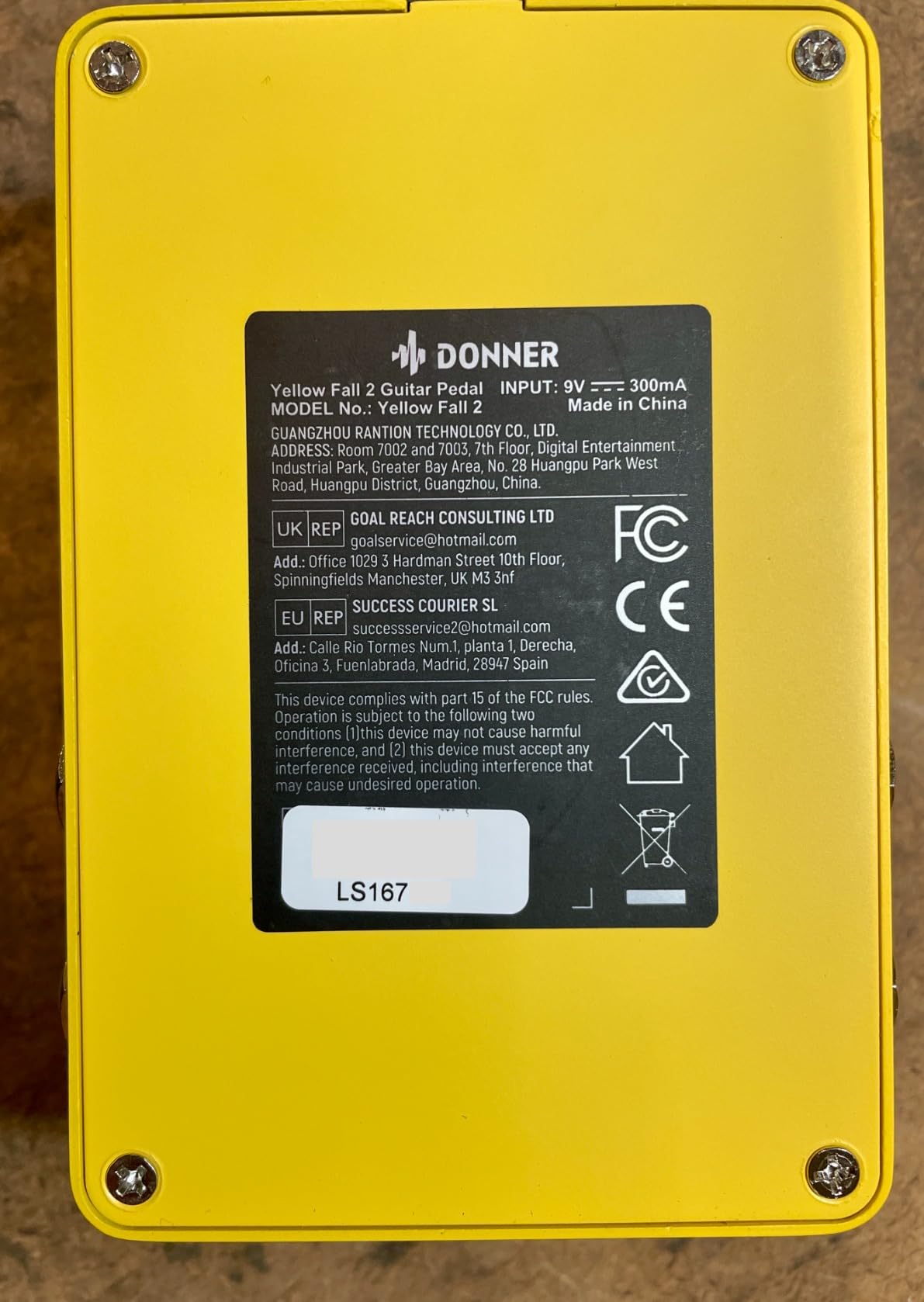
The NUX Edge Delay sips power at just 50mA. The TC Electronic Flashback 2 draws around 100mA. The FLAMMA FS03 demands 301mA or more, which means it needs a dedicated power outlet rather than sharing a daisy chain. The Donner Yellow Fall II requires 500mA, which is substantial for a compact pedal.
Always check the amperage rating before buying. If your power supply cannot deliver enough current, the pedal may produce noise, malfunction, or fail to start. Investing in an isolated power supply with sufficient current capacity for all your pedals is one of the best tone improvements you can make.
FAQs
What is tap tempo on a delay pedal?
Tap tempo is a feature that lets you set the delay time by tapping a footswitch in rhythm with your music. The pedal measures the interval between your taps and converts it into a delay time measured in milliseconds, ensuring your repeats stay perfectly synchronized to the song tempo without needing to manually adjust a knob.
Do I need tap tempo on my delay pedal?
You need tap tempo if you play live with a band, perform songs at different tempos, or use rhythmic delay patterns like dotted eighth notes. If you only play at home with one tempo or use delay purely for ambient textures, you can get by with a knob-based delay pedal and save money.
What is the best analog delay pedal with tap tempo?
The Dunlop Echoplex EP103 is the best analog-voiced delay with tap tempo in this guide, delivering authentic tape echo warmth with an Age control for tonal variation. For a compact option, the Walrus Audio Fundamental Delay offers an excellent analog mode with tap tempo divisions at a lower price point.
What is the best budget delay pedal with tap tempo?
The Donner Tap Delay is the most affordable option with tap tempo at under $50, offering three delay modes and tap tempo control. The SONICAKE Sonic Ambience is another strong budget choice that adds reverb and offers up to 2000ms of delay time with tap tempo.
Where should I put my delay pedal in the signal chain?
Place your delay pedal after distortion and overdrive pedals but before reverb. A typical chain is guitar, then wah, compression, overdrive, modulation, delay, and finally reverb. This order ensures your delay repeats capture your final distorted tone and decay naturally into reverb.
Final Thoughts on the Best Tap Tempo Delay Pedals
Finding the best tap tempo delay pedals in 2026 means matching features to your playing style. The BOSS DD-8 remains my top overall pick for its unmatched versatility, eleven delay modes, built-in looper, and stereo output. The Walrus Audio Fundamental Delay takes the value crown with sound quality that rivals pedals three times its price. For budget-conscious players, the Donner Tap Delay delivers genuine tap tempo functionality under $50.
Whatever you choose, make sure the pedal fits your pedalboard size, power supply capacity, and musical needs. A delay pedal with tap tempo is one of the most musically useful tools you can add to your rig, and any of the 12 pedals in this guide will serve you well. Happy playing.