
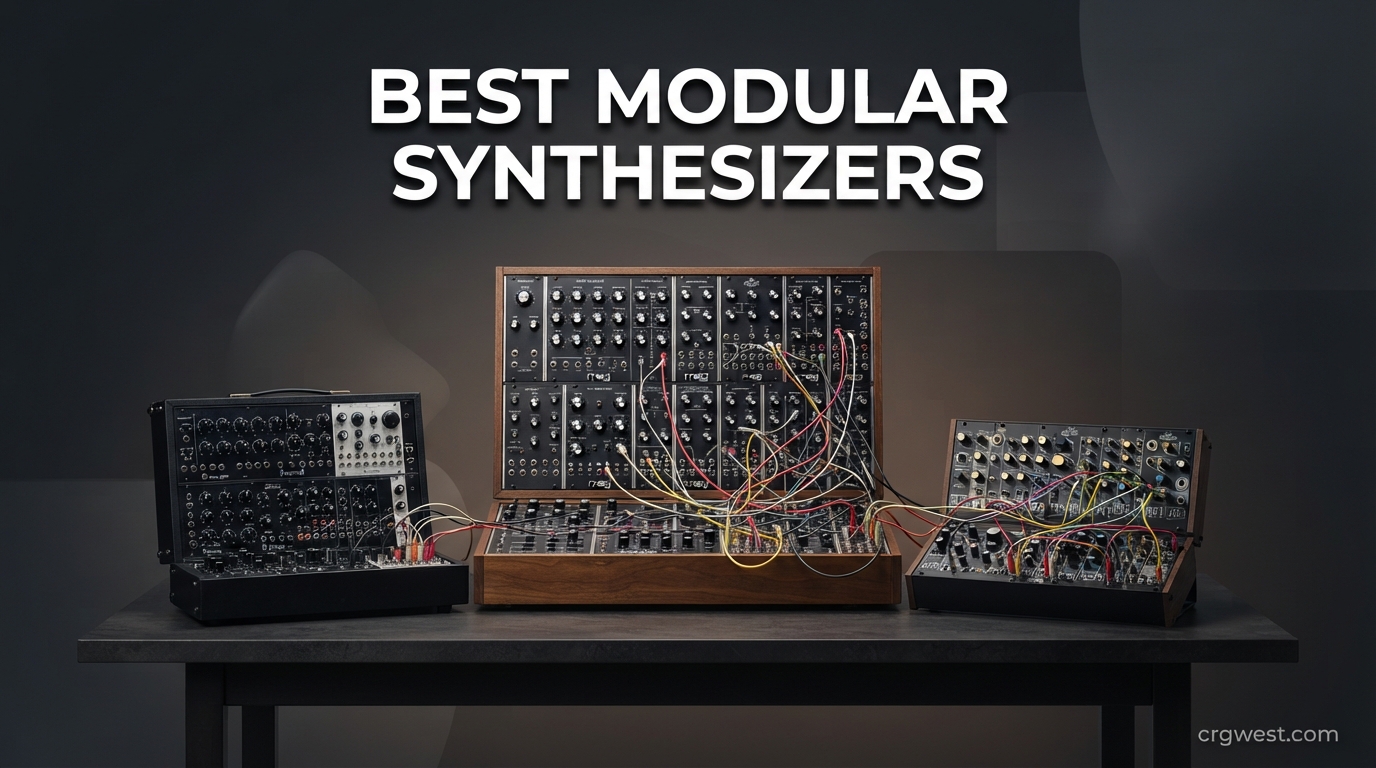
Finding the best modular synthesizers in 2026 means sorting through a crowded field of semi-modular desktop units, Eurorack-ready instruments, and classic recreations that all promise hands-on sound design. I have spent months patching cables, twisting knobs, and running these synths through studio monitors and live sets to figure out which ones actually deliver. This guide breaks down 15 standout picks across every price tier, from the budget-friendly Korg Volca Modular to the polyrhythmic Moog Subharmonicon, so you can find the right fit without guesswork.
Modular synthesis can feel intimidating if you have never patched anything before, but it does not have to be. The best modular synthesizers on this list include beginner-friendly semi-modular designs that work straight out of the box, plus deeper options that grow with you as your patching skills improve. I focused on real-world playability, sound quality, patch point flexibility, and overall value because those are the things that matter when you are three hours into a session.
Whether you are chasing West Coast wavefolding textures, East Coast subtractive warmth, or acid bass lines for techno, there is a synth here for your setup. I also kept an eye on Eurorack compatibility, since most players eventually want to expand into a full modular system. Let us get into the synths that earned their spot.
Top 3 Picks for Best Modular Synthesizers

Best Modular Synthesizers in 2026
| Product | Specifications | Action |
|---|---|---|
|
Moog Subharmonicon
|
|
Check Latest Price |
 Moog Mother-32
|
|
Check Latest Price |
 Korg Volca Modular
|
|
Check Latest Price |
 Make Noise 0-Coast
|
|
Check Latest Price |
 Moog Grandmother
|
|
Check Latest Price |
 Behringer Proton
|
|
Check Latest Price |
 Behringer Neutron
|
|
Check Latest Price |
 Arturia MiniBrute 2
|
|
Check Latest Price |
 Korg MS-20 Mini
|
|
Check Latest Price |
 Behringer Spice
|
|
Check Latest Price |
1. Moog Subharmonicon – Polyrhythmic Analog Powerhouse
MOOG Subharmonicon Semi-Modular Analog Polyrhythmic Synthesizer with Dual Sequencer, MIDI, and Patch Bay
Semi-modular analog
Dual subharmonic VCOs
Four rhythm generators
Two 4-step sequencers
60HP Eurorack
Pros
- Unique subharmonic synthesis engine
- Generative polyrhythmic capabilities
- Comprehensive 32-point patch bay
- Eurorack compatible 60HP format
Cons
- Sequencer knobs lack detents
- No on/off switch
- Niche sound for traditional players
I patched the Subharmonicon for a solid month before writing this, and it consistently surprised me. The dual VCO architecture paired with subharmonic generators creates tones I have not heard from any other synth in this price range. It is not a traditional subtractive monster like the Grandmother, but that is exactly why it stands out.
The polyrhythmic sequencing is where this instrument becomes an inspiration machine. Four rhythm generators and two 4-step sequencers interact in ways that produce evolving patterns without you touching anything. I have left it running for hours, walking back into the room to find new musical ideas still flowing.
Build quality matches what you expect from Moog. The wood side panels and aluminum housing feel solid, and the 32-point patch bay gives you plenty of room to integrate it with a larger Eurorack system. Pairing it with a Mother-32 and DFAM in a three-tier Moog rack is the dream setup many players are working toward.
The downside is that the Subharmonicon is niche. If you want classic lead and bass sounds, look elsewhere. The sequencer knobs also lack detents, which makes recalling exact settings frustrating. There is no power switch either, which is a strange omission at this tier.
Best For Experimental And Generative Music
The Subharmonicon thrives when you let it run on its own. Ambient producers, generative music artists, and anyone who enjoys watching patterns evolve will find this synth endlessly inspiring. It rewards patience and experimentation over fast riffing.
If you produce techno or experimental electronic music, the polyrhythmic engine creates foundation loops that feel alive. I tracked several patches into my DAW and they never sounded the same twice.
Integration With Larger Modular Systems
The 60HP Eurorack-compatible format means the Subharmonicon slides right into a larger rack. The patch bay accepts and sends standard Eurorack voltage levels, so you can route its sequences to external modules or modulate it from external LFOs.
MIDI In support lets you trigger it from a sequencer or keyboard without needing a separate MIDI to CV converter. That is a real cost savings if your studio already runs on MIDI clock.
2. Moog Mother-32 – The Eurorack Gateway
MOOG Mother-32 Semi-Modular Eurorack Analog Synthesizer with 32-Step Sequencer, VC Oscillator and Ladder Filter, MIDI In, Extended Patchbay, CV Jack
Semi-modular analog
Single VCO with noise
Classic Moog ladder filter
32-step sequencer
60HP Eurorack format
Pros
- Authentic warm Moog sound right out of the box
- Excellent 32-step sequencer with 64 stored patterns
- No patching required for basic operation
- Perfect gateway into Eurorack modular
Cons
- Limited sequence memory of 64 patterns
- Patch points could be more extensive
- Occasional calibration drift
The Mother-32 is the synth most experienced modular players recommend to beginners, and after living with one for weeks I understand why. It works the second you plug it in, with no patch cables needed for a basic subtractive signal path. That makes it approachable in a way most modular gear simply is not.
The classic Moog ladder filter is the star here. Run a triangle wave through it with a slow envelope and you get that buttery, warm tone Moog built its reputation on. The single VCO plus white noise generator is simpler than some competitors, but the sound quality justifies the focus.
The 32-step sequencer is more powerful than it looks at first glance. Two sequencer modes and 64 on-board pattern slots give you plenty to work with before you ever touch a patch cable. I found myself building full tracks using just the internal sequencer and a drum machine.
Where the Mother-32 shines is as part of a larger system. The 60HP Eurorack format means it mounts in a standard rack, and the patch bay exposes the signal path for modular routing. Many players build their first Eurorack system around a Mother-32 and never look back.
Sound Character And Filter Response
The ladder filter has a distinctive resonance that sits perfectly in a mix. It does not get harsh or screechy the way some modern filters do. Self-oscillation kicks in smoothly and tracks pitch well enough for melodic filter sweeps.
The single VCO might feel limited compared to the dual-oscillator competition, but Moog voiced it so carefully that it covers a wide tonal range. Mixing the sawtooth and pulse waves with the noise generator gives you more variation than you would expect.
Sequencer Workflow And Live Performance
The 32-step sequencer supports two modes for different workflow preferences. Storing up to 64 patterns means you can build entire song structures and recall them during a live set. Patching external modulation into the sequencer clock input creates polyrhythmic possibilities.
The main limitation is memory. Once you fill all 64 slots, you need to clear patterns to add new ones. For live performers who need hundreds of patterns, this gets restrictive fast.
3. Korg Volca Modular – Best Budget Modular Synth
Korg Volca Modular Micro Synthesizer Semi Modular w/ Eight Modules and 16-step Sequencer
Semi-modular analog
Eight independent modules
50 patch points
16-step sequencer
West Coast synthesis style
Pros
- Incredible value for first-time modular buyers
- 50 color-coded patch points
- Built-in speaker and battery power
- West Coast wavefolding synthesis
Cons
- Limited module count compared to pricier synths
- Some background noise reported
- Less powerful than higher-end options
The Korg Volca Modular is the synth I recommend to anyone who asks whether modular synthesis is worth trying. For a fraction of what most semi-modular synths cost, you get 50 patch points, eight modules, and a genuine West Coast synthesis voice. It is the cheapest legitimate entry point into modular thinking.
I carry mine around the house because it runs on batteries and has a built-in speaker. That portability changes how you interact with the instrument. You can patch on the couch, on the porch, or in a hotel room without any extra gear.
The West Coast synthesis approach sets it apart from the Moog-style subtractive synths on this list. Wavefolding, low-pass gate dynamics, and complex harmonic generation produce metallic, bell-like, and evolving tones that sound nothing like a standard analog synth.
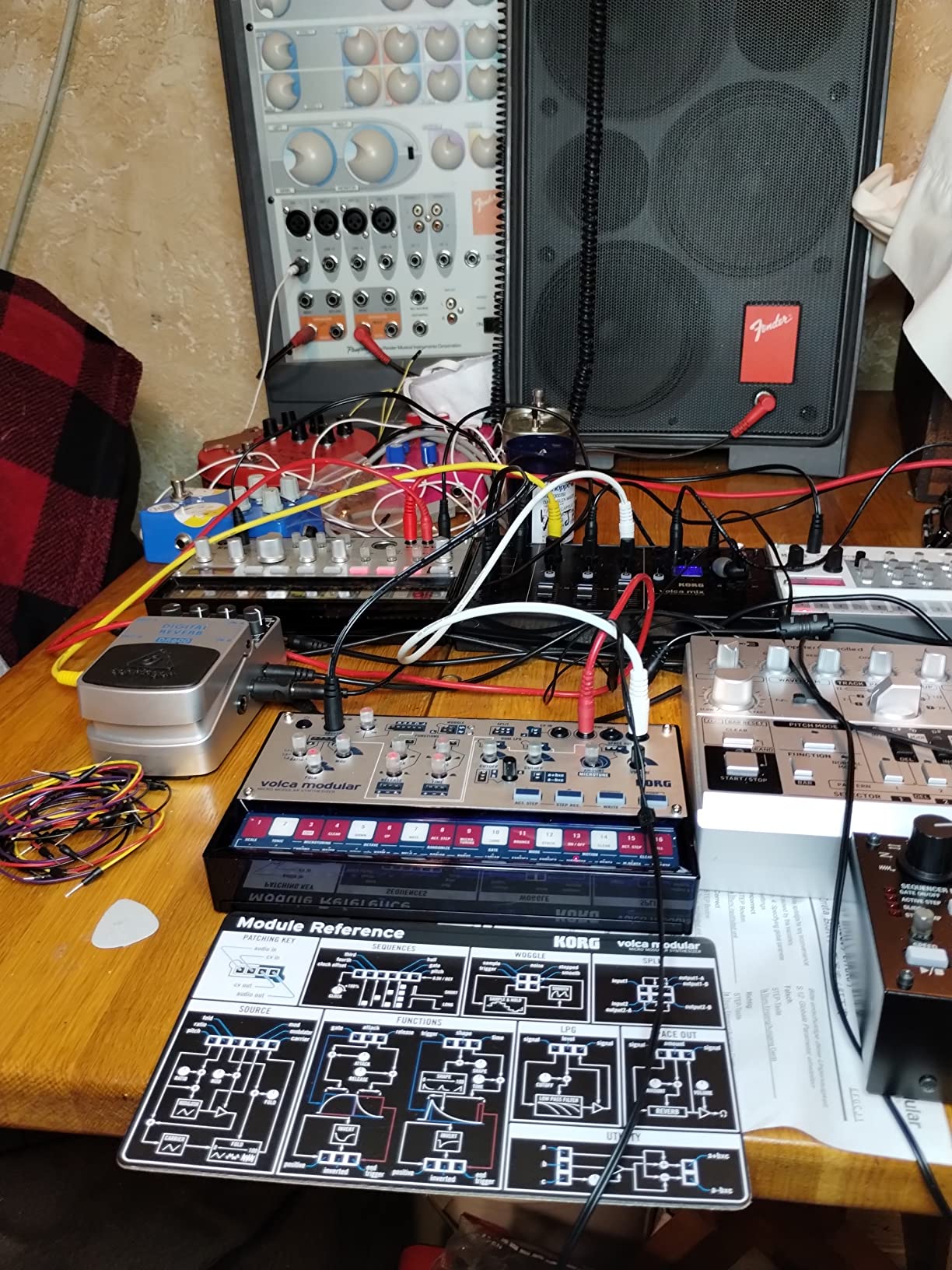
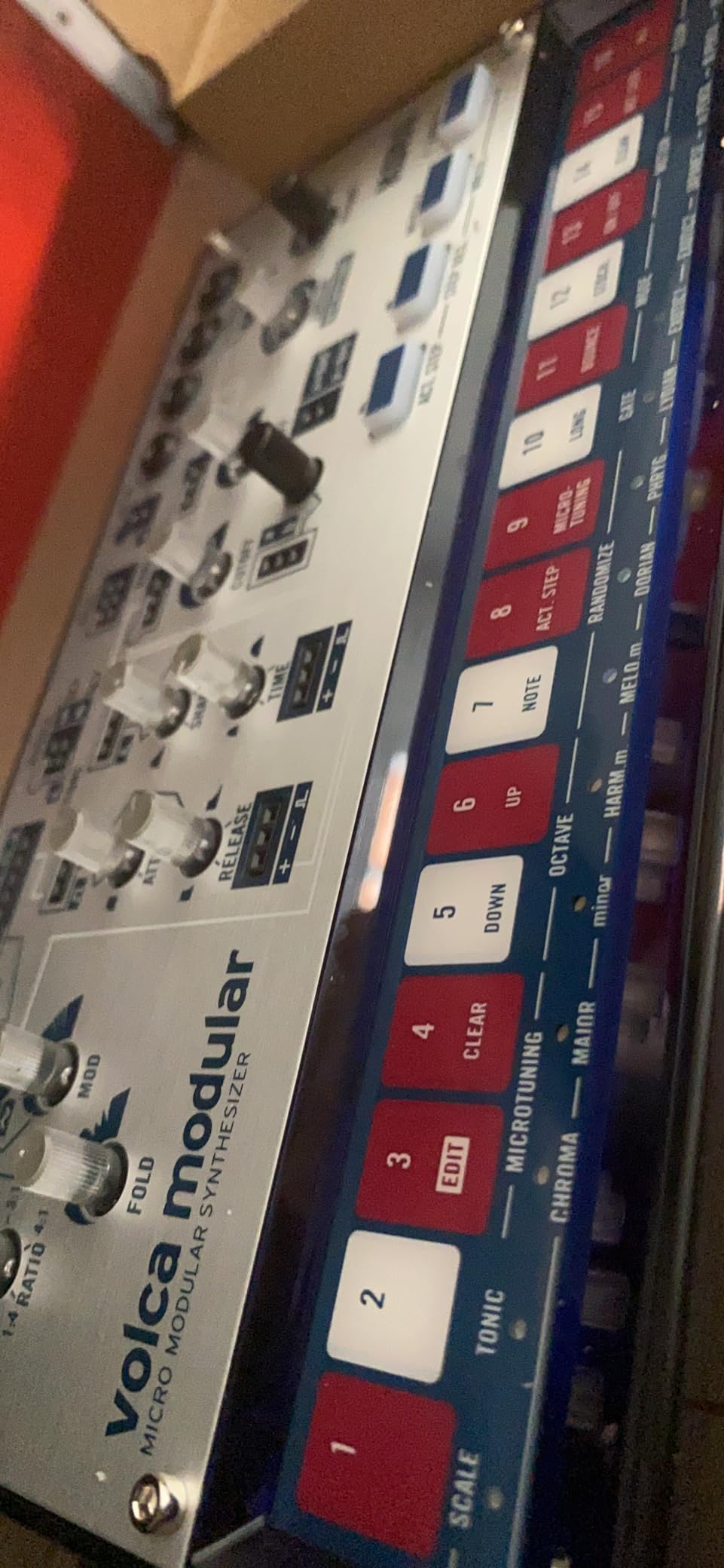
The 16-step sequencer includes a randomize function that throws out unexpected patterns. I use it constantly to break out of creative ruts. The two playback modes let you chain steps or create sub-sequences for more variation.
Color-coded patch points make the signal flow easy to follow, which matters enormously when you are learning. Inputs and outputs use distinct colors so you can trace a patch visually without reading labels. That is a thoughtful design choice for beginners.
The main trade-off is power and sound quality. The modules are limited compared to a full Eurorack system, and some users report background noise that would be unacceptable in a professional studio context. Treat it as a learning tool and creative sketchpad rather than a primary studio synth.
Ideal First Modular Synth For Beginners
If you have never patched anything before, the Volca Modular teaches you the fundamentals for less than any other option. You learn signal flow, modulation routing, and West Coast techniques without risking hundreds of dollars on a single module.
Many players buy one, learn the basics over a few months, then graduate to Eurorack with a clear understanding of what they want. That makes the Volca Modular one of the best educational investments in synthesis.
Portability And Live Performance Use
Battery power and a built-in speaker mean you can play anywhere. The compact size fits in a backpack, and the durable metal body handles travel well. Some producers use multiple Volca units chained together for full live techno sets.
The sync jack connects to other Volca devices for locked timing across a small setup. That makes building a portable groovebox rig affordable and straightforward.
4. Make Noise 0-Coast – Bridging East And West Coast
Make Noise 0-Coast
Semi-modular analog
No-coast design
27 patch points
Dual MIDI to CV channels
Built-in arpeggiator
Pros
- Unique design bridging East and West Coast synthesis
- 27 patch points with balanced sources and destinations
- Built-in MIDI to CV and MIDI to Gate conversion
- Dual-mode arpeggiator
Cons
- Small review sample size
- Steep learning curve
- Can be hard to find in stock
The Make Noise 0-Coast does not sound like any other synth on this list. Its no-coast design borrows techniques from both subtractive East Coast synthesis and complex West Coast wavefolding, then blends them into something entirely its own. I spent two weeks with it before I felt I understood the signal flow.
That learning curve is real, but the payoff is an instrument that covers enormous tonal ground. You can dial in fat bass tones and then flip a switch to get metallic, harmonically complex textures that sound like nothing else. The 27 patch points expose 13 sources and 14 destinations, giving you deep modular routing control.
The built-in MIDI to CV conversion is a major advantage. Two channels of MIDI to CV and two channels of MIDI to Gate mean you can control the 0-Coast directly from any MIDI keyboard or DAW without buying a separate interface. The dual-mode arpeggiator adds another layer of performance control.
Build quality is excellent, with a steel chassis that feels built to last. USB connectivity and 3.5mm audio jacks make integration into a modern studio straightforward. Eurorack signal compatibility means you can patch it alongside any Eurorack module.
Unique Sonic Character And Patching
The 0-Coast uses an overtone generator and a dynamics controller instead of a traditional filter-and-VCA chain. This produces tones that sit somewhere between a sine wave and a complex harmonic cluster. Wavefolding adds harmonics rather than removing them, which inverts the subtractive approach most players are used to.
If you are tired of conventional analog synth sounds, the 0-Coast will wake up your ears. Every patch feels like discovering a new instrument.
MIDI Integration And DAW Workflow
The dual MIDI to CV channels let you control pitch and gate independently from any MIDI source. Sync to MIDI clock keeps everything locked to your DAW tempo. The arpeggiator responds to incoming MIDI notes for real-time performance tweaking.
This makes the 0-Coast one of the easiest modular-friendly synths to integrate into a computer-based studio. No extra hardware is needed to get it talking to your existing setup.
5. Moog Grandmother – Keyboard Synth With Spring Reverb
MOOG Grandmother Semi-Modular Analog Keyboard Synthesizer with 32 Keys, Built-In Arpeggiator, Sequencer and Spring Reverb Tank
Semi-modular analog keyboard
32 velocity keys
Dual oscillators
Analog spring reverb
41 patch points
Pros
- Iconic Moog analog warmth with playable keyboard
- Built-in analog spring reverb tank
- 256-note sequencer with 3 pattern files
- 41 modular patch points for Eurorack integration
Cons
- Heavy at over 16 pounds
- Limited stock availability
- Power switch placement could be better
The Moog Grandmother is the synth I reach for when I want to play keys, not just patch cables. The 32 velocity-sensing full-size keys make it a proper instrument in a way the tabletop synths on this list are not. Two oscillators with selectable waveforms feed the classic Moog ladder filter, and the sound is everything you hope for from a Moog.
The built-in analog spring reverb tank is the secret weapon. It gives the Grandmother a spacious, vintage character that usually requires an external effect. Dial in a little reverb on a slow patch and the whole sound field opens up beautifully.
The 41 modular patch points expose nearly every stage of the signal path. You can patch the Grandmother into a Eurorack system, control external modules from its keyboard and sequencer, or process external audio through its filter and reverb. That flexibility justifies the premium price for serious players.
The 256-note sequencer stores three sequence files, giving you enough room for live performance material. MIDI over USB and 5-pin DIN covers all standard connectivity needs. The lacquered wood cabinet looks as good as it sounds.
Keyboard Playability And Sound Design
The 32 full-size keys have a quality feel that invites expressive playing. Velocity sensitivity responds well across the dynamic range, and the key action suits both fast bass lines and slow lead work. Having a keyboard attached means you explore sounds by playing, not just by patching.
The dual oscillator architecture produces thick, detuned leads and bass tones that fill a mix. Mix the noise generator into the filter input for percussion and texture effects.
Spring Reverb And External Processing
The spring reverb tank is a genuine analog effect, not a digital simulation. It adds character that digital reverbs struggle to replicate. The reverb sits in the signal path with its own patch points, so you can route external audio through it.
Processing drum machines or vocals through the Grandmother filter and reverb creates effects that would otherwise require a rack of modules. This makes it a creative sound design tool beyond its role as a synthesizer.
6. Behringer Proton – Paraphonic Eurorack Synth
Behringer PROTON Analog Paraphonic Semi-Modular Synthesizer with 2 VCOs, 2 Multi-Mode VCFs and 2 VCAs, 4 Envelopes and Wave Folder in Eurorack Format
Paraphonic semi-modular analog
2 VCOs
2 multi-mode VCFs
2 VCAs and 4 envelopes
Wave folder
Eurorack format
Pros
- Paraphonic architecture for chord-like patches
- Dual multi-mode VCFs with flexible routing
- Four envelopes for complex modulation
- Wave folder for harmonic richness
Cons
- Very limited review base so far
- Low stock availability
- No long-term reliability data yet
The Behringer Proton is a newer entry that brings paraphonic architecture to the Eurorack-format semi-modular space. With two VCOs, two multi-mode VCFs, two VCAs, and four envelopes, it offers more modulation depth than most competitors at this price. I was impressed by how much sound-shaping power fits into the compact panel.
The wave folder adds harmonic complexity that takes the Proton beyond basic subtractive territory. Patch the folder output back into the filter input and you get evolving, almost granular textures. The four envelopes allow for complex routing schemes that would normally require multiple external modules.
Paraphonic mode lets you play two notes simultaneously, which opens up chord and interval patches. Most semi-modular synths at this price are strictly monophonic, so the Proton stands out for players who want harmonic content without buying multiple units.
The early review base is small, which makes long-term reliability hard to judge. Behringer quality has improved significantly in recent years, but the Proton is new enough that we will know more once it has been in studios for a full year.
Paraphonic Mode And Chord Patches
Paraphonic architecture means each oscillator can play its own note while sharing a single filter and amplifier. This produces a distinctive chorus-like sound when the two VCOs are slightly detuned. It is not true polyphony, but for pads and layered textures it works well.
Try playing minor thirds and fifths for thick harmonic clusters that fill out ambient mixes.
Wave Folder And Modulation Depth
The wave folder takes simple waveforms and adds harmonics dynamically based on input level. This creates the bright, complex tones associated with West Coast synthesis. Patch an LFO or envelope into the folder amount for evolving timbral shifts.
With four envelopes available, you can shape amplitude, filter cutoff, wave folder amount, and a secondary parameter all independently. That is serious modulation depth for a single unit.
7. Behringer Neutron – Dual 3340 Analog Workhorse
Behringer Synthesizer (NEUTRON)
Semi-modular analog
Dual 3340 VCOs
Pure analog signal path
5-shape waveform blending
USB Type B
3-year warranty
Pros
- Authentic dual 3340 analog oscillators with stable tuning
- Pure analog signal path from oscillator to output
- Oscillator waveform control blends between five shapes
- Solid 3-year manufacturer warranty
Cons
- Some quality control inconsistencies reported
- Stock fluctuates regularly
- Panel layout takes getting used to
The Behringer Neutron has earned a loyal following for one simple reason: it delivers authentic dual 3340 analog oscillators and a pure signal path for far less than you would expect. I have run it alongside synths costing three times as much and the Neutron holds its own sonically.
The oscillator waveform control is a standout feature. Rather than switching between fixed wave shapes, you blend continuously between five waveform types. That smooth morphing creates transitional tones you cannot get from a switch, and it makes the Neutron feel more expressive under your fingers.
The pure analog signal path means no digital conversion anywhere in the audio chain. The sound has a thickness and warmth that digital or hybrid synths struggle to match. Bass patches in particular have a weight that sits perfectly in a club mix.
With 171 reviews and an 81 percent five-star rating, the Neutron has built enough community trust to recommend confidently. The 3-year warranty provides extra peace of mind for a synth at this price point.
Analog Oscillator Quality And Tuning Stability
The 3340 chip is the same oscillator used in classic synths like the Prophet 5 and Oberheim OB-Xa. Behringer licensed an authentic reproduction, and it shows in the tuning stability and tonal quality. I left the Neutron on for eight hours and drift was minimal.
The blendable waveform control is more useful than it sounds. Sweeping from triangle to sawtooth while modulating the blend creates movement that static wave switching cannot achieve.
Value Compared To Higher-End Alternatives
The Neutron delivers dual-oscillator analog synthesis with patch points for less than many single-oscillator competitors. The trade-off is build quality, which is good but not exceptional. The basswood body and metal panel are functional rather than luxurious.
If sound quality matters more than premium materials, the Neutron is one of the best values in modular synthesis. Pair it with a good case and power supply and you have a serious system foundation.
8. Arturia MiniBrute 2 – Semi-Modular With Keyboard
Arturia MiniBrute 2 Semi-Modular Analog Synthesizer and Step Sequencer
Semi-modular analog
2 VCOs and 2 LFOs
Steiner Parker filter
48-point patchbay
25-key keyboard with aftertouch
Pros
- 48-point CV and gate patchbay for deep modulation
- Steiner Parker filter with four distinct modes
- 25-key keyboard with aftertouch for expressive playing
- Strong entry point into Eurorack expansion
Cons
- Quality control issues reported by some buyers
- Stock availability is often limited
- Lower overall rating than some competitors
The Arturia MiniBrute 2 is the synth I recommend to keyboard players who want semi-modular flexibility without giving up playable keys. The 25-key keyboard with aftertouch feels responsive, and the 48-point patchbay exposes enough of the signal path for serious modular experimentation.
Two VCOs and two LFOs give the MiniBrute 2 more modulation depth than the original. The Steiner Parker filter with four modes is the sonic identity of this synth. It can sound aggressive and screamy in a way that complements the warmer Moog-style filters on other units.
I spent time patching the MiniBrute 2 into a Eurorack system and the integration was smooth. The patchbay uses standard 3.5mm jacks at Eurorack voltage levels, so no conversion is needed. This makes it a genuine modular hub, not just a synth with a few extra patch points.
The 4.2-star average rating is lower than most synths on this list, primarily due to quality control issues reported by some buyers. The 17 percent one-star reviews are worth noting. Arturia support is generally responsive, but factor in the possibility of needing a return or exchange.
Steiner Parker Filter Character
The Steiner Parker filter is known for its aggressive resonance and distinctive character. In low-pass mode it produces thick bass tones, while high-pass and band-pass modes open up percussive and atmospheric possibilities. The fourth mode adds a notch filter for vocal-like formant effects.
This filter pairs beautifully with the dual VCO architecture. Detune the oscillators slightly, push the resonance, and you get acid-tinged leads that cut through any mix.
Eurorack Expansion Potential
The 48-point patchbay makes the MiniBrute 2 one of the best platforms for expanding into full Eurorack. You can use its keyboard and modulation sources to control external modules, or route external audio through its filter and VCA.
Many players mount the MiniBrute 2 alongside a Eurorack case and treat it as a controller, sound source, and modulation hub all in one. That is a lot of functionality for the price.
9. Korg MS-20 Mini – Legendary Patching Synth
Korg MS20 Mini Semi-Modular Analog Synthesizer (MS20MINI), MultiColored, M
Semi-modular analog
Dual self-oscillating filters
External signal processor
Flexible patching system
USB and 5-pin MIDI
Pros
- Self-oscillating high-pass and low-pass filters with distinctive distortion
- External signal processor for processing any audio source
- Faithful recreation of the legendary MS-20 architecture
- Flexible patching with patch cables included
Cons
- Not Prime eligible
- Very limited stock availability
- Some quality concerns reported
The Korg MS-20 Mini is a faithful recreation of the synthesizer that defined a generation of electronic music. The dual self-oscillating filters are the heart of its character, producing the aggressive, distorted tones heard on countless post-punk and industrial records. Playing one feels like touching synthesizer history.
The external signal processor sets the MS-20 apart from nearly every other semi-modular synth. You can route any audio source through its filters and envelope follower, turning the synth into an effects processor for drums, vocals, or guitars. I have run entire drum mixes through the MS-20 filters for textural destruction.
The flexible patching system uses a separate patch panel rather than exposing every signal stage. This keeps the front panel organized while still giving you deep routing control. The included patch cables mean you can start experimenting immediately.
USB MIDI plus 5-pin MIDI covers all connectivity bases. With 178 reviews and a 4.4-star rating, the MS-20 Mini has the track record to back up its legendary status. Stock is often limited, so if you find one available, do not hesitate.
Filter Character And Distortion
The MS-20 filters are famous for their aggressive, almost brutal resonance. The high-pass filter self-oscillates independently, letting you create percussion-like tones and effects. When both filters interact, the harmonic distortion produces sounds no other synth can replicate.
This is not a smooth, polished filter. It growls, distorts, and surprises. For aggressive electronic music, it is unmatched.
External Signal Processing Applications
The ESP module follows the amplitude of any incoming audio and converts it to control voltage. This means you can play the MS-20 filters with a drum loop, vocal, or guitar, with the filter envelope tracking the source dynamics.
Producers use this for filtering drum breaks, creating vocal effects, and processing entire mixes. It turns the MS-20 into a creative effects unit that no software plugin can truly replicate.
10. Behringer Spice – Affordable Polyrhythmic Monosynth
Behringer Spice Analog Semi-modular Polyrhythmic Synthesizer
Semi-modular analog monosynth
2x 4-step sequencer
32-point patch matrix
Polyrhythm generator
Multimode VCF
4 sub-oscillators
Pros
- Polyrhythm generator for evolving patterns
- Affordable entry into semi-modular synthesis
- 32-point patch matrix with flexible routing
- Multimode VCF with multiple filter types
Cons
- Not Prime eligible so shipping may be slower
- Very limited review base currently
- Newer product with uncertain long-term reliability
The Behringer Spice is one of the newest affordable semi-modular options, bringing polyrhythmic sequencing to a price point that undercuts most competitors. The 32-point patch matrix gives you direct access to the signal path without the cable clutter of larger patch bays. I found it surprisingly intuitive for designing evolving patterns.
Two 4-step sequencers running simultaneously create polyrhythmic interplay that feels musical rather than chaotic. The polyrhythm generator handles the timing math so you can focus on note selection. For ambient and generative producers, this is a serious creative tool at a budget price.
The multimode VCF offers multiple filter types in a single module, giving you low-pass, high-pass, and band-pass options. Four sub-oscillators add low-end weight for bass patches that fill out the bottom of any mix. The alloy steel body feels durable enough for regular use.
With only 9 reviews so far, the Spice is still proving itself in the community. The early feedback is positive, but consider waiting for more long-term data if reliability is a top priority.
Polyrhythm Generator Workflow
The polyrhythm generator divides a master clock into different rhythmic subdivisions for each sequencer. Set one sequencer to 4 steps and another to 5, and the patterns shift against each other continuously. This produces the evolving, never-quite-repeating loops that define generative music.
For techno producers, polyrhythmic foundations add depth and movement that static loops cannot match.
Patch Matrix Vs Traditional Patch Cables
The 32-point patch matrix uses a pin-based routing system rather than cables. This keeps the panel clean and makes signal flow easy to trace. The trade-off is less flexibility than a full patch cable bay, since each point serves a fixed function.
For beginners, the matrix approach is less intimidating than a wall of cables. For experienced modular users, it may feel limiting compared to a fully patchable system.
11. Behringer 2600 – Classic ARP Recreation

Behringer 2600 Analog Semi-modular Synthesizer
Analog semi-modular
Faithful ARP 2600 recreation
Large format
3.5mm TS connectors
Educational instrument
Pros
- Warm fat analog sound faithful to the original ARP 2600
- Excellent educational tool for learning synthesis fundamentals
- Great value compared to vintage originals
- Deep architecture for complex sound design
Cons
- Steep learning curve for newcomers
- Documentation could be clearer
- Some durability concerns reported
The Behringer 2600 brings the legendary ARP 2600 architecture to a price point that actual musicians can afford. Vintage ARP 2600 units sell for thousands, but this recreation delivers the same warm, fat analog character for a fraction of the cost. Playing it feels like using a piece of synthesizer history.
The large format is a deliberate design choice that makes the 2600 one of the best educational instruments available. Every module has its own clearly labeled section on the panel, with signal flow that you can trace visually. For learning synthesis fundamentals, nothing beats a 2600-style layout.
The sound is where the 2600 truly shines. The oscillators are thick and musical, the filter is smooth and expressive, and the envelope generators have a snap and character that digital emulations miss. I spent hours just exploring the factory-default routings before patching anything.
With a 4.7-star rating from early reviews, the community response has been overwhelmingly positive. The learning curve is real, and the documentation leaves room for improvement, but the payoff is one of the most rewarding synthesis experiences available.
Educational Value For Learning Synthesis
The 2600 panel layout teaches signal flow by example. Each module is a self-contained block with inputs on the left and outputs on the right. You can see exactly how an oscillator feeds a filter, which feeds an envelope, which feeds an amplifier.
For students and self-taught producers, the 2600 is essentially a synthesis textbook you can play. Understanding this architecture transfers directly to software synths, Eurorack systems, and any other modular format.
Sound Design Depth And Patching
The 2600 includes features that most modern synths omit entirely. Ring modulation, sample and hold, a voltage processor, and a spring reverb are all built in. The internal speakers let you play without external amplification, though studio monitors reveal the full sound quality.
Complex patches involving multiple modulation sources and audio rate modulation create textures that range from musical to otherworldly. The 2600 rewards deep exploration.
12. Behringer TD-3 – Authentic Acid Bass Synth

Behringer TD-3-AM Analog Bass Line Synthesizer with VCO, VCF, 16-Step Sequencer, Distortion Effects and 16-Voice Poly Chain
Analog bass line synth
Authentic TB-303 circuitry
4-pole low-pass filter
16-step sequencer
16-voice poly chain
MIDI USB
Pros
- Authentic TB-303-style acid bass sounds at unbeatable price
- True analog circuitry with 4-pole resonant filter
- Built-in 16-step sequencer for pattern creation
- Massive community with 790 reviews backing it
Cons
- Plastic build quality feels cheap
- Built-in distortion effect is underwhelming
- Quality control inconsistencies reported
The Behringer TD-3 is the synth that made acid bass accessible to everyone. By faithfully reproducing the TB-303 circuitry at a fraction of the vintage price, Behringer gave an entire generation of producers access to the squelchy, resonant bass lines that defined acid house and techno. With 790 reviews, this is one of the most popular analog synths ever made.
The 4-pole low-pass resonant filter is the soul of the TD-3. Push the resonance up and sweep the cutoff slowly to get that unmistakable squelch. The filter responds to accent and slide commands from the sequencer, which is what gives the 303 its characteristic playing feel.
The built-in 16-step sequencer handles pattern programming with the classic x0x workflow. It takes practice to learn, but once you understand the accent and slide programming, you can create bass lines that groove in a way no software plugin matches. The 16-voice poly chain lets you link multiple TD-3 units for expanded setups.
The plastic build is the obvious compromise at this price. The distortion effect built into the unit is generally considered underwhelming, and most producers bypass it for external pedals. Quality control issues pop up in reviews, so check your unit carefully on arrival.
303-Style Sequencer Workflow
The TD-3 sequencer uses the same step-entry system as the original TB-303. You program pitch per step, then add accent and slide modifiers. This workflow forces you to think in terms of groove rather than melody, which is why 303 bass lines have such a distinctive feel.
Once you internalize the workflow, patterns come together fast. Many producers say they can build a usable bass line in under five minutes.
Live Performance And Poly Chain Setup
The poly chain feature lets you connect multiple TD-3 units and play them as a polyphonic system. Most players use a single unit for bass, but chaining two or three opens up chord and layer possibilities for live sets.
MIDI USB connectivity makes DAW integration simple. Route MIDI from your sequencer and the TD-3 locks to tempo without any manual configuration.
13. Behringer Cat – Dual VCO Paraphonic Synth

Behringer CAT Legendary Paraphonic Analog Synthesizer with Dual VCOs, 4 Mixable Waveforms, External Signal Processor, 16-Voice Poly Chain and Eurorack Format
Paraphonic analog synth
Dual VCO design
4 mixable waveforms
Duophonic mode
External signal processor
Eurorack format
Pros
- Dual VCO design produces thick and rich sounds
- Paraphonic and duophonic modes for two-note patches
- Four variable oscillator shapes per VCO
- Eurorack format compatible for easy expansion
Cons
- Bass wood body feels less premium than metal
- Limited documentation included
- Not Prime eligible
The Behringer Cat recreates the classic CAT SRM II circuitry in an affordable Eurorack-format package. The dual VCO design produces thick, rich sounds that work beautifully for bass, leads, and textural pads. With 130 reviews and a 4.6-star rating, it has built solid community trust.
Four variable oscillator shapes per VCO give you extensive tonal options before you even touch the filter. Mix between wave shapes for hybrid tones, or detune the oscillators for chorus-like thickness. The duophonic mode lets you play two notes independently, which most monophonic synths at this price cannot do.
The external signal processor adds creative flexibility. Route drum loops, vocals, or other synths through the Cat filter for textural effects that no software plugin replicates exactly. This makes the Cat a sound design tool beyond its role as a synthesizer.
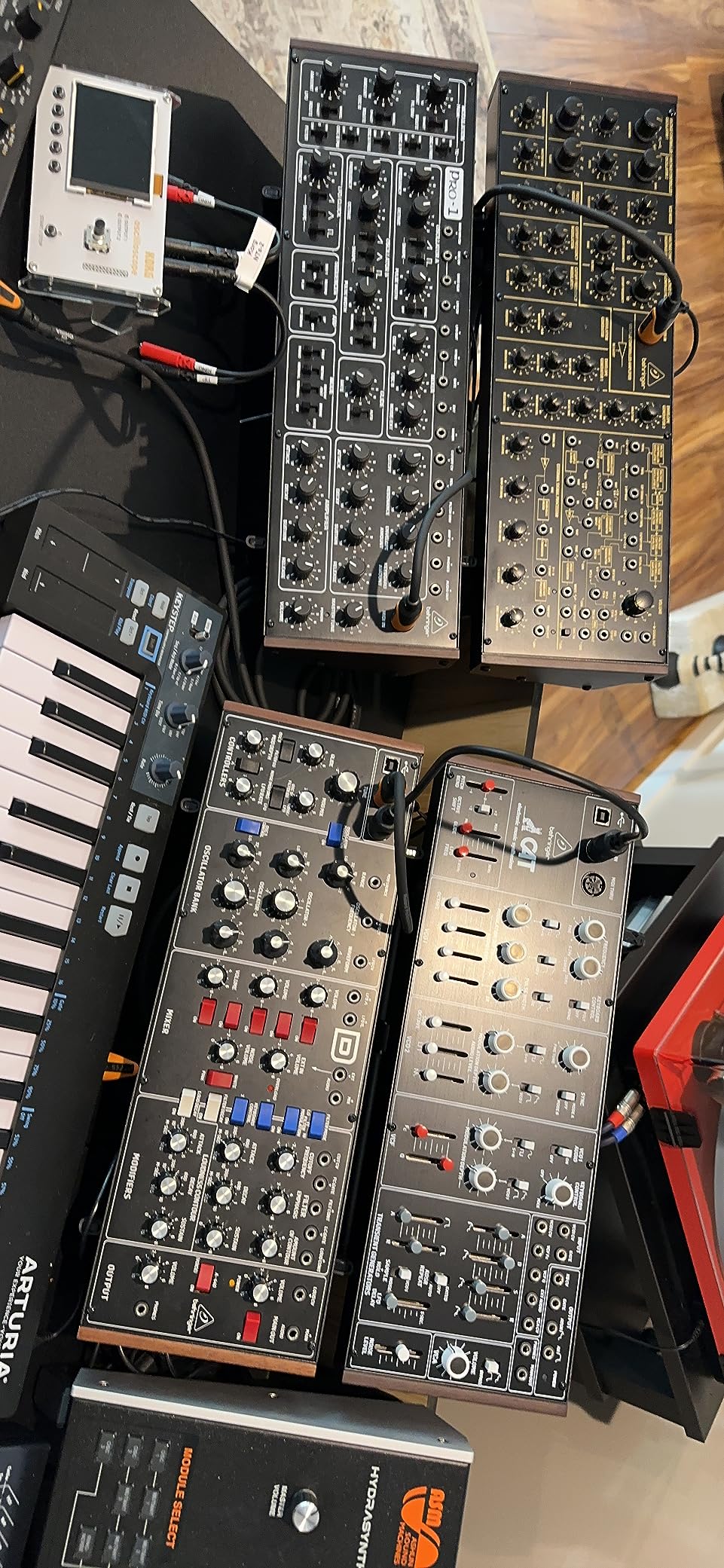
The Eurorack format means the Cat mounts in a standard rack alongside other modules. Patch points expose key signal stages for modular routing, and the 16-voice poly chain support lets you link multiple Behringer synths for expanded setups.
The basswood body is the main cost-cutting measure. It feels less substantial than the metal chassis on pricier units, but it keeps the weight down and the price accessible. Documentation is minimal, so plan to spend time with online resources to learn the signal flow.
Duophonic Mode And Two-Note Patches
Duophonic mode assigns each VCO to its own note, letting you play intervals and simple chords. This is not full polyphony, but for pads and layered textures it adds harmonic richness that monophonic synths cannot achieve.
Try playing root-fifth patterns for powerful bass lines, or minor thirds for dark ambient clusters.
External Signal Processing Power
The ESP module lets you process any audio through the Cat filter and modulation sections. This turns the synth into a creative effects unit for your entire studio. Run a drum bus through it for aggressive filtering, or process vocals for otherworldly textures.
The filter tracks the input amplitude, so modulation follows the dynamics of your source material. This creates responsive, musical effects that static processing cannot match.
14. Behringer PRO-1 – Pro-One Recreation
Behringer PRO-1
Semi-modular analog
Sequential Circuits Pro-One recreation
64-note dual step sequencer
Patch matrix
Built-in arpeggiator
Eurorack format
Pros
- Thick bass and lead sounds faithful to the original Pro-One
- 64-note dual step sequencer for complex patterns
- Built-in arpeggiator for performance
- Eurorack format compatible for expansion
Cons
- No preset memory so settings are lost on power off
- Switches feel somewhat cheap
- Stiff potentiometers
The Behringer PRO-1 recreates the iconic Sequential Circuits Pro-One, the synth behind countless 80s synth-pop and new wave classics. With 151 reviews and a 4.6-star rating, it has earned a reputation for authentic sound at a price that makes sense for working musicians.
The bass tones are where the PRO-1 shines. Thick, punchy, and present in the mix, they sit perfectly in electronic and pop productions. The dual-oscillator architecture with the characteristic Pro-One filter produces leads that cut through without harshness. I tracked bass lines that needed almost no EQ to sit right.
The 64-note dual step sequencer gives you serious pattern programming power. Two independent sequencers can run simultaneously, creating polyrhythmic interplay. The built-in arpeggiator adds another performance dimension, with multiple modes for different melodic patterns.
The patch matrix exposes key signal stages for modular routing. Eurorack format compatibility means it mounts in a standard rack. The main trade-offs are the lack of preset memory, somewhat cheap-feeling switches, and stiff potentiometers that take effort to move precisely.
Pro-One Sound Character And Bass Tones
The Pro-One filter has a distinctive snap and aggression that defined 80s electronic music. The PRO-1 captures this character convincingly, with bass tones that have weight and presence. Snappy envelope response makes percussive bass patches punch through any mix.
For synth-pop and new wave sounds, the PRO-1 is the most authentic affordable option available.
Sequencer And Arpeggiator Performance
The dual 64-note sequencer handles complex patterns with independent control over each sequence. The arpeggiator offers up, down, up-down, and random modes. Both sync to external MIDI clock for tight DAW integration.
For live performance, the combination of sequencer and arpeggiator gives you multiple hands-free pattern options. Switch between them on the fly for dynamic set progression.
15. Pittsburgh Modular Taiga – Three-Oscillator Powerhouse

Pittsburgh Modular Taiga Semi-modular Paraphonic Synthesizer
Semi-modular paraphonic
3 oscillators with wave shaping
Wavefolders
2 ADSR envelopes
Bucket brigade delay
Dynamics controller
Pros
- Three oscillators for extensive sonic range
- Wavefolders for unique harmonic content
- Bucket brigade delay for analog echo
- Dynamics controller with VCA and LPG modes
Cons
- Premium price compared to most competitors
- Only 3 reviews currently available
- BBD may malfunction intermittently
The Pittsburgh Modular Taiga is the most feature-rich semi-modular synth on this list. With three oscillators, wavefolders, a bucket brigade delay, and a dynamics controller that switches between VCA and low-pass gate modes, it covers more sonic territory than any single unit I tested. The warm, rich analog character is exactly what you hope for from Pittsburgh Modular.
The three oscillators give the Taiga paraphonic capability, letting you play chords and intervals without needing multiple units. Wave shaping on each oscillator adds harmonic complexity before the signal even reaches the filter. The wavefolders then add another layer of harmonic richness for West Coast-style tones.
The bucket brigade delay is a genuine analog effect built into the synth. It produces the warm, degraded echo that digital delays struggle to replicate. Patch it pre or post filter for different textural effects.
The dynamics controller is a standout feature. It can operate as a standard VCA or switch to low-pass gate mode, which combines amplitude and timbral control for the distinctive plucky, percussive sounds associated with West Coast synthesis. Having both modes in one module is rare and valuable.
Three Oscillator Architecture And Paraphony
Three oscillators means the Taiga can produce full triads, not just intervals. Paraphonic architecture shares a single filter and amplifier across all three voices, creating a chorused, unified character. Detune the oscillators slightly for thick pad sounds.
For ambient and cinematic music, the three-oscillator architecture eliminates the need for layering multiple synth tracks.
Low-Pass Gate And West Coast Techniques
The low-pass gate mode closes the filter as it reduces amplitude, producing the plucky, bell-like tones associated with Don Buchla designs. This is fundamentally different from a VCA, which only affects loudness. The Taiga lets you switch between both modes on the same module.
Combine the LPG with the bucket brigade delay for evolving textures that feel alive. This is West Coast synthesis at its finest, in a single integrated instrument.
How To Choose The Best Modular Synthesizer
Choosing from the best modular synthesizers means thinking honestly about your experience level, budget, and musical goals. The right synth for a first-time patcher is very different from the right synth for a seasoned Eurorack builder. These guidelines come from months of testing and years of community discussion.
Start by deciding between semi-modular and fully modular. Semi-modular synths work out of the box with default signal routings, so you can play them immediately. Fully modular systems require you to patch every connection, which means nothing makes sound until you understand signal flow. Most beginners should start semi-modular.
Consider the format carefully. Eurorack is the most popular modular format, with thousands of compatible modules from hundreds of manufacturers. Choosing a Eurorack-compatible synth means you can expand indefinitely. Other formats like Moog and Buchla have their own ecosystems, but with far fewer options.
Think about how many patch points you actually need. A synth with 20 well-chosen patch points may serve you better than one with 50 redundant points. Look at what each point exposes and whether it matches your creative goals.
Budget for accessories. Patch cables, a case or stand, and possibly a MIDI to CV converter are all extra costs. The synth itself is just the beginning of a modular investment.
Frequently Asked Questions
What is the best modular synth for beginners?
The Korg Volca Modular is the best modular synth for absolute beginners because it offers 50 patch points and West Coast synthesis techniques at the lowest price. For beginners who want a more traditional subtractive sound, the Moog Mother-32 works out of the box and grows into a full Eurorack system.
What do I need to start modular synthesis?
To start modular synthesis you need the synth itself, patch cables, a power supply, and optionally a case. Semi-modular synths include everything in one unit. For Eurorack you also need a compatible case with a power supply that delivers enough current for your modules.
What is the difference between semi-modular and fully modular synths?
Semi-modular synths have default internal routings so they produce sound without any patch cables. Fully modular synths require you to connect every signal path manually using patch cables. Semi-modular is better for beginners while fully modular offers maximum flexibility for experienced users.
How much does a modular synthesizer cost?
Modular synthesizers range from around 150 dollars for budget options like the Korg Volca Modular to over 1000 dollars for premium units like the Moog Grandmother. A full Eurorack system typically costs between 500 and 3000 dollars depending on the number and quality of modules.
Can you use a modular synth without a keyboard?
Yes, most modular and semi-modular synths work without a keyboard. You can trigger them using internal sequencers, external MIDI controllers, DAW sequencing, or even other modular modules. Many players never use a traditional keyboard with their modular system.
What is the most popular modular synth format?
Eurorack is by far the most popular modular synth format, with the largest selection of modules and manufacturers. It uses 3U height modules measured in horizontal pitch units. Most modern semi-modular synths are Eurorack compatible for easy integration into larger systems.
Final Thoughts On The Best Modular Synthesizers
The best modular synthesizers in 2026 cover an enormous range of sounds, formats, and price points. The Moog Subharmonicon took our editor’s choice spot for its unique polyrhythmic engine and inspirational generative capabilities. For budget-conscious beginners, the Korg Volca Modular delivers genuine modular thinking at a price anyone can justify. And the Behringer TD-3 remains the unbeatable value pick for acid bass and techno production.
What matters most is choosing a synth that matches your experience level and creative goals. Semi-modular options like the Mother-32, Grandmother, and Neutron let you start playing immediately while leaving room for Eurorack expansion later. The key is to start somewhere, learn the fundamentals, and let your ears guide your next purchase.
Modular synthesis is a journey, not a destination. Your system will never be truly finished, and that is the appeal. Every new module or patch cable opens creative doors you did not know existed. Pick the synth that excites you most, stock up on patch cables, and start exploring.