
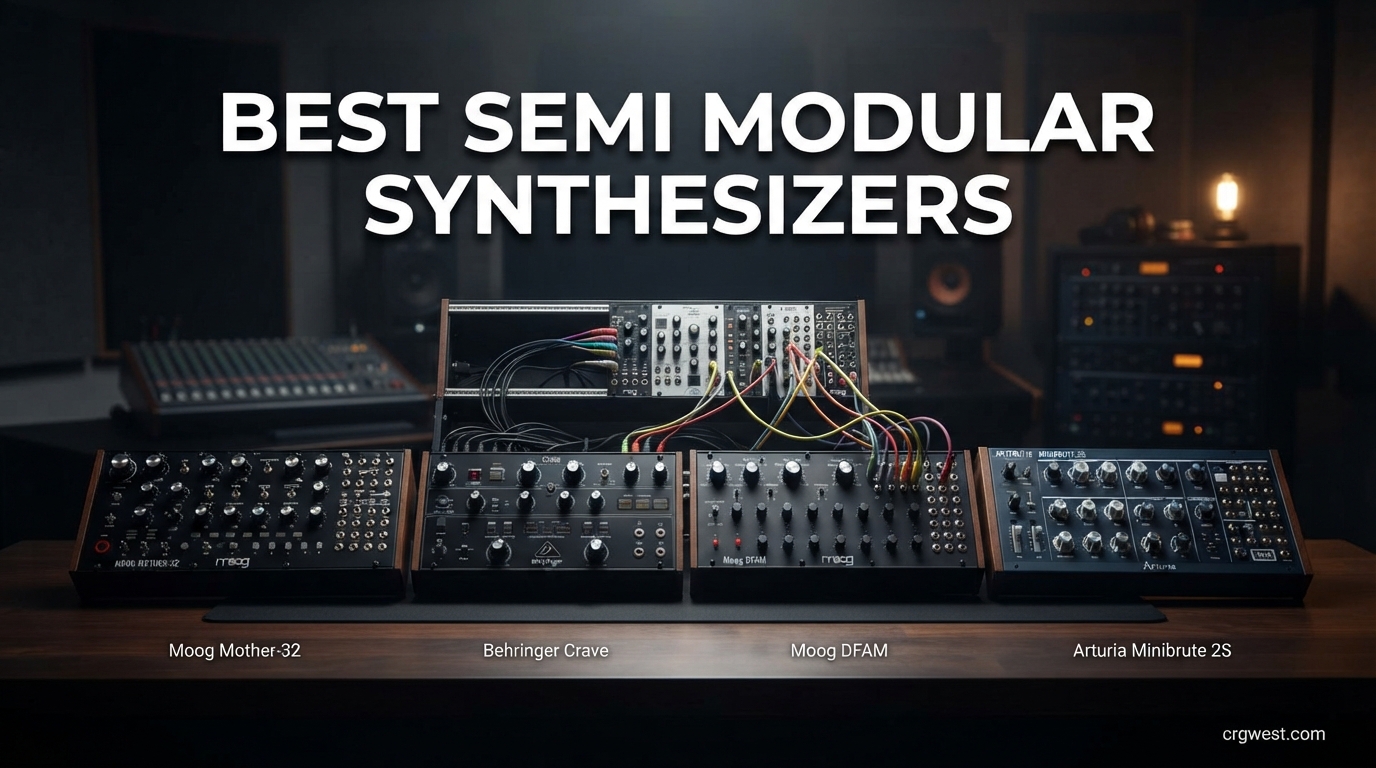
Finding the best semi modular synthesizers means sorting through a crowded field of patchable instruments that bridge traditional subtractive synthesis and full modular rigs. A semi-modular synthesizer combines a fixed internal signal path with a patchbay full of CV and gate jacks, giving you instant sound without a single cable while also letting you reroute everything when you are ready to experiment. That balance is exactly why these instruments have exploded in popularity over the last few years.
Our team has spent months comparing 10 of the most talked-about semi-modular synths on the market for this guide. We looked at sound engines, patch point counts, Eurorack compatibility, sequencer features, build quality, and real user feedback from communities like Reddit’s r/synthesizers and r/modular. Whether you want a first patchable instrument, a desktop drum synth, or a polyrhythmic powerhouse, we have a recommendation that fits your budget.
Semi-modular synths are special because they work straight out of the box like a normal analogue synthesizer, but every VCO, VCF, VCA, LFO, and envelope generator also exposes patch points for modular routing. You can process external audio through the filter, sync an LFO to MIDI clock, or chain multiple units together for a growing system. This guide covers the full range from the ultra-affordable Korg Volca Modular at under $170 to the premium Moog Grandmother at just under $1,000, organized by budget tier so you can find the right fit.
Top 3 Picks for Best Semi Modular Synthesizers

Moog Mother-32
- Analog VCO with Moog ladder filter
- 32-step sequencer with 64 patterns
- Eurorack 60HP module format

Behringer Neutron
- Dual 3340 analog oscillators
- Paraphonic architecture
- Pure analog signal path

Best Semi Modular Synthesizers in 2026
| Product | Specifications | Action |
|---|---|---|
|
Korg Volca Modular
|
|
Check Latest Price |
 Behringer Grind
|
|
Check Latest Price |
 Cre8audio West Pest
|
|
Check Latest Price |
 Moog Mavis
|
|
Check Latest Price |
 Arturia MiniBrute 2S
|
|
Check Latest Price |
|
Behringer Neutron
|
|
Check Latest Price |
 Make Noise 0-Coast
|
|
Check Latest Price |
|
Moog Mother-32
|
|
Check Latest Price |
 Korg MS-20 Mini
|
|
Check Latest Price |
 Moog Grandmother
|
|
Check Latest Price |
1. Korg Volca Modular – Best Budget Semi-Modular Synth
Korg Volca Modular Micro Synthesizer Semi Modular w/ Eight Modules and 16-step Sequencer
Eight independent modules
50 patch points
16-step sequencer
Built-in speaker
West Coast synthesis
Pros
- Eight independent modules in compact format
- 50 patch points for extensive routing
- Built-in 16-step sequencer with two playback modes
- Randomize function for creative sound generation
- Built-in speaker for immediate output
- Color-coded patch points for easy learning
Cons
- No MIDI connectivity on the device itself
- Limited patch count vs full Eurorack systems
- Mini patch cables feel cramped for advanced patching
The Korg Volca Modular is the cheapest legitimate entry point into semi-modular synthesis you can find, and it delivers surprising depth for the price. I picked one up expecting a toy and walked away genuinely impressed by how much West Coast synthesis Korg packed into a chassis smaller than a paperback book. The eight modules cover microtonal tuning, wavefolding, and modulation routing with surprising depth.
With 50 patch points, you get a real sense of what modular patching is about. The color-coded inputs and outputs help you understand signal flow without needing a manual open at all times. The built-in 16-step sequencer includes two advanced playback modes that go beyond simple step entry, and the randomize function generates happy accidents on demand.
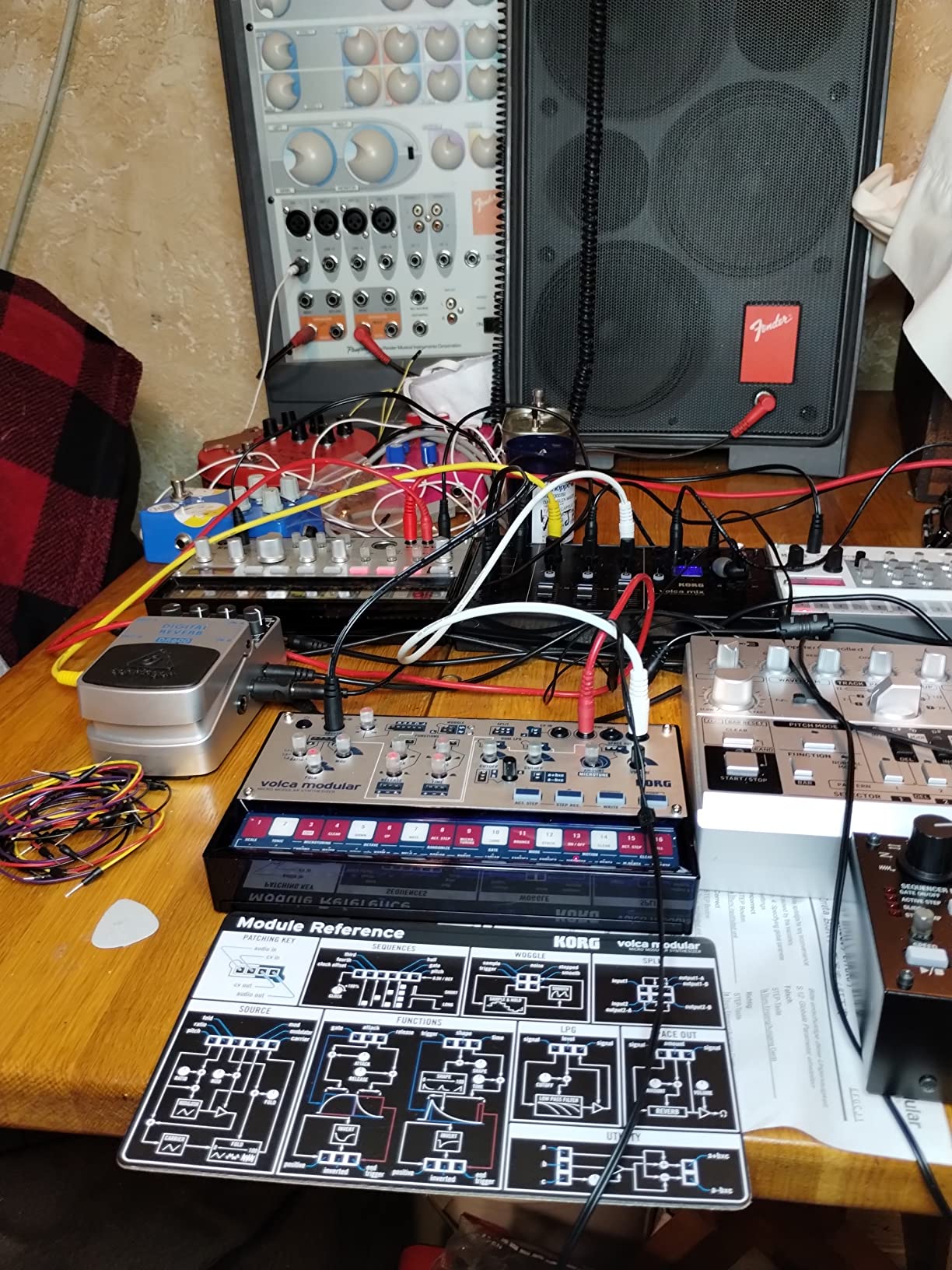
Portability is a huge selling point here. The Volca Modular runs on batteries and has a built-in speaker, so you can patch sounds on the couch, in the park, or anywhere inspiration strikes. It pairs naturally with other Volca units for an affordable tabletop rig covering drums, bass, and modular textures.
The limitations are real, though. There is no MIDI connectivity on the Volca Modular itself, which means you sync via audio trigger pulses rather than standard MIDI. The mini patch cables take some getting used to, and the small form factor can feel cramped during complex patches. But for learning synthesis fundamentals and exploring West Coast techniques, nothing touches this value at under $170.
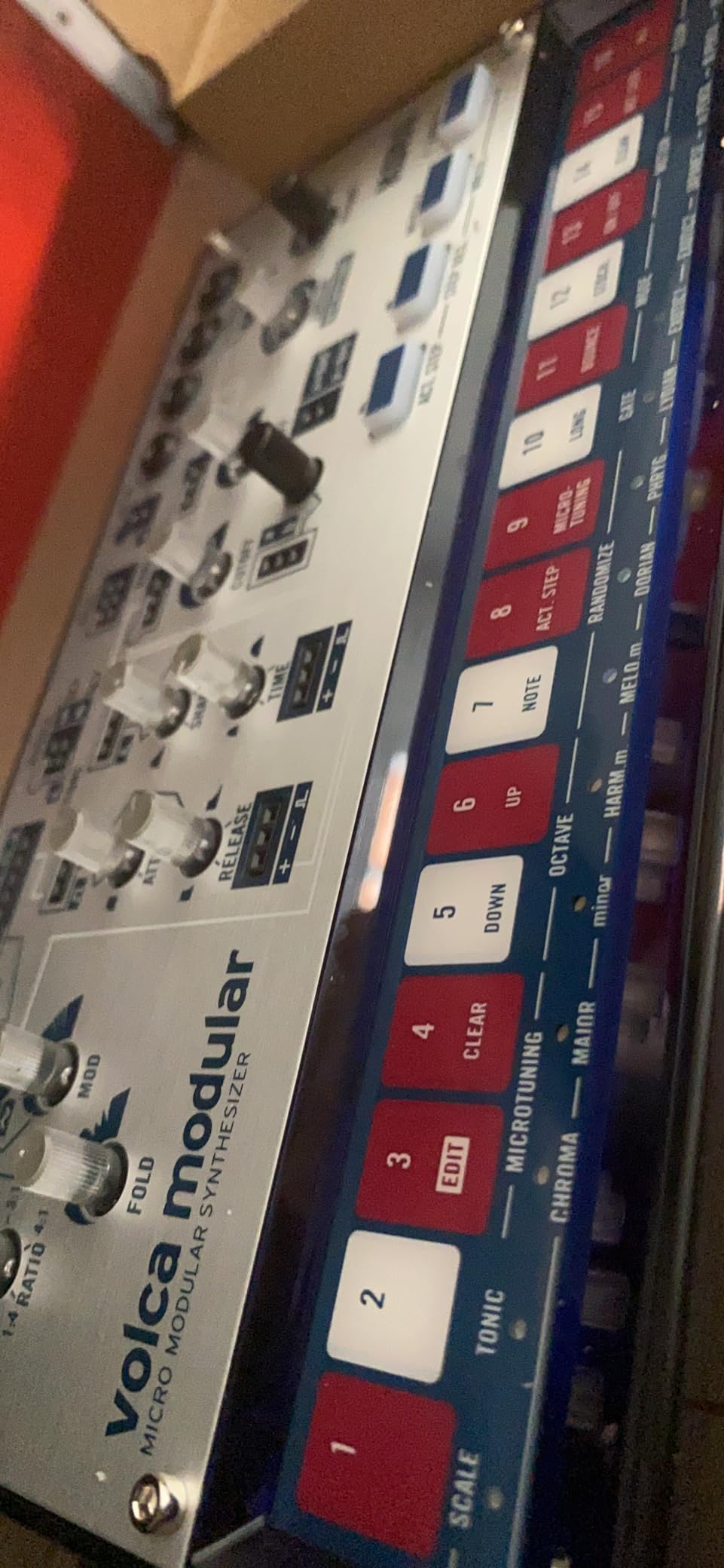
Best Use Cases for the Volca Modular
This is the ideal first semi-modular synth for absolute beginners who want to learn patching without spending hundreds. It also works well as a portable sketchpad for experienced producers who want something to noodle with away from the studio desk. The built-in speaker makes it genuinely standalone, and the battery operation means you can create wherever you go.
West Coast Synthesis on a Budget
The Volca Modular is one of the only affordable ways to explore West Coast synthesis, which emphasizes wavefolding, complex waveforms, and modulation over the traditional filter sweeps of East Coast subtractive synthesis. If that approach interests you, this is your cheapest entry ticket into a philosophy that usually costs thousands.
2. Behringer Grind – Best Hybrid Digital-Analog Semi-Modular
Behringer Grind Semi-modular Hybrid Multi-engine Synthesizer
24 digital oscillator models
10 percussion and noise engines
Analog ladder filter
32-step sequencer
Eurorack compatible
Pros
- 24 digital oscillator models across synthesis types
- 10 percussion and noise engines for rhythm
- Analog ladder filter paired with digital oscillators
- 32-step sequencer at this price point
- MIDI to CV conversion with 16 options
- Eurorack compatible for modular expansion
Cons
- LFO is basic compared to other modules in class
- 32-step sequencer has a learning curve
- Mono synth with limited polyphony
- One reported MIDI circuit failure case
The Behringer Grind takes a different approach from pure analog synths by combining 24 digital oscillator models with an analog ladder filter. The result is a hybrid architecture that covers virtual analog, FM, wavetable, and physical modeling synthesis types all in one compact unit. I was genuinely surprised by how much sonic ground this instrument covers for under $230.
The 10 percussion and noise engines are what make the Grind special. Combined with the 32-step sequencer, you can create complex rhythmic patterns and textural sound design that go far beyond what a typical budget synth can produce. The analog ladder filter adds warmth and character to the digital sources, bridging the gap between digital precision and analog musicality.
The extensive patch bay offers CV controls and attenuators for Eurorack integration, and the MIDI to CV conversion supports 16 assignable options including MIDI CC. This makes the Grind a capable centerpiece for a growing modular system. The sturdy metal enclosure feels premium despite the affordable price.
The trade-offs are a basic LFO and a sequencer with a steep learning curve. With only 30 reviews at the time of analysis, long-term reliability is still being established. One reviewer reported a MIDI circuit failure on first use, which is worth noting. But for producers who value sonic versatility over analog purity, the Grind offers exceptional creative potential.
Hybrid Architecture Benefits
The combination of digital oscillators with an analog filter gives you the precision and stability of digital sound generation with the warmth and character of analog filtering. This approach solves the tuning stability issues that plague some pure analog synths while preserving the tonal quality that makes analog instruments so appealing to listeners.
Best Applications for Percussion Engines
The 10 percussion and noise engines make the Grind particularly well-suited for electronic percussion, industrial music, and experimental sound design. Combined with the 32-step sequencer, you can build complex rhythmic patterns that a typical mono synth simply cannot produce on its own.
3. Cre8audio West Pest – Best Affordable West Coast Synth
Cre8audio Synthesizer (West Pest)
40HP Eurorack format
Wavefolding capabilities
32-step sequencer
MIDI 3.5mm and 5-pin DIN
LFO included
Pros
- Wavefolding feature for complex timbres
- 40HP Eurorack compatible format
- 32-step sequencer for pattern creation
- MIDI connectivity via 3.5mm and 5-pin DIN
- Includes patch cables and MIDI pigtails
- Highest rating in guide at 4.8 stars
Cons
- Only 15 total reviews for assessment
- Limited stock often available
- No built-in keyboard requires external controller
The Cre8audio West Pest is the highest-rated synth in this guide with a 4.8 average from users, and it brings genuine West Coast synthesis techniques to a remarkably affordable price point. The wavefolding feature is the star of the show, producing complex and evolving timbres that sound far more expensive than the price suggests. I was immediately drawn to the harmonic richness it generates.
As a 40HP semi-modular synth, the West Pest is Eurorack compatible and can be integrated into a larger modular system. The 32-step sequencer provides ample room for pattern creation, and the MIDI connectivity via both 3.5mm TRS and 5-pin DIN makes it easy to control from a keyboard or DAW. The included Nazca Noodles patch cables and MIDI pigtails mean you can start making music immediately.
Cre8audio is a newer brand, so the community support and available learning resources are not as extensive as what you find for Moog or Korg. However, the metal construction feels solid, and the design is clean and approachable for beginners. The 84 percent five-star ratio among verified reviews speaks to genuine user satisfaction.
For anyone curious about West Coast synthesis who cannot justify the price of a Make Noise 0-Coast, the West Pest is the obvious alternative. It covers the essential West Coast techniques at roughly half the cost while still sounding distinctive and musical. The included accessories add real value to the package.
West Coast Sound Character Explained
West Coast synthesis uses wavefolding and complex waveform generation to add harmonics rather than remove them with a filter. The West Pest makes this approach accessible to anyone. The resulting tones are metallic, bell-like, and experimental in ways that traditional subtractive synthesis simply cannot produce.
Pairing With Other Cre8audio Modules
Cre8audio designed the West Pest as a companion to the East Beast, and together they form a complete synthesis system covering both major synthesis traditions. The two units share the same 40HP form factor and patching format, making them natural partners for an affordable starter modular system.
4. Moog Mavis – Best DIY Semi-Modular Kit
MOOG Mavis - Standalone Semi-Modular Analog Synthesizer Kit with Keyboard, Analog Oscillator, Filter, Envelope Generator, Wavefolder, and Dust Cover
Build-it-yourself kit
Two oscillators with ADSR
Moog ladder filter
Diode wavefolder
44HP Eurorack format
Pros
- Legendary Moog ladder filter sound
- Diode wavefolder for unique harmonic textures
- Build-it-yourself kit is engaging and educational
- Eurorack compatible 44HP format
- Built-in keyboard with glide and scaling
- Complete kit with all tools and cables included
Cons
- DIY assembly required not plug and play
- 10 percent 1-star reviews suggest quality issues
- Plastic enclosure feels less premium than metal
- Limited patchbay vs full modular systems
The Moog Mavis delivers the unmistakable Moog sound at the most accessible price point the company has ever offered. The build-it-yourself kit format is part of the appeal, giving you a hands-on understanding of how the synthesizer works as you assemble it. I found the assembly process genuinely educational and satisfying, even as someone who has used synths for years.
The sound engine features two oscillators with a full ADSR envelope feeding into the legendary Moog ladder filter. The diode wavefolder is what sets Mavis apart from other Moog instruments, unlocking unique harmonic textures that you simply cannot get from the Grandmother or Mother-32. The sample and hold circuit adds another dimension of modulation possibilities.
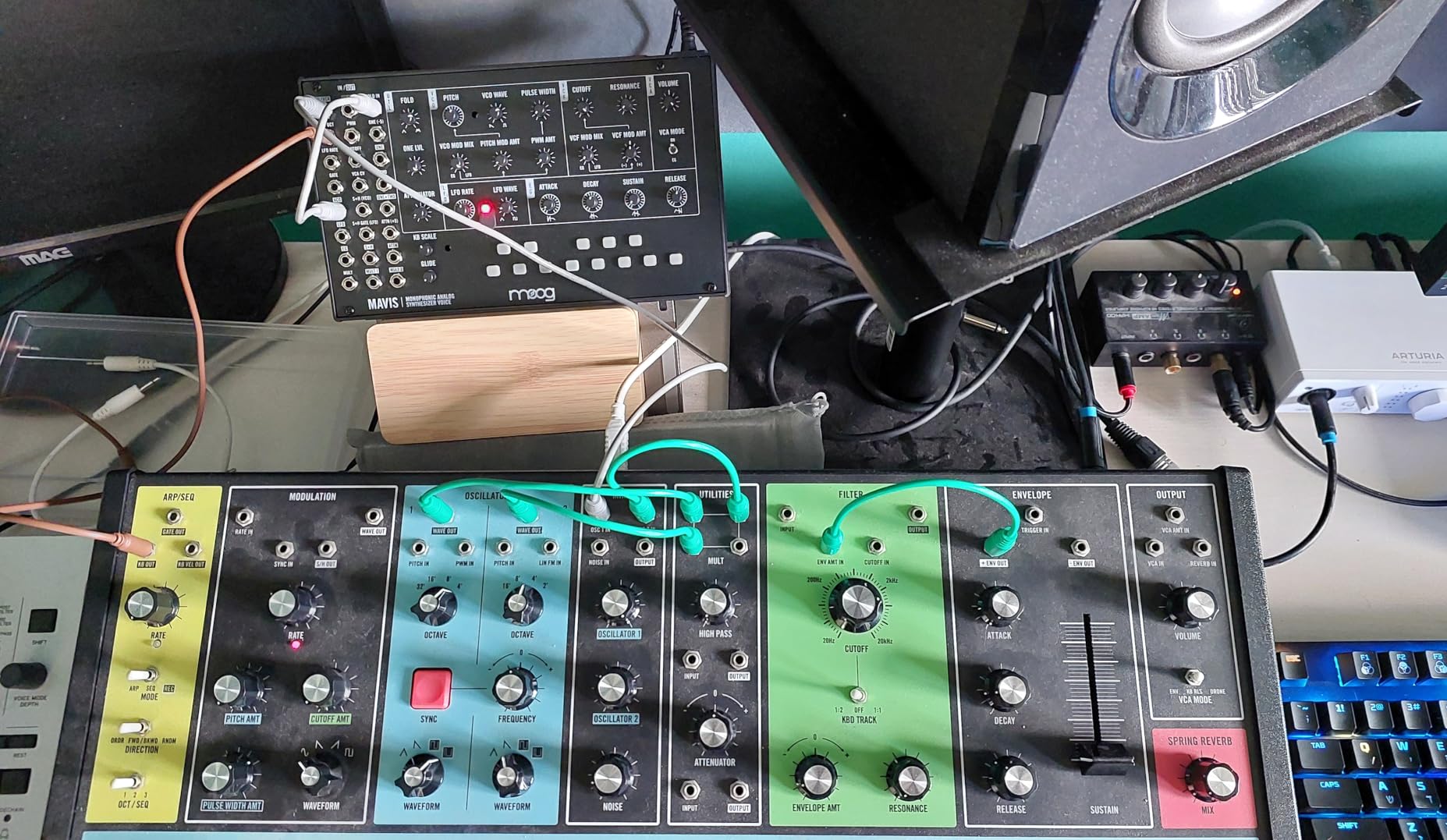
As a 44HP Eurorack-compatible module, Mavis can be removed from its case and mounted in a modular rack. The built-in keyboard with glide and keyboard scaling lets you play it expressively without an external controller. MIDI and USB connectivity ensure it integrates with any modern setup.
The trade-offs are real, though. The DIY assembly means this is not a plug-and-play instrument, and the 10 percent 1-star rate suggests some users encounter quality or calibration issues during assembly. The plastic enclosure feels less premium than the wood and metal of higher-end Moogs. But for under $300, you get genuine Moog sound and a wavefolder, which is remarkable value.
Assembly Experience and Skill Level
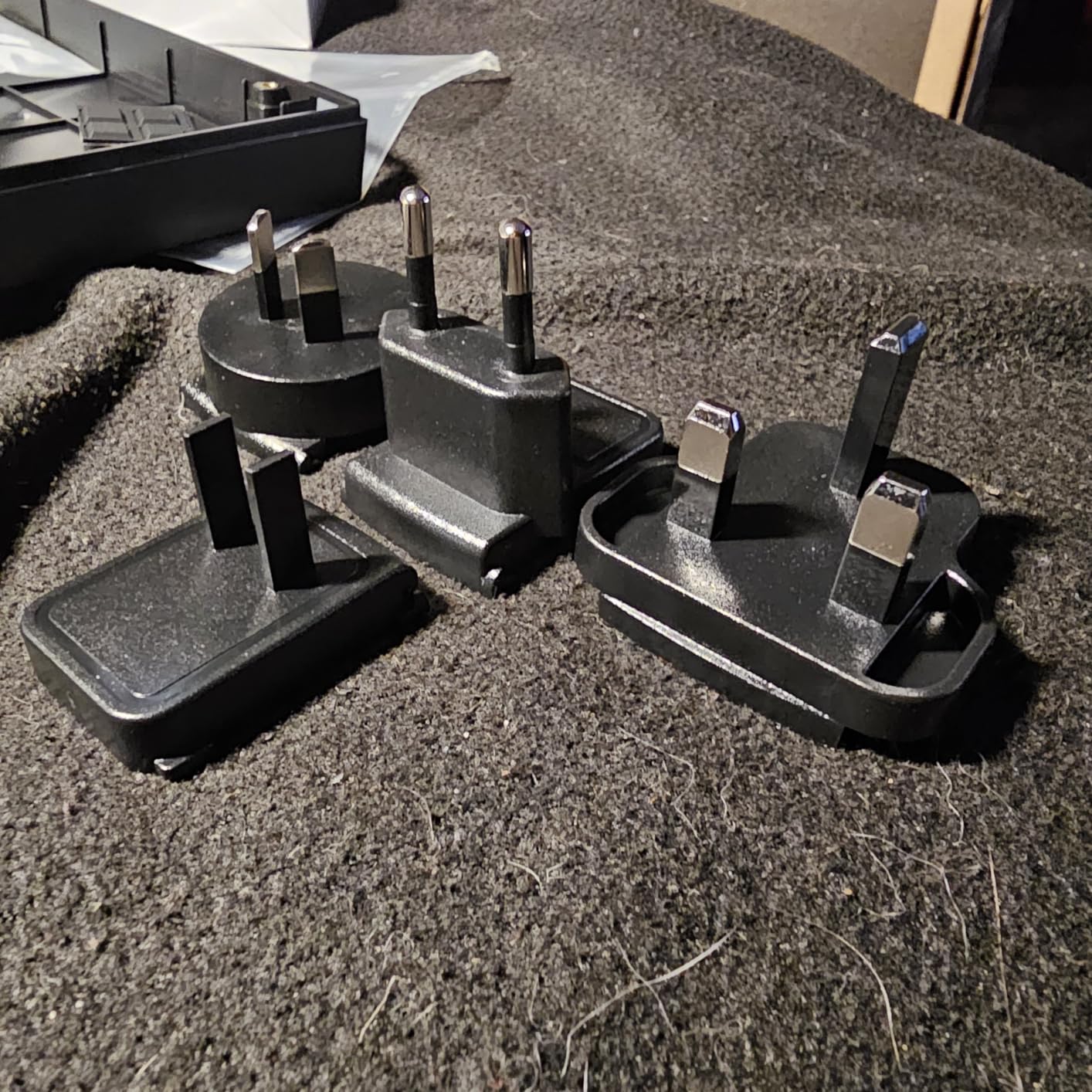
The Mavis kit requires no soldering, just mechanical assembly with the included hex nut driver and screws. Most users report completing the build in 30 to 60 minutes following the included guide. The process teaches you about the internal architecture of a synthesizer, which makes it a fantastic learning tool for newcomers to the hobby.
Why the Diode Wavefolder Matters
The diode wavefolder is the feature that gives Mavis its unique voice within the Moog lineup. Instead of just removing harmonics with the ladder filter, the wavefolder adds harmonic complexity by folding the waveform back on itself. This produces metallic, bell-like, and evolving tones that traditional subtractive synthesis cannot easily generate.
5. Arturia MiniBrute 2S – Best for Pad-Based Sequencing
Arturia MiniBrute 2S Semi-Modular Analog Synthesizer and Step Sequencer
2 VCOs and 2 LFOs
Steiner Parker 4-mode filter
48-point CV patchbay
16 velocity pads
Step sequencer with 64 memories
Pros
- Dual VCOs and dual LFOs for rich sound design
- Steiner Parker filter with 4 modes
- 48-point CV and gate patchbay
- 16 velocity and pressure sensitive pads
- Step sequencer with 64 sequence memories
- Two year manufacturer warranty
Cons
- Highest price in mid-range tier at $474
- Not Prime eligible for faster delivery
- Only 4 units left in stock at analysis time
- 11 percent 1-star reviews indicate QC issues
The Arturia MiniBrute 2S replaces the keyboard of the original MiniBrute 2 with 16 velocity and pressure sensitive pads, making it a performance-oriented machine for beatmakers and electronic producers. I found the pad layout intuitive for sequencing drum patterns and basslines, and the 64-sequence memory gives you plenty of room to build complex arrangements. The Noir black finish looks sharp on any desktop.
The sound engine features two analog VCOs and two LFOs feeding into the Steiner Parker filter, which offers four modes including low pass, high pass, band pass, and notch. This filter has a distinctive character that can range from smooth and musical to aggressive and snarling depending on the resonance setting. The dual LFOs add movement and modulation complexity.
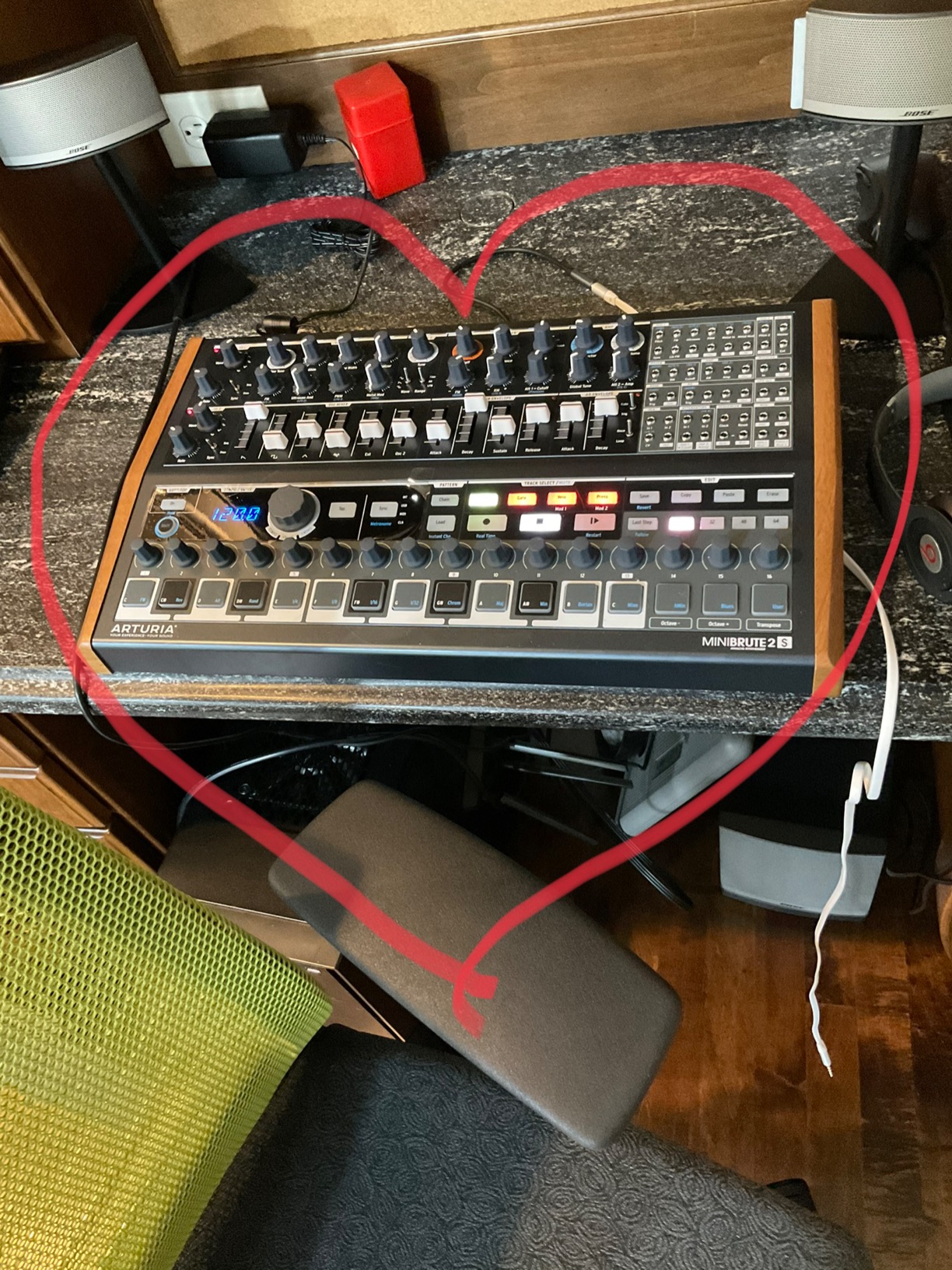
The 48-point CV and gate patchbay is one of the most generous in this price range, exposing every major modulation source and destination for creative routing. The 16 encoders provide hands-on control over parameters without menu diving, which keeps the workflow fast and tactile. The two-year warranty is the longest coverage in this batch.
Some users have reported build quality concerns, particularly regarding reliability over time. The 11 percent 1-star rate is worth noting, and the synth is not Prime eligible. At 4.88 kilograms, it is the heaviest unit in this guide. But the sound quality and feature set represent strong value for producers who prefer a pad-based workflow over a traditional keyboard.
Pad Workflow vs Keyboard Workflow
The 2S version is ideal for producers coming from drum machines, MPC-style workflows, or anyone who prefers programming sequences via pads rather than playing melodies on keys. If you are a keyboard player, the standard MiniBrute 2 with its keyboard may be a better fit for your muscle memory and playing style.
The Steiner Parker Filter Character
The Steiner Parker filter is known for its aggressive resonance and multimode versatility. It can sound smooth and warm at low resonance settings or scream with self-oscillation when pushed hard. This filter gives the MiniBrute 2S a distinctive voice that stands apart from the Moog ladder filter character.
6. Behringer Neutron – Best Value Analog Semi-Modular
Behringer Synthesizer (NEUTRON)
Dual 3340 analog VCOs
Paraphonic architecture
5 oscillator waveforms
USB connectivity
Eurorack compatible
Pros
- Dual 3340 analog oscillators for fat sound
- Pure analog signal path
- Semi-modular with no patching required to start
- 5 blendable oscillator waveforms
- 3 year manufacturer warranty
- 81 percent 5-star ratings from 171 reviews
Cons
- Firmware update process notoriously difficult
- USB MIDI connection can be noisy
- No built-in keyboard or sequencer
- Some report LFO freeze firmware glitches
The Behringer Neutron is consistently praised on Reddit and GearSpace as one of the best values in semi-modular synthesis, and after using one extensively I understand the hype. The dual 3340 analog oscillators produce that thick, warm tone that defined classic analog synths, and the pure analog signal path preserves every bit of that character through to the output. For under $490, the feature-to-price ratio is exceptional.
What makes the Neutron special is its paraphonic architecture. Both oscillators can be played independently, giving you two-note chords from a single unit. The oscillator waveform control blends seamlessly between five shapes including tone mod, pulse, sawtooth, triangle, and sine, with individual pulse width and tone modulation controls for precise sound shaping.
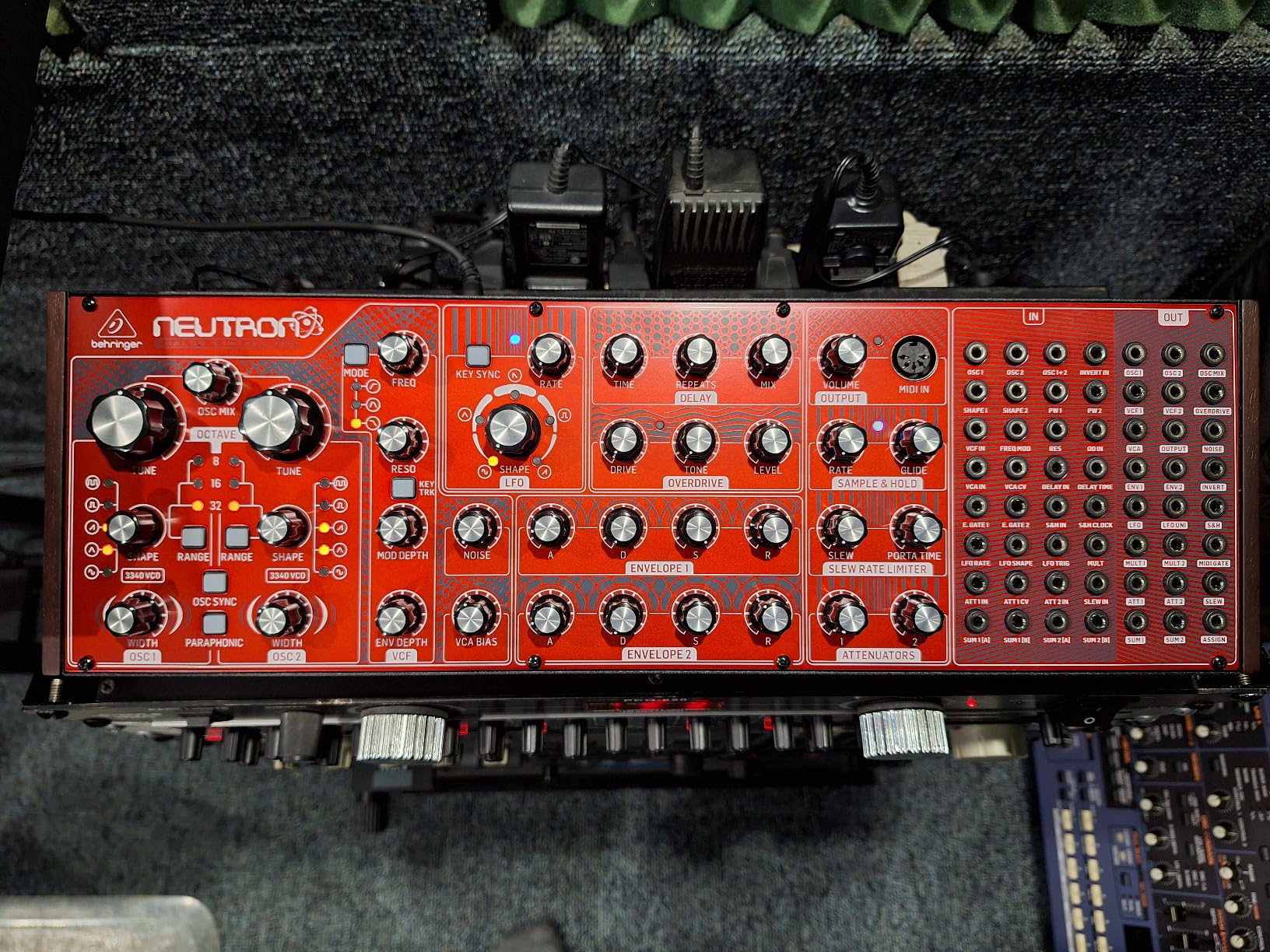
The patch bay is generous for the price, and the default routing means you can start playing immediately without any cables connected. I found the overdrive circuit particularly satisfying for pushing the oscillators into aggressive territory, which makes this synth a great choice for techno, industrial, and bass-heavy productions. The 3-year warranty provides peace of mind.
The firmware update process is the main pain point users report. It requires third-party drivers and can be frustrating even for experienced users. Some report LFO freeze glitches and a relatively high noise floor on certain signal paths. There is no built-in keyboard or sequencer, so you will need external gear to control it. But the sound quality and value are hard to beat.
Ideal Genres and Applications
The Neutron excels at bass production, lead synthesis, and aggressive sound design. Its thick analog tone and paraphonic capability make it particularly well-suited for techno, industrial, and electronic percussion. Reddit users consistently recommend it as the best bang-for-buck semi-modular on the market.
Eurorack Expansion Potential
While the Neutron is a desktop unit rather than a Eurorack module, its extensive CV and gate patch points make it an excellent companion for a growing modular system. You can use it as a voice module, a modulation source, or an interface between MIDI gear and Eurorack modules as your system expands over time.
7. Make Noise 0-Coast – Best for West Coast Synthesis
Make Noise 0-Coast
MIDI to CV conversion
13 sources and 14 destinations
Dual-mode arpeggiator
Steel chassis
Eurorack compatible
Pros
- Excellent build quality with steel chassis
- Unique West Coast sound character
- Great for Eurorack integration
- MIDI to CV conversion with dual-mode arpeggiator
- Patchable with 13 sources and 14 destinations
- Highest rating in mid-range at 4.7 stars
Cons
- Documentation confusing for beginners
- Square wave output can be unstable
- Requires external MIDI source for rhythmic music
- Steep learning curve for modular newcomers
The Make Noise 0-Coast is described by users on r/synthesizers as inspiring but complex, and my experience confirms both qualities. The name reflects its design philosophy: it bridges East Coast and West Coast synthesis traditions in a single compact instrument. The result is a sound character unlike any other semi-modular synth in this guide.
With 13 modulation sources and 14 destinations, the 0-Coast offers extensive patching possibilities despite its small footprint. The MIDI to CV conversion with dual-mode arpeggiator makes it easy to integrate with modern DAWs and controllers. The steel chassis feels built to last a lifetime, and the touch-based controls add an expressive dimension to performance.
The sound design approach here emphasizes wavefolding, dynamics, and harmonic complexity rather than traditional filter sweeps. This makes the 0-Coast ideal for experimental music, drone, ambient, and any genre that benefits from evolving, complex timbres. The sync to MIDI clock keeps everything locked to your project tempo.
I found the learning curve steeper than typical subtractive synths, but the reward is a genuinely unique instrument that can produce sounds nothing else in your collection can replicate. The documentation is notably confusing for beginners compared to the excellent Moog manuals, so expect to spend time on community resources like the r/modular subreddit for guidance.
West Coast Philosophy in Practice
The 0-Coast embraces West Coast synthesis concepts like complex waveforms, wavefolding, and low-pass gates rather than traditional filter-based tone shaping. If you want to understand this approach deeply, this instrument is the perfect teacher. The sounds it produces feel organic and alive in ways that subtractive synths rarely achieve.
Eurorack Integration and Expansion
As a desktop module that outputs Eurorack-compatible signals, the 0-Coast works as a bridge between the modular and non-modular worlds. It pairs beautifully with other Make Noise modules and integrates seamlessly into any Eurorack system as your collection grows over time.
8. Moog Mother-32 – The Gateway to Modular
MOOG Mother-32 Semi-Modular Eurorack Analog Synthesizer with 32-Step Sequencer, VC Oscillator and Ladder Filter, MIDI In, Extended Patchbay, CV Jack
Analog VCO with white noise
Moog ladder filter
32-step sequencer
Eurorack 60HP
MIDI In connectivity
Pros
- Iconic warm Moog ladder filter sound
- Semi-modular works standalone or in Eurorack
- Built-in 32-note step sequencer with 64 sequences
- Excellent build quality with aluminum and wood
- Extended patchbay for deep modulation
- Industry standard entry point for modular synthesis
- 85 percent 5-star ratings
Cons
- Relatively expensive for a single module
- Single VCO limits polyphonic capabilities
- Sequencer has a learning curve
- Premium price point than competitors
The Moog Mother-32 is widely considered the gateway drug to modular synthesis, and I can confirm that reputation is earned. The first time I patched the LFO output into the filter cutoff input and heard that classic Moog sweep, I understood why so many people describe this instrument as addictive. It is a complete subtractive synthesizer voice that works without any patch cables but rewards experimentation endlessly.
The sound engine features a single analog voltage controlled oscillator with a white noise generator feeding into the beloved Moog ladder filter. The 32-note step sequencer stores up to 64 patterns, which is more than enough for live performance and studio composition. The extended patchbay exposes all the key modulation sources and destinations for creative routing.
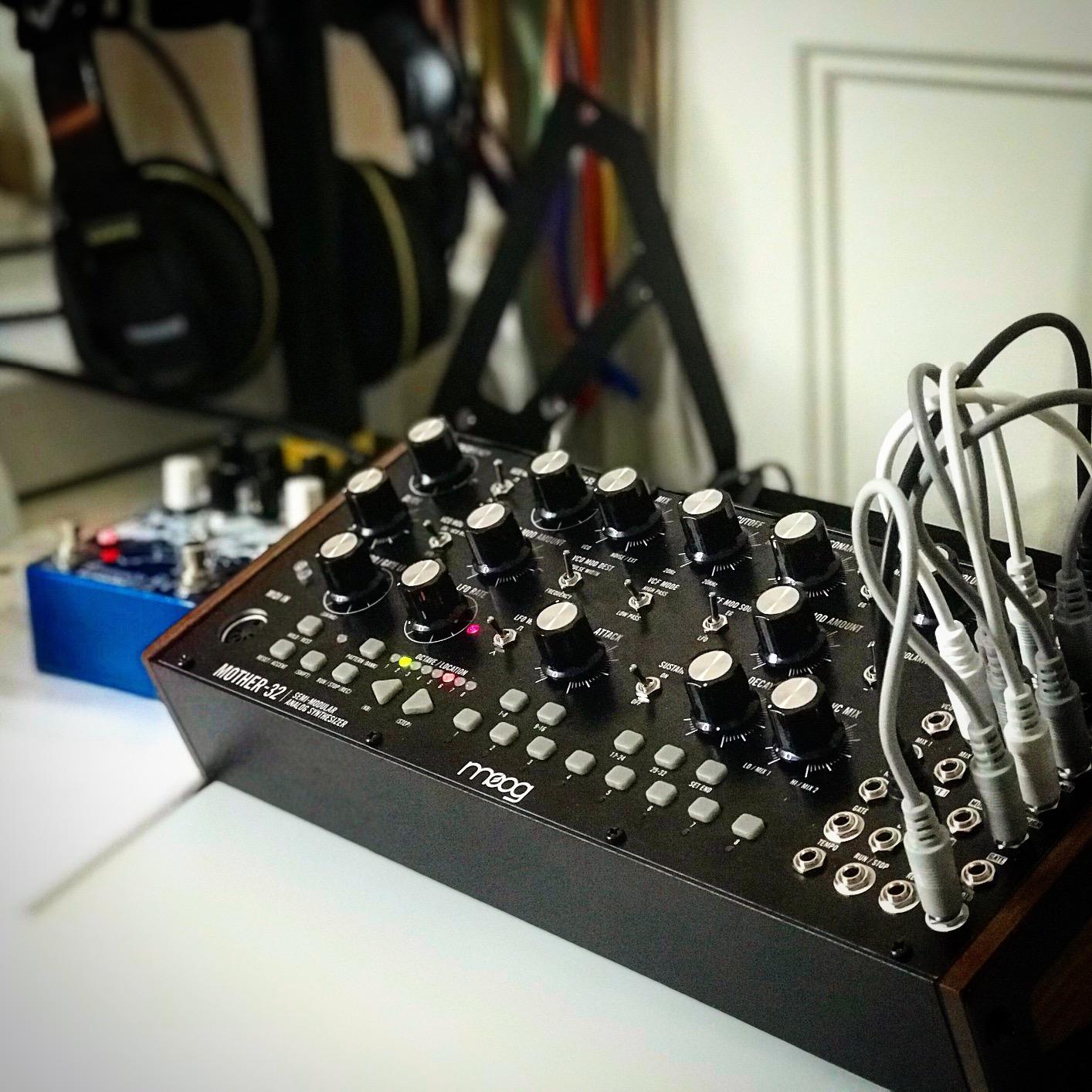
As a 60HP Eurorack module, the Mother-32 can be rack-mounted or used as a tabletop instrument. I have seen setups with multiple Mother-32 units chained together, and the creative possibilities multiply exponentially with each additional unit. The build quality is exactly what you expect from Moog, with solid jacks, smooth potentiometers, and a sturdy aluminum and wood housing.
The main limitation is the single oscillator, which restricts the harmonic richness compared to dual-VCO instruments like the Neutron. However, the external audio input lets you process other sound sources through the ladder filter, which more than compensates for the oscillator count in many studio setups. At $599 it is a premium investment, but the quality justifies the cost.
Who the Mother-32 Is Built For
This synth is perfect for anyone who wants to learn modular synthesis on a quality instrument with classic Moog tone. It is also ideal for Eurorack enthusiasts who want a reliable, self-contained voice module that does not require external patching to produce great sounds right out of the box.
Pairing With Other Moog Semi-Modulars
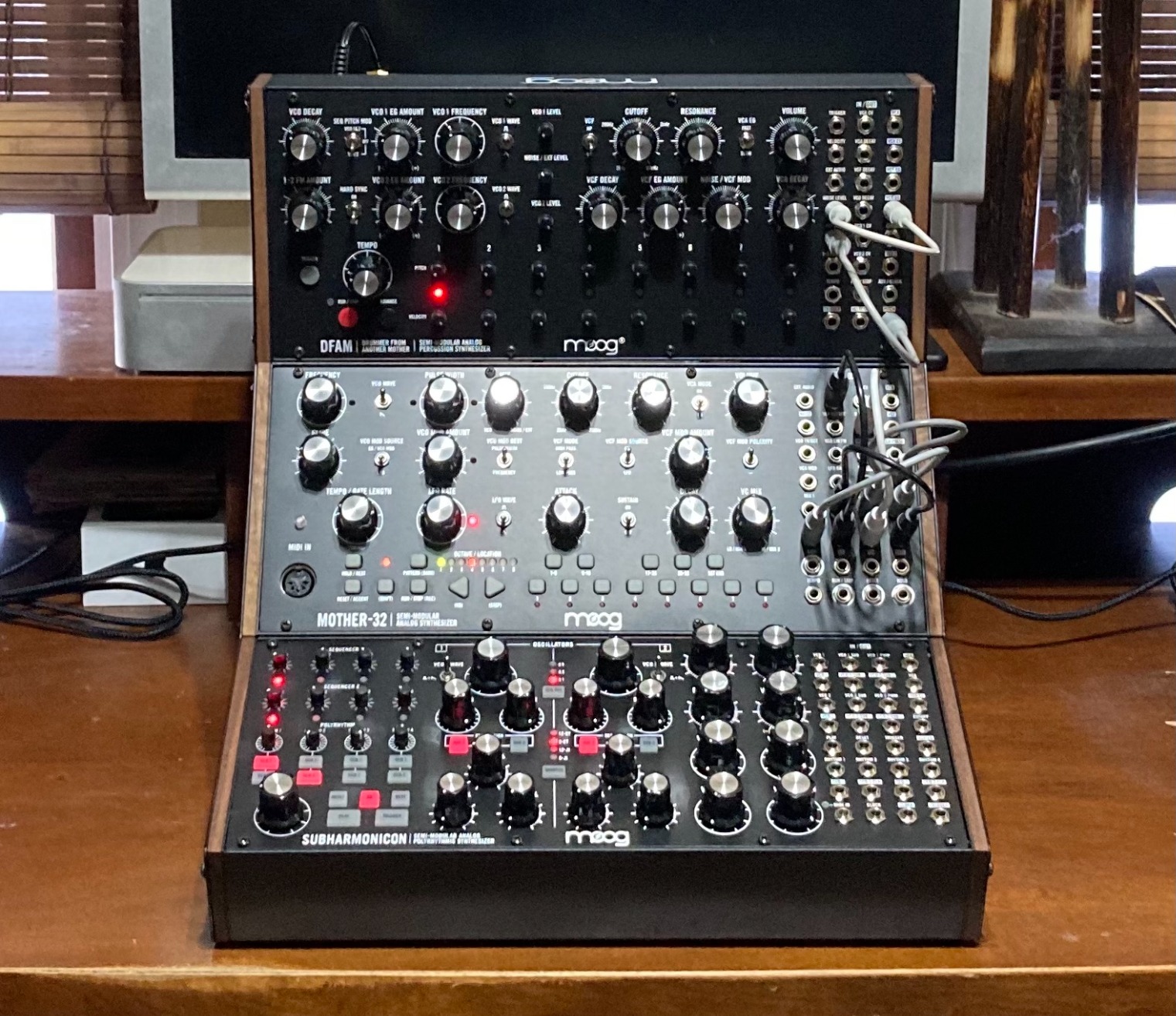
The Mother-32 is designed to integrate with the DFAM, Subharmonicon, and Grandmother, creating a growing Moog ecosystem. You can chain multiple units using patch cables to create increasingly complex systems. This is the foundational unit for a Moog-based modular rig that can grow over years of use.
9. Korg MS-20 Mini – Best for Classic Filter Character
Korg MS20 Mini Semi-Modular Analog Synthesizer (MS20MINI), MultiColored, M
Self-oscillating HP and LP filters
External signal processor
Flexible patching system
USB MIDI and 5-pin MIDI
Compact miniaturized format
Pros
- Self-oscillating filters with distinctive distortion
- External signal processor for external audio
- Flexible patching faithful to original MS-20
- USB MIDI plus traditional 5-pin MIDI
- Authentic recreation of legendary MS-20 sound
- 178 reviews with strong satisfaction
Cons
- Not Prime eligible for faster shipping
- Very low stock at analysis time
- Plastic body vs original metal build
- Mini key size may not suit all players
- Patching system intimidating for beginners
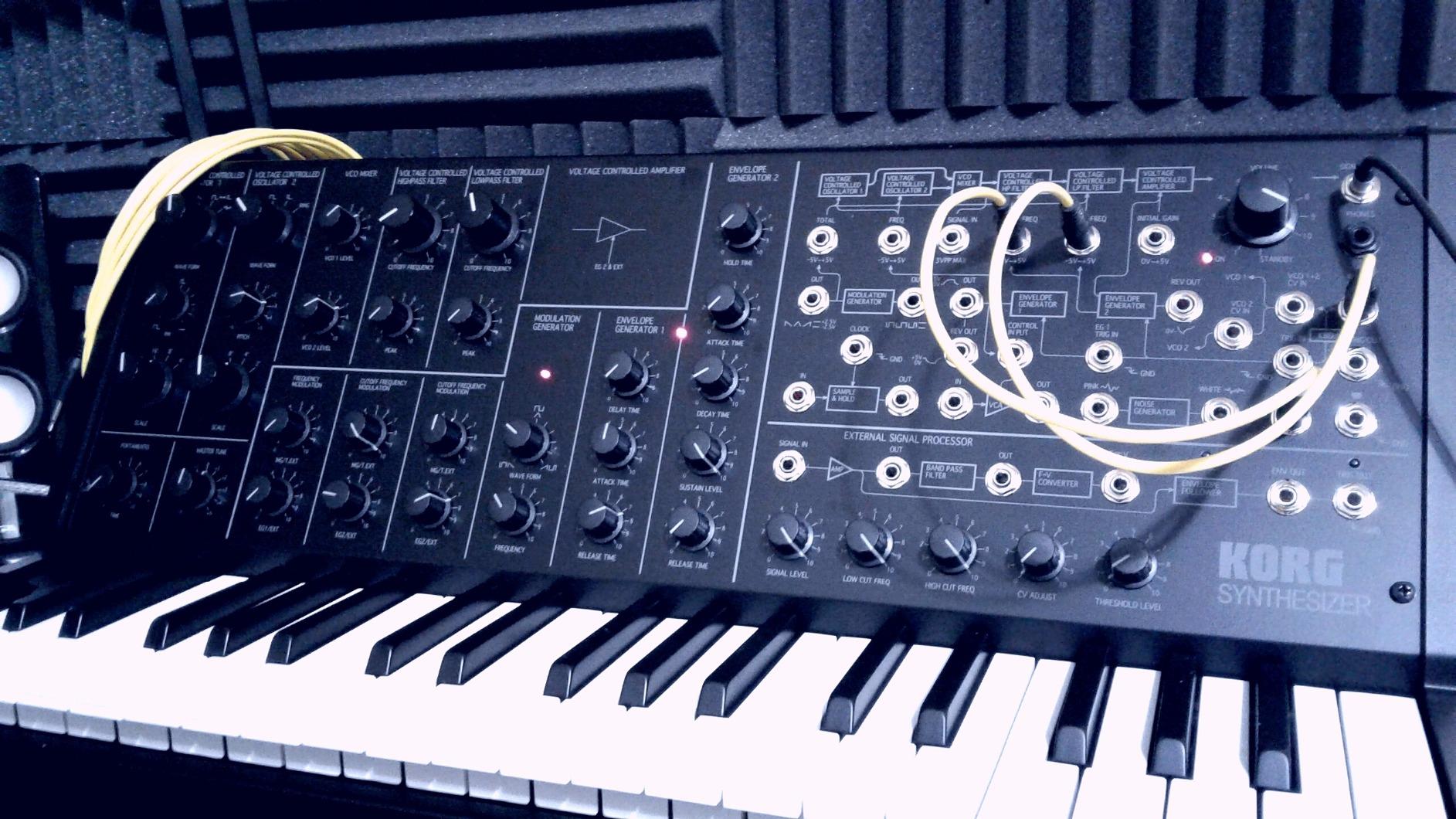
The Korg MS-20 Mini recreates one of the most iconic synthesizers ever made, and its filter character is immediately recognizable from the first note. The self-oscillating high-pass and low-pass filters have a distinctive distortion quality that gives the MS-20 its aggressive, snarling personality. I have never played another synth that sounds quite like this.
The external signal processor, or ESP, is a standout feature that lets you route external audio through the filters and modulation sections. This turns the MS-20 into a powerful effects processor for guitars, drum machines, or any other line-level source. The flexible patching system uses mini-jacks for connecting various modulation sources and destinations.

The build is mostly plastic, which keeps the weight down but does not feel as premium as a Moog instrument. However, the sound quality is where the MS-20 Mini truly delivers, faithfully reproducing the aggressive character that made the original a studio staple for decades. The mini keys may not suit all players, but they keep the footprint manageable.
With both USB MIDI and traditional 5-pin MIDI, the MS-20 Mini integrates easily into any modern setup. The voltage controlled oscillator provides stable tuning and rich harmonic content across the frequency range. At $899 it is a significant investment, but the sound and heritage justify the price for serious synthesists.
The MS-20 Filter Legacy
The filters on the MS-20 are legendary for their ability to self-oscillate and produce resonant peaks that cut through any mix. This is the synth that defined the sound of countless industrial, techno, and electronic artists, and the Mini version captures that character faithfully in a smaller package.
External Signal Processing Capabilities
The ESP section sets the MS-20 apart from most other semi-modular synths. You can plug a guitar or vocal into the input, run it through the filters and envelope follower, and create sounds that range from subtle warming to extreme distortion and beyond. This makes it a dual-purpose instrument and effects processor.
10. Moog Grandmother – Best Semi-Modular With a Keyboard
MOOG Grandmother Semi-Modular Analog Keyboard Synthesizer with 32 Keys, Built-In Arpeggiator, Sequencer and Spring Reverb Tank
32 velocity-sensing keys
2 oscillators with selectable waveforms
Analog spring reverb tank
41 modular patch points
256-note sequencer with arpeggiator
Pros
- Rich and warm Moog analog sound with iconic character
- Analog spring reverb adds lush dimension
- 41 modular patch points for exploration
- 256-note sequencer with 3 sequence files
- Built-in arpeggiator and 32 full-size keys
- Compatible with Mother-32 DFAM and Eurorack systems
Cons
- Expensive at $999 price point
- Some units reported scratchy potentiometers
- Limited pitch range on built-in keyboard
- Mod wheel response reported inconsistent
- Limited stock availability
Playing the Moog Grandmother feels like playing a piece of synthesizer history. The 32 velocity-sensing full-size keys give you immediate tactile control, and the spring reverb tank adds a dimension of warmth and depth that digital effects simply cannot replicate. This is the kind of instrument that makes you want to play for hours on end without realizing how much time has passed.
The sound engine features two oscillators with selectable waveforms, a white noise generator, and the classic Moog ladder filter. With 41 modular patch points, you can reroute virtually every aspect of the signal path for deep experimental work. The built-in arpeggiator and 256-note sequencer provide plenty of compositional tools without needing external gear.
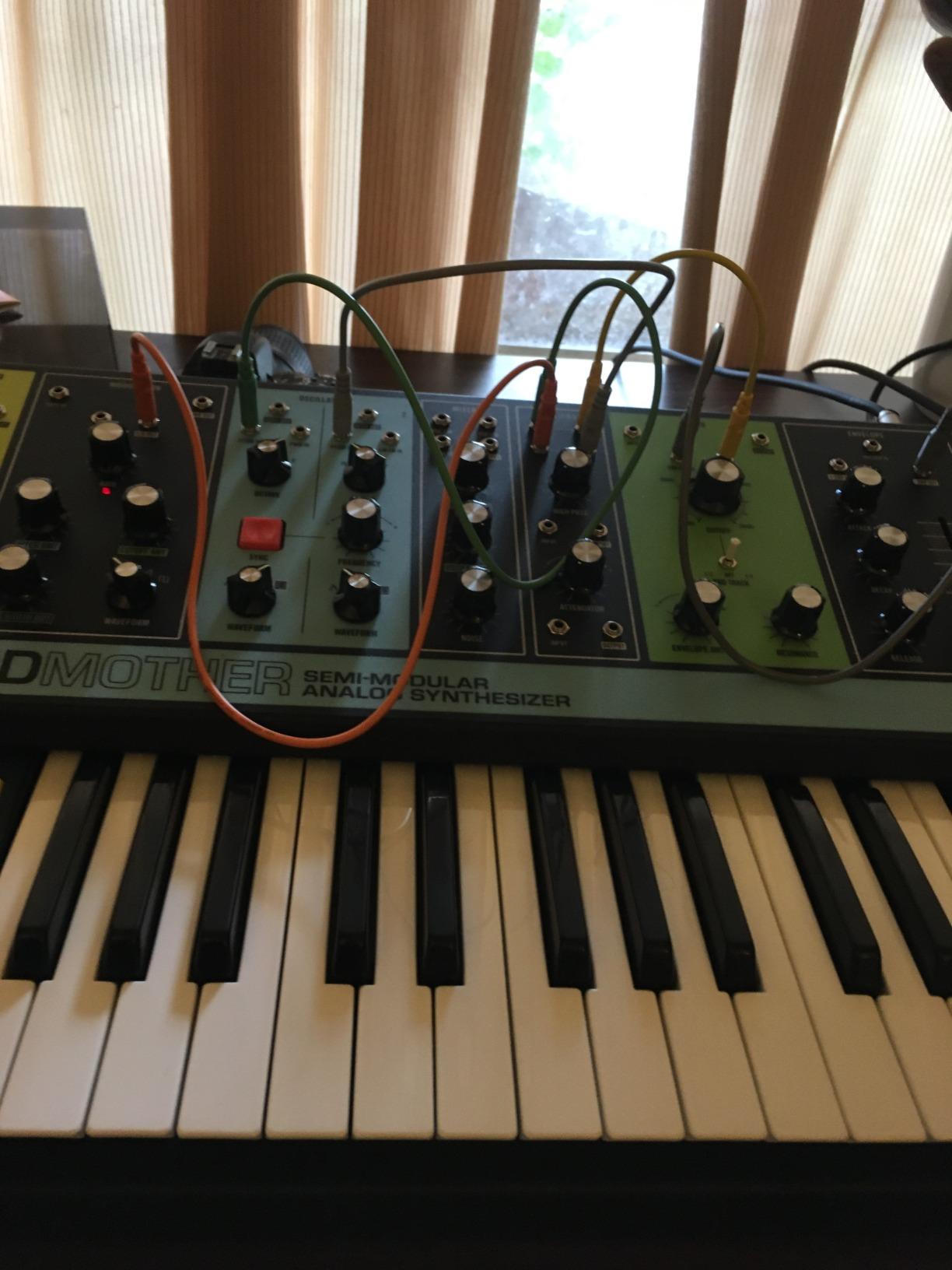
I particularly love how the Grandmother bridges the gap between a performance keyboard and a modular instrument. You can sit down and play it like a traditional synth, then gradually introduce patch cables to push the sound into new territory. The 1/4-inch audio input even lets you process guitars or drum machines through the filter and reverb.
The build quality is excellent with solid wood side panels and a metal chassis. Made in the USA at the Moog factory in Asheville, North Carolina, the Grandmother carries the heritage of classic Moog instruments in every component. Some users report isolated quality control issues with scratchy pots or loose hardware, but the 81 percent 5-star rating reflects strong overall satisfaction despite the premium price.
Performance vs Studio Use
The Grandmother shines in live performance settings thanks to its keyboard, arpeggiator, and intuitive layout. The spring reverb adds an organic quality that sits beautifully in a live mix. For studio work, the patch points and external audio input make it a versatile sound design tool that earns its keep across many sessions.
Build Quality and Long-Term Value
While some users have reported quality control issues with scratchy potentiometers or loose nuts, these appear to be isolated cases rather than widespread problems. The overall build quality is excellent, and Moog instruments tend to hold their resale value remarkably well over time. This is an investment-grade synthesizer.
Buying Guide: How to Choose a Semi-Modular Synthesizer
Choosing from the best semi modular synthesizers comes down to understanding your needs, budget, and the specific features that matter most for your music. This guide breaks down the key factors to consider so you can make an informed decision that fits your creative goals and financial situation.
What Is a Semi-Modular Synthesizer?
A semi-modular synthesizer is a hardware instrument that combines fixed internal wiring with a patchbay. This means it works immediately without any patch cables, producing sound through a default signal path from oscillator to filter to amplifier. The patch points let you override or extend this default routing by connecting patch cables between various sources and destinations.
This architecture sits between traditional hard-wired synthesizers and fully modular systems. You get the instant playability of a normal synth plus the creative flexibility of modular routing. It is the ideal middle ground for learning synthesis fundamentals while keeping the door open for modular expansion as your skills and ambitions grow.
Key Factors to Consider
Patch Points Count: More patch points mean more routing possibilities. The Korg Volca Modular leads the budget category with 50 patch points, while the Moog Grandmother offers 41 patch points for deep experimentation. Consider how much patching flexibility you actually need based on your experience level and creative goals.
Eurorack Compatibility: If you plan to build a modular system eventually, choose a synth that fits the Eurorack format. The Moog Mother-32 is a 60HP Eurorack module, while the Cre8audio West Pest and Moog Mavis are 40HP and 44HP modules respectively. The Behringer Neutron and Make Noise 0-Coast also offer Eurorack compatibility for seamless integration.
Sound Engine: The number and type of oscillators, filters, and modulation sources define the character of the synth. Dual VCO synths like the Behringer Neutron produce richer sounds than single-oscillator units. The filter type matters too: the Moog ladder filter sounds different from the Korg MS-20 filter or the Arturia Steiner Parker filter.
Sequencer Features: A built-in sequencer lets you create patterns without external gear. The Moog Mother-32 offers 64 sequences with 32 steps each, while the Behringer Grind provides a 32-step sequencer. The Arturia MiniBrute 2S includes 64 sequence memories triggered via performance pads for a different creative workflow.
Keyboard vs Desktop: Decide whether you need a built-in keyboard or prefer a desktop module controlled via MIDI. The Moog Grandmother includes 32 full-size keys, while most other options in this guide are desktop units that require an external controller for melodic playing.
West Coast vs East Coast Synthesis
East Coast synthesis, also called subtractive synthesis, starts with harmonically rich waveforms and uses a filter to remove frequencies. This is the approach used by Moog instruments and most classic analog synths. The sound is warm, familiar, and musical to most ears.
West Coast synthesis uses wavefolding and complex waveform generation to add harmonics rather than remove them. The Make Noise 0-Coast, Korg Volca Modular, and Cre8audio West Pest all embrace this approach. The resulting sounds are more metallic, bell-like, and experimental than traditional subtractive tones.
Both approaches are valid and complementary. If you can only choose one, start with East Coast subtractive synthesis as it is more intuitive for beginners. Many experienced synthesists eventually own instruments from both traditions to maximize their creative palette.
Desktop Module vs Keyboard Format
Desktop modules like the Behringer Neutron, Make Noise 0-Coast, and Moog Mother-32 are compact and affordable but require an external controller for keyboard playing. They are ideal for studio use where you already have a MIDI keyboard or sequencer in your setup.
Keyboard-equipped synths like the Moog Grandmother and Korg MS-20 Mini are self-contained performance instruments. They cost more and take up more space, but they let you sit down and play immediately without any additional gear. Choose based on how you plan to make music.
Beginner Recommendations
If this is your first semi-modular synth, start with something affordable and approachable. The Korg Volca Modular is the cheapest legitimate entry point at under $170, while the Cre8audio West Pest offers more features for around $250. The Moog Mavis delivers genuine Moog sound as a build-it-yourself kit for under $300.
Once you understand synthesis fundamentals, you can graduate to more complex instruments. The Moog Mother-32 is the natural next step for building a modular system, and the Make Noise 0-Coast offers a uniquely inspiring approach for experimental sound design that rewards patience and curiosity.
FAQs
What is a semi-modular synthesizer?
A semi-modular synthesizer is a hardware instrument that combines fixed internal wiring with a patchbay, allowing you to play it without cables while also offering patch points to reroute signals through the VCO, VCF, VCA, and modulation sources. This makes it ideal for both immediate sound creation and experimental modular routing.
Are semi-modular synths good for beginners?
Yes, semi-modular synths are excellent for beginners because they work immediately without any patch cables, producing sound through a default signal path. Beginners can start playing right away and gradually experiment with patch cables as they learn synthesis concepts. Affordable options like the Korg Volca Modular and Cre8audio West Pest make learning accessible.
How can I expand the capabilities of my semi-modular synth?
You can expand a semi-modular synth by connecting it to Eurorack modules, chaining multiple units together, integrating guitar pedals via the audio output, using external sequencers and controllers via MIDI, and patching external audio through the filter and modulation sections. Moog instruments like the Mother-32 and Grandmother are designed to work together as a system.
What factors should I consider when buying a semi-modular synth?
Consider the number of patch points for routing flexibility, Eurorack compatibility for future expansion, the sound engine including oscillator and filter types, built-in sequencer features, whether you need a keyboard or prefer a desktop module, and your budget. Also check build quality, warranty coverage, and community support resources.
Which semi-modular synth has the best feature-to-price ratio?
The Behringer Neutron is widely recommended by the synthesizer community as the best value semi-modular synth, offering dual analog oscillators, paraphonic architecture, and an extensive patchbay for under $490. For budget buyers, the Korg Volca Modular offers 50 patch points and West Coast synthesis at under $170.
Conclusion: Finding Your Ideal Semi-Modular Synth in 2026
The best semi modular synthesizers offer a perfect balance between instant playability and creative depth, and our top picks reflect the range of options available in 2026. The Moog Mother-32 stands out as our Editor’s Choice for its iconic ladder filter sound, powerful sequencer, and proven track record as the gateway to modular synthesis. For value-conscious buyers, the Behringer Neutron delivers authentic dual-oscillator analog tone at an unbeatable price-to-feature ratio. And for absolute beginners, the Korg Volca Modular provides a legitimate West Coast synthesis experience at the lowest price in this guide.
Whatever your budget or experience level, there has never been a better time to explore semi-modular synthesis. The instruments in this guide cover every approach from classic Moog warmth to experimental West Coast wavefolding, and each one offers a genuine path into the world of patchable sound design. Pick the one that matches your musical goals and start patching today.