
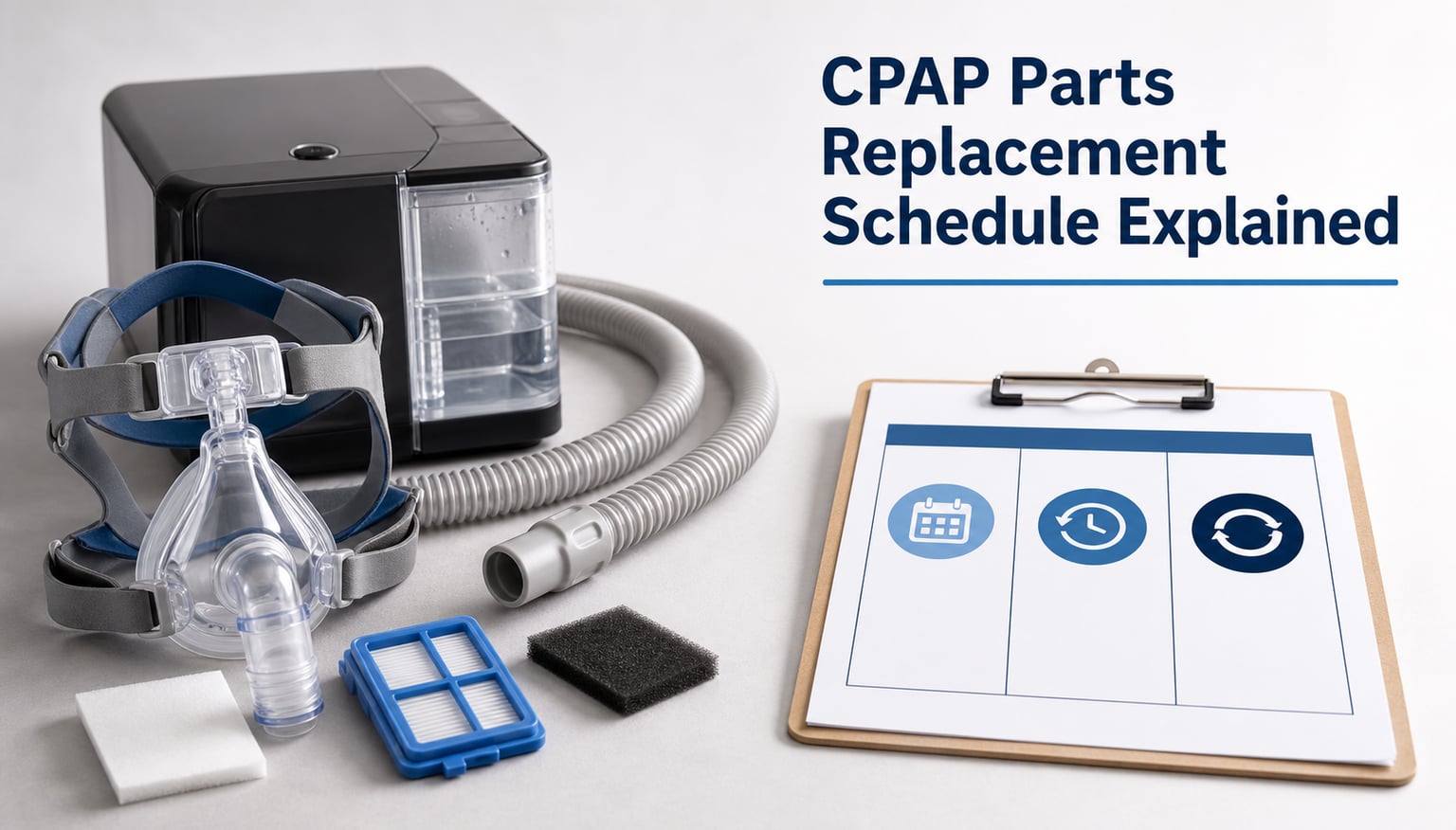
A CPAP parts replacement schedule is a practical guide for checking when the mask, filters, tubing, headgear, and humidifier pieces may no longer support comfortable, effective sleep apnea therapy. The usual schedule groups supplies into monthly, three-month, and six-month intervals, but the condition of each part still matters.
That distinction matters because a clean cushion that still seals well is different from one that feels tacky, leaks, or irritates skin. At the same time, waiting through clear damage or persistent leaks can make therapy harder to stick with.
This guide explains the commonly used CPAP supplies replacement schedule, what each interval covers, and when to replace a part earlier. We also separate resupply guidance from cleaning and from the insurance compliance terms that often cause confusion.
The CPAP parts replacement schedule starts with three time intervals
Use this quick reference as a starting point, then inspect your own equipment and follow the instructions for your machine and mask. A clinician or equipment supplier can help when a part’s condition, fit, or cleaning guidance is unclear.
- Every month: Mask cushions or nasal pillows and CPAP machine filters are commonly checked for replacement.
- Every 3 months: The mask frame without headgear and CPAP tubing are commonly checked for replacement.
- Every 6 months: Headgear, chin straps, and the humidifier water chamber are commonly checked for replacement.
The schedule is intentionally simple: parts that contact skin, collect moisture, or filter room air tend to need attention sooner than structural pieces. Heated tubing, reusable filters, and mask designs can have their own instructions, so the manual for your exact setup takes priority.
Quick definition: A mask cushion is the soft sealing surface on a nasal or full-face mask. Nasal pillows are the smaller soft inserts that rest at the nostrils; both affect the mask seal and can wear sooner than the mask frame.
Worn CPAP parts can reduce comfort and therapy consistency
CPAP therapy keeps the airway open with prescribed air pressure, so the system works best when airflow travels through intact, clean equipment and the mask seals comfortably. A cushion that has lost its shape or a tube with a split can create air leaks that interrupt sleep or lead a person to tighten the mask too much.
Skin oils, moisture, and regular handling change the feel of silicone and fabric over time. Filters collect airborne material, while the water chamber and tubing require routine attention because they are part of a humidified airflow path.
Replacement is not a substitute for cleaning, and cleaning cannot repair worn silicone, stretched elastic, cracks, or damaged connections. Think of the schedule as a planned inspection rhythm rather than a blind discard date.
Warning: Do not alter pressure settings to solve a new leak or a comfort problem. Check the fit and the physical condition of the supplies first, and contact your sleep-care clinician if the issue continues.
Monthly checks focus on cushions, nasal pillows, and filters
Mask cushion replacement and CPAP nasal pillows replacement commonly appear in the monthly part of a schedule because these pieces directly create the seal against the face or nostrils. Replace them sooner if they become sticky, stiff, torn, discolored, difficult to clean, or unable to seal at the usual fit.
Some published schedules are more aggressive, while user discussions describe nasal pillows lasting two or three months with careful cleaning. That real-world variation is useful context, not a reason to keep a part that has stopped sealing, causes irritation, or has visible damage.
Disposable filters need regular inspection because room air varies
CPAP filter replacement is commonly listed monthly for disposable filters. A home with pets, dust, smoke, seasonal pollen, or higher particle exposure may make a filter look dirty sooner, while the machine’s manual sets the appropriate filter type and handling.
Hold the filter up in good light during your routine check. If it is visibly soiled or the manufacturer says it is single-use, change it rather than trying to wash it.
Reusable filters follow the machine manual rather than a one-size-fits-all date
Reusable filters are not the same as disposable filters. Follow the manual’s washing, drying, and replacement directions, and never put a damp filter back into the machine.
Clean, fully dry reusable filters may have a different service interval than disposable filters. Confirm which type your machine uses before making a maintenance calendar.
Practical tip: Put a recurring reminder on the day you clean the mask. A short monthly inspection catches loss of elasticity, discoloration, and small tears before they become a frustrating nighttime leak.
Three-month checks focus on tubing and the mask frame
CPAP tubing replacement is commonly scheduled every three months, along with the mask frame without headgear. These parts do not usually touch the face in the same way as a cushion, yet they still face repeated bending, connection stress, moisture, and normal wear.
CPAP tubing should be replaced when it no longer stays intact and dry
Before reconnecting tubing, look through it for moisture, residue, or obvious damage. Check both ends for a secure connection and look over the full length for splits, pinholes, flattened areas, or kinks that do not relax.
Heated tubing has electrical contacts and model-specific care instructions. Do not treat it like ordinary tubing if its manual says otherwise.
The mask frame should be replaced when it cannot support a stable seal
A frame can look fine while its connection points or shape no longer support the cushion correctly. If a clean, properly seated cushion suddenly leaks and the frame is cracked, warped, or loose at the elbow or clips, replace the affected part.
Do not over-tighten headgear to compensate for a failing frame. Excessive tension can cause pressure marks and may make leaks worse.
Six-month checks focus on headgear, chin straps, and water chambers
CPAP headgear replacement is commonly scheduled every six months because fabric and elastic can gradually stretch with nightly use and washing. A chin strap, if you use one, belongs in the same condition check.
Headgear should be replaced when adjusted straps no longer hold the mask
Mark the usual adjustment points when the fit is comfortable. If you repeatedly need to shorten the straps to stop leaks, the elastic may have lost enough resilience that a new cushion alone will not solve the problem.
Frayed fabric, failing hook-and-loop closures, and broken clips are additional reasons to replace it earlier. Comfort and a consistent seal are better signals than the calendar alone.
The water chamber should be replaced when damage affects safe use
CPAP water chamber replacement is commonly listed every six months. Inspect the chamber for cracks, cloudiness that does not clear with appropriate cleaning, mineral buildup, damaged seals, and any distortion that prevents a proper fit.
Using distilled water and emptying the chamber as directed can limit mineral deposits. If the chamber leaks or cannot be cleaned according to its instructions, stop using it and get guidance on a replacement.
Early replacement is appropriate when performance or hygiene changes
The calendar is useful, but several signs call for action before the scheduled interval. A single bad night may be a fit issue; a repeated pattern after normal cleaning deserves a closer inspection.
- Air leaks: New whistling, fluttering, dry eyes, or a persistent leak alert after proper fitting can point to a cushion, frame, tube, or connection problem.
- Skin discomfort: New redness, pressure marks, itching, or soreness can mean the cushion has changed, the fit needs review, or the mask is no longer the right interface.
- Visible wear: Cracks, tears, stretched elastic, damaged clips, loose connectors, and tubing holes are direct replacement signals.
- Cleaning changes: An odor, residue, discoloration, or film that remains after cleaning exactly as directed means the item needs attention from the supplier or clinician.
- Filter buildup: A visibly dirty disposable filter should not wait for the next calendar reminder.
Start with the least complicated check: wash and dry the part as directed, reseat every connection, and refit the mask while awake. If the problem remains, identify the damaged component rather than replacing unrelated parts at random.
Warning: Persistent snoring, daytime sleepiness, breathing concerns, or a major change in therapy results needs clinical advice. A parts schedule cannot diagnose sleep apnea treatment problems.
Proper cleaning supports useful life but does not reverse wear
CPAP equipment maintenance works best as a simple routine: follow the instructions for your exact mask and machine, clean the parts at the stated frequency, rinse thoroughly where the manual permits, and allow everything to dry fully before reassembly. Regular care removes the skin oils and moisture that can affect comfort and the seal.
Keep the routine gentle. Abrasive products, unapproved cleaners, extreme heat, and improvising with parts not specified for the device can shorten the life of silicone, fabric, plastics, or electrical components.
A small cleaning routine makes inspection easier
- Disconnect the mask, tubing, chamber, and filter only as the manual directs.
- Wash the components that are approved for washing, then rinse away cleaning residue.
- Air-dry the pieces completely in a clean location before putting the system back together.
- During reassembly, check the cushion edge, strap elasticity, tubing ends, chamber seal, and filter condition.
- Record the date when you replace a component, especially if a recurring leak appears.
Community conversations often connect rigorous cleaning with longer-lasting pillows or cushions. The sensible takeaway is to inspect after cleaning and judge the item by cleanliness, integrity, comfort, and seal—not to use cleaning as proof that a worn part is still usable.
Less waste starts with accurate replacement and responsible disposal
Many users are understandably concerned about disposable supplies. Avoiding unnecessary replacement begins with knowing which components are disposable, observing the manufacturer’s cleaning rules, and replacing a part when its condition calls for it rather than because a generic reminder arrived.
Ask your supplier or local recycling program what, if anything, they accept; CPAP materials and local rules differ. Do not reuse a single-use filter or a visibly damaged part to reduce waste.
A replacement log makes the schedule personal and useful
A simple log turns a general CPAP part lifespan guide into information you can act on. Write down the date you opened a cushion, filter, tube, chamber, or headgear set, then add short notes when you clean it, adjust it, or notice a leak.
After a few checks, the record can show whether the same item always fails early or whether an apparent equipment problem began after a change in sleep position, facial hair, room conditions, or cleaning routine. That pattern is more helpful in a conversation with a supplier or clinician than a vague report that the mask “stopped working.”
A condition check should happen before and after a leak problem
Start by making the bed-side check repeatable. Inspect the cushion edge, frame clips, elbow, tubing ends, water chamber seal, and filter, then reassemble the system exactly as directed.
Next, put the mask on while awake and adjust it only enough to get a comfortable seal. If the leak is new but no part is damaged, review the fitting instructions and check whether the cushion is seated evenly instead of immediately tightening every strap.
If the same leak returns after normal cleaning and careful fitting, record where it seems to come from and when it occurs. That helps separate a worn cushion or tube from a fit issue, a damaged connector, or a setting that needs clinical review.
Replacement timing varies because use conditions vary
Nightly hours of use, facial oils, humidity, household dust, pets, cleaning habits, and the specific mask design all affect wear. That is why one person may report a usable cushion after a longer period while another notices seal trouble much sooner.
Do not compare your equipment only with another user’s calendar. Compare it with the product instructions and with its current seal, comfort, cleanliness, and physical condition.
Practical tip: Keep one spare of the items most likely to disrupt sleep when they fail, such as the correct filter or cushion. A spare does not change the replacement schedule; it gives you a clean option when an inspection finds a problem at night.
Machine replacement is separate from replacing CPAP supplies
The CPAP machine itself is a separate device from its replaceable supplies. Competitor research commonly notes a machine lifespan of about five years, but a machine’s service needs, warranty terms, recorded performance, and coverage rules should be checked with the manufacturer, supplier, and insurer.
Do not assume a new cushion, filter, or water chamber will fix a device problem. Unusual noise, loss of airflow, error messages, damaged power equipment, or a change in recorded results calls for the device instructions and professional support.
Keeping the machine exterior and approved components clean supports regular maintenance, while scheduled supplies address the mask system and airflow path. Treating those as two related but different tasks prevents both missed supply checks and unnecessary device changes.
Insurance resupply rules and compliance rules answer different questions
Insurance coverage may set intervals for when a replacement supply can be billed or sent through a resupply program. That administrative timing is not a guarantee that a particular cushion, tube, or chamber must be replaced on that exact day.
Before accepting or delaying a resupply, check your plan documents, supplier records, and the condition of the part. Keep a brief list of replacement dates and recurring fit issues so you can ask more specific questions.
The 70 rule refers to adherence, not a CPAP parts replacement schedule
The phrase “70 rule” is commonly used in CPAP coverage conversations to describe an adherence requirement rather than the lifespan of masks or filters. The exact definition and documentation requirements can vary by insurer or program, so confirm them with your plan and clinical team.
The 4-hour rule also concerns therapy use, not supply wear
The “4-hour rule” is another CPAP compliance term related to recorded therapy use. It does not tell you when to replace CPAP components, although a comfortable mask and reliable equipment can make regular use easier.
The following answers address common CPAP replacement questions
What is the replacement schedule for CPAP supplies?
A common CPAP supplies replacement schedule is monthly checks for mask cushions or nasal pillows and filters, three-month checks for tubing and the mask frame, and six-month checks for headgear, chin straps, and the water chamber. Use the condition of the part and its manufacturer instructions to decide whether it needs earlier replacement.
What is the 70 rule for CPAP?
The 70 rule is commonly an insurance or therapy-adherence term, not a CPAP supply replacement interval. Its exact requirements may differ by plan or program, so ask your insurer, equipment supplier, or sleep-care team how it applies to your coverage.
How often should I replace CPAP components?
Common guidance is monthly for cushions, nasal pillows, and disposable filters; every three months for tubing and the mask frame; and every six months for headgear, chin straps, and water chambers. Replace earlier for cracks, loss of seal, stretched straps, visible soil, odors that remain after approved cleaning, or damage.
What is the 4-hour rule for CPAP?
The 4-hour rule is a term used for CPAP therapy compliance, not for replacing supplies. It relates to recorded device use, while a replacement schedule is based on part type, manufacturer instructions, cleanliness, wear, and mask performance.
The best CPAP parts replacement schedule combines timing with inspection
A dependable CPAP parts replacement schedule uses monthly, three-month, and six-month checkpoints to make routine care manageable. It also asks a more useful question each time: does this clean, correctly assembled part still seal, fit, and function as it should?
Set reminders, follow the product manual, keep a replacement record, and act early on leaks, damage, or discomfort. If we notice a recurring issue after those checks, our next step should be a conversation with the equipment supplier or sleep-care clinician rather than guessing at a fix.