
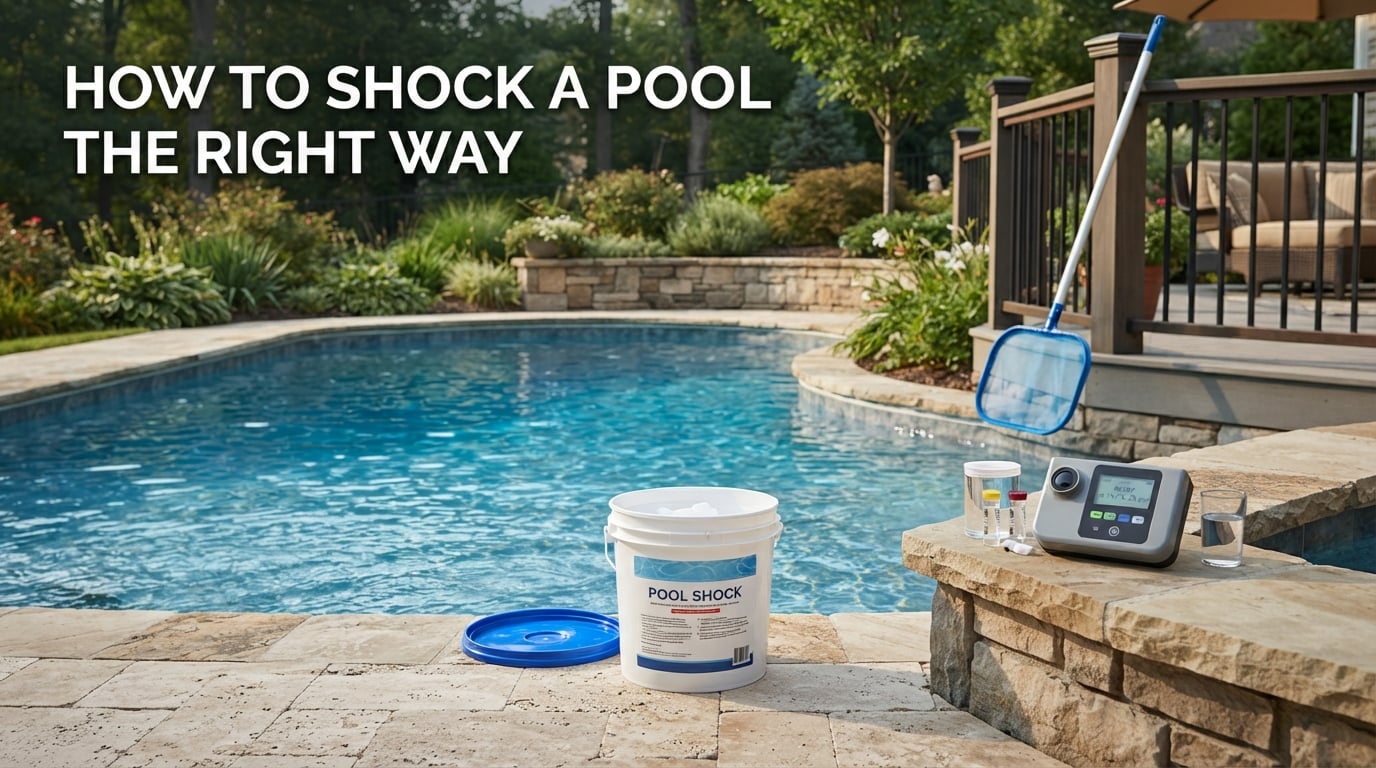
Learning how to shock a pool the right way is one of the most important skills a pool owner can master. I have spent years maintaining my own pool and helping neighbors troubleshoot theirs, and I can tell you that proper shocking makes the difference between crystal-clear water and a green swamp you do not want to touch.
Shocking a pool means adding a concentrated dose of chlorine (or a non-chlorine oxidizer) to raise the free chlorine level high enough to destroy contaminants that regular chlorination cannot handle. Think of it as a deep clean for your water. Your daily chlorine tablet keeps things sanitized day to day, but shock treatment hits the reset button when organic load builds up.
In this guide, I will walk you through everything from understanding why shocking works to choosing the right chemical, calculating dosage, and executing the process step by step. By the end, you will know exactly how to shock a pool the right way and keep your water swim-ready all season long.
What Does Shocking a Pool Actually Do?
Shocking a pool raises the free chlorine level high enough to destroy chloramines, bacteria, algae, and organic contaminants in a process called breakpoint chlorination. When you add chlorine to pool water normally, it attaches to contaminants and forms combined chlorine, also known as chloramines. These chloramines are what cause that harsh “chlorine” smell and eye irritation people associate with pools.
Chloramines are essentially spent chlorine. They have already bonded with contaminants and can no longer sanitize your water effectively. Worse, they actually interfere with the active chlorine still in your pool. The only way to clear them out is to raise the free chlorine level to roughly ten times the combined chlorine level. That ratio is called the breakpoint, and hitting it is what “shocking” means.
Free Available Chlorine vs. Combined Chlorine
Free available chlorine (FAC) is the active sanitizer in your pool. It is the chlorine that has not bonded with anything yet and is ready to kill bacteria and viruses. Your FAC level should sit between 1 and 3 parts per million (ppm) for normal swimming conditions.
Combined chlorine (CC) is the chlorine that has already done its job and bonded with contaminants. When your combined chlorine reads above 0.2 ppm, you need to shock. Total chlorine (TC) is simply the sum of free and combined chlorine. If your total chlorine equals your free chlorine, you have zero combined chlorine and do not need to shock right now.
Why Regular Chlorine Is Not Enough
Daily chlorine tablets and floaters release chlorine slowly to maintain a steady sanitizer level. They cannot deliver the sudden, concentrated dose needed to reach breakpoint chlorination. Without that spike, chloramines accumulate, algae takes hold, and your water quality spirals downward fast.
I learned this the hard way my second summer as a pool owner. I kept my chlorine floater full every week, skipped shocking entirely, and by mid-July my pool had a dull green tint that would not go away. Once I started a weekly shock routine, the water stayed clear all season. Shocking is not optional maintenance; it is essential chemistry.
When to Shock Your Pool
You should shock your pool on a regular weekly schedule during swim season and additionally whenever specific situations spike your contaminant load. I recommend picking a consistent day each week, like Sunday evening, so it becomes routine. Beyond weekly maintenance, here are the scenarios that call for an extra shock treatment.
Weekly Maintenance Shock
During peak swim season, shocking once per week prevents chloramine buildup before it becomes visible. Pool owners on a weekly schedule report far fewer algae problems and more consistent water clarity. In cooler months when nobody is swimming, you can reduce to every two weeks.
After Heavy Rain
Rain washes debris, dirt, pollen, and organic matter straight into your pool. A heavy thunderstorm can overwhelm your normal chlorine levels in hours. I always shock after any storm that drops more than half an inch of rain. The sooner you shock after the rain stops, the less chance algae has to establish itself.
Algae Bloom
If you spot any green tint, slimy walls, or visible algae patches, shock immediately. Algae spreads fast, and a small bloom can turn your entire pool green in 48 hours. For a green pool, you will likely need a double or triple dose and may need to repeat the treatment over several days. Brushing the walls before shocking helps break the algae loose so the chlorine can do its job.
After Heavy Pool Use
A pool party with ten or more swimmers introduces a massive load of sweat, body oils, sunscreen, and cosmetics into your water. Even if the water looks fine afterward, contaminant levels spike. Shock the same evening after any large gathering to prevent problems before they start.
Pool Opening and Closing
When you open your pool for the season, a strong shock treatment kills whatever grew during the off-season. I always shock to double the normal maintenance dose on opening day, then let the pump run for 24 hours before testing. At closing, a final shock ensures the water stays clean through the winter months.
Fecal or Vomit Incident
This is an emergency shock situation. The CDC recommends raising free chlorine to at least 2 ppm (for formed stool) or 20 ppm (for diarrhea incidents) and maintaining that level for a specific contact time before allowing anyone back in the pool. Follow CDC guidelines carefully and test before reopening.
Seasonal Shocking Frequency Guide
Here is a quick reference for how often to shock based on the season. Summer (June through August): shock weekly. Spring and fall (shoulder seasons): shock every two weeks. Winter (if pool stays open): shock once per month. Adjust upward if you live in a hot climate or have heavy tree debris around your pool.
Types of Pool Shock Explained
There are four main types of pool shock, and choosing the right one depends on your pool type, the problem you are treating, and your personal preference. Each has different chlorine concentrations, dissolution rates, and side effects on your water chemistry. Let me break them down so you can choose with confidence.
Calcium Hypochlorite (Cal-Hypo)
Cal-Hypo is the most popular and widely used pool shock. It contains 65 to 75 percent available chlorine, making it one of the strongest options available. It is fast-acting, kills algae and bacteria aggressively, and is relatively affordable compared to other options.
The trade-off is that Cal-Hypo adds calcium to your pool water with each use. Over time, this can raise your calcium hardness level, which causes scaling on pool surfaces and equipment. If you already have hard water, Cal-Hypo may push your calcium levels too high. Cal-Hypo is unstabilized, meaning it contains no cyanuric acid (CYA) and will not protect chlorine from UV degradation on its own.
Best use: General maintenance shocking and algae treatment in pools with normal calcium hardness. Always pre-dissolve Cal-Hypo in a bucket of water before adding to the pool to prevent bleaching your liner or plaster.
Sodium Dichlor (Dichlor)
Dichlor contains 56 to 62 percent available chlorine and is stabilized, meaning it includes cyanuric acid. The CYA protects the chlorine from sunlight breakdown, making Dichlor a good choice for outdoor pools that receive direct sun exposure.
Dichlor dissolves quickly and has a near-neutral pH, so it will not drastically shift your water balance the way Cal-Hypo can. The downside is that every dose adds cyanuric acid to your pool. Over time, CYA levels can climb too high (above 50 ppm), which actually reduces chlorine effectiveness. If CYA gets too high, you will need to partially drain and refill your pool to lower it.
Best use: Regular maintenance shocking in sunny pools where CYA levels are currently low. Not ideal for frequent use if your CYA is already in the 30 to 50 ppm range.
Potassium Monopersulfate (Non-Chlorine Shock)
Non-chlorine shock does exactly what the name implies. It oxidizes contaminants without adding chlorine to your water. It destroys chloramines, body oils, and organic matter but cannot kill algae or bacteria on its own. You use it to refresh your water without spiking chlorine levels.
The big advantage of non-chlorine shock is that you can swim within 15 to 30 minutes after adding it. There is no need to wait overnight. This makes it perfect for quick refreshes between swims or when you want to reduce chloramine levels without a full chlorine shock.
Best use: Boosting water clarity between regular chlorine shocks, refreshing water before a party, or maintaining oxidation levels without raising chlorine. Do not use non-chlorine shock as your only shock method, because it will not kill algae.
Liquid Chlorine (Sodium Hypochlorite)
Liquid chlorine is essentially the same chemical as household bleach but at a much higher concentration, typically 10 to 12.5 percent sodium hypochlorite. It pours directly into the pool with no pre-dissolving required, which many pool owners appreciate for convenience.
Liquid chlorine acts fast and distributes evenly through the pool because it is already dissolved. It adds no calcium and no cyanuric acid, making it ideal for saltwater pools and pools where those levels need to stay low. The trade-off is that it has a high pH (around 13), so repeated use can push your pH upward and require adjustment with muriatic acid.
Liquid chlorine also degrades in storage faster than granular products. A jug stored for a month in a hot garage loses significant potency. Buy fresh and use it quickly.
Best use: Saltwater pools, pools with high calcium or CYA, and for pool owners who value convenience. Many pool service professionals use liquid chlorine exclusively.
How to Shock a Pool the Right Way: Step-by-Step
Follow these steps in order for a safe and effective shock treatment. I have refined this process over years of pool ownership, and each step matters. Skipping any step can lead to wasted chemical, bleached surfaces, or ineffective treatment.
Step 1: Test Your Water
Before adding anything to your pool, test the water. You need to know your current pH, free chlorine, combined chlorine, total alkalinity, and cyanuric acid levels. Use a reliable test kit or take a water sample to your local pool store for professional testing. You cannot dose what you have not measured.
The most critical reading is pH. If your pH is above 7.8, your shock will be significantly less effective. Chlorine’s killing power drops dramatically at higher pH levels. Adjust pH to the 7.2 to 7.4 range before shocking for maximum impact.
Step 2: Balance pH and Alkalinity
If your pH is too high, add muriatic acid or dry acid (sodium bisulfate) following the manufacturer’s dosage chart. If total alkalinity is below 80 ppm, add baking soda (sodium bicarbonate) to bring it up. Proper alkalinity buffers your pH so it stays stable after you add shock.
Wait at least 30 minutes after adding pH adjustments before adding shock. This gives the chemicals time to mix and stabilize so they do not react with each other.
Step 3: Calculate Your Dosage
Determine how much shock you need based on your pool volume and the condition of the water. The general rule for Cal-Hypo (68 percent) is one pound per 10,000 gallons for routine maintenance. For algae treatment, you may need two to three pounds per 10,000 gallons. Always check the product label for specific dosage instructions.
If you do not know your pool volume, calculate it from the dimensions. For a rectangular pool: multiply length times width times average depth times 7.5 to get gallons. For a round pool: multiply diameter times diameter times average depth times 5.9.
Step 4: Pre-Dissolve Granular Shock
This is the step most people skip, and it causes the most problems. For granular shock (Cal-Hypo or Dichlor), fill a clean five-gallon bucket about three-quarters full of warm pool water. Then slowly pour the measured shock granules into the water while stirring with a plastic or wooden stick.
Always add chemicals to water, never add water to chemicals. Adding water to dry chemical can cause a violent reaction and splashing. The old chemistry class rule holds true here: “Do as you oughter, add acid to water.” The same principle applies to pool chemicals.
Pre-dissolving prevents granules from settling on the pool floor where they can bleach stains into vinyl liners or etch plaster surfaces. I have seen white bleached spots on dark blue liners from owners who just dumped dry shock straight in. Do not let that happen to you.
Step 5: Add Shock to the Pool
With the pool pump running, slowly pour the dissolved shock mixture around the perimeter of the pool. Walk around the edge and pour evenly so the chemical distributes throughout the water. Avoid pouring into the skimmer under any circumstances.
Never put shock through your skimmer. If you have an inline chlorine feeder or an automatic chlorinator, shock chemicals can react with residual chlorine tablets inside the system and cause a fire or explosion. I have read forum posts from pool owners who damaged their equipment this way. Pour shock directly into the pool water only.
For liquid chlorine, pour it slowly into the pool near the return jets where water flows back into the pool. The circulating water helps distribute it quickly.
Step 6: Run the Pump and Filter
Keep your pump running continuously for at least 8 hours after shocking, ideally overnight. The pump circulates the shock throughout the entire pool and pushes water through the filter where dead contaminants get trapped. If you shut the pump off too early, the shock may not reach all areas of the pool.
For algae treatment, run the pump for a full 24 hours. After heavy algae blooms, clean or backwash your filter afterward because it will be loaded with dead algae and debris. A dirty filter can reintroduce contaminants back into your clean water.
Step 7: Wait and Retest
Wait at least 8 hours after a chlorine shock before retesting the water. For most shock treatments, overnight is the standard wait time. Test free chlorine and combined chlorine again. If you started with algae, your free chlorine should still read high (above 5 ppm), and combined chlorine should be dropping.
If combined chlorine is still above 0.2 ppm after the first shock, you did not reach breakpoint. Shock again with a higher dose. For severe algae, it can take two or three treatments over consecutive days to fully clear the water.
Step 8: Brush and Vacuum
After shocking for algae, brush the pool walls and floor thoroughly. Dead algae settles as a fine dust on surfaces and can cloud the water. Vacuum the pool to waste (bypassing the filter) if you have a multiport valve, or vacuum normally and then backwash the filter.
Brushing also helps any remaining shock residue dissolve evenly. Make this part of your post-shock routine whenever treating algae.
How Much Shock to Use: Dosage Guide
Dosage depends on three factors: your pool volume, the type of shock you are using, and the condition of your water. Here is a practical reference for Cal-Hypo at 68 percent strength, the most common granular shock.
Routine Weekly Maintenance
For clear water with no algae, use one pound of Cal-Hypo per 10,000 gallons. This maintains your chlorine levels and oxidizes the week’s accumulated contaminants. If you use Dichlor, the same one pound per 10,000 gallons applies for maintenance. For liquid chlorine (10 percent), use about one gallon per 10,000 gallons.
Light Algae or Cloudy Water
When the water has a slight green tint or cloudiness, double the maintenance dose. Use two pounds of Cal-Hypo per 10,000 gallons. Brush the walls before shocking and run the pump for 24 hours. Test the next day and shock again if the green tint persists.
Heavy Green Algae
For a visibly green pool, use three pounds of Cal-Hypo per 10,000 gallons. Brush every surface thoroughly before adding the shock. You will likely need to repeat this dose daily for two to three consecutive days until the water clears. Keep the pump running continuously throughout the treatment.
Dark Green or Black Algae
Severe algae infestations require aggressive treatment. Use four pounds of Cal-Hypo per 10,000 gallons for the first treatment. Black algae, which appears as dark spots on pool surfaces, is particularly stubborn and may require specialized algaecide in addition to shock. If three full-strength shock treatments do not clear the pool, consider draining partially and refilling with fresh water.
Pool Volume Quick Reference
Common residential pool sizes and their approximate volumes: A 16 by 32 foot pool with an average depth of 4.5 feet holds about 17,000 gallons. A 20 by 40 foot pool at 4.5 feet holds about 27,000 gallons. A 24-foot round pool at 4 feet holds about 13,500 gallons. An 18-foot round pool at 4 feet holds about 7,600 gallons. Always verify with actual measurements for accurate dosing.
How to Shock a Saltwater Pool
Saltwater pools absolutely need to be shocked, despite what some people assume. The salt chlorine generator produces chlorine from dissolved salt, but it cannot produce chlorine fast enough to reach breakpoint chlorination. You will still need manual shock treatments for algae, heavy use, and chloramine removal.
For saltwater pools, liquid chlorine is the preferred shock choice. It adds no calcium and no cyanuric acid, which matters because salt cells can develop calcium scale buildup when calcium hardness gets too high. Cal-Hypo works in a pinch, but regular use will gradually raise calcium levels and stress your salt cell.
Many salt chlorine generators have a “boost” or “super chlorinate” mode that runs the cell at maximum output for 24 hours. This is helpful for mild maintenance needs but is not a substitute for a true shock treatment when you have algae or high chloramines. Use the boost mode as a supplement to regular shocking, not a replacement.
The process for shocking a saltwater pool is identical to a traditional pool. Test, balance pH, add your chosen shock with the pump running, and wait. One advantage: saltwater pools tend to have more stable pH, so you may need fewer pH adjustments before shocking.
Pool Shock Safety Tips
Pool shock is a powerful chemical. Treat it with respect and follow these safety protocols every single time. I have seen too many forum posts about chemical burns, ruined clothing, and dangerous reactions from careless handling.
Wear Protective Gear
Always wear safety goggles, rubber gloves, and old clothing when handling pool shock. Granular chlorine dust can irritate your eyes and respiratory system. If you are sensitive to chemical odors, wear a simple dust mask when measuring granular shock. Liquid chlorine splashes cause chemical burns on skin.
Never Mix Different Chemicals
This is the single most important safety rule. Never mix different types of pool shock together. Mixing Cal-Hypo with Dichlor, or mixing any chlorine shock with acids, can produce toxic gases or cause a fire. Add only one chemical to your pool at a time, and wait at least 30 minutes between different additions.
Add Chemical to Water, Never Water to Chemical
When pre-dissolving granular shock, always fill the bucket with water first, then add the shock to the water. Adding water to dry concentrate can cause a rapid heat reaction, splashing, and chemical release. This rule applies to all pool chemicals, not just shock.
Store Shock Properly
Keep pool shock in its original container with the lid tightly sealed. Store in a cool, dry, well-ventilated area away from other chemicals, fertilizers, or flammable materials. Never store chlorine and acid side by side. Liquid chlorine degrades in heat and sunlight, so use it within a month of purchase.
Keep Shock Away from the Skimmer
I have mentioned this before, but it bears repeating as a safety tip. Never add shock through the skimmer. If shock reaches chlorine tablets sitting in the skimmer basket or inline chlorinator, it can trigger a chemical fire or explosion that damages your equipment and potentially injures anyone nearby. Pour shock directly into the pool water only.
Troubleshooting: When Shocking Does Not Work
Sometimes you shock your pool and the water still looks terrible the next day. This is frustrating, but there is always a reason. Here are the most common causes of failed shock treatments and how to fix each one.
Your Cyanuric Acid Is Too High
This is the number one reason shocking fails. Cyanuric acid (CYA) protects chlorine from UV breakdown, but too much CYA actually binds up your chlorine and reduces its effectiveness. If your CYA level is above 50 ppm, your chlorine may not be strong enough to kill algae even after a heavy shock.
The only way to lower CYA is to partially drain your pool and refill with fresh water. There is no chemical additive that removes CYA. If your CYA reads 80 or higher, drain 30 to 50 percent of your water, refill, then shock again. The difference will be dramatic.
Your pH Was Too High Before Shocking
Chlorine is most effective at lower pH levels. At a pH of 8.0, your chlorine is only about 20 percent as effective as it is at pH 7.2. If you shocked without testing and adjusting pH first, you may have wasted the treatment. Test your pH, adjust it down to 7.2 to 7.4, and shock again.
You Did Not Use Enough Shock
Under-dosing is extremely common. Pool owners read “one pound per 10,000 gallons” and apply that maintenance dose to an algae problem. Maintenance doses will not kill active algae. You need two to four times the maintenance dose depending on severity. When in doubt, use more rather than less for algae treatment.
You Did Not Brush the Pool
Algae clings to pool walls and floors in a protective biofilm. Chlorine in the water cannot penetrate this film effectively. Brushing breaks the biofilm and releases algae into the water where the shock can reach and kill it. Brush before shocking and again 24 hours after for best results.
Your Filter Is Dirty or Undersized
After shocking, dead algae and contaminants need to be filtered out. If your filter is clogged or too small for your pool, those contaminants stay in the water and the pool remains cloudy or green. Backwash sand and DE filters before shocking for algae. Clean cartridge filters thoroughly. If your filter is undersized for your pool volume, consider upgrading.
When to Call a Professional
If you have shocked three times, balanced your pH, brushed thoroughly, cleaned your filter, and your pool is still green after a week, it is time to call a pool service professional. You may have a problem beyond DIY chemistry, such as a phosphates issue, a metals problem causing staining, or a filtration system that needs professional servicing. There is no shame in getting expert help when you have exhausted your options.
How Long After Shocking a Pool Can You Swim?
You should wait at least 8 hours after a chlorine shock before swimming, and ideally wait overnight. Test your free chlorine level before getting in. If it reads below 5 ppm, the water is safe for swimming. For non-chlorine shock, you can typically swim within 15 to 30 minutes.
The reason for the overnight wait is safety. High chlorine levels irritate skin, eyes, and respiratory passages. Swimming in over-chlorinated water can cause redness, burning, and coughing. Waiting also lets the shock fully oxidize contaminants so you are not swimming in treated water. Always test before you swim, no exceptions.
FAQs
Do you just pour shock directly into the pool?
For liquid chlorine, yes, you can pour it directly into the pool near the return jets. For granular shock like Cal-Hypo or Dichlor, you should pre-dissolve it in a bucket of warm water first, then pour the mixture around the pool perimeter. Pouring dry granules directly into the pool can bleach spots on vinyl liners and etch plaster surfaces.
Will shocking a pool get rid of dirt?
Shocking kills bacteria, algae, and organic contaminants, but it does not remove physical dirt or debris. You still need to skim, vacuum, and brush your pool to remove leaves, dirt, and sediment. Shock oxidizes organic matter in the water but physical debris must be manually removed or filtered out.
Do you shock a pool with the pump on or off?
Always shock with the pump running. The pump circulates the shock chemical throughout the entire pool so it reaches every corner. Keep the pump running for at least 8 hours after shocking, or 24 hours for algae treatment. Running the pump also pushes dead contaminants through the filter for removal.
Do you put shock and chlorine in at the same time?
No, never add shock and chlorine tablets at the same time. Add only one chemical to your pool at a time and wait at least 30 minutes between different chemical additions. Mixing shock with other chlorine products, especially in the skimmer or chlorinator, can cause dangerous chemical reactions. Shock is itself a form of chlorine, so adding it alongside regular chlorine is redundant and potentially unsafe.
How long after shocking a pool can you swim?
Wait at least 8 hours after a chlorine shock treatment before swimming, and ideally wait overnight. Test your free chlorine level before getting in. If it reads below 5 ppm, the water is safe. For non-chlorine shock products, you can typically swim within 15 to 30 minutes of application.
Can you over-shock a pool?
Yes, you can add too much shock. While it is difficult to cause serious damage with a single over-treatment, repeatedly over-shocking can raise pH and calcium levels, bleach vinyl liners, and waste money. Follow dosage guidelines based on your pool volume and water condition. If you accidentally add too much, keep the pump running and wait for chlorine levels to drop naturally before swimming.
Conclusion
Knowing how to shock a pool the right way transforms pool maintenance from a guessing game into a reliable routine. The key takeaways are simple: test your water first, balance pH before shocking, choose the right shock type for your pool, pre-dissolve granular products, keep the pump running, and wait overnight before swimming.
Shock weekly during swim season and after any major event like storms, parties, or algae sightings. Adjust your dose based on water condition, and always brush the walls when treating algae. If your shock treatment fails, check your CYA and pH levels first, then increase your dosage.
Pool care rewards consistency. Once you build shocking into your weekly routine, you will spend far less time fighting green water and far more time actually enjoying your pool. Start this week, pick your shock day, and commit to the process. Your future self, standing next to a sparkling clean pool, will thank you.