
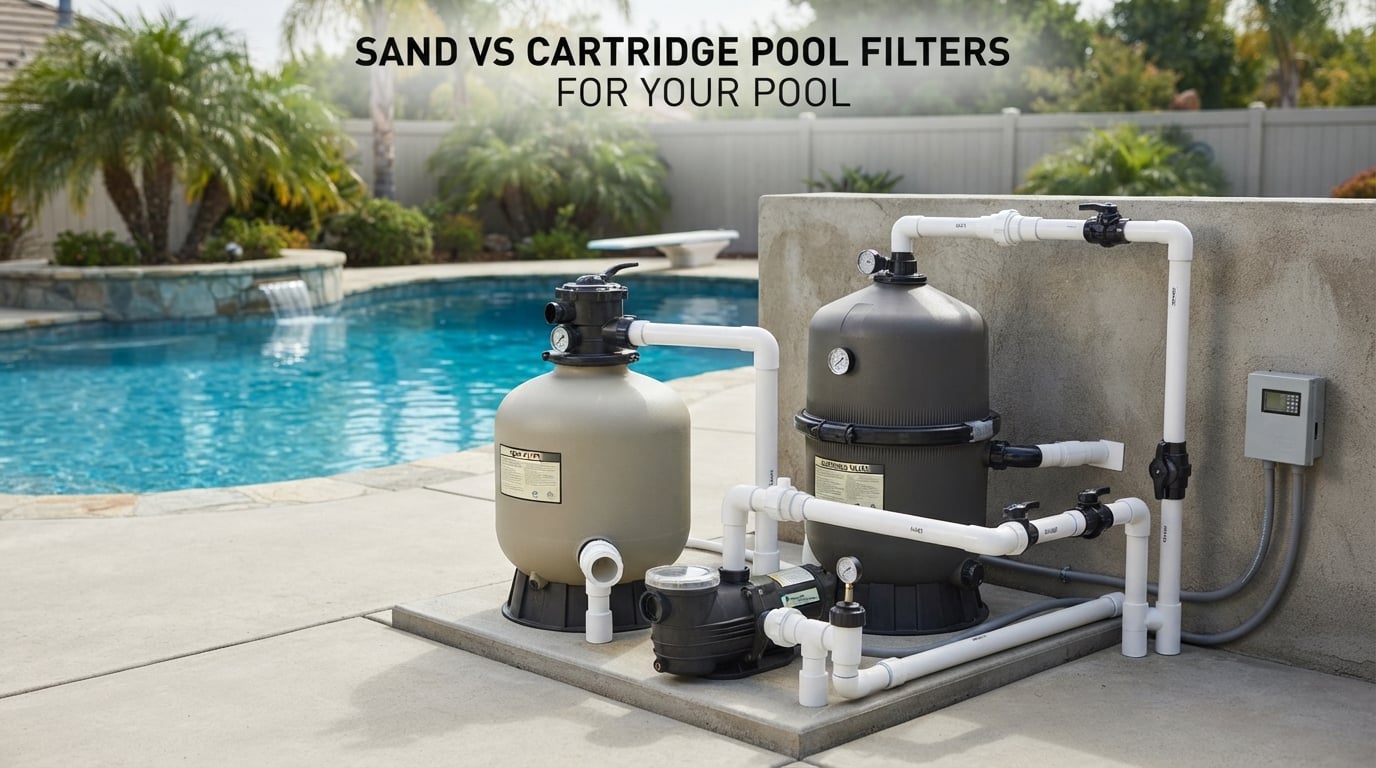
If you are building a new pool or replacing an aging filtration system, the sand vs cartridge pool filters debate is one of the most important decisions you will make. Your filter is the heart of your pool’s circulation system. It determines how clean your water stays, how much time you spend on maintenance, and how much money you shell out over the years.
I have spent years researching pool filtration systems, digging through forum discussions from r/pools and r/swimmingpools, and comparing what professionals recommend versus what real pool owners actually experience. The truth is, neither filter type is universally better. The right choice depends on your pool size, your local environment, your water supply, and how much maintenance effort you are willing to put in.
This guide breaks down exactly how each filter works, compares them head-to-head on filtration efficiency, maintenance, cost, and real-world performance, and helps you pick the right one for your specific situation. Whether you have an above-ground pool in a dusty rural area or an inground pool in the suburbs, you will have a clear answer by the end.
How Sand Filters Work?
A sand filter uses a large tank filled with specially graded pool filter sand to trap debris as water passes through. Your pool pump pushes water into the top of the filter tank, where a diffuser spreads it evenly across the surface of the sand bed. The water then travels downward through roughly 200 to 300 pounds of sand, depending on the tank size.
As water moves through the sand bed, particles get trapped in the tiny gaps between sand grains. The cleaned water collects at the bottom of the tank through a set of laterals (slotted pipes that let water through but keep sand in), then returns to your pool through the return jets. This process is continuous while your pump runs.
Sand filters typically capture particles down to about 20 to 40 microns. For context, a human hair is roughly 70 microns thick, so sand filters catch most visible debris but let some finer particles pass through. The water will look clean, but it may not have that sparkling, mirror-like clarity that some pool owners want.
The cleaning process for a sand filter is called backwashing. When the filter pressure gauge reads 8 to 10 PSI above the normal operating pressure, you flip the multi-port valve to the backwash setting. This reverses the water flow through the sand bed, flushing trapped debris out through the waste line. The entire process takes about 3 to 5 minutes and requires no disassembly of the filter.
One detail many pool owners overlook is that sand filters actually filter better as they get dirtier. A freshly backwashed sand bed lets slightly larger particles through, but as debris accumulates, the trapped particles create additional filtering surfaces that catch even smaller contaminants. This is why you do not want to backwash too frequently.
Pool filter sand typically lasts 3 to 5 years before it needs replacement. Over time, the sharp edges of the sand grains wear smooth, reducing their ability to trap particles. When you notice your water getting cloudy even after backwashing, or if you are adding more chemicals than usual, it is probably time for new sand.
How Cartridge Filters Work?
A cartridge filter uses pleated polyester media arranged around a cylindrical core to trap debris from your pool water. Water enters the filter tank and is forced through the pleated fabric, which captures particles as small as 8 to 15 microns. That is significantly finer than what a sand filter can catch.
The pleated design is key to how cartridge filters achieve their superior filtration. Think of it like an accordion. All those folds dramatically increase the surface area available to catch debris. A standard cartridge might have 100 to 500 square feet of filtering surface, compared to the effective surface area of sand in a comparable sand filter.
Because cartridge filters trap finer particles, they produce noticeably clearer water. Many pool owners describe the difference as going from clean to sparkling. If you have ever seen a pool where the water seems to glisten and you can see straight to the bottom of an 8-foot deep end with crystal clarity, that is often the work of a cartridge filter.
Unlike sand filters, cartridge filters do not use a multi-port valve and do not require backwashing. When the filter pressure rises 8 to 10 PSI above normal, you shut off the pump, open the filter tank, remove the cartridge, and hose it off. A standard garden hose with a spray nozzle is usually all you need.
The cleaning process takes longer than backwashing. Removing the cartridge, hosing it clean, and reassembling the tank can take 15 to 30 minutes depending on how dirty the filter is. Forum users on r/pools frequently mention this as the main downside. One professional pool service provider noted that cartridge cleaning is more tedious because of the disassembly required.
Cartridges typically last 1 to 3 years depending on usage and water conditions. After multiple cleanings (usually 3 to 4), the fabric loses effectiveness and needs replacement. Replacement cartridges range from $50 to $200 depending on the size and brand. Some users report needing multiple replacements per season in debris-heavy areas, which adds up quickly.
Sand vs Cartridge Pool Filters: Pros and Cons
Now let us look at the sand vs cartridge pool filters comparison head-to-head. Each type has distinct advantages and disadvantages that matter differently depending on your situation.
Pros of Sand Filters
Sand filters are the easiest to maintain on a day-to-day basis. Backwashing takes minutes and requires no tools or disassembly. You flip a valve, run the pump for a few minutes, and you are done.
The ongoing costs are minimal. A full replacement of pool filter sand costs roughly $30 to $60 and only needs to happen every 3 to 5 years. There are no cartridges to buy season after season.
Sand filters are forgiving with heavy debris loads. If your pool gets bombarded with leaves, dust, or algae, a sand filter handles the load without clogging as quickly as a cartridge would.
They are also more affordable upfront. Sand filter systems generally cost less than comparable cartridge systems, making them popular for budget-conscious pool owners and above-ground pool setups.
Cons of Sand Filters
The filtration is coarser. At 20 to 40 microns, sand filters cannot match the water clarity that cartridge filters produce. If you want sparkling, glistening water, sand may fall short.
Backwashing wastes significant water. Each backwash cycle can use 100 to 300 gallons of water that gets flushed out of your system. In water-restricted areas or regions with drought concerns, this is a real drawback.
Sand filters run at higher pump pressures. This means your pump works harder, which can mean higher energy costs over time compared to the lower resistance of a cartridge system.
Pros of Cartridge Filters
Cartridge filters produce superior water clarity. With filtration down to 8 to 15 microns, they capture particles that sand filters miss, leaving your pool noticeably cleaner and more sparkling.
They save water. No backwashing means you are not dumping hundreds of gallons of treated pool water down the drain every few weeks. This makes cartridge filters more environmentally friendly, especially in dry climates.
They operate at lower pump pressure. Reduced resistance means less strain on your pump and potentially lower energy bills. The lower pressure also means quieter operation.
Cartridge filters are compact. They take up less space than sand filters, which matters for tight equipment pads or indoor pool installations where space is at a premium.
Cons of Cartridge Filters
Cleaning is more involved. You have to disassemble the filter tank, remove the cartridge, hose it off thoroughly, and put everything back together. It takes significantly longer than flipping a backwash valve.
Replacement cartridges add to ongoing costs. At $50 to $200 each, with replacements needed every 1 to 3 years, the long-term cost can exceed what you would spend on sand.
In debris-heavy or dusty environments, cartridges clog fast. Several users in rural areas near farmland reported needing to clean their cartridges every 1 to 2 weeks during peak season. One user ultimately switched from cartridge back to sand because the constant cleaning was unsustainable.
Filtration Efficiency and Micron Ratings Explained
Micron ratings tell you how small a particle a filter can capture. One micron is one-thousandth of a millimeter. The lower the micron rating, the finer the filtration.
Sand filters capture particles down to about 20 to 40 microns. This handles most visible debris, dead algae, insects, and larger contaminants. However, it allows finer particles like pollen, some bacteria, and very fine silt to pass through. Your water will look clean, but it may carry a slight haze under certain lighting.
Cartridge filters capture particles down to about 8 to 15 microns. That is roughly twice as fine as sand filtration. The result is water that not only looks clean but has a noticeably brighter, more transparent quality. If you have ever noticed that some pools seem to glow while others just look clear, micron rating is often the difference.
For context, diatomaceous earth (DE) filters, the third major pool filter type, can capture particles as small as 3 to 5 microns. DE filters use a powder made from fossilized diatoms coated on fabric-covered grids. While DE offers the finest filtration of all three, it also requires the most maintenance and carries additional handling considerations with the DE powder.
For most residential pool owners, the difference between 20 microns and 10 microns is visible but not dramatic. If you are hosting pool parties and want show-pool water quality, cartridge gives you that edge. If you just want clean, safe swimming water, sand is perfectly adequate.
Maintenance Requirements Compared
Maintenance is where the sand vs cartridge pool filters comparison gets really practical. Let us break down what you will actually be doing with each system.
With a sand filter, your routine maintenance is backwashing. When the pressure gauge rises 8 to 10 PSI above your clean baseline, you turn off the pump, set the multi-port valve to backwash, run the pump until the sight glass shows clear water, then rinse for about 30 seconds and return to filter mode. Total time: 5 minutes. Frequency: every 2 to 4 weeks depending on debris load and pool usage.
Every 3 to 5 years, you will need to replace the sand. This is a bigger job that involves opening the tank, scooping out the old sand, and adding new filter sand. It takes a few hours but only happens once every several seasons. The sand itself costs $30 to $60.
With a cartridge filter, routine maintenance involves removing and hosing off the cartridge. You turn off the pump, relieve the tank pressure, open the clamp or lid, pull out the cartridge, and spray it down with a garden hose. You need to get between all the pleats to remove trapped debris. Total time: 15 to 30 minutes. Frequency: every 1 to 4 weeks depending on conditions.
Every few cleanings, you may want to soak the cartridge in a cleaning solution overnight to remove oils and minerals that hosing alone cannot address. This adds another step to the process. After 3 to 4 deep cleanings, the cartridge media loses its effectiveness and needs replacement.
Forum discussions on r/pools reveal an interesting divide. One professional pool service provider stated they would rather clean a cartridge filter 10 to 20 times over 5 years than deal with a sand filter replacement every 5 years. But users in dusty areas tell the opposite story. Someone near farmland switched from cartridge to sand because weekly cartridge cleaning was eating their weekends.
The honest takeaway is this: sand filters win on ease and speed of routine maintenance. Cartridge filters win on avoiding the rare but labor-intensive sand replacement. Your local conditions tip the scale.
Cost Comparison: Initial vs Long-Term
Understanding the full cost picture requires looking at both upfront and ongoing expenses over a 5 to 10 year period.
For initial purchase, sand filters are generally cheaper. A quality sand filter system for a typical residential pool runs roughly $250 to $600. Cartridge filter systems for the same pool size typically range from $400 to $900. The gap widens with larger pool sizes.
For ongoing costs, the comparison flips somewhat. Sand replacement costs $30 to $60 every 3 to 5 years. That is incredibly cheap. Cartridge replacement costs $50 to $200 per cartridge, with typical replacement every 1 to 3 years. If you need multiple cartridges (many systems use 2 to 4), the cost multiplies.
Over a 10-year period, a sand filter system might cost you $300 to $700 total including the initial purchase and sand replacements. A cartridge system over the same period might run $600 to $1,500 or more, factoring in initial purchase plus multiple cartridge replacements.
However, there is a hidden cost saving with cartridge filters that many comparisons miss: water. Each backwash cycle with a sand filter uses 100 to 300 gallons of water. If you backwash every 2 weeks during a 6-month pool season, that is 1,200 to 7,200 gallons of wasted water per year. In areas with high water rates or water restrictions, this cost is real and recurring.
The break-even point where cartridge water savings offset the higher cartridge replacement costs depends entirely on your local water rates. In areas where water is expensive or scarce, cartridge filters can close the cost gap significantly over several years. In areas with cheap, abundant water, sand retains its cost advantage.
Energy and Water Usage Considerations
Pump pressure requirements differ noticeably between sand and cartridge filters, and this affects both energy consumption and pump longevity.
Sand filters operate at higher pressure, typically 10 to 20 PSI during normal operation. The denser filtration media creates more resistance to water flow. Your pump has to work harder to push water through the sand bed, which translates to higher energy draw. If you run your pump 8 hours a day during pool season, that extra resistance adds up on your electric bill.
Cartridge filters operate at lower pressure, typically 5 to 12 PSI. The pleated media creates less resistance, allowing water to flow more freely. This means your pump does not work as hard, which can reduce energy costs. The difference is not enormous for a single season, but over 5 to 10 years it becomes meaningful.
The lower operating pressure of cartridge filters also means quieter operation. If your equipment pad is near your patio or living area, the reduced pump strain from a cartridge system can make a noticeable difference in noise levels.
On the water usage side, cartridge filters have a clear advantage. No backwashing means no regular water waste. You only lose water when you remove the cartridge for cleaning, and that is minimal. Sand filters, by contrast, regularly dump hundreds of gallons through the waste line. In drought-prone regions like California, Arizona, and Texas, this is a deciding factor for many pool owners.
Indoor pool owners also benefit from cartridge filters here. No backwash line means no need for a dedicated drain or waste water connection in your equipment room. This simplifies installation and reduces infrastructure requirements.
Regional and Debris Considerations
Where you live should heavily influence your filter choice, and this is something most comparison guides gloss over.
If you live in a dusty area, near farmland, or in a region with heavy pollen seasons, a sand filter is often the better practical choice. Sand handles large volumes of fine debris without requiring frequent intervention. You backwash when the pressure rises and move on with your day.
In those same conditions, a cartridge filter can become a maintenance nightmare. Forum users in dusty rural environments report cleaning cartridges every 1 to 2 weeks during peak season. The fine dust and silt pack into the pleats and can be difficult to fully remove with a garden hose. One Reddit user who lives near farmland switched from cartridge to sand and reported being much happier with the change.
If you live in a relatively clean suburban environment with minimal airborne debris, a cartridge filter shines. You get superior water clarity without the cleaning burden. The cartridge only needs attention every 3 to 4 weeks, and the cleaning process is straightforward.
Trees are another factor. If your pool is surrounded by trees that shed leaves, seeds, or sap, consider how that debris interacts with each filter type. Large leaves should be caught by your skimmer baskets before they reach the filter, but fine seeds and pollen will get through. Sand handles this load well. Cartridge filters will catch more of the fine material but will also clog faster.
For pools in seasonal climates where you close the pool for winter, consider that both filter types need proper winterization. Sand filters need to be drained and the multi-port valve winterized. Cartridge filters should have the cartridge removed, cleaned, and stored indoors if possible.
Which Filter Suits Your Pool Type?
Different pool types have different filtration needs. Here is how to match your pool to the right filter system.
Above-Ground Pools
Sand filters are the most popular choice for above-ground pools. They are affordable, easy to maintain, and forgiving with the lighter-duty pumps that above-ground pools typically use. Most above-ground pool packages come with a sand filter as standard equipment for good reason.
If you have a smaller above-ground pool (under 15,000 gallons) and want the simplest maintenance experience, sand is hard to beat. The lower cost also makes sense for a pool that may not be a permanent installation.
Inground Pools
Both filter types work well for inground pools, and the choice depends more on your priorities. If you want the clearest possible water and do not mind more hands-on maintenance, go with cartridge. If you want set-and-forget simplicity and lower long-term costs, sand is the way to go.
For larger inground pools (over 25,000 gallons), sand filters are often preferred because they handle high flow rates well. A large sand filter can process more gallons per minute (GPM) efficiently. Cartridge filters for very large pools require multiple large cartridges, which increases cost and complexity.
Fiberglass pool owners often lean toward cartridge filters because of the lower operating pressure. Fiberglass pools have smooth surfaces that require less chemical use overall, and the superior filtration of a cartridge system complements the low-maintenance nature of the pool itself.
Spas and Hot Tubs
Cartridge filters are the clear winner for spas and hot tubs. The compact size fits the tight equipment spaces typical of spa installations. No backwash line means simpler plumbing. And the superior water clarity is especially important in a small body of water heated to high temperatures, where any contamination is more noticeable.
Spa owners almost universally use cartridge filters, and for good reason. The small water volume means even minor cloudiness is immediately visible, and the finer filtration of a cartridge keeps spa water crystal clear between changes.
Sizing Your Filter
Proper sizing matters regardless of filter type. A general rule for sand filters is to select a filter rated for at least the flow rate of your pump in GPM. For a 10,000 gallon pool with a pump that moves 40 to 50 GPM, a 24-inch sand filter is typically appropriate. When in doubt, oversize the filter. A larger filter means longer cycles between cleanings and better overall performance.
For cartridge filters, match the square footage of filter media to your pool volume. A common guideline is 100 square feet of cartridge surface area per 10,000 gallons of pool water. Again, oversizing provides longer intervals between cleanings.
FAQs
What are the disadvantages of cartridge filter?
Cartridge filters require more hands-on cleaning since you must disassemble the tank and hose off the cartridge, which takes 15 to 30 minutes per cleaning. Replacement cartridges cost $50 to $200 and need replacing every 1 to 3 years. In dusty or debris-heavy areas, cartridges clog quickly and may need cleaning every 1 to 2 weeks.
What are the disadvantages of a sand filter?
Sand filters only capture particles down to 20 to 40 microns, producing less sparkling water than cartridge filters. Backwashing wastes 100 to 300 gallons of water per cycle, which is a concern in drought-prone areas. Sand filters also run at higher pump pressure, which can increase energy costs over time.
Do you backwash with a cartridge filter?
No, you do not backwash a cartridge filter. Cartridge filters do not have a multi-port valve or backwash setting. Instead, you clean them by removing the cartridge from the tank and hosing it off with a garden hose when the pressure gauge reads 8 to 10 PSI above normal.
What size sand filter do I need for a 10,000 gallon pool?
For a 10,000 gallon pool, a 22-inch or 24-inch sand filter is typically the right size. Match the filter flow rate to your pump output, which is usually 40 to 50 GPM for this pool size. Oversizing the filter slightly is always fine and means longer intervals between backwashing.
Conclusion
The sand vs cartridge pool filters decision comes down to your priorities. Choose sand if you want low-cost, low-effort maintenance and live in a debris-heavy area. Choose cartridge if you want the clearest possible water, lower water waste, and quieter operation. Match your filter to your pool type, your local environment, and your willingness to do hands-on maintenance.
Whatever you choose, proper sizing and regular maintenance are more important than the filter type itself. A well-maintained sand filter will outperform a neglected cartridge filter every time. Take the time to understand your pool’s needs, and you will enjoy clean, clear water all season long in 2026.