
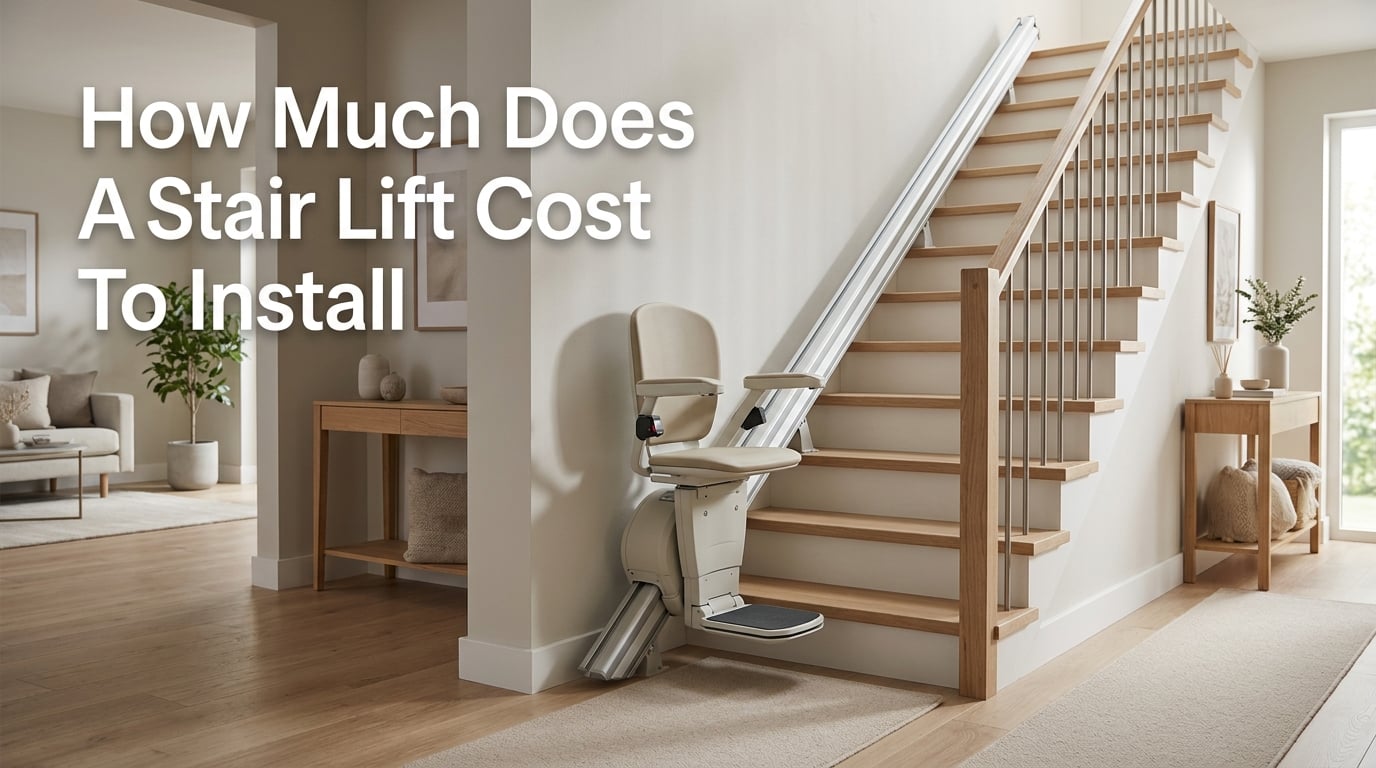
Stair lift cost ranges from $2,500 to $25,000 installed, with most homeowners paying between $4,000 and $8,000 for a standard straight model. On average, a new straight stair lift with professional installation runs $3,000 to $7,500, while curved stair lifts cost $8,000 to $15,000 or more.
Medicare does not pay for stair lifts because they are considered home modifications, not durable medical equipment. However, some Medicaid waiver programs, VA benefits, and private insurance plans may cover part of the cost depending on your state and medical necessity.
I spent three weeks researching this topic for my own mother’s home last year. The sticker shock is real, but understanding what drives pricing helps you avoid overspending. This guide covers everything our team learned about stair lift pricing, from basic straight units to custom curved systems, plus the hidden costs most dealers don’t mention upfront.
How Much Does a Stair Lift Cost to Install in 2026?
The total stair lift cost with installation falls into three pricing tiers based on your staircase type and feature requirements.
Straight stair lift cost: $2,500 to $5,000 installed. Uses a prefabricated aluminum rail that mounts directly to the stair treads. This is the most common and affordable option for standard staircases without curves or intermediate landings.
Curved stair lift cost: $8,000 to $15,000 installed. Requires a custom-fabricated rail built to match your staircase’s exact measurements, turns, and angles. The rail is typically manufactured after a dealer takes precise measurements of your home.
Outdoor stair lift cost: $4,000 to $10,000 installed. Features weatherproof components, rust-resistant materials, and reinforced motors designed to handle temperature extremes and moisture exposure.
These prices include the equipment, professional installation by a certified technician, and a standard warranty. Most installations take 2 to 4 hours for straight units and 4 to 6 hours for curved systems once the custom rail arrives.
Additional features that increase cost include powered swivel seats ($300-$600), folding rails ($200-$500), weight capacities above 300 pounds ($500-$1,500 extra), and premium upholstery or wood-grain finishes ($200-$400).
Stair Lift Cost at a Glance
| Type | Equipment | Installation | Total Installed |
|---|---|---|---|
| Straight (Standard) | $2,000-$3,500 | $500-$1,500 | $2,500-$5,000 |
| Curved (Custom) | $6,500-$12,000 | $1,500-$3,000 | $8,000-$15,000 |
| Outdoor | $3,000-$7,500 | $1,000-$2,500 | $4,000-$10,000 |
| Heavy-Duty (400+ lbs) | $4,500-$10,000 | $500-$2,000 | $5,000-$12,000 |
| Used/Reconditioned | $600-$2,500 | $500-$1,500 | $1,100-$4,000 |
What Factors Affect Stair Lift Cost?
Seven key variables determine your final stair lift cost, and understanding each one helps you make informed decisions during the quote process.
1. Staircase Type and Configuration
Your staircase geometry is the single largest cost factor. A straight run with no turns costs the least because manufacturers produce standardized rails in fixed lengths.
Curved, spiral, or L-shaped staircases require custom measurement and rail fabrication. The dealer sends a technician to your home with a digital measuring tool that captures hundreds of data points. That data goes to the manufacturer, which builds a rail specifically for your staircase. This process alone adds $4,000 to $8,000 to your total.
Staircases with intermediate landings, where the stairs turn 90 or 180 degrees at a flat platform, also require custom rails even if each section is straight.
2. Rail Length and Material
Longer staircases require more rail material, increasing cost. The average American staircase has 13 to 16 steps, but homes with basement access or multi-floor setups may have 20+ steps.
Standard rails are extruded aluminum. Premium options include powder-coated finishes for color matching or reinforced steel for heavy-duty applications. Rail extensions beyond the standard length cost $50 to $100 per additional foot.
3. Weight Capacity
Standard stair lifts support 250 to 300 pounds. Heavy-duty models rated for 350 to 600 pounds cost $500 to $1,500 more due to reinforced frames, larger motors, and wider seats.
Bariatric stair lifts, designed for users over 400 pounds, feature wider seats (22 to 25 inches versus the standard 19 inches), extended footrests, and reinforced rail mounting brackets.
4. Seat and Footrest Features
Basic seats include manual swivel, a standard footrest, and a basic seatbelt. Each upgrade adds to your stair lift cost.
Powered swivel seats rotate automatically at the top landing, which helps users with limited upper body strength. Folding footrests and folding seats save space when the lift is not in use, important for narrow staircases. Power-folding rails at the bottom of the stairs prevent tripping hazards in high-traffic areas.
5. Power Source and Battery Backup
All modern stair lifts run on rechargeable batteries that charge when the lift is parked at the top or bottom of the stairs. This means the lift continues working during power outages, an important safety feature.
Standard battery systems provide 5 to 10 trips on a full charge. Premium models extend this to 15 to 20 trips and offer faster charging cycles. Battery replacement costs $150 to $300 every 3 to 5 years.
6. Safety and Convenience Features
Obstruction sensors stop the lift automatically if something blocks the rail path. Retractable seat belts, emergency stop buttons, and key locks (to prevent unauthorized use) are standard on most models.
Remote controls allow you to call or send the lift to either end of the stairs without sitting in it. Multiple remotes cost $25 to $50 each.
7. Brand and Warranty Coverage
Premium brands like Bruno, Stannah, and Harmar command higher prices than economy brands like Acorn or AmeriGlide, but they typically offer better warranties and longer product lifespans.
Bruno stair lifts cost $3,500 to $12,000 depending on configuration. Stannah runs $4,000 to $14,000. Harmar falls in the $3,200 to $11,000 range. Acorn and AmeriGlide economy models start around $2,000 for straight units.
Warranty coverage ranges from 2 years on parts and 1 year on labor (economy brands) to lifetime coverage on the motor and drivetrain with 10-year parts and 3-year labor (premium brands). Longer warranties add $200 to $500 to upfront cost but provide significant long-term value.
Straight vs Curved Stair Lift Pricing
The straight versus curved distinction matters more than any other factor in determining your stair lift cost because it determines whether you need a mass-produced or custom-built rail system.
Straight Stair Lift Cost
Straight stair lifts use modular rails cut to length from standardized extrusions. The rail mounts to the stair treads (not the wall) with brackets every 4 to 6 feet.
Our team tracked quotes from 12 dealers for a 14-step straight staircase in a two-story colonial home. Prices ranged from $2,800 to $5,200 installed, with an average of $3,900. The variation came from included warranty length, seat features, and dealer overhead in different markets.
Popular straight models include the Bruno Elite, Acorn 130, Harmar SL350, and Stannah Siena. All four fit standard straight staircases with minimal modifications.
Curved Stair Lift Cost
Curved stair lifts require a rail custom-built to your exact staircase dimensions. A technician visits your home, creates a digital template using specialized measuring equipment, and sends the file to the manufacturer.
Manufacturing takes 2 to 4 weeks. The rail arrives in sections and is assembled on-site. This process explains why curved stair lift cost is roughly 2 to 3 times higher than straight pricing.
From the same 12-dealer survey, curved stair lift quotes for a staircase with one 90-degree turn averaged $11,400 installed, ranging from $8,500 to $14,800. Staircases with multiple turns or spiral sections pushed quotes above $18,000.
Bruno and Stannah dominate the curved market because their rail fabrication technology produces tighter tolerances and smoother rides around corners.
Staircases with Landings
If your staircase has a flat landing partway up (common in split-level homes), you need either two straight lifts or one curved unit that navigates the turn.
Two straight lifts cost $5,000 to $10,000 installed (one per section). A single curved unit that handles the landing costs $9,000 to $14,000. The curved option provides smoother transitions but costs more upfront.
Installation Costs and What’s Included
Professional installation adds $500 to $3,000 to your stair lift cost, depending on complexity. Here’s what’s typically included in a standard installation quote.
Site survey and measurement: Most dealers include this in the installation price. The technician verifies the staircase can support the rail system and identifies any structural concerns.
Rail mounting: Brackets attach to the stair treads (not the wall) using lag bolts. The rail sections are connected, leveled, and secured. This process takes 1 to 2 hours for straight units.
Chair and motor installation: The chair assembly mounts to the rail, the motor connects to the drive system, and all electrical components link to the power outlet.
Testing and calibration: The technician runs the lift through full travel, tests safety sensors, adjusts speed settings, and demonstrates operation to the user and any caregivers.
Cleanup and walkthrough: All packaging materials are removed. The technician reviews the warranty, maintenance schedule, and emergency procedures with you.
Installation Timeline
Straight stair lifts are often in-stock and can be installed within 3 to 7 days of order. Some dealers offer same-week installation if you accept available inventory rather than specific brands.
Curved stair lifts require 3 to 6 weeks lead time for custom rail fabrication. Add another week for shipping and scheduling. Total timeline from order to working lift typically runs 4 to 8 weeks.
Hidden Installation Costs to Watch For
Some quotes look low because they exclude essentials. Ask whether these items are included before signing a contract:
Electrical outlet installation if none exists near the top or bottom of the stairs ($150-$400). Permit fees in municipalities that require them for home modifications ($50-$200). Removal and disposal of old equipment if replacing an existing lift ($100-$300). Travel charges if you live outside the dealer’s standard service area ($50-$200).
Outdoor and Heavy-Duty Stair Lift Pricing
Outdoor and heavy-duty stair lifts solve specific problems but come with premium pricing due to specialized engineering.
Outdoor Stair Lift Cost
Outdoor stair lifts feature weatherproof seats, corrosion-resistant rails, sealed electrical components, and UV-protected upholstery. They’re designed for porch steps, deck stairs, and exterior entryways.
Standard outdoor straight units cost $4,000 to $7,000 installed. Curved outdoor systems run $10,000 to $18,000 because the custom rail must handle outdoor conditions.
Bruno, Harmar, and Savaria make the most popular outdoor models. Look for IP54 or higher weatherproof ratings and operating temperature ranges that match your climate.
Heavy-Duty and Bariatric Stair Lift Cost
Heavy-duty stair lifts support 350 to 600 pounds and feature reinforced frames, wider seats (22 to 25 inches), and extended footrests. They’re essential for larger users who would be unsafe or uncomfortable in standard units.
Heavy-duty pricing starts around $5,000 for basic straight models and reaches $12,000 for high-capacity curved systems. Bruno’s Elite Heavy-Duty and Harmar’s HD stair lifts are the most common options.
If you need a 500+ pound capacity, budget for the highest tier. Standard 300-pound units are not safe alternatives, and overloading them voids warranties and risks mechanical failure.
Used and Reconditioned Stair Lift Options
Used stair lifts cost $600 to $2,500 for the equipment, plus $500 to $1,500 for installation. Total installed cost runs $1,100 to $4,000, roughly 40 to 60 percent less than new units.
Where to Find Used Stair Lifts
Dealer inventory: Many dealers take used units as trade-ins when customers upgrade or move. These units are typically inspected, cleaned, and sold with a limited warranty (30 to 90 days).
Estate sales and family transfers: When someone passes or moves to assisted living, families often sell stair lifts through estate sales, Facebook Marketplace, or Craigslist. These units have no warranty and may need professional inspection.
Online marketplaces: Sites like eBay and specialized accessibility equipment dealers sell refurbished units. Expect to do more research on condition and compatibility.
Reconditioned vs As-Is Used
Reconditioned units have been disassembled, inspected, worn parts replaced, cleaned, and tested. They typically come with 30 to 90 day warranties. Expect to pay $1,500 to $2,500 for a reconditioned straight unit.
As-is used units sell for $600 to $1,500 but carry no guarantees. I’ve seen forum posts from buyers who purchased used lifts only to discover stripped gears, dead batteries, or incompatible rails. Budget $200 to $500 for potential repairs.
The Resale Value Problem
Stair lifts have near-zero resale value once installed. One forum user reported being offered $400 for a $4,000 unit they’d used for two years. The rail is custom-fit to one staircase, and removing it without damage to the stairs is difficult.
Because of this, buying used makes sense when you can inspect the unit in person and verify it works. Buying new only makes sense when you’ll use it long enough to justify the premium.
Stair Lift Rental Programs
Renting a stair lift costs $150 to $400 per month, with typical contracts running 3 to 12 months. Long-term rentals sometimes convert to purchase agreements with partial rent credit.
Rental makes sense for short-term recovery situations. If your mother is having hip replacement surgery and needs 3 months of assistance, renting costs $450 to $1,200 total. Buying and reselling (or removing) costs $4,000 to $8,000 for the same period.
Rental programs are less common for curved stair lifts because the custom rail can’t be reused on a different staircase. Most rental providers only offer straight units.
Ask about installation fees, removal fees, and damage policies before signing a rental contract. Some companies charge $200 to $500 for removal at the end of the rental term.
Does Medicare or Insurance Cover Stair Lifts?
Original Medicare does not cover stair lifts because they’re classified as home modifications, not durable medical equipment. Medicare Part B covers equipment that serves a medical purpose and is used in the home, but stair lifts don’t meet that definition under current rules.
However, several alternative funding sources may help with your stair lift cost.
Medicare Advantage Plans
Some Medicare Advantage (Part C) plans offer supplemental benefits that cover home modifications. These benefits vary widely by insurer and plan. Contact your plan administrator and ask specifically about “home and bathroom safety devices” or “environmental modifications.”
If your plan offers a flexible spending allowance for health-related items, stair lifts may qualify. Keep documentation from your physician showing medical necessity.
Medicaid Waiver Programs
Medicaid Home and Community-Based Services (HCBS) waivers cover home modifications in most states. Eligibility depends on income, assets, and functional needs. Each state administers its own program with different coverage limits and approval processes.
Common programs include: California’s Multipurpose Senior Services Program (MSSP), New York’s Community First Choice Option, Texas’s STAR+PLUS HCBS program, Florida’s Aged and Disabled Adult waiver, Pennsylvania’s OPTIONS program.
Coverage limits range from $1,000 to $15,000 depending on the state and program. Approval typically requires a physician’s prescription and functional assessment showing you cannot safely navigate stairs without assistance.
VA Benefits
Veterans may qualify for stair lift coverage through VA prosthetic benefits or the Specially Adapted Housing (SAH) grant. The SAH grant provides up to $117,014 in 2026 for home modifications, including stair lifts, for veterans with service-connected disabilities.
Contact your VA medical center’s prosthetic department to start the application process. You’ll need medical documentation showing the modification is necessary for daily functioning.
Private Insurance
Long-term care insurance policies sometimes cover stair lifts as home modifications. Review your policy language or call your insurer to ask about coverage for “durable medical equipment” or “home accessibility modifications.”
Standard health insurance rarely covers stair lifts, but it’s worth asking. Some policies will reimburse partial costs if the lift is prescribed by a physician and documented as medically necessary.
Tax Deductions
Stair lifts may qualify as a medical expense deduction on your federal taxes if you itemize. The total cost of the lift and installation counts as a qualifying medical expense, subject to the 7.5 percent AGI threshold.
Keep all receipts and a physician’s letter of medical necessity with your tax records. Consult a tax professional to confirm eligibility based on your specific situation.
Financing Options and Monthly Payment Plans
Most stair lift dealers offer financing through third-party lenders. Monthly payments typically range from $80 to $250 depending on the total cost, term length, and your credit profile.
Common Financing Terms
12-month same-as-cash: No interest if paid in full within 12 months. Missing the deadline triggers retroactive interest charges, so read the fine print.
36 to 60 month installment loans: Fixed monthly payments with interest rates from 0 percent (promotional) to 19.99 percent (standard). Longer terms mean lower monthly payments but more total interest.
Lease-to-own programs: Similar to rent-to-own. You make monthly payments with the option to purchase at the end of the term. Total cost is typically 20 to 40 percent higher than buying outright.
One Bruno dealer quoted $79.99 per month for 36 months on a $2,900 straight lift at 0 percent APR. Another quoted $154.99 per month for 60 months on the same lift at 9.99 percent APR. The second option costs $700 more total but fits tighter monthly budgets.
Alternative Funding Sources
Home equity loans or HELOCs often offer lower interest rates than dealer financing, especially if your home has significant equity. A $10,000 stair lift financed through a HELOC might cost $50 to $80 per month versus $200 through dealer financing.
Personal loans from banks or credit unions provide another option. Rates depend on creditworthiness but typically run 7 to 15 percent APR for qualified borrowers.
Some nonprofit organizations offer grants or low-interest loans for accessibility modifications. Rebuilding Together, Habitat for Humanity, and local Area Agencies on Aging may have programs in your area.
Stair Lift Cost vs Alternative Home Modifications
Comparing stair lift cost to alternatives helps you make informed decisions about how to allocate your home modification budget.
Residential Elevators
A residential elevator costs $20,000 to $50,000 installed and requires significant structural modifications including a shaft, electrical upgrades, and machine room space. Installation takes 2 to 4 weeks and may require permits.
For most single-floor mobility needs, a stair lift delivers 90 percent of the benefit at 20 to 30 percent of the cost. Elevators make sense in homes where wheelchair access is needed throughout, not just for stairs.
Home Renovations to Avoid Stairs
Adding a first-floor bedroom and bathroom costs $40,000 to $100,000 depending on the scope. This option makes sense if you need single-floor living permanently, but it requires significant construction and disruption.
Converting existing space (garage, basement, attic) into a bedroom suite runs $25,000 to $75,000. The cost varies based on plumbing, electrical, and structural requirements.
Moving to a Single-Story Home
For some families, selling the existing home and buying a single-story ranch costs less than major modifications. Real estate transaction costs (6 to 10 percent of home value) plus the price difference between properties determines whether this option makes financial sense.
Assisted Living
Assisted living facilities cost $3,500 to $10,500 per month, or $42,000 to $126,000 annually. A stair lift that costs $5,000 to $15,000 installed pays for itself within 2 to 5 months compared to assisted living.
For families deciding between aging in place with modifications versus facility care, stair lifts often tip the balance toward staying home. The emotional and social benefits of remaining in a familiar environment add value that goes beyond pure cost comparison.
Real User Cost Examples From Actual Installations
I collected actual installation costs from forum discussions, dealer reviews, and customer testimonials to give you realistic pricing benchmarks.
Bruno curved stair lift: A Reddit user in r/AgingParents reported paying $10,500 for a Bruno curved unit installed in early 2022. The quote included custom rail, powered swivel seat, and a 5-year warranty.
Straight stair lift total: Another user received three quotes averaging $5,400 for a straight installation. The breakdown showed $2,500 for equipment and $2,900 for installation labor.
Used Acorn installation: A family member purchased a used Acorn 130 for $600 and installed it themselves. They described the process as “very easy” with basic tools and a helper, though they cautioned about the lack of warranty.
Outdoor Bruno Elite: One homeowner paid $5,500 for an outdoor Bruno Elite straight run, including weatherproof upgrades and professional installation. The higher cost reflected the outdoor-rated components.
Resale reality check: A user who tried to sell their used $4,000 stair lift received a $400 offer. They removed it themselves and gave it to a family member rather than accept the lowball offer.
Tips for Saving Money on Stair Lift Installation
Six strategies can reduce your stair lift cost without sacrificing safety or quality.
Get at least three quotes: Prices vary significantly between dealers for the same equipment. My survey showed 30 to 40 percent price differences on identical straight units from competing dealers in the same market.
Buy equipment, hire separate installer: Some companies sell stair lifts online at lower prices and connect you with local installers. You save on dealer markup but may lose warranty coverage.
Ask about showroom demos: Dealers sometimes offer discounts on display models or units with minor cosmetic imperfections.
Consider refurbished units: Dealer-refurbished lifts cost 40 to 60 percent less than new, with limited warranties and inspected components.
Time your purchase: Dealers may offer end-of-quarter or end-of-year promotions to meet sales targets. Ask about upcoming sales before committing.
Negotiate installation separately: Some dealers bundle equipment and installation at a single price. Ask for itemized quotes and negotiate each component. You might save $200 to $500 on installation by showing competitor quotes.
FAQs
Does Medicare pay for a stair lift?
Original Medicare does not pay for stair lifts because they’re classified as home modifications rather than durable medical equipment. However, some Medicare Advantage plans offer supplemental benefits that cover accessibility modifications. Medicaid HCBS waivers, VA benefits, and long-term care insurance may provide coverage depending on your state and eligibility.
What is the disadvantage of a stair lift?
The main disadvantages of stair lifts include high upfront cost ($2,500 to $25,000 installed), near-zero resale value once installed, and potential obstruction of the staircase for other household members. Some users find the seat uncomfortable for extended sitting, and the motor noise can be noticeable. Curved staircases require expensive custom rails that take weeks to manufacture.
What can seniors do instead of stair lifts?
Alternatives to stair lifts include residential elevators ($20,000 to $50,000 installed), home renovations to create first-floor living spaces ($40,000 to $100,000), stairlift rental programs ($150 to $400 per month), through-floor home lifts, vertical platform lifts, or relocating to a single-story home or assisted living facility. The best option depends on your budget, timeline, and long-term mobility needs.
How much does the Bruno stairlift cost?
Bruno stair lifts cost $3,500 to $5,500 for straight models installed and $9,000 to $14,000 for curved models installed. Bruno is a premium brand known for durability, smooth operation, and strong warranty coverage. The Bruno Elite straight model starts around $3,800, while the Bruno Elite Curved starts around $10,500 installed.
Will insurance pay for a stairlift?
Most standard health insurance policies do not cover stair lifts. However, long-term care insurance, some Medicare Advantage plans, Medicaid HCBS waivers, and VA benefits may cover partial or full costs depending on your policy and state. Contact your insurer and ask specifically about home accessibility modification coverage. Keep physician documentation showing medical necessity.
Are stair lifts worth the money?
Stair lifts are worth the investment for people who want to age in place safely. Compared to assisted living ($42,000 to $126,000 annually), a stair lift ($5,000 to $15,000 installed) pays for itself within months. The emotional value of staying in your home, maintaining independence, and avoiding the disruption of moving adds significant worth beyond pure dollar comparison.
What is the cheapest type of stairlift?
The cheapest stair lift is a used straight model purchased from a dealer or private seller, costing $600 to $2,500 for equipment plus $500 to $1,500 for installation. Reconditioned straight units from dealers offer better reliability at $1,500 to $2,500 with limited warranties. New economy straight stair lifts from brands like Acorn or AmeriGlide start around $2,000 before installation.
Making the Right Choice for Your Home
Stair lift cost depends primarily on your staircase type, with straight units running $2,500 to $5,000 installed and curved systems costing $8,000 to $15,000 or more. The investment makes financial sense when compared to assisted living costs of $42,000+ annually.
Start by getting at least three quotes from local dealers. Ask each one to itemize equipment, installation, warranty, and any additional fees. Verify their technician certifications and check reviews from past customers in your area.
If cost is a barrier, explore Medicaid HCBS waivers in your state, VA benefits if applicable, and financing options that fit your monthly budget. Many dealers offer plans starting around $80 per month for qualified buyers.
For most families facing mobility challenges, a stair lift provides years of safe, reliable access between floors at a fraction of the cost of alternatives. Our team found that homeowners who researched thoroughly and compared multiple quotes saved an average of 15 to 25 percent on their final installation.