
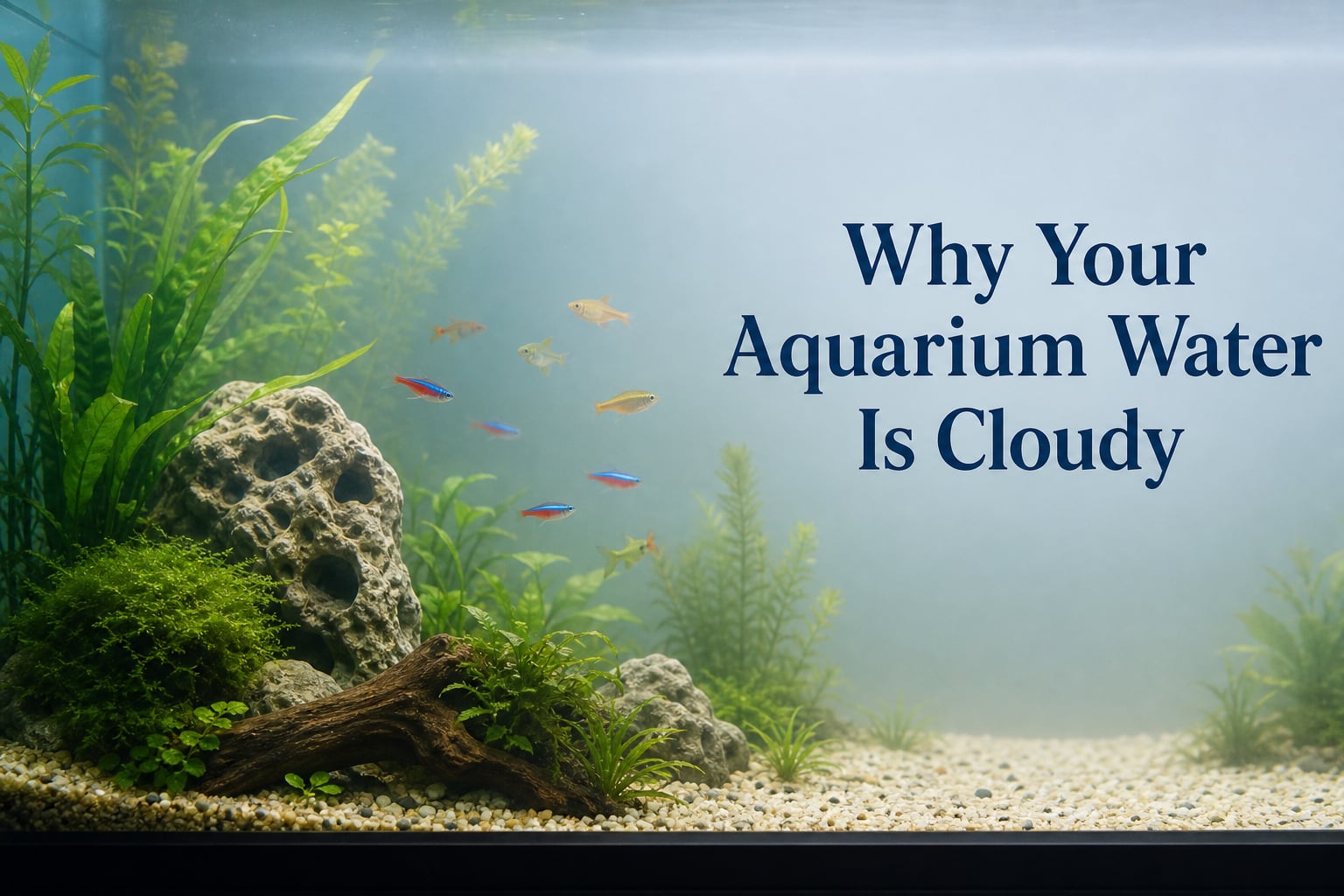
Cloudy aquarium water is usually a sign of suspended bacteria, algae, fine debris, or natural color released by wood. The color, the tank’s age, and your water-test results point to the cause far better than a quick treatment does.
If you are asking why your aquarium water is cloudy, start by looking at it in a clear glass or against a white background. Milky white water, pea-green water, and tea-colored water have different causes, different timelines, and different levels of risk for fish.
A sudden haze can feel alarming, especially after a water change or when a new fish arrives. In many cases it settles without drama, but cloudy water paired with ammonia or nitrite needs a prompt, measured response.
Our practical approach is simple: identify the cloud type, test the water, reduce the source of waste or light, and avoid dramatic changes. That sequence helps you improve aquarium water clarity without disrupting the filter bacteria that keep a tank stable.
The advice below covers a new tank cloudy after one day, a mature aquarium that turns murky overnight, and water that stays discolored after maintenance. It also explains when waiting is sensible and when your fish need action now.
Cloudy aquarium water has three common color patterns
Color does not give a full diagnosis, yet it narrows the list quickly. Check whether the water looks white or gray, green, or brown and then compare it with the tank’s recent history.
| Water appearance | Most likely cause | Typical duration | First safe response |
|---|---|---|---|
| White or gray, milky haze | Bacterial bloom, fine substrate dust, or organic waste | Several days to two weeks; longer if the source remains | Test ammonia and nitrite, feed less, remove debris, and keep the filter running |
| Green, pea-soup water | Algae bloom fueled by light and nutrients | Several days to a few weeks | Cut light duration, limit feeding, and address nitrate or phosphate buildup |
| Brown or yellow, tea-like water | Tannins from driftwood or leaves; sometimes dirty substrate | Days to weeks, depending on source | Decide whether natural tint is acceptable; siphon debris if it is not |
Before changing anything, note the tank age, the last feeding, any new fish, plants, wood, or substrate, and the last filter cleaning. A change that happened shortly before the haze is often the clue you need.
Cloudiness is different from particles that settle
Fine particles from new gravel, disturbed sand, or a recently moved decoration often settle within a few hours to a day. They are most visible near the substrate and do not usually make the whole water column look like fog.
A bloom stays suspended throughout the aquarium and can become denser even when nobody touches the tank. That distinction matters when you are working out why your aquarium water is cloudy after a routine water change.
White or gray water usually points to a bacterial bloom or debris
A milky aquarium is often a bacterial bloom, particularly in a tank that is new, newly stocked, or recently deep-cleaned. Heterotrophic bacteria respond fast when extra food and waste are available, while the slower-growing beneficial bacteria in the filter are still catching up.
This does not mean you have “bad bacteria” in the simple sense. It means the balance between waste entering the aquarium and waste being processed has shifted.
A new aquarium turns cloudy when its nitrogen cycle is still forming
New tank cloudy water is common because there is little established biological filtration at first. Fresh filter media, substrate, decorations, and tap water may also carry small amounts of dust or dissolved material that change the water’s look.
A new tank bacterial bloom often appears within the first few days, including the “cloudy after one day” and “cloudy after three days” situations many fishkeepers describe. If ammonia and nitrite remain at zero and fish are acting normally, it may clear in roughly three to fourteen days as the tank settles.
Do not add more fish just because the water looks better for a day. The tank is not fully cycled until repeated tests show ammonia at 0 parts per million, nitrite at 0 parts per million, and nitrate is present but managed.
Established tanks turn white when extra organic waste feeds bacteria
In an established aquarium, a sudden white haze often follows overfeeding, a dead fish or snail hidden in the tank, a clogged filter, a dirty substrate bed, or an overstocked setup. A large amount of uneaten food can release dissolved organic carbon, often shortened to DOC, and bacteria respond quickly to it.
Check under ornaments, behind the heater, and inside dense plants for decaying material. Then look at filter flow: a weak output can mean the filter is blocked, or simply that its intake is coated in debris.
Do not rinse biological media under untreated tap water or replace every piece of filter media at once. Chlorine or chloramine and a full media swap can remove much of the beneficial bacteria that help control ammonia and nitrite.
A white bacterial bloom clears when you remove the fuel, not when you chase the haze
- Test first. Measure ammonia, nitrite, nitrate, pH, and temperature before treating the appearance.
- Feed lightly. Offer only what fish finish in about one to two minutes, and skip a feeding for healthy adult fish if excess food is visible.
- Remove visible waste. Use a gravel vacuum to lift debris from accessible areas without stripping the entire substrate.
- Change a modest amount of water. Replace about 20 to 30 percent with temperature-matched, conditioned water when tests or visible waste call for it.
- Keep filtration and aeration running. Rinse a dirty sponge gently in a bucket of removed aquarium water, then return it to the filter.
People often report repeating large water changes for days with no improvement. That can happen because a water change dilutes waste but does not remove the feeding pattern, hidden decay, or interrupted biofilter behind the bloom.
Tip: If ammonia and nitrite test at 0 parts per million, fish are breathing normally, and the cloud is white, give the system a few days after removing the waste source. Patience is often more useful than replacing half the water every day.
Green water is an algae bloom driven by light and nutrients
Green, cloudy aquarium water is made of suspended algae, not dirt that a basic filter pad can always catch. It may look like a light green fog at first and then become opaque enough that the back glass disappears.
Green water is especially likely when a tank gets direct sunlight, a light runs for much of the day, or fish receive more food than they can use. It can also appear after a disturbance releases nutrients from substrate or after a tank’s plant growth slows down.
Test nitrates and, if your kit supports it, phosphates. Nitrate below about 20 parts per million is a reasonable target for many community aquariums, although planted tanks may be managed differently; a fast upward trend is more useful than one isolated reading.
A green-water fix starts with less light and less nutrient input
- Move the aquarium away from direct sun or block the sun during the brightest part of the day.
- Set the aquarium light to about six to eight hours daily while you correct the bloom.
- Reduce feeding and remove uneaten food promptly.
- Siphon loose debris and complete a 20 to 30 percent water change if nitrate is elevated.
- Maintain steady filter flow and clean only the mechanical media that is clogged.
Live plants can compete for nutrients once they are actively growing, but adding many plants to solve an emergency is not instant. Give any change time, then reassess with the same test kit and light schedule rather than making several new changes at once.
Warning: Do not black out a tank or stop feeding for extended periods without considering its inhabitants. Fish still need appropriate care, and a sudden mass die-off of algae can increase oxygen demand.
Brown or yellow water is often harmless tannin color, not a dangerous cloud
Brown or amber water has two very different presentations. Clear water with a tea color commonly comes from driftwood, botanicals, or leaf litter, while brown water with visible floating particles may mean debris is being stirred from the substrate.
If you added driftwood and can still see clearly through the water, tannins are probably the answer to why your aquarium water is cloudy or tea colored. Some fishkeepers like the natural blackwater look; others prefer clearer water, and either choice can be compatible with healthy fish.
Partial water changes gradually dilute tannins. Pre-soaking or boiling suitable driftwood before use can reduce the initial release, although wood may continue coloring water for a while.
Brown water that smells foul, contains drifting bits, or appears right after you stir a deep substrate layer needs a different response. Siphon only the surface debris and accessible areas in sections over several maintenance sessions rather than aggressively churning the entire bed.
Cloudy water is harmful when water tests or fish behavior show distress
Cloudiness itself is not always harmful. A mild bacterial bloom or tannin tint can be mostly cosmetic, but the same conditions that caused the change can put fish at risk when ammonia, nitrite, low oxygen, or a sharp temperature shift is involved.
Test ammonia and nitrite immediately if fish gasp at the surface, clamp their fins, lie on the bottom, dart erratically, stop eating, or if the water smells rotten. Both ammonia and nitrite should be 0 parts per million in a stocked freshwater aquarium.
You should act now when ammonia or nitrite is detectable
Any detectable ammonia or nitrite calls for action, especially with fish already present. Change 25 to 50 percent of the water with tap water conditioner and closely matched temperature, increase surface agitation for oxygen exchange, stop adding livestock, and retest daily.
A nitrate reading is less urgent than ammonia or nitrite, but readings above roughly 40 parts per million in a typical community tank call for gradual reduction through partial water changes and lower waste input. Avoid trying to correct nitrate with one extreme change that swings temperature, pH, or hardness.
Also investigate pH only when it changes suddenly; stability is usually more important than chasing a single “perfect” number. A shift larger than about 0.2 to 0.3 pH in a day deserves a look at your source water, substrate, and maintenance routine.
You can wait briefly when the tank is stable and the cloud is mild
Waiting is reasonable when a white haze appears in a new tank, ammonia and nitrite are 0, fish behave normally, and the filter is running well. It is also reasonable to wait on clear tea-colored tannins if livestock is comfortable and tests are normal.
Keep a simple log for two or three days: test readings, water temperature, feeding, water-change amount, and whether the haze is improving. A pattern removes the guesswork and helps prevent the panic-water-change cycle that can make a young tank less stable.
Clearing cloudy aquarium water works best as a measured recovery plan
When you need to clear the water, fix the cause first and make each change small enough that you can tell what helped. This seven-step plan suits most freshwater tanks, whether the cloud began after feeding, cleaning, or a new setup.
- Identify the color and timing. White, green, and brown water call for different priorities.
- Test ammonia, nitrite, nitrate, pH, and temperature. Record the results before a water change.
- Remove a specific source of waste. Take out leftover food, dead plant leaves, or an unseen animal if present.
- Perform a partial, not total, water change. Use conditioned, temperature-matched replacement water; 20 to 30 percent is a sensible routine amount for many situations.
- Clean the filter gently. Swish blocked sponges or pads in old tank water and keep established biological media in place.
- Adjust feeding and light. Feed less for a week and shorten light exposure if the water is green.
- Retest and wait. Check values daily during an active problem, then give the tank several days between non-emergency adjustments.
Tap water conditioner matters because municipal water can contain chlorine or chloramine that can injure fish and harm filter bacteria. Treat new water according to the conditioner directions before or as it enters the aquarium, and match the new water’s temperature closely.
Mechanical filtration catches particles, while biological filtration processes waste. If filter flow is weak, clean the intake and the most clogged mechanical material first; leaving some established media undisturbed helps the nitrogen cycle recover.
Tip: A clear glass of aquarium water is a useful low-cost check. Fine debris may settle in the glass, while a bacterial or algae bloom remains evenly suspended and keeps its white or green cast.
Preventing cloudy aquarium water comes down to stable habits
The best way to prevent recurring cloudiness is to keep waste input predictable and the filter colony undisturbed. A stable routine is easier on fish and gives you cleaner test results when something does change.
- Feed small portions and remove food that remains after a couple of minutes.
- Add fish slowly, with time for the biological filter to adjust between additions.
- Do not overstock the aquarium for its water volume and filtration capacity.
- Use a partial water-change schedule that suits the tank’s stocking and nitrate trend.
- Vacuum a different section of substrate at each maintenance session rather than stripping it all at once.
- Rinse filter sponges and media in removed aquarium water, not untreated tap water.
- Keep lights on a timer and limit direct sunlight.
- Test ammonia, nitrite, and nitrate after major changes, new livestock, or unexplained cloudiness.
A mature aquarium may still become cloudy after a vacation feeder, a missed cleaning, or a new fish. Catching a rising nitrate trend and checking the filter flow early is far easier than recovering from an ammonia spike.
Common questions about cloudy aquarium water have practical answers
How do you get rid of cloudy water in an aquarium?
Identify whether the water is white, green, or brown, then test ammonia, nitrite, and nitrate. Remove visible waste, make a temperature-matched partial water change if tests or debris call for it, feed less, and keep the filter running; avoid replacing all filter media or doing repeated total changes.
Is cloudy water harmful to fish?
Cloudiness is not always harmful, but it can signal unsafe ammonia, nitrite, low oxygen, or decaying material. Test right away if fish gasp, stop eating, clamp fins, or act unusually; ammonia and nitrite should both be 0 parts per million.
Will cloudy aquarium water clear on its own?
A mild bacterial bloom in a stable new tank can clear on its own in several days to about two weeks, and tannin tint may fade gradually. It will not reliably clear if overfeeding, dead material, excess light, or a filter issue continues to feed the problem.
How do I get my fish tank water crystal clear?
Keep feeding modest, remove debris, maintain steady filter flow, use conditioned water for partial changes, and control light exposure. Crystal-clear water follows a stable nitrogen cycle and sensible maintenance, not aggressive cleaning.
Why is my fish tank water cloudy all of a sudden?
Sudden cloudiness often follows excess food, a hidden dead animal, disturbed substrate, a clogged filter, added livestock, a water change, or extra sunlight. Compare what changed in the previous few days with the water color and test readings.
Can overfeeding cause cloudy water?
Yes. Uneaten food and increased fish waste raise dissolved organic material, which can feed a white bacterial bloom and raise nitrate or phosphate levels that support green algae. Feed only a small amount that fish finish quickly.
Why is my new tank cloudy after one or three days?
A new tank often becomes cloudy because free-floating bacteria are responding to new organic material while the biological filter is still developing. Test ammonia and nitrite, avoid adding more fish, keep feeding low, and give the tank time if livestock is safe and readings are zero.
Cloudy aquarium water clears when you diagnose it calmly
Why your aquarium water is cloudy usually comes back to one of three things: a bacterial bloom, an algae bloom, or tinted or disturbed material. Match the water color with test results and recent changes before you act.
Protect fish by treating detectable ammonia or nitrite promptly, while giving stable tanks time to settle after modest corrective steps. A consistent feeding, testing, water-change, and filter-care routine keeps aquarium water clarity far more reliable in 2026.