
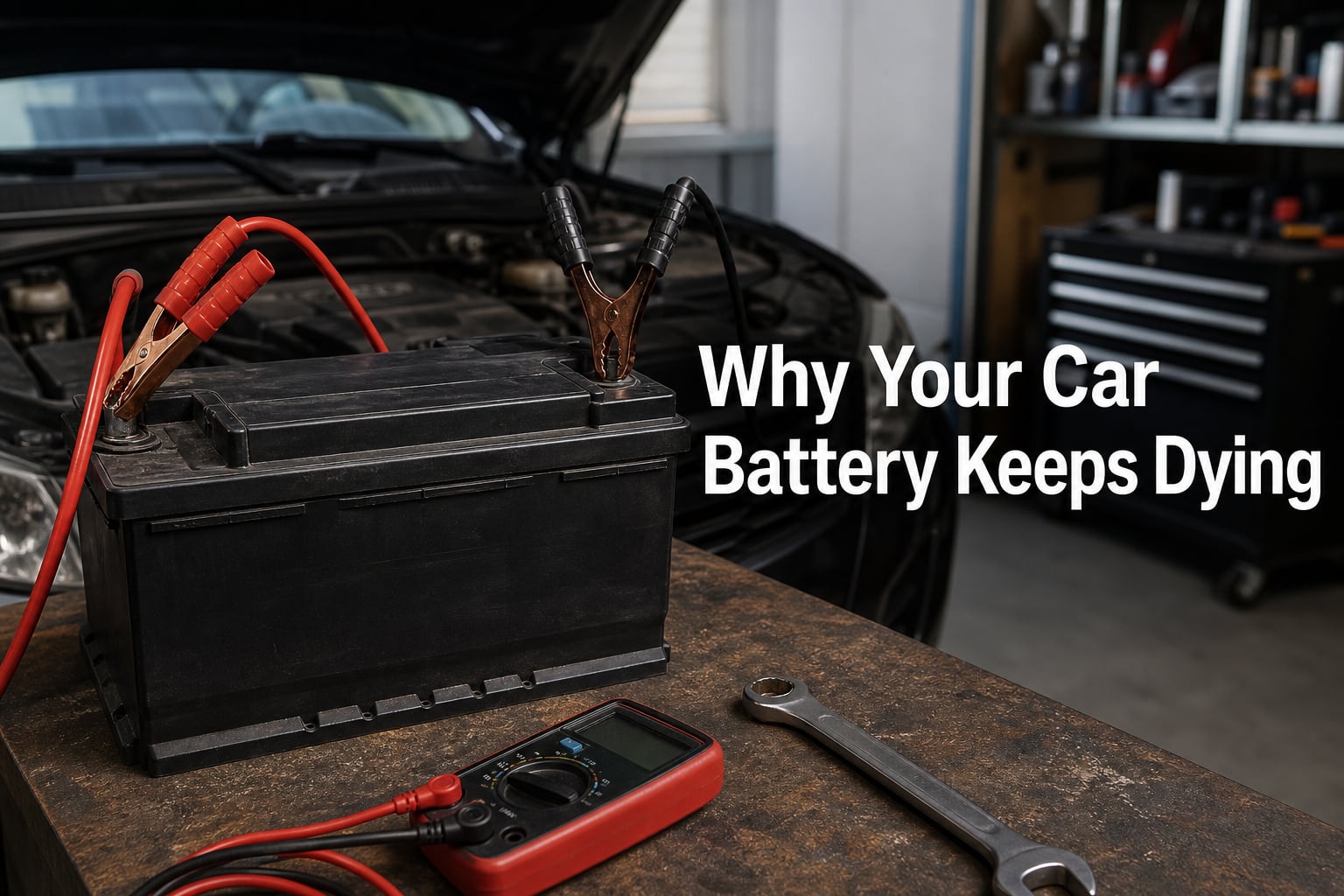
There is nothing worse than turning your key (or pushing your start button) and hearing nothing but a weak click or complete silence. You grab the jumper cables, get the engine running, drive around for twenty minutes, and think the problem is solved. But two days later, you are stuck in the same spot again. If this sounds familiar, you are dealing with a recurring battery drain, and understanding why your car battery keeps dying is the first step to fixing it for good.
I have spent years researching automotive electrical issues, and the truth is that a dead battery is almost never the actual problem. It is a symptom of something else going wrong in your vehicle’s electrical system. A battery’s job is simply to store energy and deliver it when needed. When it keeps running out of juice, something is either draining it faster than it should be, or it is not getting recharged properly while you drive.
In this guide, I will walk you through the 7 most common causes of car battery drain, show you exactly how to diagnose which one applies to your situation, and give you practical steps to prevent it from happening again. Whether you are dealing with an overnight drain, a new battery that keeps dying, or a car that will not start after sitting for a few days, you will find answers here.
Why Your Car Battery Keeps Dying: 7 Common Causes
If your car battery keeps dying, one of these seven issues is almost certainly to blame. I have listed them from most to least common based on mechanic reports and owner forums, so you can start your diagnosis at the top.
1. Parasitic Draw From Electrical Components
A parasitic draw happens when an electrical component in your car continues to pull power even after the engine is shut off. Modern vehicles have dozens of modules, sensors, and computers that stay active in the background. The clock, alarm system, keyless entry, and engine computer all draw a tiny amount of current continuously. This is normal.
The problem arises when something goes wrong and the draw becomes excessive. A common culprit is a stuck relay, a faulty module that will not go to sleep, or even a trunk light, glove box light, or dome light that stays on because the switch is broken. A single interior bulb that stays on can drain a healthy battery in under 48 hours.
On forums like r/MechanicAdvice and r/Cartalk, I have seen countless stories from owners whose new battery keeps dying while parked. Many of them traced the issue back to a faulty aftermarket alarm system, a malfunctioning radio, or even a USB charger left plugged into the power outlet that stays active when the car is off.
2. Alternator or Charging System Failure
Your alternator is responsible for recharging the battery while the engine runs. If it fails or underperforms, your battery slowly loses charge with every mile you drive until there is nothing left. Many people assume a dead battery means a bad battery, but the alternator is often the real villain.
Signs of alternator trouble include a battery warning light on the dashboard, dimming headlights at idle, flickering interior lights, or a whining noise from the engine bay. I have talked to owners who replaced their battery two or three times before anyone thought to test the alternator. Do not make that mistake.
The alternator belt (also called the serpentine belt) can also be the issue. If it is loose, cracked, or slipping, the alternator will not spin fast enough to generate proper voltage. A voltage regulator that has failed can also prevent the alternator from sending the right amount of charge to the battery.
3. Loose or Corroded Battery Connections
Loose battery connections and corrosion buildup are incredibly common and surprisingly destructive. When the terminals are loose or covered in white, crusty corrosion, the battery cannot send or receive a proper charge. The connection resistance causes voltage drops that confuse the charging system and can even trick the car’s computer into overcharging or undercharging.
Corrosion forms naturally as a byproduct of the chemical reaction inside the battery, but it accelerates in humid environments and when the battery is overcharged. Les Schwab, one of the most trusted names in tire and battery service, lists loose or corroded connections as the number one reason batteries fail before their time.
The fix is simple and inexpensive. You can clean battery terminals with a wire brush and a baking soda and water solution in about ten minutes. I recommend checking your terminals every few months, especially before winter, to ensure they are tight and clean.
4. Lights or Accessories Left On
This is the most obvious cause, but it still catches people off guard. Headlights, dome lights, trunk lights, and even phone chargers can drain a battery if left on overnight. Modern cars often have automatic shutoff features for headlights, but older vehicles and certain models do not.
The trickier scenario is when a light stays on without you knowing. A trunk that does not latch fully, a glove box door that is slightly ajar, or a vanity mirror light that fails to turn off can silently drain your battery over several days. One owner on Reddit shared that their Honda Odyssey would die overnight because the rear hatch was not closing completely, leaving the cargo light on.
5. Extreme Temperature Damage
Both heat and cold can kill a car battery, but they do it in different ways. Heat is actually the bigger long-term threat. When temperatures climb above 100 degrees Fahrenheit, the chemical reaction inside the battery accelerates, causing fluid to evaporate and internal plates to corrode faster. That is why batteries in hot climates like Arizona, Texas, and Florida typically last only 2 to 3 years compared to 4 to 5 years in moderate climates.
Cold weather, on the other hand, reduces the battery’s ability to deliver power. A battery at 32 degrees Fahrenheit performs at about 65 percent of its capacity. At 0 degrees, that drops to roughly 40 percent. If your battery is already weak from age or heat damage, the first cold snap of winter can finish it off.
I always tell people in northern states to have their battery tested before winter hits. A test at any auto parts store takes about two minutes and is usually free. If the reading shows the battery is marginal, replace it before the cold weather arrives.
6. Frequent Short Trips
If you mostly drive short distances, like a 5-minute commute to the grocery store or a quick drop-off at school, your battery may never fully recharge. Starting the engine requires a massive burst of energy from the battery, and it takes at least 20 to 30 minutes of driving for the alternator to replenish that charge.
Over time, the battery enters a state called deep discharge, where it is repeatedly drained below its safe minimum voltage. This dramatically shortens battery life because deep discharging damages the internal lead plates. A battery that is regularly deep-discharged may only last 12 to 18 months instead of the expected 3 to 5 years.
The solution is simple. Try to take your car on a 30-minute drive at least once a week, preferably at highway speeds. This gives the alternator enough time to fully recharge the battery and helps burn off moisture that accumulates in the engine oil.
7. Old Battery Age and Natural Degradation
Sometimes the answer to why your car battery keeps dying is simply that the battery is old. The average car battery lasts 3 to 5 years, depending on climate, driving habits, and maintenance. As a battery ages, its internal plates sulfate and its ability to hold a charge decreases.
One frustration I see repeatedly on forums is when a battery dies after only a year or two. Owners feel skeptical about battery quality, but in many cases, the real issue is an undiagnosed problem (like a parasitic draw or weak alternator) that is putting extra stress on a new battery and wearing it out prematurely. A brand-new battery should not die after sitting for just a few days unless something else is wrong.
Check the date code stamped on your battery case. Most batteries have a round sticker with a letter and number combination. The letter indicates the month (A for January, B for February, etc.) and the number indicates the year. If your battery is more than 4 years old and keeps dying, replacement should be your first step.
How to Diagnose What’s Draining Your Battery
Now that you know the common causes, here is a step-by-step process to figure out exactly which one is affecting your vehicle. I have broken this down into five clear steps that anyone can follow, even without specialized tools.
Step 1: Check for Obvious Causes
Start with the easy stuff. Make sure all lights are off when you park, including headlights, dome lights, trunk lights, and under-hood lights. Remove any phone chargers or accessories plugged into the power outlets. Check that all doors, the trunk, and the glove box are fully closed. Wait until dark and look at your car from the outside to see if any interior lights are glowing faintly.
Step 2: Inspect Battery Connections and Terminals
Open the hood and examine the battery terminals. Look for white, blue, or green crusty buildup on the metal posts and cable clamps. Grab each cable and gently try to wiggle it. If there is any movement, the connection is too loose. Clean the terminals with a wire brush and a mixture of baking soda and water, then tighten the connections with a wrench.
Step 3: Test Battery Voltage With a Multimeter
A digital multimeter costs about $15 to $25 at any hardware store and is one of the most useful tools for diagnosing battery problems. Set the multimeter to DC volts (20V range) and touch the red probe to the positive terminal and the black probe to the negative terminal.
A healthy battery should read between 12.4V and 12.7V when the engine is off. If it reads below 12.0V, the battery is discharged. If it reads between 12.0V and 12.4V, it is partially charged but may indicate a problem. Write down this number because you will need it for comparison after testing the alternator.
Step 4: Perform a Parasitic Draw Test
This is the test that most competitors skip, but it is the most important diagnostic step if your battery dies while parked. Here is how to do it with a multimeter.
First, make sure the car has been off for at least 30 minutes so all modules go to sleep. Set your multimeter to the 10-amp DC setting. Disconnect the negative battery cable and connect the multimeter in series between the cable and the negative terminal (red probe to the cable, black probe to the terminal). A normal parasitic draw should be between 0.02 and 0.05 amps (20 to 50 milliamps). If the reading is higher than 0.1 amps (100 milliamps), you have a parasitic draw problem.
To find which circuit is causing the draw, pull fuses one at a time from the fuse box while watching the multimeter. When you pull the fuse for the problematic circuit, the reading will drop to normal. That tells you exactly which system is staying on and draining your battery.
Step 5: Check Alternator Output
With the engine running, use your multimeter to measure voltage across the battery terminals again. A healthy alternator should produce between 13.8V and 14.8V. If the reading is below 13.5V or above 15V, your alternator or voltage regulator may be failing. If the voltage does not change at all from your earlier reading with the engine off, the alternator is definitely not charging the battery.
If any of these tests point to a problem you are not comfortable fixing yourself, it is time to visit a mechanic. But at least you can tell them exactly what you found, which saves diagnostic time and money.
Signs Your Alternator is the Real Problem
If your alternator is failing, replacing the battery will only give you a temporary fix. The new battery will die again within days or weeks. Here are the most reliable signs that your alternator is the actual cause of your battery problems.
The battery warning light on your dashboard is designed to detect charging system problems, not just low battery voltage. If this light comes on while driving, your alternator is likely not producing enough power. Do not ignore it. You may only have 20 to 30 minutes of driving time before the battery is completely drained.
Dimming or flickering headlights are another classic sign. The alternator powers all electrical systems while the engine runs, so if it is weak, lights will dim at idle and brighten when you rev the engine. You may also notice power windows operating slowly, the radio cutting out, or the heater fan losing power.
Strange smells and sounds can also point to alternator trouble. A burning rubber smell may indicate a seized alternator bearing causing the belt to slip. A whining or grinding noise from the alternator itself means the internal bearings are failing. If you notice any of these symptoms alongside a dying battery, have the alternator tested before spending money on a new battery.
How Extreme Temperatures Affect Battery Life
Temperature extremes are one of the most underappreciated factors in battery life. Both heat and cold stress your battery in different ways, and understanding how they work can help you take preventive action.
Hot weather is the silent battery killer. Temperatures under the hood can exceed 200 degrees Fahrenheit on a summer day. This extreme heat causes the electrolyte fluid inside the battery to evaporate, exposing the lead plates to air. Once exposed, the plates corrode and sulfate rapidly. You may not notice the damage during summer because warm batteries perform well. The problems show up months later when the first cold morning hits and the weakened battery cannot deliver enough cranking amps.
Cold weather does not damage the battery directly, but it reduces its output dramatically. At 0 degrees Fahrenheit, a fully charged battery only produces about 40 percent of its rated power. At the same time, cold oil makes the engine harder to crank, increasing the demand on the battery. This double whammy is why dead batteries are so common in January and February.
If you live in a climate with harsh winters, I recommend having your battery tested every fall. Most auto parts stores offer free testing. If the test shows the battery is below 75 percent capacity, replace it before the cold weather arrives.
Prevention Tips to Stop Battery Drain
Preventing battery drain is much easier than diagnosing it after the fact. Here are proven tips that mechanics and experienced car owners recommend.
Drive your car regularly. If your car sits for more than a week without being driven, the battery will slowly lose charge from natural self-discharge and parasitic draw. The 30-day rule is real: a healthy battery in a car with no parasitic issues can still go dead after about 30 days of sitting. If you have a vehicle you do not drive often, invest in a battery tender (also called a trickle charger) to keep the battery topped up.
Clean your battery terminals twice a year. Corrosion buildup is gradual, so you may not notice it until it causes starting problems. Remove the cable clamps, scrub the posts and clamps with a wire brush and baking soda solution, then coat them with dielectric grease to slow future corrosion.
Avoid short trips when possible. Every engine start draws a significant amount of battery power. If your trips are under 15 minutes, the alternator may not have enough time to fully recharge. Try to combine errands into one longer trip, or take a 30-minute drive at least once a week.
Turn off all accessories before shutting off the engine. This includes the radio, heater fan, headlights, and seat heaters. When you start the car next time, the battery will not have to power those accessories during the most demanding moment of the start cycle.
Check for parasitic draws if your car sits often. If you notice the battery weakening after just a few days of not driving, there may be a component that is not going to sleep properly. Follow the parasitic draw test steps above to identify the culprit.
Use a battery tender for stored vehicles. If you store a car, boat, or motorcycle for the winter, a battery tender is the best investment you can make. These devices monitor the battery voltage and deliver a small maintenance charge to keep it at 100 percent without overcharging. Most quality tenders cost under $50.
What to Do When Your Battery Dies
When your battery is dead, you need to get back on the road safely. Here is a step-by-step guide to jump-starting your car, plus guidance on when to call for professional help.
How to Jump-Start Your Car Safely
You will need a set of jumper cables and a second vehicle with a good battery. Position the two cars close enough that the cables can reach both batteries, but do not let the vehicles touch each other.
Turn off both cars and remove the keys from the ignition. Open the hoods and locate the positive (+) and negative (-) terminals on each battery. Red is positive, black is negative.
Connect the cables in this exact order. First, attach one red clamp to the positive terminal of the dead battery. Second, attach the other red clamp to the positive terminal of the good battery. Third, attach one black clamp to the negative terminal of the good battery. Fourth, attach the remaining black clamp to an unpainted metal surface on the dead car’s engine block or chassis, away from the battery. This grounding point reduces the risk of sparks near battery gases.
Start the good car and let it idle for 2 to 3 minutes. Then start the dead car. If it starts, let both cars run for a few more minutes. Remove the cables in reverse order: black clamp from the grounded metal surface, black clamp from the good battery, red clamp from the good battery, red clamp from the dead battery.
Drive the jumped car for at least 30 minutes at highway speeds to allow the alternator to recharge the battery. If the car dies again shortly after removing the cables, the alternator may not be charging the battery at all.
When to Call a Professional
If your car does not start even with a jump, or if it dies immediately after being jumped, you likely have a bad alternator rather than a dead battery. At this point, calling for a tow or roadside assistance is your best option. Driving a car with a failing alternator can damage the new battery you just jumped and leave you stranded in a dangerous location.
If you have performed the diagnostic steps above and found a parasitic draw but cannot identify the specific circuit, a mechanic with professional diagnostic equipment can track it down quickly. Most shops charge between $100 and $200 for parasitic draw diagnosis, which can save you hours of frustration and repeated battery replacements.
FAQs
How do I fix a car battery that keeps dying?
To fix a car battery that keeps dying, first identify the root cause. Check for loose or corroded terminals, test the alternator output (should be 13.8-14.8V while running), check for parasitic draws using a multimeter, and replace the battery if it is more than 4 years old. Clean the terminals, drive for at least 30 minutes per trip, and use a battery tender if the car sits for long periods.
What drains the car battery when the car is off?
The most common things that drain a car battery when off are parasitic draws from electrical components like alarm systems, clock, radio memory, and engine computers. Abnormal drains include faulty relays, stuck modules, trunk or dome lights that stay on, and aftermarket accessories like phone chargers or dash cams that remain powered.
How do I find out what keeps draining my car battery?
To find what is draining your car battery, perform a parasitic draw test with a multimeter. Set the multimeter to 10-amp DC, disconnect the negative cable, and connect the multimeter in series. A normal reading is 0.02-0.05 amps. If higher, pull fuses one at a time until the reading drops to normal, which identifies the faulty circuit.
How do I stop my car battery from draining so fast?
To stop fast battery drain, clean corroded terminals, drive for at least 30 minutes per trip to allow proper charging, turn off all lights and accessories when parking, check for parasitic draws, and use a battery tender if the vehicle sits unused for more than a week. Replace batteries older than 4 years.
Conclusion
Understanding why your car battery keeps dying comes down to identifying one of seven common causes: parasitic draws, alternator failures, corroded connections, lights left on, extreme temperatures, short trips, or old battery age. The diagnostic process I have outlined, from checking obvious causes to performing a multimeter-based parasitic draw test, will help you pinpoint the exact problem in under an hour.
If your battery is more than 4 years old and tests below 75 percent capacity, replacement is the right call. But if your battery is relatively new and keeps dying, do not just keep replacing it. There is an underlying issue that needs to be diagnosed and fixed, or you will keep throwing money at the symptom instead of the cause.
Regular maintenance is your best defense. Clean your terminals twice a year, drive the car long enough to recharge the battery, and use a battery tender if the vehicle sits for extended periods. A few minutes of prevention can save you from being stranded and extend your battery’s life by years.