
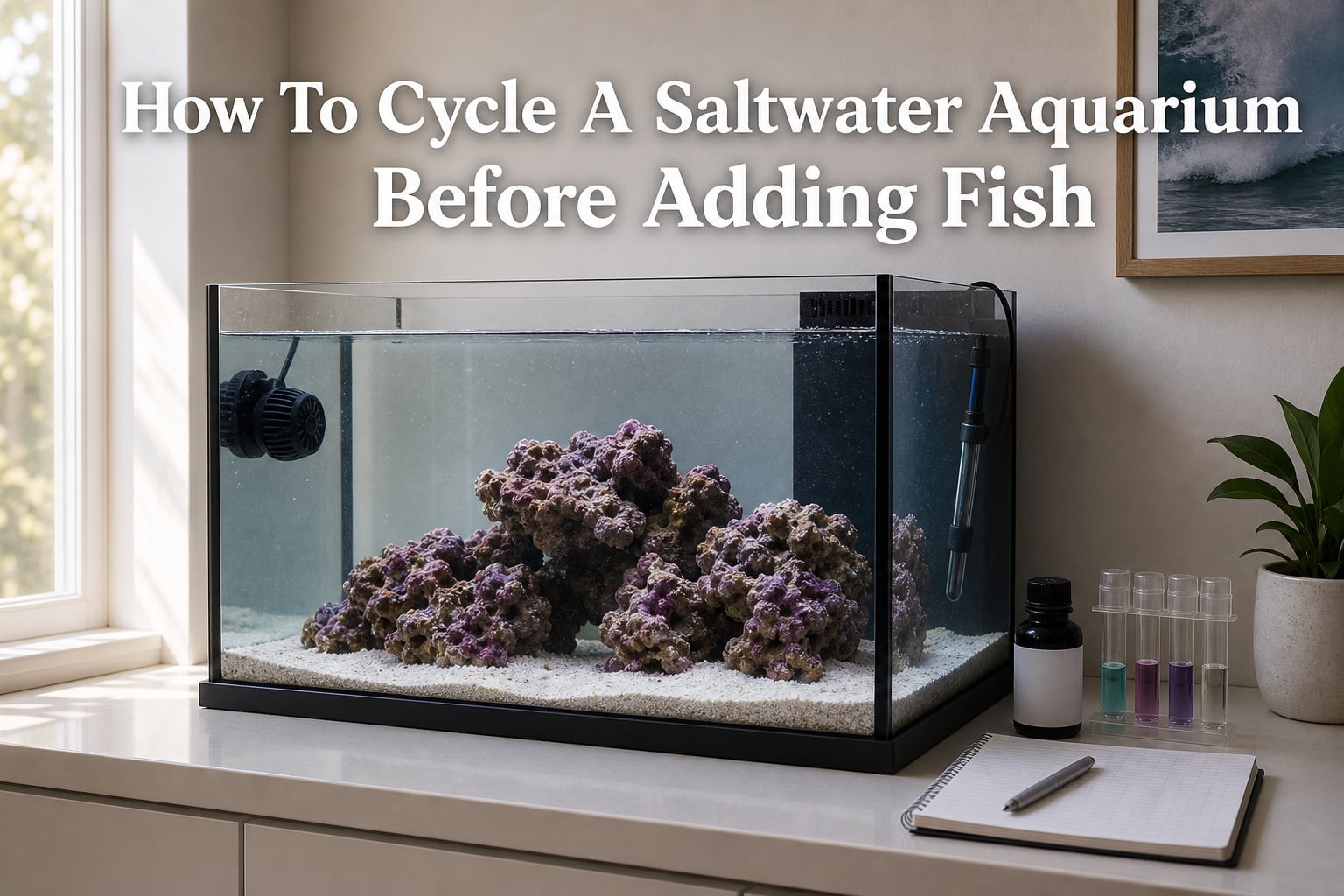
Cycling a saltwater aquarium is the single most important step you take before adding any fish. Skip it, and the ammonia your livestock produces will burn their gills within days. I learned this the hard way with my first clownfish, which died 48 hours after I added it to an uncycled tank.
This guide walks you through exactly how to cycle a saltwater aquarium before adding fish. You will learn what the nitrogen cycle actually is, how long it takes, and how to confirm your tank is ready. I have cycled eight reef tanks over the past decade, and the process is the same every time.
What Is the Nitrogen Cycle and Why It Matters
The nitrogen cycle is the process of building beneficial bacteria colonies that convert toxic fish waste into safer compounds. Without these bacteria, ammonia from fish waste, uneaten food, and decaying matter builds up and poisons your livestock. This is why cycling comes first.
Three bacteria groups do the work. Nitrosomonas bacteria convert ammonia (NH3/NH4) into nitrite (NO2). Nitrobacter bacteria then convert that nitrite into nitrate (NO3). Nitrate is far less toxic and is removed through water changes or absorbed by live plants and macroalgae.
Here is what each compound means for your fish:
- Ammonia – Highly toxic. Burns gills and fins. Should always read 0 ppm in an established tank.
- Nitrite – Also toxic. Binds to hemoglobin and prevents oxygen transport. Target is 0 ppm.
- Nitrate – Less toxic at low levels. Keep under 10-20 ppm in a reef tank, under 40 ppm in fish-only setups.
The cycle is complete when your tank can process 2-4 ppm of ammonia into 0 ppm ammonia and 0 ppm nitrite within 24 hours. Until then, your fish will suffer.
How Long Does It Take to Cycle a Saltwater Tank?
A saltwater tank takes 4-6 weeks to cycle fully. That is roughly twice as long as a freshwater aquarium because saltwater nitrifying bacteria grow more slowly.
Several factors affect your timeline:
- Live rock source – Cured live rock from an established system can shorten cycling to 1-2 weeks.
- Bacteria supplements – Quality bottled bacteria products can shave 1-2 weeks off the process.
- Temperature – Bacteria multiply fastest between 78-82°F (25.5-28°C).
- Seeding material – Filter media, substrate, or decorations from a healthy tank jumpstart bacterial colonization.
- Salinity – Stable 1.024-1.026 specific gravity supports bacterial growth.
Can you cycle a saltwater tank in one week? Not reliably. Anyone claiming a 24-hour cycle is selling shortcuts that crash within months. I tried the “instant cycle” route once and lost three fish to ammonia spike at week three.
Fishless vs Fish-In Cycling: Which Method Works Best?
Fishless cycling is the ethical and practical standard for new saltwater tanks. You add pure ammonia or another ammonia source to feed the bacteria colonies without putting any fish at risk. This method is faster, safer, and recommended by every marine biologist I have spoken with.
Fish-in cycling uses a hardy fish (often a damsel) to produce ammonia naturally. I do not recommend this approach. The fish endures toxic ammonia and nitrite spikes, often suffering permanent gill damage even if it survives. The marine hobby has moved past this practice.
Three ammonia sources work for fishless cycling:
- Pure liquid ammonia – The cleanest option. Look for ammonia with no surfactants, scents, or additives.
- Ghost feeding – Adding small pinches of fish food that decompose into ammonia. Less precise dosing.
- Raw shrimp method – Place a raw shrimp in the tank and let it decompose. A traditional approach that works but is messier.
I prefer pure liquid ammonia because you control the dose precisely. Aim for 2-4 ppm ammonia at each dosing.
Step-by-Step Guide to Cycling Your Saltwater Aquarium
Follow these six steps to cycle your saltwater tank before adding fish. The entire process takes 4-6 weeks, and your patience pays off with healthy livestock for years.
Step 1: Set Up the Tank and Equipment
Place your aquarium, sump, return pump, protein skimmer, heater, and powerheads. Rinse sand and substrate with RODI water only. Never use soap or tap water at any point in the process.
Fill the tank with RODI or distilled water mixed with marine salt to 1.024-1.026 specific gravity. Turn on the heater and set it to 78°F. Run the system for 24-48 hours to confirm temperature and salinity are stable.
Step 2: Add Live Sand (Optional)
Live sand introduces beneficial bacteria and provides a natural-looking substrate. Add 1-2 inches of aragonite or crushed coral sand. Live sand carries both aerobic and anaerobic bacteria that help process waste.
Step 3: Add Live Rock
Live rock is the biological heart of a saltwater aquarium. Use 1-1.5 lbs per gallon of tank volume. Arrange it to create caves, overhangs, and stable structures.
Fully cured live rock already contains the bacteria you need. Uncured rock will go through a curing process during cycling, producing ammonia on its own. Both work, but cured rock shortens the timeline.
Step 4: Dose Ammonia to 2-4 ppm
Once your live rock is in place, add pure liquid ammonia to reach 2-4 ppm on your test kit. If you are ghost feeding or using the shrimp method, skip the ammonia dose and let the natural decomposition drive the cycle.
Test ammonia after dosing to confirm the level. Note this in a cycling log along with the date.
Step 5: Test Daily and Track the Spikes
Test ammonia, nitrite, and nitrate at the same time every day. Record results in a notebook or spreadsheet. The progression follows a predictable pattern:
- Days 1-7: Ammonia rises as you dose. Nitrite and nitrate stay near zero.
- Days 7-21: Ammonia drops as Nitrosomonas establish. Nitrite spikes sharply.
- Days 21-35: Nitrite drops as Nitrobacter colonize. Nitrate rises steadily.
- Days 35-45: Both ammonia and nitrite read 0 ppm within 24 hours of dosing. Cycle complete.
Step 6: Confirm the Cycle Is Complete
Add ammonia to 2-4 ppm one final time. Wait 24 hours, then test. Ammonia should be 0 ppm and nitrite should be 0 ppm. Nitrate should be elevated but manageable. This confirms both bacteria colonies are mature.
Do a 25-50% water change to bring nitrate below 10 ppm before adding livestock. Your tank is now ready for fish.
Testing Water Parameters: Ammonia, Nitrite, and Nitrate
A reliable test kit is non-negotiable during cycling. Test strips are convenient but less accurate. I recommend a liquid test kit from API, Red Sea, or Salifert for the most trustworthy readings.
You need to track three values:
- Ammonia (NH3/NH4) – Test daily during cycling. Safe level is 0 ppm.
- Nitrite (NO2) – Test daily during cycling. Safe level is 0 ppm.
- Nitrate (NO3) – Test every 2-3 days. Reef tanks want under 10 ppm. FOWLR tanks under 40 ppm.
During cycling, ammonia can safely climb to 5 ppm as long as you are dosing intentionally. The bacteria colonies can handle that load. Above 5 ppm, the bacteria themselves start to suffer and the cycle slows down.
Log every reading. The data tells you exactly where your cycle is and when it will finish. I use a simple Google Sheet with date, time, ammonia, nitrite, nitrate, and notes. After eight tanks, I can predict cycle completion within three days based on the spike pattern.
Tips to Speed Up the Cycling Process
These methods have worked for me and other hobbyists to shave days or weeks off cycling. They do not bypass the biology, but they accelerate it.
- Seed with established media – Borrow a sponge filter, ceramic rings, or filter floss from a healthy tank. Even a handful of gravel from an established aquarium helps.
- Use a quality bacteria supplement – Products like Dr. Tim’s One and Only, FritzZyme, or MicroBacter7 contain live nitrifying bacteria. They work when stored and dosed properly.
- Keep temperature stable at 78-82°F – Bacteria multiply faster in warmer water.
- Maintain strong flow – Powerheads push oxygen-rich water across bacterial colonies. Low oxygen slows everything down.
- Buy fully cured live rock – Cured rock from a reputable dealer ships with active bacteria colonies.
- Avoid UV sterilizers during cycling – UV kills free-floating bacteria before they can colonize.
Set realistic expectations. Even with every trick, a saltwater cycle takes at least 2-3 weeks. Patience protects fish.
Common Mistakes to Avoid When Cycling
I have made most of these mistakes myself over the years. Avoiding them saves fish, time, and money.
- Adding fish too soon – The most common and deadliest mistake. Wait until ammonia and nitrite hold at 0 ppm for 24 hours after dosing.
- Using chlorinated tap water – Chlorine kills beneficial bacteria. Always use RODI or distilled water mixed with marine salt.
- Overcleaning the tank – Do not wash filter media, rock, or sand in tap water. Even small amounts of chlorine stall the cycle.
- Dosing too much ammonia – Above 5 ppm ammonia actually slows bacterial growth and harms the colonies you are trying to build.
- Skipping water changes during cycling – If ammonia climbs above 5 ppm or nitrate gets extreme, do a partial water change to bring levels back down.
- Turning off equipment at night – Keep flow and filtration running 24/7. Bacteria need constant oxygen and water movement.
- Ignoring salinity swings – Top off evaporated water with RODI only. Salt does not evaporate, so adding saltwater slowly raises salinity and stresses bacteria.
- Using antibiotics or medications during cycling – These kill the bacteria you are trying to grow.
- Panicking at cloudy water – Bacterial blooms cause temporary cloudiness. It is normal and clears on its own within a week.
- Trusting the “instant cycle” products – Most bottled bacteria products help but do not replace the natural cycling timeline.
Signs Your Tank Is Fully Cycled
Three signs confirm your saltwater tank is fully cycled and ready for fish.
- Ammonia reads 0 ppm 24 hours after dosing to 2 ppm. The Nitrosomonas colony is mature.
- Nitrite reads 0 ppm 24 hours after dosing. The Nitrobacter colony is mature.
- Nitrate is present and rising steadily. The full conversion pathway is working end to end.
Some aquarists also check pH stability and temperature consistency before adding fish. A stable tank between 78-80°F with pH 8.1-8.4 is ideal for most marine livestock.
If ammonia or nitrite is not at 0 ppm, keep waiting. Do not add fish to “test it out.” That is how livestock dies.
Adding Your First Fish After Cycling
Once your cycle is complete, start with one or two hardy fish. Clownfish, damselfish, and royal grammas are popular starter choices. Add fish one at a time, spaced 2-3 weeks apart, to avoid overloading your bacteria colonies.
Acclimate new fish slowly using the drip method or float-and-add method. Match salinity, temperature, and pH before releasing them into the tank. Feed lightly for the first week to let your bacteria adjust to the new bioload.
Continue testing ammonia and nitrite for two weeks after adding fish. Any spike means your bacteria are struggling and need time to catch up. A small water change resolves most issues.
Frequently Asked Questions
How long should I cycle my saltwater tank before adding fish?
A saltwater aquarium takes 4-6 weeks to cycle fully. You can confirm the cycle is complete when ammonia and nitrite both read 0 ppm within 24 hours of dosing 2-4 ppm of ammonia. Nitrate should be present and stable.
What is the fastest way to cycle a saltwater tank?
Use fully cured live rock, seed with established filter media from a healthy tank, dose a quality bottled bacteria supplement, and keep temperature at 78-82°F. With these methods, you can shorten cycling to 2-3 weeks, but no saltwater tank cycles reliably in less than two weeks.
How to tell when a saltwater tank is cycled?
Your tank is cycled when ammonia drops to 0 ppm within 24 hours of dosing, nitrite also reads 0 ppm within 24 hours, and nitrate is present in measurable amounts. Run this test twice across 48 hours to confirm the result is stable.
Can a saltwater tank be cycled in 1 week?
No. Saltwater cycling reliably takes 4-6 weeks because saltwater nitrifying bacteria grow more slowly than freshwater species. Products claiming 24-hour or 1-week cycles are not biologically accurate and risk fish death once livestock is added.
Cycling Your Saltwater Aquarium: The Final Word
Learning how to cycle a saltwater aquarium before adding fish is the foundation of a healthy marine tank. The 4-6 week wait protects your livestock from ammonia and nitrite poisoning, sets up your bacteria colonies for long-term stability, and saves you the heartbreak of losing fish in the first month.
Set up your tank, dose ammonia or use the shrimp method, test daily, and wait for ammonia and nitrite to hit 0 ppm. That is the whole process. Use a quality test kit, keep temperature and salinity stable, and resist the urge to add fish early.
Once your tank is cycled, you are ready to stock it with the marine livestock you have been planning. Start with one or two hardy fish, build your cleanup crew slowly, and enjoy the tank for years to come.