
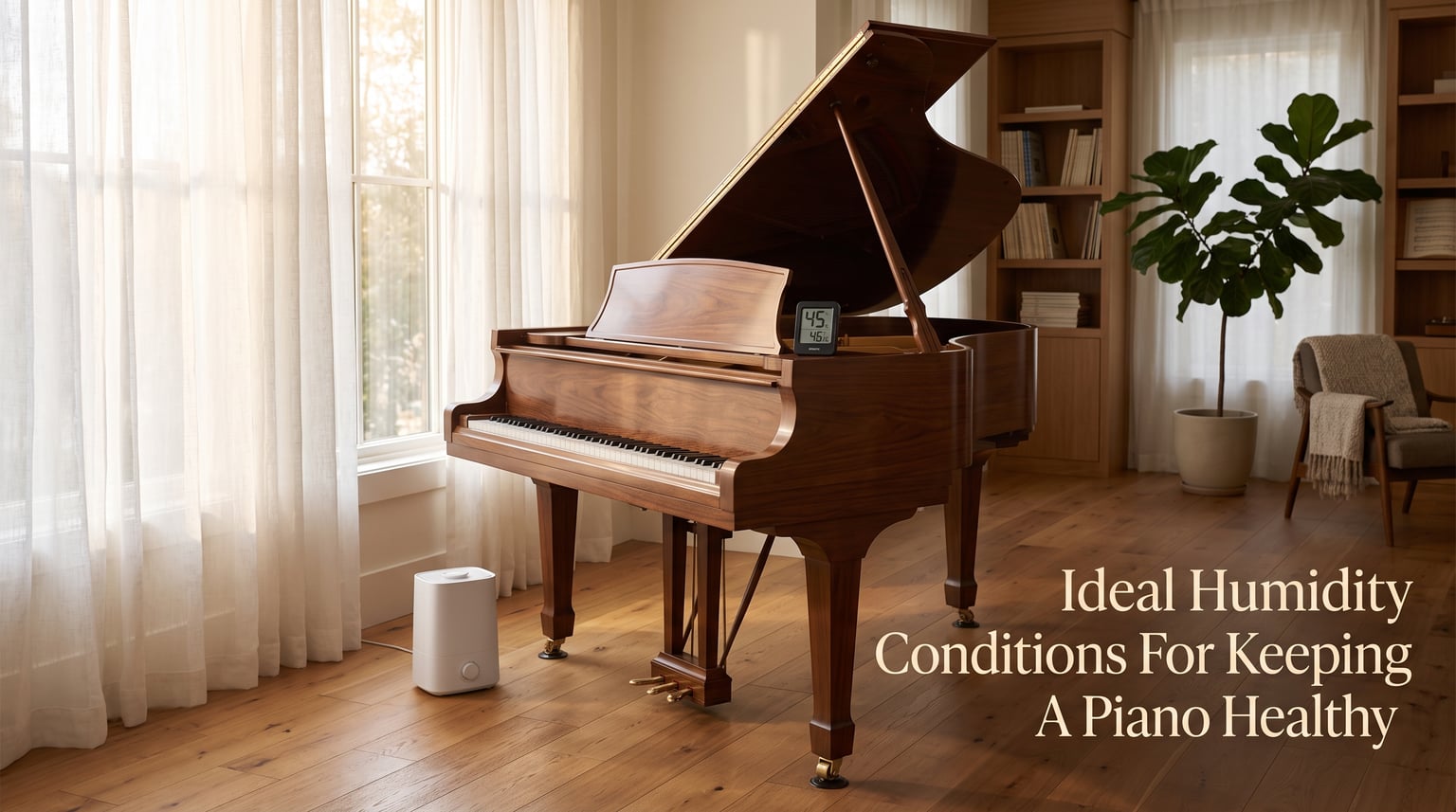
A piano is a living instrument made of wood, felt, leather, and metal, and all of these materials react to the air around them. I have seen beautiful grand pianos develop soundboard cracks, sluggish keys, and chronic tuning problems simply because nobody paid attention to the room environment. The ideal humidity conditions for keeping a piano healthy sit between 42% and 45% relative humidity at roughly 68 degrees Fahrenheit (20 degrees Celsius), and maintaining that narrow band year-round is the single most important thing you can do to protect your instrument. In this guide, I will walk you through the exact ranges manufacturers recommend, the damage that happens when humidity drifts too high or too low, and the practical steps you can take today to stabilize your piano’s environment.
What Is the Ideal Humidity for a Piano?
The short answer is 42% to 45% relative humidity, maintained at a steady temperature around 68 degrees Fahrenheit (20 degrees Celsius). This range represents the sweet spot where the soundboard, bridges, action parts, and strings all remain dimensionally stable and your piano holds its tuning reliably between service visits.
Most major manufacturers agree on a broader acceptable window of 40% to 60% relative humidity. Steinway and Sons recommends 45% to 50%. C. Bechstein specifies 40% to 60%. Fazioli and Bosendorfer echo similar ranges, typically centering around 45%. The reason each builder gives a slightly different number comes down to how their specific wood species and construction methods respond to moisture.
What every manufacturer stresses, though, is that consistency matters far more than hitting an exact percentage. A piano kept at a rock-steady 50% will perform better than one that bounces between 35% and 55% every few weeks. Rapid swings in humidity force the soundboard to expand and contract repeatedly, and that cyclic stress is what leads to cracks, loose tuning pins, and sluggish action parts.
If you take only one thing away from this section, make it this: aim for 42% to 45% if you can, accept anything in the 40% to 60% band, and fight to keep fluctuations under 10% in either direction.
Quick Reference: Piano Humidity Zones
Ideal zone: 42% to 45% relative humidity at 68 degrees Fahrenheit. Your piano will hold tuning longest and suffer the least wear.
Safe zone: 40% to 60% relative humidity. Acceptable for long-term piano health if levels remain stable.
Caution zone (dry): Below 35%. Soundboard cracks, loose tuning pins, and brittle felt become real risks.
Caution zone (humid): Above 65%. Wood swelling, sticking keys, string corrosion, and mold growth are likely.
Danger zone: Below 25% or above 70%. Structural damage can occur within days to weeks.
Why Humidity Matters for Piano Health
To understand why humidity is such a big deal, it helps to know that a piano contains over 12,000 parts, and the vast majority of them are made from organic materials that absorb and release moisture continuously. The soundboard, for instance, is a large sheet of spruce typically 8 to 9 millimeters thick. Spruce is hygroscopic, meaning it acts like a sponge for water vapor in the air.
When humidity rises, the soundboard absorbs moisture and swells. That swelling pushes against the bridges, which increases downward pressure on the strings and raises the pitch. When humidity drops, the soundboard shrinks, pressure decreases, and the pitch falls. This constant push-and-pull is why a piano in an unstable room can drift noticeably out of tune in as little as two weeks, even if nobody plays it.
Beyond tuning instability, uncontrolled humidity damages the felt hammers, the leather and cloth used in the action assembly, the wooden keys, and even the metal strings. The cost of ignoring humidity is measured in hundreds of dollars of extra tuning visits, thousands in structural repairs, and in the worst cases, a total loss of the instrument. I have talked with piano technicians who charge $1,500 or more to repair a single cracked soundboard, and that repair may not even be possible if the damage is severe.
Problems from Low Humidity (Dry Conditions)
Low humidity is the more common threat for most piano owners, especially during winter when forced-air heating pulls moisture out of the air. I live in a climate where indoor humidity can plummet to 20% in January, and without active humidification, an acoustic piano would be in serious trouble within a single heating season.
When the relative humidity around your piano drops below 35%, several damaging processes begin. The soundboard loses moisture and shrinks. Because it is glued around its perimeter to the piano’s rim, that shrinkage creates enormous internal tension. Eventually, something has to give, and what gives is usually the wood itself. Soundboard cracks can appear suddenly, often running parallel to the grain, and while small cracks may not affect tone immediately, they always worsen over time.
The pin block is another casualty of dry conditions. This laminated hardwood block holds the tuning pins in place by friction. When it dries out, the wood contracts around the pins, reducing the grip. Loose tuning pins mean your piano cannot hold a tune, and replacing or re-pinning a pin block is a major rebuild that can cost thousands.
Other components suffer too. Felt hammers become brittle and lose their voicing. Key bushings shrink, causing keys to wobble side to side. Wooden action parts can warp, causing uneven touch response across the keyboard. And the glue joints that hold everything together can dry out and fail.
Warning Signs of Low Humidity Damage
Piano goes flat between tunings, especially in the middle and upper registers
Visible cracks on the soundboard surface
Keys feel loose or rattle side to side when played
Buzzing or rattling sounds that were not present before
Hammers sound harsh or overly bright
Tuning pins feel loose (your technician may mention this)
Gaps appear between the soundboard and the bridges
Problems from High Humidity (Moisture Damage)
High humidity is the opposite problem but equally destructive. When the relative humidity around a piano exceeds 60% for extended periods, the wood absorbs excess moisture and swells. This is particularly common in coastal regions, tropical climates, and during summer months in areas with humid air masses. Basements are especially dangerous because they tend to have the highest humidity levels in a home.
The first thing most owners notice in a humid environment is that keys start sticking. The wooden key bodies swell, and the felt bushings that guide the keys absorb moisture and expand, creating friction. Sticking keys are not just annoying. They indicate that the entire action assembly is absorbing moisture, and that means hammer timing, repetition speed, and touch sensitivity are all being compromised.
The soundboard swells just as it shrinks in dry conditions, but in the opposite direction. Increased crown pressure pushes the pitch sharp, sometimes dramatically so. I have seen pianos in uncontrolled tropical environments sit a quarter-tone above pitch after just a few weeks of high humidity.
Metal components face their own threat: corrosion. Piano strings are made of high-carbon steel wire, and bass strings are wrapped with copper or iron. When humidity stays above 65%, these metals begin to oxidize. Rusty strings produce a dull, dead tone and are far more likely to break during tuning. The tuning pins themselves can rust inside the pin block, making future tuning difficult and eventually impossible without major work.
Felt and leather parts also absorb moisture, becoming sluggish and mold-prone. In extreme cases, you may see visible mold on the hammers or dampers, and mold spores can spread to the keys and case finish. The action assembly’s precision tolerances, measured in fractions of a millimeter, are disrupted by swelling leather and cloth punchings.
Warning Signs of High Humidity Damage
Keys stick, are sluggish to return, or make a thumping sound
Piano goes sharp between tunings
Visible rust or discoloration on strings
Musty odor coming from inside the piano
Hammers feel heavy or the action feels sluggish when playing fast passages
Visible mold on felt hammers or dampers
Finish damage, cloudiness, or sticky residue on the case surface
Damp or warped music desk and other wooden components
How to Monitor Humidity Levels
You cannot manage what you do not measure, and monitoring humidity is the first step every piano owner should take. The tool you need is called a hygrometer, and it measures relative humidity in the air. A basic digital hygrometer costs under $20 and is perfectly adequate for most situations. Place it near the piano, ideally at the same height as the keyboard, and check the reading at least once a week.
For more active monitoring, consider a thermo-hygrometer that logs temperature and humidity over time. Some models store weeks or months of data, letting you see trends and identify seasonal patterns. This historical data is invaluable because it reveals the swings that matter most. A single snapshot reading of 45% looks fine, but if the hygrometer log shows the room dropping to 30% overnight and climbing to 55% during the day, you have a serious fluctuation problem.
Smart hygrometers take monitoring a step further by connecting to your home Wi-Fi and sending alerts to your phone when humidity drifts outside your preset range. I find these especially useful for piano owners who travel or who keep their instrument in a room they do not use daily. Govee, SensorPush, and Ambient Weather all make affordable smart sensors that pair with mobile apps and support alert thresholds. Some even integrate with smart home platforms like Alexa and Google Home, so you could theoretically automate a humidifier to switch on when levels drop.
One important note: do not place your hygrometer directly on or inside the piano. The instrument’s own microclimate can give misleading readings. Instead, position the sensor 3 to 5 feet from the piano at roughly the same height as the soundboard for the most accurate representation of the air your piano is actually breathing.
Climate Control Solutions for Pianos
Humidifier Solutions for Dry Climates
If your readings consistently fall below 40%, you need to add moisture to the air. The most common approach is a room humidifier, and there are two main types to consider. Evaporative humidifiers use a fan to blow air through a wet wick or filter, adding moisture naturally without producing white dust. These are generally recommended for piano rooms because they are self-regulating: as humidity rises, the evaporation rate slows. Warm mist humidifiers boil water to produce steam, which is effective but uses more energy and can raise the room temperature.
One type I strongly recommend avoiding near a piano is the ultrasonic humidifier. These devices create a fine mist using high-frequency vibrations, and they can release minerals from the water into the air as a fine white dust. That dust settles on every surface in the room, including your piano’s strings, soundboard, and finish. Over time it can cause corrosion and cosmetic damage. If you must use an ultrasonic unit, fill it exclusively with distilled water, but even then, an evaporative model is the safer choice.
For a more targeted solution, consider a dedicated piano climate control system. The Piano Life Saver System by Dampp-Chaser is the industry standard and is installed inside the piano itself. It combines a humidifier and dehumidifier in one unit, controlled by a humidistat that constantly monitors the microclimate around the soundboard. These systems cost roughly $500 to $800 installed, but piano technicians consistently recommend them as the most effective solution for maintaining stable humidity. The system keeps the environment stable regardless of what the room humidity is doing, which is especially valuable for pianos in difficult spaces like churches, schools, and older homes.
Forum discussions on r/piano and Piano World reveal that many owners find room humidifiers insufficient on their own, particularly in very dry climates or large rooms. The Dampp-Chaser system is frequently recommended when humidity fluctuates more than 20% to 30% seasonally, as it addresses the problem at the source rather than trying to condition an entire room.
Dehumidifier Solutions for Humid Climates
When readings climb above 60%, the priority shifts to removing moisture from the air. A portable room dehumidifier is the simplest solution for most situations. These units pull air over cooled coils, condensing moisture into a collection tank or draining it through a hose. A mid-size dehumidifier rated for 30 to 50 pints per day will handle most piano rooms effectively. Look for a model with a built-in humidistat so you can set your target humidity and let the unit cycle automatically.
Air conditioning is also a powerful dehumidifier, and many piano owners in humid climates rely on central AC to keep both temperature and humidity in check. The key is to run the AC consistently rather than cycling it on and off, because short bursts do not run long enough to remove meaningful moisture. If you use window units, make sure the piano is not in the direct path of the cold air stream.
The Dampp-Chaser system mentioned above includes a dehumidifier rod as part of its setup, which gently warms the air inside the piano to lower relative humidity at the instrument level. This is particularly effective for grand pianos where the lid traps a microclimate of moisture. Many technicians recommend the dehumidifier component even if you do not install the humidifier half, especially in consistently humid environments.
If your piano lives in a basement, you are fighting an uphill battle. Basements are naturally humid environments, and I have seen far too many pianos ruined by basement storage. If a basement piano is unavoidable, you need a serious dehumidification strategy: a large-capacity dehumidifier running continuously, a Dampp-Chaser system installed in the piano, and a reliable hygrometer with alerts. Even then, consider relocating the instrument to a main-floor room if at all possible.
Piano Placement Guidelines
Where you place your piano in a room has a direct impact on its humidity exposure. Interior walls are always preferable to exterior walls, because exterior walls experience greater temperature and humidity fluctuations due to outdoor conditions. If your piano must sit against an exterior wall, leave at least 6 inches of clearance for air circulation.
Keep the piano away from heating vents, radiators, fireplaces, and heat registers. Direct heat dries the air immediately around the piano and accelerates moisture loss from the wood. The same applies to air conditioning vents, which blow cold, dry air directly onto the instrument. Similarly, avoid placing the piano directly under or next to windows, where sunlight and outdoor temperature variations create unstable microclimates.
Kitchens and bathrooms introduce humidity spikes from cooking and showering. Doorways and hallways with drafts create constant air exchange that makes it harder to maintain stable conditions. The best location is an interior wall in a temperature-controlled room where the piano receives consistent airflow but no direct blasts of heated or cooled air.
Regional climate also matters. Pianos in arid climates like the American Southwest face chronic dryness and almost always need active humidification. Pianos in humid regions like the Gulf Coast or Southeast Asia need constant dehumidification. Four-season climates require seasonal adjustment, with humidification in winter and dehumidification in summer. Knowing your regional pattern helps you plan ahead rather than reacting after damage has already occurred.
Seasonal Piano Care Tips
Seasonal changes are the biggest challenge for piano humidity control. In winter, forced-air heating systems can drop indoor humidity from a comfortable 45% to a dangerous 25% within days of the heating season starting. If you live in a cold climate, start running a humidifier before the heat comes on, not after you notice problems. Check your hygrometer readings daily during the transition weeks of autumn and spring, when heating and cooling systems are being switched on and off.
Summer brings the opposite problem. In humid regions, summer humidity can push indoor levels above 70%, especially in homes without air conditioning. Run your dehumidifier or AC continuously during the most humid months. Pay extra attention during late summer, when humidity peaks in most temperate climates.
Your tuning schedule should adjust to these seasonal shifts. Most piano technicians recommend at least two tunings per year for a piano in a stable environment: once after winter heating settles in, and once after summer humidity stabilizes. If your room humidity fluctuates significantly between seasons, four tunings per year will keep the instrument sounding its best. Your technician can also advise you on the specific timing based on your local climate patterns.
Beyond tuning, schedule an annual maintenance visit with a qualified piano technician. A professional can spot early signs of humidity damage that you might miss, check the action regulation, inspect the soundboard and bridges, and verify that any climate control systems are functioning properly. This annual checkup is your early warning system for problems that, if caught early, are far cheaper to fix than to ignore.
FAQs
Is 70% too humid for a piano?
Yes, 70% relative humidity is too high for a piano. The danger zone begins above 65%, and sustained levels of 70% will cause wood swelling, sticking keys, string corrosion, and potential mold growth on felt components. You should actively dehumidify the room to bring levels back into the 40 to 60% safe range.
Can a piano be stored in a cold garage?
No, a cold garage is one of the worst environments for a piano. Garages experience extreme temperature and humidity swings, lack climate control, and are often damp. These conditions will cause rapid soundboard damage, tuning instability, and potential structural failure. Pianos should always be kept in climate-controlled interior spaces.
Does a piano need a humidifier or dehumidifier?
It depends on your climate and season. If your room humidity is consistently below 40%, you need a humidifier. If it exceeds 60%, you need a dehumidifier. Many piano owners need both at different times of year. A combined system like the Dampp-Chaser Piano Life Saver handles both functions automatically.
Does humidity damage pianos?
Yes, humidity is the leading cause of preventable piano damage. High humidity causes wood swelling, sticking keys, and string rust. Low humidity causes soundboard cracks, loose tuning pins, and brittle felt. Even moderate fluctuations between seasons will knock a piano out of tune and accelerate wear on action parts.
What is the ideal humidity for a piano?
The ideal humidity for a piano is 42% to 45% relative humidity at approximately 68 degrees Fahrenheit (20 degrees Celsius). The acceptable range is 40% to 60%, but the key factor is consistency. Keeping humidity stable within that band is more important than hitting any exact number.
How to remove moisture from piano?
To remove moisture from a piano, use a room dehumidifier set to 45% relative humidity, run air conditioning consistently, and consider installing a Dampp-Chaser dehumidifier rod inside the piano. Avoid pointing fans directly at the piano, and move the instrument away from damp areas like basements or exterior walls in humid weather.
Does humidity cause piano keys to stick?
Yes, high humidity is a primary cause of sticking piano keys. When relative humidity exceeds 60%, the wooden key bodies and felt key bushings absorb moisture and swell, creating friction. If keys are sticking, check your hygrometer reading first. Reducing humidity to the 42 to 45% range often resolves the issue without any mechanical adjustment.
Keeping Your Piano Healthy for the Long Run
Maintaining the ideal humidity conditions for keeping a piano healthy comes down to three simple actions: measure the air, stabilize the environment, and adjust seasonally. Buy a hygrometer today if you do not already have one, place it near your piano, and start tracking. If your readings fall outside the 40% to 60% safe zone, invest in a humidifier or dehumidifier appropriate for your situation. For pianos in challenging climates, consider a Dampp-Chaser system for the most reliable protection. Your piano will hold its tuning longer, play better, and serve you for decades rather than years. The small effort and cost of humidity control is always cheaper than the repair bill for neglecting it.