
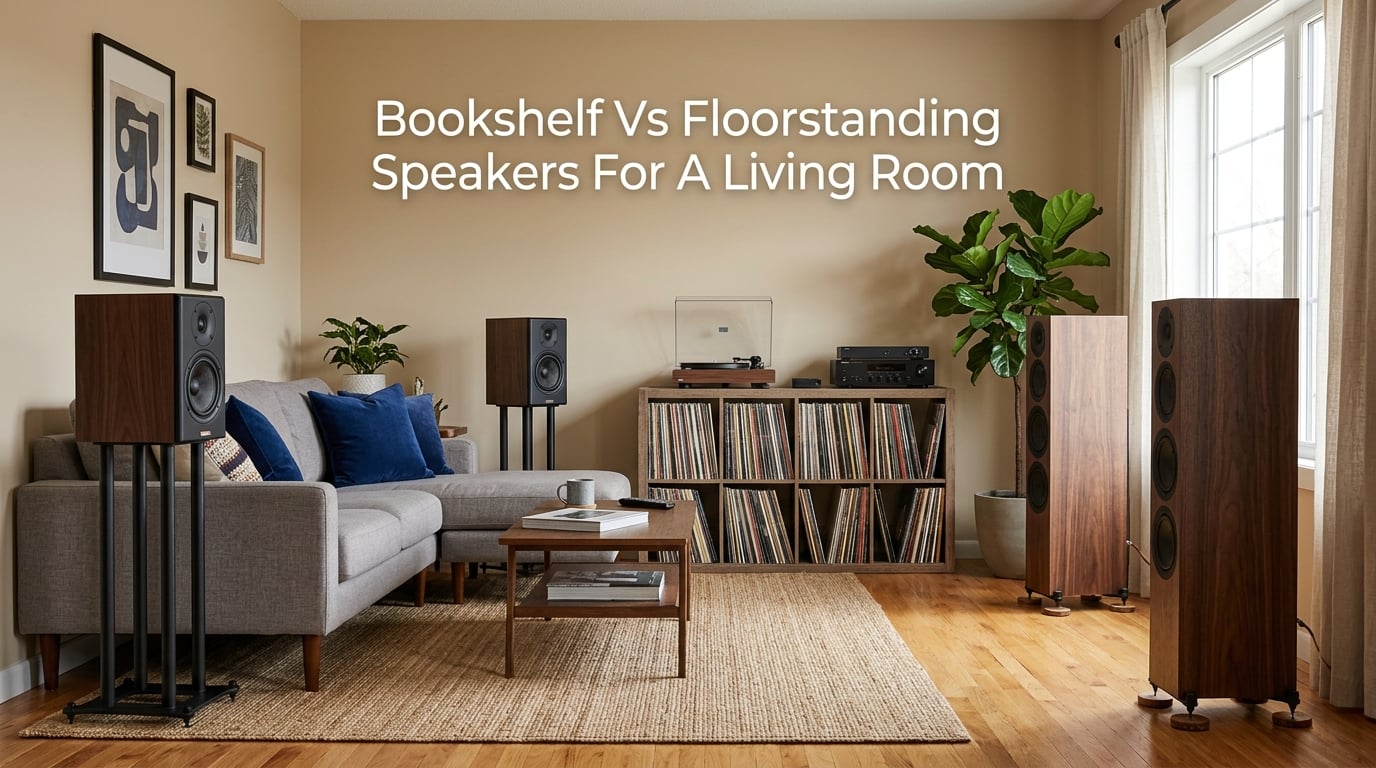
For bookshelf vs floorstanding speakers living room decisions, choose bookshelf speakers when space, flexible placement, or a future subwoofer matter most; choose floorstanding speakers when the room can accommodate them and you want fuller bass from a two-speaker system. Neither category is automatically better, because the cabinet, drivers, amplifier, placement, and room all affect what you hear.
A pair of tower speakers can give a large living room a convincing, effortless presentation without adding a subwoofer. A good pair of bookshelf speakers on proper stands can be just as satisfying in a compact room, and a bookshelf-plus-subwoofer setup can cover a wider frequency range than many people expect.
This guide separates the real trade-offs from the usual shorthand. It explains speaker drivers, bass response, soundstage, power handling, placement guidelines, room size, and the practical details that matter when speakers share space with a sofa, television, windows, and neighbors.
Bookshelf vs floorstanding speakers for a living room: the short answer is room fit first
Start with the room, not the size of the speaker. A speaker that is too large for its position can make bass thick and uneven, while a smaller speaker placed at the right height and distance from boundaries can sound focused and spacious.
Floor standing speakers, also called tower speakers, have taller cabinets and usually more internal volume. That volume supports larger woofers or additional drivers, which can help them move more air and reproduce lower frequencies with less assistance.
Bookshelf speakers are compact loudspeakers intended for a shelf, cabinet, desk, or, preferably, dedicated stands. The name does not mean a bookcase is always the best location: a shelf can create reflections and restrict the rear port on many models.
- Measure usable space. Include room behind and beside each speaker, not only the footprint.
- Decide how you listen. Music at moderate levels, movie impact, and late-night apartment use lead to different priorities.
- Plan the whole system. Decide whether a subwoofer is welcome, and check that the amplifier can comfortably drive the chosen speakers.
The useful shortcut is simple. Bookshelf speakers favor flexibility and often give strong sound quality per cabinet size; floorstanding speakers favor output, dynamic range, and deeper bass when the room and placement permit it.
Floorstanding speakers are tall multi-driver systems built for fuller-range sound
Floorstanding speakers rest directly on the floor, often on feet or spikes, and their cabinets stand roughly near seated-ear height or taller. A tower may be a two-way design with a tweeter and one or more woofers, or a three-way design that gives the midrange its own driver.
Driver count alone does not decide quality. Cabinet tuning, crossover design, the driver materials, and how the speaker behaves in a room matter at least as much, but the larger enclosure gives a designer more capacity for bass extension and output.
A typical floorstander can spread the workload among multiple drivers. For example, one or more woofers can handle bass, a dedicated midrange can cover voices and instruments, and a tweeter can reproduce high frequencies; that arrangement can reduce strain at higher listening levels.
The audible result can be a sense of scale. When a recording has a kick drum, bass guitar, orchestra, or movie effects, a capable tower can maintain dynamics without asking a small woofer to do every job at once.
Floorstanding speakers work best when they have breathing room
Towers are not merely large bookshelf speakers with no stands. Their extra bass output interacts more strongly with the room, especially near corners and rear walls, so their placement can decide whether they sound controlled or boomy.
Forum discussions repeatedly flag this issue: in a small room, a tower can excite room modes and make certain notes linger or sound woolly. That is not a defect in the speaker; it is the speaker-and-room combination telling you that placement or bass management needs attention.
A practical starting point is 12 to 18 inches of space between the back of a floorstanding speaker and the wall behind it when the layout allows. Move the speaker a few inches at a time while playing familiar bass lines, since the best distance is room-specific.
Floorstanding speakers bring strengths and limits to a living room
- Strengths: More cabinet volume, potentially deeper bass, higher output, and a full stereo system without a separate subwoofer.
- Strengths: Their tweeters are often near ear height when seated, which can simplify vertical alignment.
- Limits: They occupy visible floor space and may be harder to place clear of furniture and walls.
- Limits: Their bass capability can be more difficult to tame in a compact or open-sided room.
I would favor towers when the listening position is several feet from the speakers, the room has open space around the front wall, and a clean two-channel system is the goal. They also make sense for a living room that doubles as a home theater where wide dynamic swings are part of the experience.
Bookshelf speakers are compact systems that need the right support and height
Bookshelf speakers are usually two-way designs: a woofer covers bass and midrange while a tweeter handles treble. Their smaller cabinets limit how much deep bass they can produce, but that limitation does not mean they cannot create precise imaging, clear voices, and a broad soundstage.
Many excellent stereo speakers use this format because a smaller cabinet is easier to place and can keep the listening area visually open. In a modest living room, the reduced bass output can also be an advantage because it is less likely to overload the room’s lowest frequencies.
The best bookshelf speaker position puts the tweeter close to seated ear height, with the speakers aimed toward or just past the listening position as a starting point. That is why stands matter: they create stable height, keep the cabinet from vibrating against furniture, and let the speaker sit away from a rear wall.
Bookshelf speakers give you placement flexibility, not a free pass on placement
Putting bookshelf speakers directly on the floor is generally a poor choice. The tweeter ends up far below ear height, bass reflections from the floor become stronger, and the soundstage can seem as if it is coming from ankle level rather than filling the room.
Use stands, a stable media console, or a solid shelf that raises the tweeter near ear height. If a shelf is the only choice, pull the speaker’s front edge near the front of the shelf and leave room around a rear port where its manual calls for it.
Do not assume bookshelf speakers need to be physically placed on a bookshelf. They perform best when the left and right speakers have similar surroundings, reasonable separation, and a clear path toward the listening seat.
Bookshelf speakers bring strengths and limits to a living room
- Strengths: Compact cabinets, easier decor integration, flexible placement, and often strong clarity for near to mid-distance listening.
- Strengths: A well-chosen subwoofer can take over deep bass, letting the main speakers focus on midrange and treble.
- Limits: Stands add floor footprint, so they are not always smaller in practical terms than a slim tower.
- Limits: Without a subwoofer, some models may not reproduce the deepest bass or sustain cinema-level dynamics in a large room.
For apartment speakers, this format is often attractive because it lets you keep the system controlled at lower volumes. Still, a compact speaker can bother neighbors if it is close to a shared wall or cabinet, so placement and listening level remain important.
Sound and bass differ because cabinet volume and drivers differ
Floorstanding speakers usually reach deeper bass because larger cabinets and additional woofers can move more air. Their frequency response may extend lower than a compact speaker’s, which gives drums, bass guitar, organ notes, and movie effects more weight without an external subwoofer.
Bookshelf speakers can sound remarkably complete through the midbass and midrange, yet their deepest notes often roll off sooner. A subwoofer fills that missing lower range, and when it is properly integrated it can make the system sound bigger without making the main speakers sound less refined.
Bookshelf speakers can be as good as floorstanding speakers in the areas that matter to you
Bookshelf speakers can equal or surpass floorstanding speakers in clarity, imaging, tonal balance, and enjoyment when the models are comparable and the room is suitable. They usually cannot match a capable tower’s deep bass and high-output headroom by themselves, but a well-matched subwoofer can close or remove that gap.
“Better” has to include the room. A tower that loads a small room with excess bass may sound less accurate than a bookshelf speaker that fits the space, while the same bookshelf pair may sound thin in a much larger area without subwoofer support.
Soundstage describes the apparent width, depth, and scale of the recorded performance. It comes from the recording, matched speakers, and placement; a large cabinet does not automatically create a larger soundstage, and a compact pair can disappear nicely when both speakers are placed symmetrically.
Imaging is related but more specific: it is how clearly instruments and voices occupy locations between the speakers. Matching the distance from each speaker to the main seat, keeping both tweeters at the same height, and limiting nearby reflections can improve imaging more than changing categories.
Dynamics and volume headroom favor towers in large rooms
Dynamic range is the distance between quiet and loud passages. More cone area and cabinet volume can let floorstanding speakers play louder with lower strain, which is useful for a large living room, energetic music, and home theater scenes with sudden effects.
That does not make loudness the objective. If you mainly listen at moderate volume, a quality bookshelf speaker may operate comfortably and deliver the detail you value; forcing a very large speaker into a small room just for headroom can trade one problem for another.
Room size and placement decide which speaker will work well
There is no universal room-size cutoff because ceiling height, openings, furniture, wall construction, and listening distance all change the result. The more useful question is whether the speaker can be positioned away from boundaries while leaving a sensible triangle with the main listening seat.
In a small living room, bookshelf speakers on stands are often the low-risk choice. They can sit with some clearance from the wall, their tweeters can be set to ear level, and adding a subwoofer later gives you a way to control bass placement independently.
In a medium or large room, a floorstanding speaker may have the space to do what its cabinet was built to do. It can make a more effortless stereo presentation, particularly when the seat is farther away and the room absorbs some energy through rugs, soft seating, and furnishings.
Floorstanding speakers need space from walls to keep bass balanced
Walls and corners reinforce bass. Put a tower too close to the back wall and the added reinforcement may make bass sound fuller at first, yet certain notes can become exaggerated and less distinct; put it in a corner and the effect can grow stronger.
Begin with each tower 12 to 18 inches from the wall behind it when possible, and keep the left and right speakers reasonably clear of side walls. If the living room dictates a closer position, try modest toe-in and reduce bass with the amplifier’s room-correction or crossover options if your equipment provides them.
Keep the speakers out of corners when you can. A corner placement is sometimes unavoidable, but it is a location to test carefully rather than a default because it can intensify room modes.
Bookshelf speakers need stands and equal treatment on both sides
With bookshelf speakers, start with the tweeters near seated ear height and place the stands so the two speakers and your main chair form an approximate triangle. The triangle does not have to be perfectly equilateral, but very narrow separation can shrink the stereo image and very wide separation can leave a hole in the middle.
Try six to ten feet between speakers in a typical living room, then adjust by ear and according to your furniture. Place the speakers slightly forward of a media cabinet’s front plane when possible, so the cabinet does not block or reflect as much of their output.
Stands should be rigid and level. A wobbly stand, a small speaker balanced on a deep soft surface, or one speaker on a shelf while the other is in open air creates unequal conditions that can pull voices off center.
Both speaker types improve with a repeatable placement process
- Set symmetry first. Make each speaker’s distance to the main seat similar, and avoid putting only one speaker in a corner or beside a large cabinet.
- Set height next. Aim for tweeters near ear height at the main listening position; tilt a speaker only when changing height is impossible.
- Adjust wall distance. Move both speakers together in small increments, then listen for changes in bass definition and vocal clarity.
- Try toe-in. Start by aiming speakers toward the seat, then rotate them outward slightly if the treble seems too direct or the image is too narrow.
- Move the seat if needed. Sitting against the rear wall can exaggerate bass, so even a small forward move can make the response smoother.
Living rooms are rarely empty rectangles, and that is fine. Rugs, curtains, books, and upholstered furniture tend to reduce some reflections, but they do not replace careful placement; start with geometry, then use furnishings as part of the room rather than treating them as an obstacle.
A subwoofer makes bookshelf speakers a full-range alternative to towers
A bookshelf-plus-subwoofer system separates the work. The bookshelf speakers reproduce the midrange and treble, while the subwoofer handles the lowest frequencies, allowing the bass source to sit where the room responds most evenly rather than where the main speakers must stand for stereo imaging.
This is why community discussions often recommend a subwoofer with bookshelf speakers. It is not an admission that the main speakers are inadequate; it is a way to use the right-sized driver and cabinet for each frequency range.
A receiver or amplifier with bass management can send frequencies below a selected crossover point to the subwoofer. The exact crossover depends on the speakers and room, so follow the equipment guidance as a starting point and adjust with familiar material rather than assuming one setting fits every system.
A subwoofer is useful when deep bass matters, not mandatory for every listener
For music at modest volumes in a small room, bookshelf speakers alone may be entirely satisfying. For movies, electronic music, orchestral recordings, or a larger open-plan living area, a subwoofer often adds the low-frequency foundation that compact cabinets cannot provide.
Subwoofer placement is a separate decision from main-speaker placement. If a sub makes every room surface buzz or creates a heavy one-note effect, lowering its level, changing its location, or selecting a different crossover point is usually more effective than turning up the main speakers.
For apartment living, deep bass passes through structures more readily than many mid and high frequencies. Use moderate subwoofer levels, avoid placing it directly against a shared wall where possible, and consider the time of day as part of a neighbor-friendly setup.
Amplifier matching matters more than whether a speaker sits on a stand or floor
Do not choose speakers by wattage numbers alone. Sensitivity, impedance, listening distance, and how loudly you listen all affect the amplifier demand; a sensitivity rating indicates how loud a speaker can play from a given input, while impedance describes the electrical load the amplifier sees.
Higher sensitivity can let a speaker reach a given volume with less amplifier power, but it is not a complete quality score. A speaker’s impedance can dip at certain frequencies, and a stable amplifier paired with speakers it is designed to drive is more important than chasing a single specification.
Floorstanding speakers sometimes appear easier to drive because they can be more efficient, yet this varies by model. Bookshelf speakers can also be demanding if their sensitivity is low or their impedance behavior asks more of the amplifier, so check the manufacturer’s stated amplifier recommendation before connecting them.
Power handling is a limit, not a promise of sound quality
Power handling describes the amount of amplifier power a speaker can tolerate under stated conditions. It does not say how loud the speaker will be in your room, how deeply it plays, or whether an amplifier will remain clean when a demanding movie passage arrives.
Use an amplifier or AV receiver that is comfortable with the speakers’ impedance and listen for distress rather than pushing through it. Harshness, compression, or obvious distortion are reasons to lower the level and reassess the system, not signs that a speaker needs to be “broken in” at excessive volume.
A room-correction feature can help with broad response issues, particularly bass, but it works best after sensible physical placement. Electronic correction cannot fully undo a speaker trapped in a corner or a listening seat fixed at a severe bass peak.
Music, movies, decor and future plans point to different speaker choices
For stereo music, both speaker types can work beautifully. Choose floorstanding speakers when you want a simple two-speaker system with stronger bass foundation and higher dynamic range; choose bookshelf speakers when precision, compact scale, and stand placement work better in the room.
For home theater speakers, towers make compelling left and right channels because they can handle wide swings in movie soundtracks. Bookshelf speakers also work well in a surround sound system, especially when a subwoofer already handles low-frequency effects and matching compact surrounds fit the room better.
Living-room decor should shape the decision without overruling sound
Towers make a visible statement because their cabinets are tall and always occupy floor space. They can frame a television or fireplace nicely in a wider room, but they can also make a narrow wall look crowded if there is no clearance around them.
Bookshelf speakers can disappear more easily into a room’s visual plan, although stands are still furniture. Choose stand finishes and cabinet colors that relate to the existing console or flooring, and avoid hiding a speaker behind plants, curtains, or decorative objects that block a driver.
Think about everyday movement. A speaker beside a doorway, a child’s play route, or a pet’s favorite path needs a stable position and cable management; a speaker that looks perfect but gets bumped often will not stay properly aligned.
Budget is about the complete system, not the cabinet category
Compare complete paths rather than assuming one type is always the economical choice. Bookshelf speakers may require stands and, depending on your bass goals, a subwoofer; floorstanding speakers may remove the need for those items but ask for more open placement.
Put a sensible share of your plan toward the amplifier, placement, and source equipment. Spending all attention on cabinet size while ignoring a weak amplifier, unstable stands, or an awkward room position rarely produces the result a specification sheet suggests.
If you expect to add surround speakers later, consider how the front pair will match the rest of the system in tonal character and physical scale. A staged system can be practical when the room and listening habits are still evolving.
Speakers settle with normal use, but placement deserves attention first
Some listeners report that speakers sound different after a normal-use period of roughly 20 to 30 hours. Treat that time as a chance to become familiar with the system, not as a reason to dismiss an obvious placement problem or force high volume.
Our ears also adjust to a new tonal balance, so compare changes methodically. Keep the same track and listening level, change one variable at a time, and write down whether a move improved bass definition, center imaging, or treble comfort.
Choose between bookshelf and floorstanding speakers with three checks
First, draw the room and mark where speakers can actually stand. If floorstanding speakers would have to sit in corners or directly against the wall, compact speakers on stands and a carefully positioned subwoofer may be the more convincing option.
Second, identify your lowest-frequency needs. If you want a straightforward two-channel music system with substantial bass, towers deserve a close listen; if you welcome a subwoofer or mostly listen at moderate levels, bookshelf speakers can give you more control over the room.
Third, audition whenever possible. Bring music you know, listen at ordinary and slightly louder levels, and ask for a setup that resembles your listening distance; hands-on listening tells you more than a driver-count comparison.
Frequently asked questions answer the main bookshelf and floorstanding speaker concerns
Are bookshelf speakers as good as floorstanding speakers?
Bookshelf speakers can equal or beat floorstanding speakers in clarity, imaging and tonal balance when they suit the room. Floorstanding speakers usually offer deeper bass and more high-volume headroom without a subwoofer, while a bookshelf-and-subwoofer system can provide comparable full-range performance.
Are bookshelf speakers good for a living room?
Yes. Bookshelf speakers are a strong living-room choice when placed on stable stands with tweeters near ear height. They are especially practical in compact rooms, apartments and layouts where tower speakers would sit too close to walls; add a subwoofer if you want more deep bass.
Is it okay to put bookshelf speakers on the floor?
It is possible, but it is usually not a good setup. Floor placement puts the tweeters below ear height, increases floor reflections and weakens the stereo image. Use stands, a sturdy console or a shelf that brings the tweeters close to seated-ear height instead.
Are floorstanding speakers worth it?
Floorstanding speakers are worth it when your living room has space around them and you want deeper bass, stronger dynamics and a simple two-speaker system. They are less compelling when they must sit in corners or against walls, where a bookshelf-and-subwoofer setup may give more controlled bass.
The right living-room speaker is the one your room supports
The bookshelf vs floorstanding speakers living room choice comes down to the balance between room fit, bass needs, listening level, and system plan. Bookshelf speakers offer compact flexibility and become full-range partners with a well-integrated subwoofer, while towers offer a direct path to larger-scale sound and deeper bass.
Measure the available positions, place the speakers carefully, and listen with recordings you know before treating category as destiny. In 2026, the sensible choice is still the pair that works in your actual room rather than the pair that merely looks more substantial on paper.