
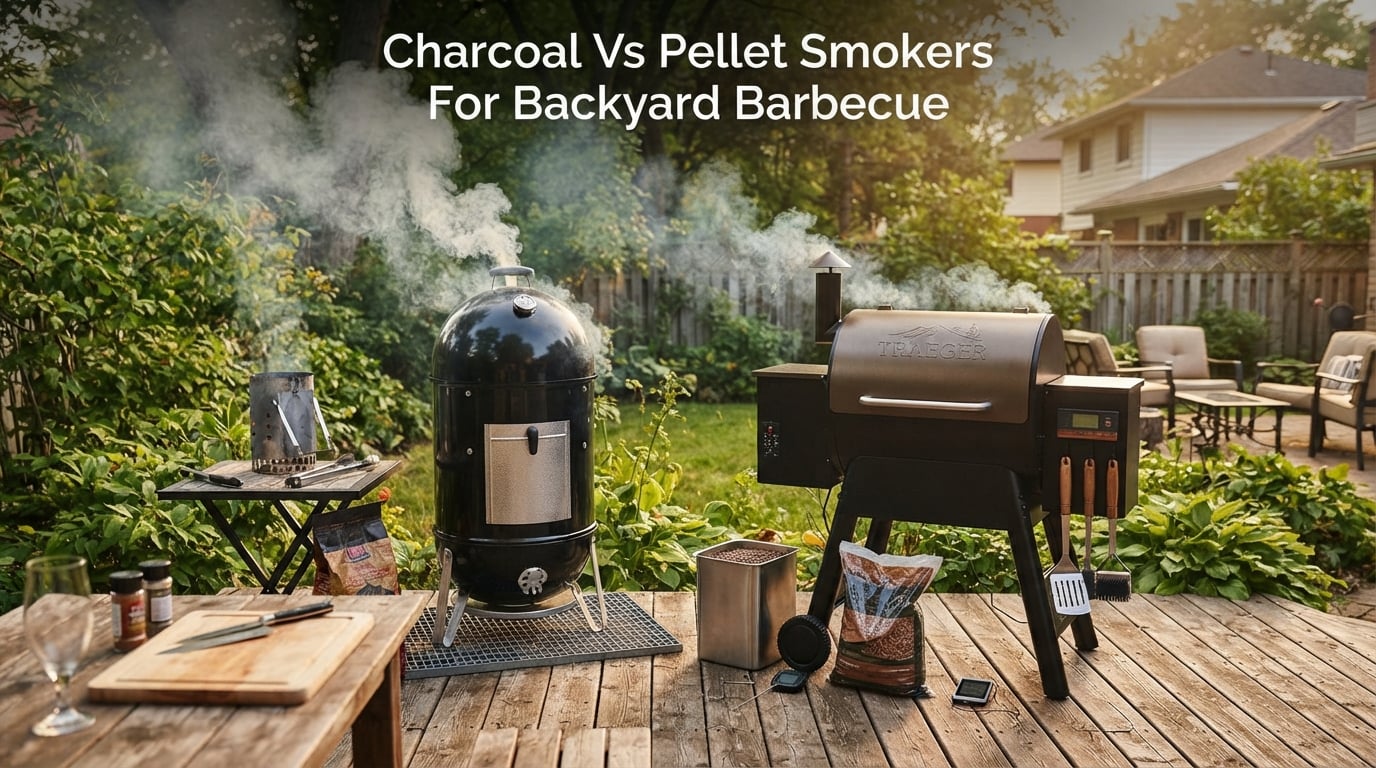
Standing in your backyard with a slab of ribs ready to go, you face the question every barbecue enthusiast eventually asks: charcoal or pellet? I have spent years cooking on both types of smokers, and the answer is rarely simple. Each fuel type brings its own personality to your backyard barbecue.
The debate around charcoal vs pellet smokers for backyard barbecue comes down to what you value most. Some pitmasters want bold, traditional smoke flavor and hands-on fire management. Others want to set a temperature, walk away, and come back to perfectly cooked brisket eight hours later.
In this guide, our team breaks down everything you need to know about charcoal vs pellet smokers for backyard barbecue. We cover flavor differences, temperature control, upfront and ongoing costs, maintenance, health considerations, and which type fits your cooking style. By the end, you will have a clear picture of which smoker belongs on your patio.
Whether you are a first-time buyer or upgrading from a basic grill, this comparison will help you make an informed choice. Let us dig into the details.
What Is a Charcoal Smoker?
A charcoal smoker uses burning charcoal as its primary heat source. You load lump charcoal or charcoal briquettes into a firebox or fire basket, light them, and manage the temperature by adjusting airflow through vents. The burning charcoal produces both heat and smoke, cooking your food through indirect heat at low temperatures.
Charcoal smokers come in several configurations. Offset smokers have a separate firebox attached to the side of the main cooking chamber. Bullet or water smokers use a vertical design with a charcoal bowl at the bottom and a water pan between the heat source and the food. Kamado-style smokers use thick ceramic walls for excellent heat retention.
The defining characteristic of charcoal smoking is the hands-on experience. You manage the fire yourself, adjusting intake vents to raise or lower the temperature. This gives you total control over the cooking environment, but it also demands attention. A typical low-and-slow cook might require vent adjustments every 30 to 60 minutes.
Most charcoal smokers can reach temperatures between 200 and 700 degrees Fahrenheit. That wide range means you can smoke a brisket at 225 degrees in the morning and sear steaks at 650 degrees that evening, all on the same equipment.
What Is a Pellet Smoker?
A pellet smoker uses compressed wood pellets as its fuel source. These pellets, made from food-grade hardwood sawdust, are loaded into a hopper on the side of the grill. An auger system automatically feeds pellets from the hopper into a burn pot, where an igniter rod starts them burning.
A digital control panel lets you set your desired cooking temperature. Internal sensors monitor the heat and adjust the auger feed rate to maintain that temperature. A convection fan circulates the heat and smoke throughout the cooking chamber, creating even temperatures across the grate.
This is what people mean when they call pellet smokers “set it and forget it.” You set the temperature on the control panel, and the grill handles the rest. Many modern pellet smokers connect to Wi-Fi or Bluetooth, letting you monitor and adjust temperatures from your phone.
Pellet smokers typically operate between 180 and 500 degrees Fahrenheit. Some high-end models reach 700 degrees with direct-flame access, but most pellet grills excel at low-and-slow cooking rather than high-heat searing. The hopper capacity varies, with most home models holding 15 to 20 pounds of pellets, enough for 8 to 20 hours of cooking.
Charcoal Vs Pellet Smokers For Backyard Barbecue: The Flavor Showdown
Flavor is where the charcoal vs pellet smokers for backyard barbecue debate gets heated. After cooking hundreds of meals on both types, I can tell you the differences are real and noticeable.
Charcoal smokers produce a bolder, more intense smoke flavor. The burning charcoal creates compounds that penetrate the meat, giving you that classic barbecue taste. When you add wood chunks or chips to the charcoal, you layer additional flavor profiles like hickory, mesquite, apple, or cherry on top of the charcoal base. Most experienced pitmasters on Reddit and smoking forums agree that charcoal delivers a deeper, more authentic smoke ring and flavor penetration.
Pellet smokers deliver a cleaner, milder smoke flavor. The wood pellets burn efficiently and produce less of the heavy smoke compounds that charcoal generates. The result is a refined, subtle smokiness that many people prefer for everyday cooking. One forum user put it well: pellet grills give you a gentle smoke flavor that does not overpower the natural taste of the meat.
If you want to boost smoke flavor on a pellet grill, you have options. Smoke tubes filled with wood pellets can add extra smoke during the early stages of cooking. Choosing stronger wood pellet varieties like hickory or mesquite also helps intensify the smoke profile.
For competition-style barbecue where bold smoke flavor is the goal, charcoal has the edge. For weeknight dinners where you want a hint of smoke without overwhelming the dish, pellet smokers shine.
Temperature Control and Ease of Use
Temperature control separates these two smoker types more than any other factor. Understanding how each manages heat will shape your cooking experience.
Pellet smoker temperature control: Set the dial to your target temperature and walk away. The digital controller, auger system, and convection fan work together to hold that temperature within a few degrees. Most pellet grills maintain plus or minus 15 degrees Fahrenheit. You can sleep through an overnight brisket cook without touching a single vent.
Charcoal smoker temperature control: Managing a charcoal fire is a skill that takes practice. You adjust the intake vents to control airflow, which regulates how fast the charcoal burns. Opening vents raises the temperature; closing them lowers it. Weather, wind, and fuel load all affect how the fire behaves. After a few cooks, most people develop a feel for it, but the learning curve is steeper than pellet grilling.
For beginners, pellet smokers are dramatically easier. You do not need to learn fire management, vent adjustments, or fuel layering. Set the temperature, add food, and check back when the timer goes off. This convenience is the main reason pellet grills have exploded in popularity over the past decade.
For experienced cooks who enjoy the craft of barbecue, charcoal fire management is part of the appeal. Tending the fire, reading the smoke, and making adjustments creates a connection to the cooking process that pellet smokers cannot match.
Cost Comparison: Upfront and Ongoing
Cost breaks down into two categories: what you pay for the smoker itself and what you pay for fuel over time. Both categories favor charcoal, though the gap varies.
Upfront cost: Entry-level charcoal smokers start around 150 to 300 dollars. A quality kamado like a Big Green Egg runs 1,000 dollars or more, but most backyard charcoal smokers sit in the 300 to 600 dollar range. Pellet smokers typically start at 400 to 500 dollars for basic models, with mid-range units costing 700 to 1,200 dollars and premium models exceeding 2,000 dollars.
Fuel cost: A 20-pound bag of charcoal briquettes costs roughly 15 to 20 dollars. Lump charcoal runs 20 to 30 dollars for a similar amount. A 20-pound bag of wood pellets costs 15 to 25 dollars depending on brand and wood type. Pellets are generally more fuel-efficient because the auger feeds them precisely, but per-bag costs are similar.
During a typical 12-hour brisket cook, you might burn through 10 to 15 pounds of charcoal or 6 to 8 pounds of pellets. The pellet smoker uses less fuel per hour, which partially offsets the higher upfront cost if you cook frequently.
Long-term ownership costs: Pellet smokers have more components that can fail. Auger motors, hot rod igniters, convection fans, and digital control boards all have finite lifespans. Replacing these parts costs 50 to 200 dollars each. Charcoal smokers have very few mechanical parts, which means lower long-term maintenance costs.
Maintenance and Durability
Both smoker types require regular maintenance, but the nature of that maintenance differs significantly.
Charcoal smoker maintenance: After each cook, you empty the ash from the firebox and clean the cooking grates. Every few cooks, you should do a deeper clean of the firebox and check for rust. Charcoal smokers produce significant ash, so ash management is an ongoing task. However, the mechanical simplicity means there is very little that can break.
Pellet smoker maintenance: Pellet smokers produce less ash per cook since pellets burn efficiently. However, you still need to vacuum the burn pot and firebox every 3 to 5 cooks to prevent ash buildup. The auger tube should be cleaned periodically to prevent pellet jams. Grease management requires attention, as the grease tray and drip bucket need regular cleaning.
During the off-season, pellet smokers need additional care. You should empty the hopper to prevent pellets from absorbing moisture, which causes them to swell and jam the auger. Vacuuming out all pellets before storing the grill for winter is a step many new pellet owners learn the hard way.
In terms of durability, charcoal smokers win. A well-maintained charcoal smoker can last decades because there are no electronic components to fail. The only commonly replaced part is the cooking grate. Pellet smokers rely on electronics and moving parts that will eventually need replacement, though quality brands like Traeger, Rec Tec, and Camp Chef build durable components that last many years with proper care.
One Reddit user summarized the durability difference well: the grill in a charcoal smoker is the only replaceable part, while a pellet smoker has many different parts that may need attention over the years.
Searing Capabilities
If you love a hard sear on your steaks, this section matters. The two smoker types handle high-heat cooking very differently.
Charcoal smoker searing: Charcoal burns hot and can easily reach 700 degrees or more. In a kamado grill, you can sear steaks directly over the coals at temperatures that create a beautiful crust in under two minutes per side. Offset smokers can also sear when you build a hot fire in the firebox and place the meat close to the heat source.
Pellet smoker searing: Most pellet smokers top out around 500 degrees, which is adequate for grilling but not ideal for true searing. Some newer models include direct-flame technology that slides a plate aside, exposing the food to the flame from the burn pot. These models can reach 650 to 700 degrees, but the searing performance still does not match a charcoal fire.
For cooks who want one device that can smoke a pork shoulder at 225 degrees and sear ribeyes at 700 degrees, charcoal smokers are the clear winner. Pellet smokers excel at smoking and low-temperature cooking, but high-heat searing is not their strength.
Health Considerations of Grilling Methods
No competitor thoroughly addresses health aspects, so let us cover this often-overlooked topic.
Both charcoal and pellet cooking produce polycyclic aromatic hydrocarbons (PAHs) and heterocyclic amines (HCAs) when fat drips onto the heat source and creates smoke. However, pellet smokers generally produce fewer of these compounds because they burn fuel more efficiently and maintain more consistent temperatures.
Charcoal grilling, especially when fat drips directly onto hot coals, can produce more smoke containing PAHs. Using a drip pan and cooking at lower temperatures reduces this exposure. Lump charcoal tends to burn cleaner than briquettes, which often contain binders and additives.
Neither method poses a significant health risk when used in moderation as part of a balanced diet. Using lean cuts of meat, trimming excess fat, and avoiding prolonged exposure to heavy smoke are practical steps for healthier grilling on either type of smoker.
Who Should Choose a Charcoal Smoker?
Charcoal smokers are the right choice for specific types of backyard cooks. Here is how to know if charcoal fits your style.
You prioritize bold, traditional smoke flavor above all else.
You enjoy the hands-on process of managing a fire and adjusting vents.
You want the ability to sear at high temperatures on the same equipment.
You prefer simpler equipment with fewer parts that can break.
You have a tighter upfront budget for your smoker purchase.
If you grew up watching a parent or grandparent tend a charcoal grill and want to continue that tradition, a charcoal smoker keeps that connection alive. The ritual of building a fire, managing the heat, and smelling the smoke is part of the experience.
Who Should Choose a Pellet Smoker?
Pellet smokers suit a different set of priorities. Consider this route if the following describes you.
You value convenience and want to set a temperature and walk away.
You are new to smoking and want a gentle learning curve.
You cook on weeknights when time and attention are limited.
You want consistent, repeatable results without fire management.
You appreciate Wi-Fi connectivity and remote monitoring features.
Many pellet grill owners describe the experience as having a kitchen oven that happens to cook with real wood smoke. That analogy captures the convenience and consistency pellet smokers provide. You get genuine wood-fired flavor without the labor of charcoal fire management.
Forum users with both types often say they reach for the pellet smoker for weekday cooks and save the charcoal smoker for weekends when they have time to enjoy the process.
Common Myths About Charcoal and Pellet Smokers
Several misconceptions float around both types of smokers. Let us clear up the most common ones.
Myth 1: Pellet smokers do not produce real smoke flavor. This is false. Pellet smokers burn real hardwood pellets and produce genuine wood smoke. The flavor is milder than charcoal, but it is authentic smoke flavor, not artificial. Using a smoke tube or selecting stronger wood varieties increases the intensity.
Myth 2: Charcoal is always cheaper than pellets. Upfront, yes. But pellets are more fuel-efficient per hour of cooking. Over hundreds of cooks, the fuel cost gap narrows. The real cost difference is in equipment price and potential replacement parts.
Myth 3: Pellet smokers are too complicated for beginners. Actually, pellet smokers are the easiest type of smoker for beginners. The digital controls handle temperature management automatically. Charcoal smokers require more skill to operate successfully.
Myth 4: You cannot get a smoke ring with a pellet smoker. You absolutely can. The smoke ring depends on nitrogen dioxide from the combustion process interacting with the meat. Pellet smokers produce this gas, and a visible smoke ring forms readily with proper technique.
Myth 5: Charcoal smokers cannot hold steady temperatures. With practice and quality equipment, a charcoal smoker can hold temperatures within 10 to 15 degrees for hours. The key is learning how your specific smoker responds to vent adjustments.
Charcoal Vs Pellet Smokers For Backyard Barbecue: Quick Decision Guide
Still unsure which direction to go? Use this quick reference to match your priorities to the right smoker type.
Choose charcoal if: flavor is your top priority, you enjoy the cooking process as much as the food, you want searing capability, you have a limited budget, or you want equipment that lasts decades with minimal repairs.
Choose pellet if: convenience matters most, you are a beginner, you cook frequently on busy weeknights, you want Wi-Fi monitoring, or you prefer a milder smoke flavor that complements rather than dominates your food.
Choose both if: you are a serious barbecue enthusiast with space and budget. Many experienced pitmasters own one of each, using the pellet grill for everyday cooks and the charcoal smoker for special occasions.
FAQs
Which is better, a pellet smoker or a charcoal smoker?
There is no universal winner. Charcoal smokers deliver bolder smoke flavor, higher searing temperatures, and simpler construction. Pellet smokers offer set-and-for-it convenience, precise temperature control, and easier cleanup. Choose charcoal for flavor and tradition; choose pellet for convenience and consistency.
What are the drawbacks of using a pellet smoker?
Pellet smokers cost more upfront, have electronic components that can fail, produce milder smoke flavor than charcoal, typically cannot sear at high temperatures, and require electricity to operate. The auger system can also jam if pellets absorb moisture.
Do pellet smokers taste as good as wood smokers?
Pellet smokers produce real wood smoke flavor, but it is milder and cleaner than what charcoal smokers deliver. Many people find pellet smoke flavor pleasant and sufficient for everyday cooking. For competition-level bold smoke flavor, charcoal smokers have the advantage.
What is the healthiest grilling method?
Both charcoal and pellet grilling produce some potentially harmful compounds when fat drips onto the heat source. Pellet smokers generally produce fewer of these compounds due to more efficient combustion. Using lean meats, trimming fat, and cooking at moderate temperatures reduces exposure on either type.
Which is better, charcoal or pellets?
Charcoal wins on flavor intensity, searing power, upfront cost, and durability. Pellets win on convenience, temperature consistency, ease of use, and fuel efficiency. Your choice depends on which factors matter most for your backyard barbecue style.
Do pellets last longer than charcoal?
Pellets are more fuel-efficient per hour of cooking. A typical 12-hour brisket cook might use 6 to 8 pounds of pellets compared to 10 to 15 pounds of charcoal. However, per-bag costs are similar, so the long-term fuel savings depend on how frequently you cook.
Are charcoal smokers harder to use than pellet smokers?
Yes, charcoal smokers require learning fire management, vent adjustment, and fuel layering. Pellet smokers use digital controls that handle temperature automatically. Beginners typically find pellet smokers much easier to operate successfully from day one.
Final Thoughts on Charcoal Vs Pellet Smokers For Backyard Barbecue
There is no wrong choice between charcoal vs pellet smokers for backyard barbecue, only the choice that fits your cooking style, schedule, and flavor preferences. Charcoal smokers reward effort with unmatched smoke flavor and the satisfaction of mastering fire. Pellet smokers reward convenience with consistent results and the freedom to enjoy your party while the food cooks itself.
Whatever you choose, the most important step is simply getting started. Great barbecue comes from practice, experimentation, and a genuine love of feeding people. Pick the smoker that excites you, grab some quality meat, and start cooking. Your backyard barbecue journey begins with that first fire.