
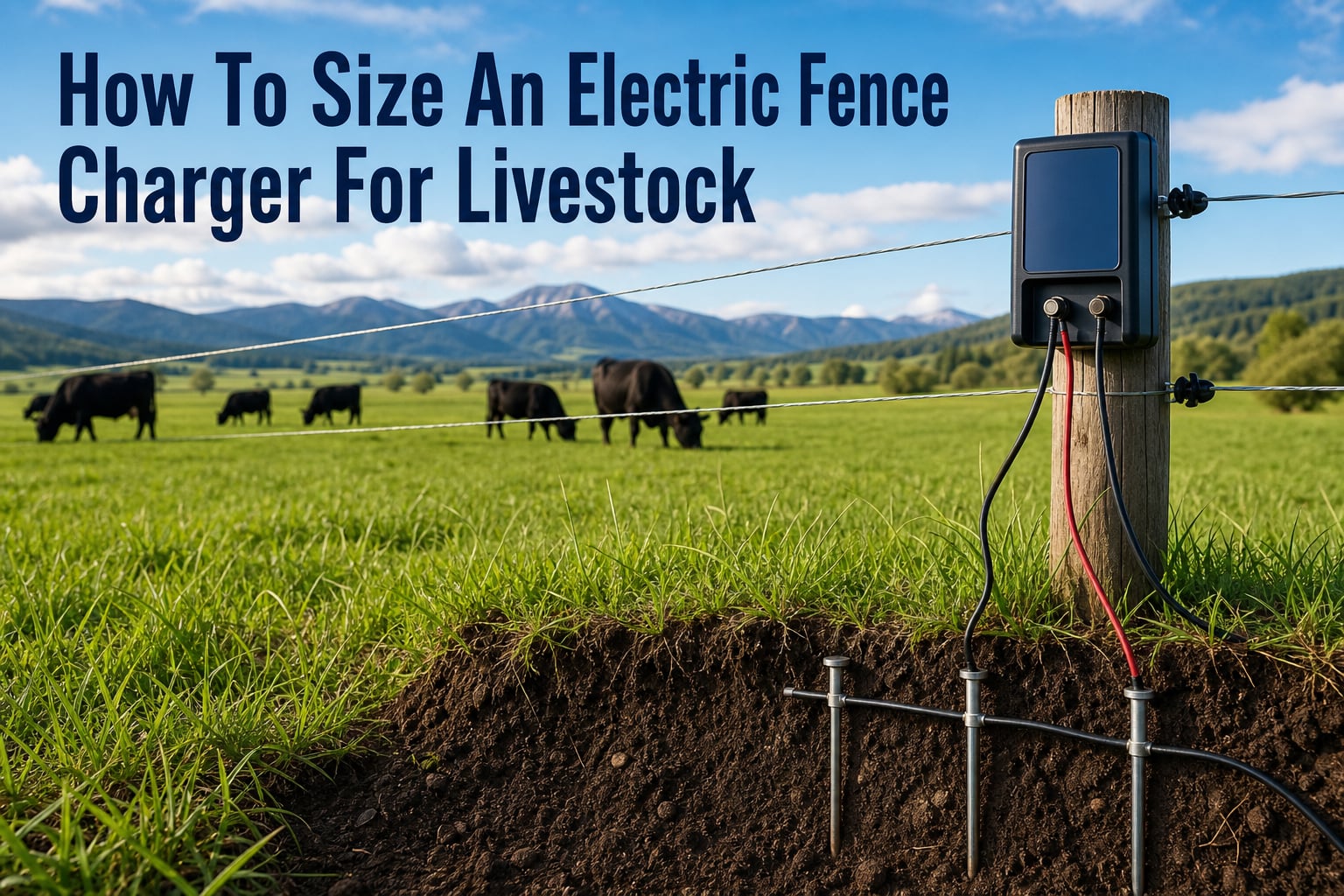
Sizing an electric fence charger for livestock starts with the total fence load, the animal you need to contain, the vegetation touching the wire, and the available power source. A charger that looks adequate on a distance rating alone can still produce a weak fence if it is asked to power too many conductors, fight a heavy weed load, or work through poor grounding.
This guide explains how to size an electric fence charger without guessing from a single “miles of fence” number. I would treat the energizer, fence conductors, vegetation, and ground system as one circuit, because livestock only receives a meaningful pulse when that entire circuit works.
The short version is simple: calculate conductor miles, choose the voltage needed at the fence for the animal and conditions, select an energizer by output joules, then build grounding to match it. Leave capacity for seasonal vegetation and the next paddock, rather than sizing only for a clean fence on installation day.
You can size an electric fence charger in seven practical steps
Use these steps as a field-ready fence charger joules calculator. They put the physical load first and the label claim second, which is the safer order for permanent fence energizer and rotational grazing fence setup decisions.
- Map every energized conductor. Multiply the route length by the number of hot wires, and include powered cross-fences, lead-out cable, and future runs.
- Set the fence-end voltage target. Cattle and horses are commonly guided by a 2–4 kV target at the fence, and a fence needs at least 3,000 volts for an effective shock.
- Classify the load as clean, moderate, or heavy. Grass and brush touching the line continuously drain pulse energy; wet growth is a more demanding weed load electric fence condition than a clean, dry line.
- Choose the wire system. High-tensile steel wire, polywire, polyrope, and polytape do not present the same resistance or maintenance demands.
- Pick the power source for the location. AC suits locations with mains power, while DC battery and solar fence charger sizing require attention to battery condition and solar collection.
- Compare output joules, not stored joules alone. Output joules describe the energy available to the fence more directly than the larger stored-energy figure.
- Build the ground system and leave headroom. Plan a minimum of 3 feet of ground rod per output joule, install rods at least 10 feet apart, and do not spend all capacity on the first layout.
Quick answer: Size for the longest likely fence configuration with the heaviest realistic vegetation load, not for the shortest clean-wire configuration. The extra capacity is useful only when the ground system and connections are built to carry it back to the energizer.
Output joules, voltage, and impedance answer different sizing questions
An electric fence energizer sends short, high-voltage electrical pulses through the hot wire. When an animal touches the hot wire and has a path through the ground, the circuit returns through the grounding system to the energizer and produces the memorable shock that forms a psychological barrier.
Voltage is the force that helps a pulse cross hair, hide, or skin. Joules measure energy in the pulse, so they indicate how much reserve the system has to keep delivering a useful shock when wire resistance, distance, and vegetation add load.
Output joules are the number to compare when choosing capacity
Stored joules and output joules are not interchangeable. Stored joules describe energy held inside the unit before release, while output joules describe energy delivered from the energizer toward the fence.
For electric fence energizer sizing, compare output joules whenever the manufacturer supplies both figures. A stored-joule figure can look impressive, but it does not by itself tell you how much energy reaches a loaded fence line.
Low impedance helps a charger keep working under vegetation load
Impedance is resistance to the electrical pulse moving through the system. A low-impedance fence charger is designed to keep sending energy when vegetation contacts the wire, instead of losing effectiveness as soon as the line is no longer perfectly clean.
Low impedance is not permission to ignore mowing or trimming. Every stem touching a hot wire creates a route for energy to leak away, so a clean fence will always make better use of the energizer you already have.
Definition: Voltage helps the pulse reach through an animal’s coat; output joules provide the energy reserve that lets the fence maintain that voltage when real-world load is present. Grounding completes the circuit, so neither number can compensate for an inadequate ground system.
You calculate fence load by counting energized conductor miles
Start with the physical route length, then multiply it by the number of energized wires. A one-mile perimeter with four hot wires has four conductor miles of energized wire, even though the property boundary itself is only one mile long.
Repeat that calculation for powered interior divisions, alleyways, and lead-out sections. For rotational grazing, count the configuration that can be energized at one time, not merely the permanent perimeter.
A written fence map prevents the most common distance mistake
Draw each run and mark hot, ground, and non-electrified wires. Include gateways and underground lead-out cable in the plan, then identify which branches will operate together; that turns a vague “five-mile fence” description into a usable electrical-load estimate.
Manufacturer distance ratings are a starting point, not a promise that every installation will perform identically. The rating may assume a certain wire type, clean conditions, and a properly installed ground system, while your property may have wet weeds, more conductors, or dry soil.
Headroom is the practical answer to future fence expansion
Choose capacity for the fence you expect to operate, plus a reasonable allowance for additional paddocks or a longer perimeter. Expanding a fence without reconsidering the energizer and grounding is a common route to a weak shock.
A bigger charger does not excuse unsafe installation, bad joints, or poor grounding. It does mean that a clean line can retain useful output when summer growth, longer wire runs, or extra energized strands increase the load.
Cattle and horses need a fence that holds roughly 2–4 kV at the wire
The supplied guidance for cattle and horses is 2–4 kV at the fence, and 3,000 volts is the minimum stated threshold for an effective shock. Check voltage at the far end of the fence rather than relying only on a reading beside the energizer.
Animal behavior and coat condition matter alongside species. Sheep, goats, and predator-control work are commonly treated as more demanding fence uses because hair, wool, determination, and contact conditions can make a weak pulse easier to ignore; use the energizer manufacturer’s animal-specific output guidance for the final joule selection.
| Fence use | Voltage guidance supported by the research | Sizing implication |
|---|---|---|
| Cattle containment | Maintain at least 3,000 volts; 2–4 kV is the cited cattle target range. | Measure at distant points and add capacity for wire count and vegetation. |
| Horse fencing | 2–4 kV is the cited horse target range. | Match energizer output to conductor miles and keep visible fence material well maintained. |
| Sheep and goats | No numeric figure was supplied in the research set. | Confirm the manufacturer’s animal guidance and give extra attention to grounding, wool or hair, and weed contact. |
| Predator control | No numeric figure was supplied in the research set. | Treat it as a demanding use case and follow the selected system’s stated requirements. |
This distinction matters when people ask, “How many joules do I need for cattle?” There is no reliable one-number answer without conductor miles, wire type, weed pressure, grounding, and whether the cattle fence also serves as a perimeter or a temporary subdivision.
AC, DC, and solar chargers fit different fence locations
Choose the power source before finalizing the energizer because it affects where the unit can live, what maintenance it needs, and how dependable its output will be. The strongest paper specification is not helpful if the source cannot stay charged at the installation site.
| Power source | Works best when | Planning issue |
|---|---|---|
| AC | Mains power is available near a protected installation point. | Plan a safe connection and protection from weather and lightning-related surges. |
| DC battery | The fence is remote but battery servicing is practical. | Battery condition and routine charging are part of output reliability. |
| Solar | The fence is remote and the panel can collect adequate sun. | Seasonal solar output, shade, panel orientation, and battery reserve affect performance. |
Solar capacity must account for winter and shade
Solar electric fence charger sizing is more than selecting a solar-labeled unit. A panel that keeps a battery full in a clear, high-sun period can collect less energy in a lower-sun season or when grass, branches, dust, or an installation angle reduces exposure.
Check the intended panel location through the season, not only at midday on installation day. If shade or winter output is questionable, account for it before relying on solar at a remote pasture where a low battery may not be noticed quickly.
DC systems need battery maintenance to remain dependable
A DC fence charger depends on the deep-cycle battery as much as on the energizer electronics. Put battery checks into the routine fence inspection, since a declining battery can look like an unexplained weak-fence problem.
AC eliminates battery charging work at the energizer location, but it still needs appropriate installation, sound wiring, and surge planning. Select the source that your property can maintain consistently rather than assuming one source is always better.
Vegetation and conductor material determine how much energy the fence wastes
Weed load is one of the biggest reasons a fence that worked in spring loses authority later. Grass, vines, and brush touching a hot wire create leakage paths, and the total effect grows as contact points multiply along the line.
Walk the fence after rain as well as in dry weather. Moist vegetation can make the load more severe, so a single dry-day voltage check does not describe the toughest conditions your low-impedance charger will face.
Steel wire and poly conductors need different maintenance expectations
High-tensile steel wire is associated with permanent fence and is a different conductor choice from polywire, polyrope, and polytape. Poly materials are often selected for visibility or temporary and rotational grazing layouts, while the complete installation still needs good connections and careful handling.
Resistance is part of every wire decision. Do not assume that a distance rating based on one conductor will translate unchanged to another material, especially after adding multiple strands, joins, gateways, and vegetation contact.
| Conductor type | Typical planning role | What to check |
|---|---|---|
| High-tensile steel wire | Permanent fence runs | Connections, tension, insulation, and total energized strands. |
| Polywire | Temporary or movable runs | Continuity, joins, handling damage, and the manufacturer’s distance guidance. |
| Polyrope | Visible movable fencing | Connections, resistance over the run, and vegetation contact. |
| Polytape | Highly visible fencing | Continuity, wind movement into vegetation, and sound tape connections. |
Warning: Do not size a charger on clean-wire distance alone if the planned line runs through persistent vegetation. Either make vegetation control part of the operating plan or select capacity that reflects that real load, then verify voltage with a fence tester at the distant end.
Ground rods must match output joules and soil conditions
Grounding is not an accessory to electric fence charger sizing; it is one half of the shock circuit. An animal touching a hot wire needs a route through the earth and ground system back to the energizer, so a strong energizer with poor grounding can still make a disappointing fence.
The supplied guideline is a minimum of 3 feet of grounding rod per output joule, with rods installed at least 10 feet apart. For example, a 15-output-joule energizer calls for a minimum of 45 feet of ground rod under that guideline, placed with the required spacing rather than treated as one short cluster.
Soil conductivity tells you how closely grounding needs attention
Ground resistance depends on soil conductivity. Dry, sandy, rocky, or frozen ground can make it harder for the system to return the pulse effectively than moist, conductive soil.
Place rods where conditions support a dependable earth connection and inspect the ground system as conditions change. If the fence weakens during a dry stretch, investigate both weed load and grounding before assuming the energizer has failed.
A grounding checklist makes installation easier to audit
- Base total rod length on output joules using the 3-feet-per-output-joule minimum.
- Space individual ground rods at least 10 feet apart.
- Use secure clamps and connections so the return path is continuous.
- Keep the ground system separate from unrelated electrical grounding as required by the energizer instructions and local electrical rules.
- Test voltage at distant fence points after installation and again when vegetation or soil conditions change.
Never treat an impressive voltage reading at the charger as proof that the far end of the fence is working. A tester reading at several distant points tells you whether the entire path—energizer, conductor, insulation, vegetation control, soil return, and rods—is doing its job.
Lightning protection reduces the chance that a surge ends the season
Long fence lines can collect lightning-related surge energy, so surge protection and a lightning diverter deserve a place in the design discussion. Follow the energizer manufacturer’s installation instructions for isolation, grounding, and protection components rather than improvising a connection at the energizer.
Lightning protection does not eliminate weather risk. It gives the system a planned route for surge energy and can reduce the chance that a storm turns a working perimeter into an urgent repair job.
An undersized system usually shows up as low distant-end voltage
A weak shock, livestock testing the boundary, or a large difference between readings near and far from the energizer are signs to inspect the system. They do not automatically prove that joule rating is too low; a broken conductor, loose connection, vegetation contact, or inadequate grounding can create the same result.
Start troubleshooting with a structured walk. Check battery condition on DC and solar units, inspect the fence line for weeds and breaks, examine gates and joins, test the ground system, then recheck voltage at multiple locations.
You can avoid most sizing mistakes before buying or installing
- Do not confuse route miles with energized conductor miles.
- Do not compare stored joules as though they were output joules.
- Do not pick a power source without considering access, battery work, shade, and seasonal solar output.
- Do not build a minimal ground system for a high-output energizer.
- Do not ignore weed load because the line is clean on one inspection day.
- Do not plan only for the current fence if more paddocks or hot wires are likely.
If I were planning a new fence, I would keep the map, conductor-mile count, output-joule figure, rod-length calculation, and distant-end voltage readings together in a simple maintenance record. That makes later expansion and troubleshooting much less dependent on memory.
These electric fence charger sizing questions have direct answers
How many joules do I need for cattle?
Choose output joules after counting energized conductor miles, assessing weed load, wire type, grounding, and planned expansion. Research guidance places cattle at 2–4 kV at the fence and says at least 3,000 volts is needed for an effective shock, but it does not support one universal joule figure for every cattle fence.
How do you size an electric fence charger?
Map every energized conductor, multiply route length by hot-wire count, set the animal voltage target, assess vegetation and conductor type, select AC, DC, or solar power, compare output joules, then install a matching ground system. Allow extra capacity for seasonal growth and fence expansion.
How many volts should an electric fence be for cows?
A cattle fence should maintain at least 3,000 volts for an effective shock. The cited target range for cattle is 2–4 kV at the fence; test distant points instead of measuring only beside the energizer.
Can an electric fence charger be too big?
More energizer capacity can help with longer lines, vegetation, and future expansion, but it cannot correct bad joints or inadequate grounding. Match the output to the system, build ground rods to the output-joule guideline, and follow the energizer manufacturer’s installation and safety instructions.
You can size an electric fence charger confidently by planning the complete circuit
How to size an electric fence charger comes down to more than a mileage claim. Count energized conductor miles, use output joules as the main capacity comparison, plan for vegetation and the selected wire, choose a dependable power source, and match the grounding system to the energizer.
Before turning livestock onto a new line, test its voltage at the farthest practical points and repeat that check as vegetation and soil conditions change. That routine turns a charger selection into a working livestock-containment system rather than a label-based guess.