
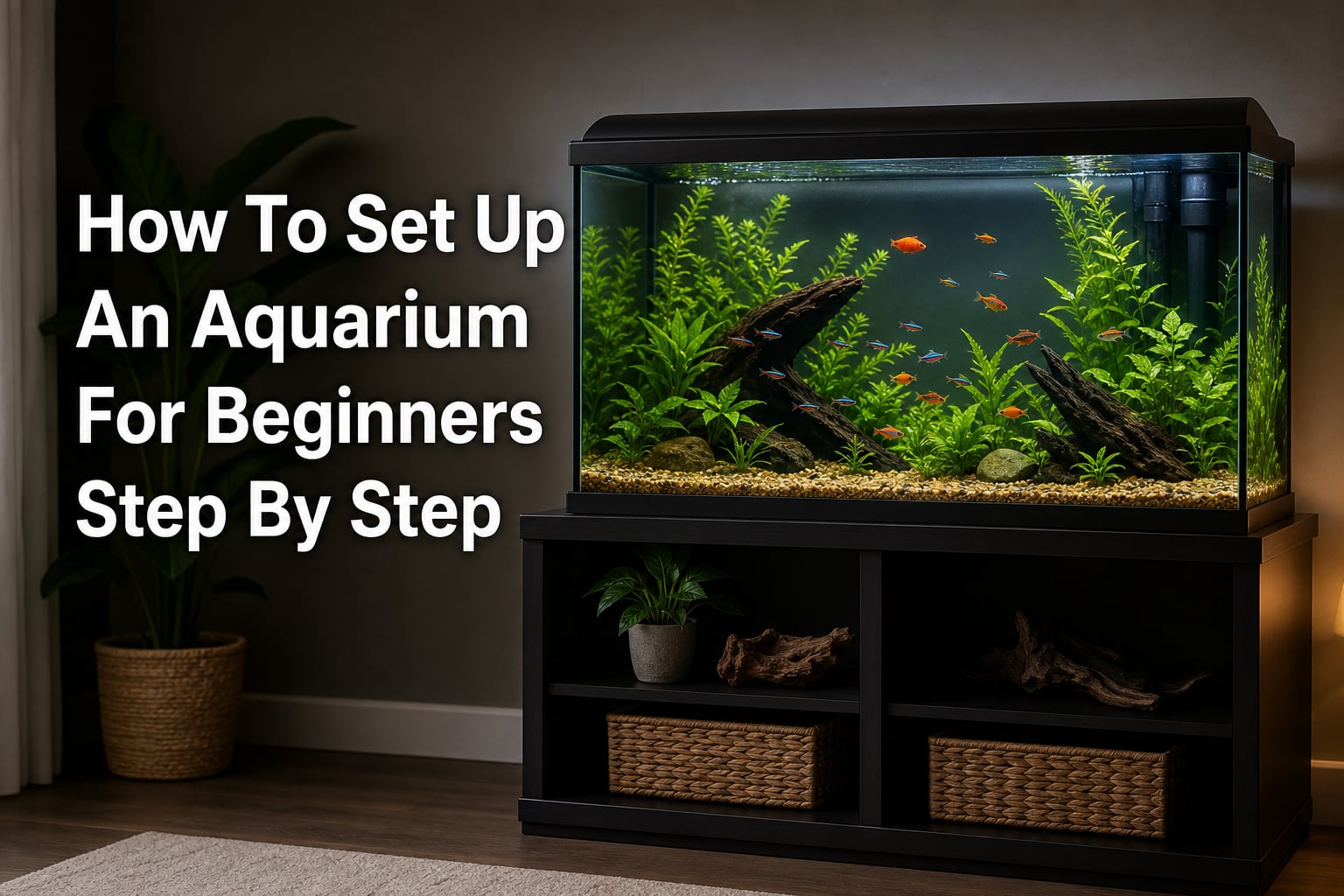
Learning how to set up an aquarium for beginners step by step is mostly a lesson in doing the right tasks in the right order. A freshwater aquarium is ready for fish only after it has stable equipment, conditioned water, and a working bacterial filter that can process fish waste.
The difficult part is not filling a glass box with water. It is resisting the urge to bring fish home on day one, because ammonia and nitrite can rise quickly in an uncycled tank and harm or kill them.
This guide walks through a practical freshwater aquarium setup for a first aquarium, including the equipment to gather, the seven setup steps, the nitrogen cycle aquarium process, and a low-stress way to add fish. The same fundamentals apply to many community tanks, though goldfish, saltwater animals, and species with unusual water needs need their own research.
The short answer: Place the empty tank on a level, weight-bearing stand away from heat and sun; rinse the substrate and decor; install the filter and heater; fill with conditioned water; run the equipment; cycle the aquarium until tests show ammonia 0, nitrite 0, and nitrate present; then add a small first group of compatible fish gradually.
That waiting period feels slow, but it is the part that protects your fish. Community discussions repeatedly describe a painful pattern: a new keeper is told to add fish immediately, the water turns cloudy or toxic, and losses follow within days.
One reported example involved 18 fish placed in a 10-gallon tank on the day it was bought; all had died within three days. Treat that story as a warning against rushing, not as a reason to fear fishkeeping: patience and a liquid test kit give you far more control.
Set up an aquarium for beginners step by step by following these seven actions
These seven actions cover the physical build, water preparation, and the biological work that makes a beginner fish tank livable. Read all seven before purchasing fish, since the cycle takes longer than the assembly.
Choose the tank, stand, and location. Pick a manageable freshwater tank, put it on a level surface built for its filled weight, and keep it away from direct sun, drafts, and heat sources.
Rinse substrate and decorations. Use plain water only, then arrange the gravel or sand and fish-safe decor in the empty tank.
Install the equipment. Fit the filter, heater if your planned fish need one, thermometer, lid, and light before filling.
Fill and condition the water. Add tap water slowly and dose a water conditioner that treats chlorine or chloramine according to its label.
Run and check the system. Start the filter and heater, set the target temperature for the planned fish, and inspect for leaks and steady flow.
Cycle the aquarium without fish. Feed an ammonia source and test until bacteria convert ammonia to nitrite and then nitrate.
Add fish gradually and maintain the tank. Acclimate a small compatible group, test frequently at first, and keep up with partial water changes.
Choose the tank and stocking plan before buying equipment
Start by deciding what animals you want to keep, then choose a tank that meets their adult size, activity, social needs, and water temperature. A larger volume is usually easier for a beginner because a small mistake changes the water parameters less abruptly.
Many new keepers find a 20-gallon long freshwater aquarium easier to manage than a tiny desktop tank. Its wider footprint offers more swimming room and surface area for oxygen exchange, while the extra water volume gives you a little more time to spot and correct a problem.
A small tank is not automatically wrong, but it limits fish choices and demands closer attention. Do not use the old one-inch-per-gallon rule as a stocking formula; fish body shape, adult size, waste output, behavior, filtration, and tank dimensions all matter.
Plan first: Write down each species, its adult length, temperature range, social requirement, and whether it occupies the bottom, middle, or upper water level. Check compatibility before buying any fish, not while standing in the store with a bag in hand.
Put the aquarium on a level, stable location
A filled aquarium is surprisingly heavy. Water alone weighs about 8.3 pounds per gallon, and the tank, substrate, rocks, and equipment add more, so use a purpose-built aquarium stand or furniture rated for that load.
Choose a spot away from windows with strong direct sunlight, heating or cooling vents, exterior doors, radiators, and speakers that vibrate. Sunlight can drive algae growth and temperature swings, while a vent can make a heater work harder and leave fish with unstable conditions.
Leave enough clearance to open the lid, access the filter, and carry a bucket safely during water changes. A nearby outlet helps, but use drip loops: let each cord dip below the outlet before rising to the plug so water cannot travel along a cord into the socket.
Rinse the substrate and arrange safe decor
Gravel and sand substrate often hold dust from packaging. Put small portions in a clean bucket and rinse with tap water until the runoff is much clearer; do not add soap, household cleaners, or chemical residues to anything that will enter the tank.
Add substrate to the empty aquarium, creating a gentle slope from back to front if you want debris to be easier to see and siphon. For a planted aquarium, select a substrate that suits the plants you intend to grow and anchor roots before filling.
Use decorations sold as aquarium-safe, with no sharp edges or openings that can trap a fish. Driftwood may tint water a tea color from tannins, which is often harmless, but boil or soak only when the material and seller guidance say it is appropriate.
Set large rocks directly on the tank bottom before adding loose substrate so a digging fish cannot undermine them. Keep decor clear of heater guards, filter intakes, and the surface, where fish need open space for normal movement and gas exchange.
Install the filter, heater, thermometer, and light correctly
A filter is more than a device that clears floating particles. Its media provides a home for beneficial bacteria, forming the biological filter that changes toxic waste products into less harmful nitrate.
For a first freshwater aquarium, use a filter with a flow rate and media capacity suited to the tank and the future bio load. Hang-on-back filters are simple to access, internal filters fit inside the tank, and sponge filters offer gentle flow and useful biological filtration when run with an air pump.
Pick flow based on the fish, too. Bettas and some long-finned fish may struggle in a strong current, while many schooling fish appreciate more movement; a baffled outlet or adjustable flow can make the current calmer.
Tropical fish need a heater and a thermometer, because the number printed on a heater dial is not proof of the water temperature. Position the heater where water movement carries warmth through the aquarium, fully submerge it only if its instructions allow that, and let it sit in water before powering it on.
Use a lid or hood unless your livestock plan specifically calls for something else. It reduces evaporation and the chance of fish jumping out, while the aquarium lights should be on a timer for a consistent daily schedule rather than all day.
Do not replace all filter media at once. The brown material inside a mature filter is often holding much of the useful bacterial colony. Rinse reusable media gently in a bucket of removed tank water, not untreated tap water, and replace parts one at a time only when they are falling apart.
Fill slowly and prepare tap water for fish
Place a bowl or plate on the substrate and pour water onto it to keep gravel from being blasted into a cloud. Fill only to the level recommended for your filter, leaving the needed gap under a lid.
Most municipal tap water contains chlorine or chloramine that can hurt fish and damage beneficial bacteria. Add a water conditioner, sometimes called a dechlorinator, in the dose and method stated on its label each time new tap water enters the aquarium.
Water conditioner makes disinfected tap water safer, but it does not cycle the tank and does not set every water parameter. Test your source water for pH, ammonia, nitrite, and nitrate, especially if you use well water or know your area has unusual water chemistry.
Do not chase a particular pH number just because it appears in a care sheet. A stable pH that suits the fish you chose is normally safer than a number pushed up and down with additives.
Run the equipment and inspect the tank before cycling
Turn on the filter and confirm it is moving water as intended. Check every seal, connection, and fitting while the aquarium is still fish-free, then wipe the outside dry and look again for drips over the next day.
For a heated beginner tropical fish tank, set the heater for the needs of the planned species and compare it against the thermometer after the water has had time to stabilize. Sudden temperature changes can cause thermal shock, so make adjustments slowly rather than moving the dial dramatically.
Run lights on a modest, consistent schedule while you learn how the tank responds. More light does not make a new aquarium mature faster; it often just gives algae more opportunity before plants and maintenance routines settle in.
Cycle the fish tank before it holds fish
Cycling a fish tank means growing bacteria that process nitrogen waste. This is the core safety task in a freshwater aquarium setup, and a tank can look crystal clear while still being biologically unsafe.
Fish waste and uneaten food create ammonia. Beneficial bacteria first change ammonia into nitrite, which is also toxic, and another bacterial group changes nitrite into nitrate; nitrate is removed mainly through regular partial water changes and, to a smaller extent, by living plants.
Nitrogen cycle in one line: ammonia becomes nitrite, then nitrite becomes nitrate. A cycled tank should test at 0 ammonia, 0 nitrite, and show some nitrate after an ammonia source has been processed.
A fishless cycle is the preferred route for a first aquarium because no fish must endure the ammonia and nitrite spike. Use a known ammonia source intended for aquarium cycling, follow its instructions, and test water with a liquid test kit rather than relying on appearance alone.
At the start, add only enough ammonia to begin the process and record the test results. When ammonia falls and nitrite appears, the first bacterial group is working; later, nitrite falls and nitrate appears as the second group catches up.
The process often takes four to six weeks, though it can be shorter or longer depending on temperature, pH, seed material, and the bacteria involved. A bottle labeled as beneficial bacteria may help introduce microbes, but test results—not the calendar or a clear-water look—tell you whether the biofilter is ready.
Confirm the cycle by adding the ammonia amount recommended for the method you are using and checking that ammonia and nitrite both return to 0 within roughly a day, with nitrate present. Perform a partial water change if nitrate is high before fish arrive, then condition the replacement water.
Add a small first group and acclimate it slowly
Once the tank is cycled, choose a small first group that matches your plan instead of filling every open inch of water. Adding livestock in stages lets the bacterial colony expand with the waste load rather than being overwhelmed at once.
For a peaceful community tank, beginner-friendly choices can include hardy small schooling fish, corydoras in a suitable group, or a single betta in an appropriate setup, but species needs vary. Research adult size, school size, temperament, water temperature, and whether the fish may nip fins before combining anything.
Float the sealed transport bag in the aquarium for about 15 to 20 minutes to bring the temperature closer. Then add small amounts of tank water to the bag over the next 20 to 30 minutes, net the fish into the tank, and discard the bag water rather than pouring store water into your aquarium.
Keep the lights low for the first few hours and feed lightly after the fish have settled. Test ammonia and nitrite daily for the first week after each addition, because a mature-looking cycle can still lag behind a new bio load.
Warning: Do not add all fish at once because a shop employee says the filter is ready. If ammonia or nitrite registers above 0 after fish arrive, pause new purchases, perform a conditioned partial water change, reduce feeding, and test again; seek species-specific guidance if fish show distress.
Choose your aquarium equipment by function, not by extras
Your aquarium equipment list should focus on water quality, temperature, safety, and maintenance before decorative extras. Buying the basics first also makes it easier to diagnose a problem because you know what each part is supposed to do.
Tank, lid, and rated stand: hold the water safely and reduce evaporation or escapes.
Filter with suitable media: circulates water, traps debris, and supports biological filtration.
Heater and thermometer: needed for most tropical fish to keep temperature stable.
Water conditioner: treats chlorine or chloramine in tap water.
Liquid test kit: measures ammonia, nitrite, nitrate, pH, and sometimes other parameters.
Substrate and fish-safe decor: provide footing, hiding places, and a natural environment.
Light and timer: support viewing and live plants while limiting excess light.
Gravel vacuum, bucket, and algae tool: make partial water changes and cleaning practical.
Fish net and siphon hose: help with routine work and safe fish transfers.
An air pump is not mandatory for every tank. If the filter creates gentle surface movement, oxygen exchange may already be adequate; an air stone can still be helpful for extra surface agitation or a sponge filter.
Live plants can be rewarding for a beginner planted aquarium, but select easy species and learn their light and nutrient needs. Artificial plants do not consume nutrients, yet they can still provide cover if they are smooth and aquarium-safe.
Keep the first aquarium stable with a simple maintenance routine
After cycling, routine care is about removing nitrate and debris without stripping out the bacterial colony. A small amount of regular work is gentler than letting waste build up and making one dramatic correction.
Change part of the water every week
Use a gravel vacuum during a partial water change to pull waste from accessible areas of the substrate. Many freshwater tanks do well with a weekly change of roughly 20 to 30 percent, but your test results, stocking, plant growth, and local water conditions should guide the exact amount.
Prepare replacement tap water with conditioner and bring it close to the aquarium temperature before adding it. Avoid changing all the water unless a qualified situation calls for it, because a complete reset can shock fish and disrupt the tank’s balance.
Test water before a small concern becomes an emergency
During the first several months, test ammonia, nitrite, nitrate, and temperature often enough to learn the tank’s pattern. After it is established, continue testing when fish behave differently, after adding livestock, after a missed maintenance session, or when water looks unusual.
Ammonia and nitrite should remain at 0 in a cycled, stocked aquarium. Nitrate should be managed with water changes before it rises to a level that is unsuitable for the animals you keep; the acceptable number depends on the species and aquarium plan.
Feed lightly and observe daily
Offer only what the fish can eat promptly, then remove obvious leftovers if needed. Overfeeding is a frequent beginner mistake because excess food becomes ammonia, fuels cloudiness, and increases the burden on the filter.
Take a minute each day to check temperature, filter flow, water level, and fish behavior. Gasping at the surface, clamped fins, hiding beyond normal habits, or a heater that is not maintaining temperature are reasons to test and investigate rather than adding random chemicals.
Fix common first-week aquarium problems by testing before treating
New aquarium water often turns cloudy, and that appearance alone does not identify the cause. It may be harmless substrate dust, a bacterial bloom during cycling, suspended debris, or, less commonly, an issue caused by overfeeding or a filter that is not operating properly.
First check that the filter is running, do not overfeed, and test ammonia and nitrite. Do not keep replacing all the water or adding clarifiers blindly, because a bacterial bloom can settle as the tank matures while impulsive interventions may delay useful bacteria.
Stop a cloudy-water panic with a short checklist
Check the filter intake and output for blockage and verify water is circulating.
Test ammonia and nitrite, then respond to any reading above 0 with a conditioned partial water change if fish are present.
Feed less, remove decaying plant matter, and do not add new fish.
Give rinsed substrate dust time to settle and use fine filter floss only if it suits your filter.
Keep lights consistent and reduce direct sun if the cloudiness is green algae rather than white haze.
Respond to fish added before cycling with frequent testing
If fish are already in an uncycled aquarium, do not abandon the tank or add more animals. Test ammonia and nitrite at least daily, change a portion of the water with conditioned, temperature-matched water whenever either becomes detectable, and feed sparingly while the biofilter develops.
This fish-in approach is more demanding and carries more risk than a fishless cycle, which is why prevention is better. Keep the filter running continuously, do not rinse biological media under untreated tap water, and ask an experienced aquatic veterinarian or a trusted fishkeeping specialist for help if fish are gasping, lying over, or showing severe distress.
Avoid algae by managing light and nutrients
Algae is common and not proof that you have failed. Start by shortening the light period, keeping the tank out of direct sunlight, removing excess food, and maintaining water changes instead of adding algae-eating fish as a shortcut.
An algae eater is still a fish with its own adult size and care needs. Do not buy one simply to solve a maintenance issue unless it fits the aquarium’s long-term stocking plan.
FAQs
How do you properly set up a fish tank for the first time?
Set up a first fish tank by choosing a stable location and suitable tank, rinsing substrate and decor with plain water, installing the filter and heater, filling with conditioned water, and running all equipment. Then cycle the aquarium before adding fish. Test until ammonia and nitrite are both 0 and nitrate is present, then add a small compatible group gradually.
How long should a new fish tank sit before adding fish?
A new fish tank should not be stocked just because it has sat for a certain number of days. A fishless nitrogen cycle commonly takes four to six weeks, sometimes more or less. Add fish only after testing shows the tank can process an ammonia dose to 0 ammonia and 0 nitrite within about a day, with nitrate present.
How do you cycle a new fish tank for the first time?
Cycle a new tank without fish by running the filter and heater, adding an aquarium-appropriate ammonia source as directed, and testing ammonia, nitrite, and nitrate regularly. Bacteria first convert ammonia to nitrite, then a second group converts nitrite to nitrate. The tank is ready when ammonia and nitrite return to 0 after dosing and nitrate is detectable.
What should you put in a fish tank for the first time?
Put in rinsed substrate, aquarium-safe decor or plants, a correctly sized filter, a heater and thermometer for tropical fish, a lid, and conditioned water. Keep a liquid test kit, gravel vacuum, bucket, fish net, and water conditioner ready outside the tank. Add fish only after the nitrogen cycle is complete.
What fish are good for beginners?
Good beginner fish are species whose adult size, social needs, and water requirements fit the aquarium you have cycled. Small schooling fish, groups of appropriate corydoras, and a single betta can work in suitable setups, but research each species before buying. Avoid choosing fish based only on their juvenile size or appearance.
Why is my new aquarium cloudy?
New aquarium cloudiness may be substrate dust, suspended debris, a bacterial bloom during cycling, overfeeding, or algae. Check that the filter is working, test ammonia and nitrite, feed lightly, and avoid chemical fixes before identifying the cause. White bacterial haze often settles as the aquarium matures, while green water points to excess light and nutrients.
Conclusion
How to set up an aquarium for beginners step by step comes down to a reliable order: choose an appropriate tank and location, install the equipment, condition the water, establish the nitrogen cycle, and add livestock in stages. The filter and heater matter, but the tested bacterial cycle is what turns a new tank into a functioning home.
Start your project by writing a fish plan and gathering the aquarium equipment list, then give cycling the four to six weeks it may need. When the test kit shows 0 ammonia, 0 nitrite, and nitrate present, you can add a modest compatible first group with far more confidence.
Keep observing, testing, and changing part of the water each week. A calm, steady routine is more useful to fish than quick fixes, and it gives you the foundation to enjoy your aquarium for years.