
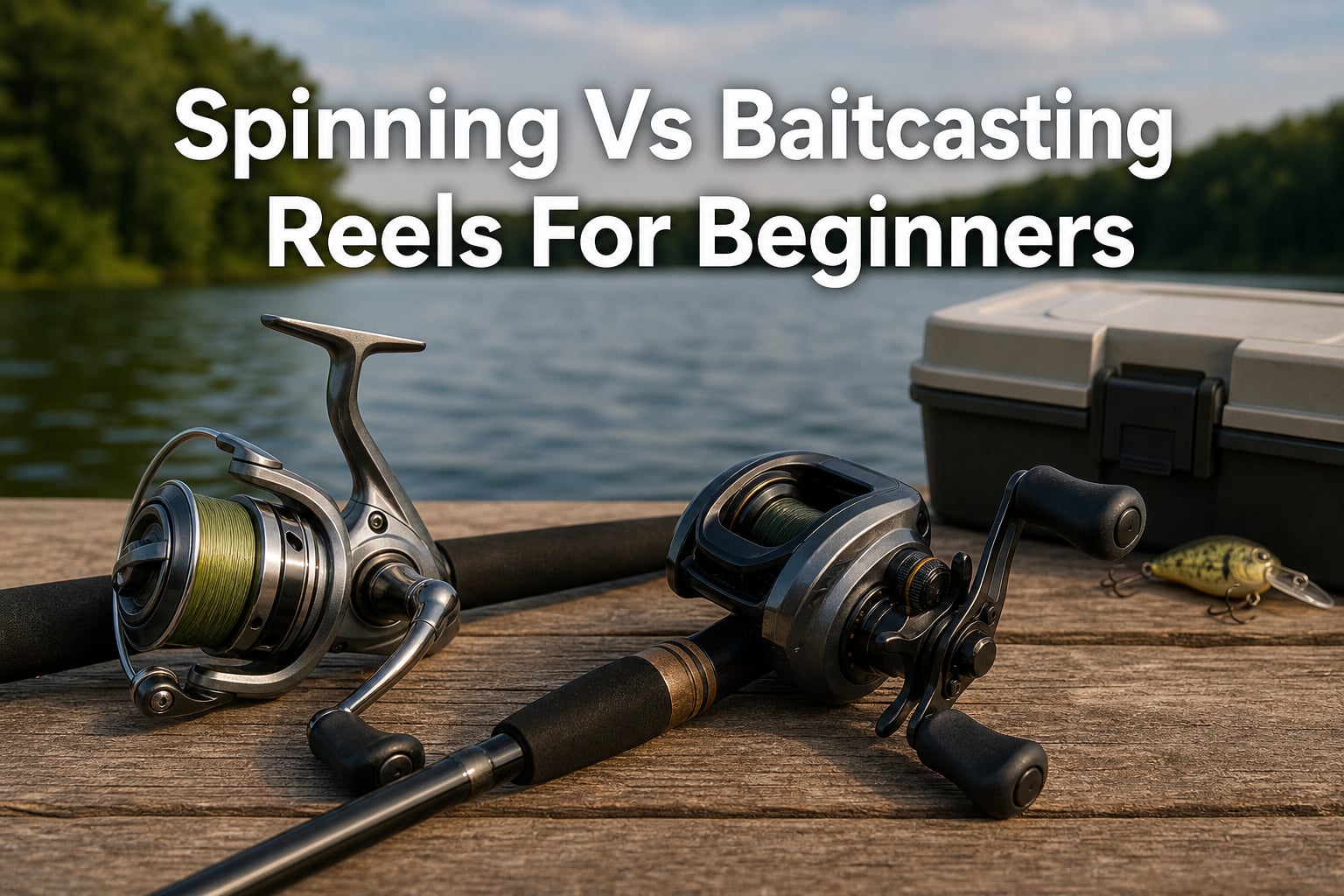
Choosing between spinning vs baitcasting reels for beginners comes down to one key tradeoff: ease of use versus control. Spinning reels are easier to learn and handle lighter lures, while baitcasting reels offer more precision and power for heavier presentations. The fixed spool design of a spinning reel releases line freely, making it forgiving for newcomers. A baitcasting reel has a rotating spool that requires thumb control but rewards practice with better accuracy and distance. In this guide, I’ll break down exactly when to choose each type, how to set them up, and what to expect as you develop your skills.
Spinning Vs Baitcasting Reels For Beginners: The Core Difference
The mechanical difference between these two reel types shapes everything about how they perform. A spinning reel uses a fixed spool that stays stationary while line peels off during the cast. This design eliminates the need for precise thumb control. Line flows freely from the spool without mechanical interference, which is why spinning reels are so beginner-friendly.
A baitcasting reel works differently. The spool rotates as you cast, spinning in sync with line leaving the reel. Your thumb controls this rotation, slowing the spool as the lure loses momentum. When done correctly, you achieve pinpoint accuracy and longer casts. When done poorly, you get backlash—a tangled mess of line that frustrates beginners.
This fundamental difference affects casting distance, accuracy, lure weight handling, and learning curve. Understanding this helps you choose the right reel for your fishing style and experience level.
What Is a Spinning Reel?
A spinning reel hangs below the fishing rod with a fixed, stationary spool that points toward the rod tip. The spool never rotates during casting. Instead, line simply peels off the stationary spool as the lure flies through the air. This design makes casting intuitive—you open the bail, hold the line, swing, release, and the line flows freely.
How a Spinning Reel Works
When you cast with a spinning reel, the bail arm opens to release the line. Gravity and momentum pull line from the fixed spool without any resistance from rotating parts. The spool remains stationary throughout the cast, which is why there’s no need for thumb control or brake adjustments. After the cast, you close the bail, and the drag system engages when a fish pulls.
The drag system on a spinning reel sits at the front of the spool and adjusts with a knob. It applies pressure to the spool, determining how much force a fish needs to pull line. This straightforward operation makes spinning reels the go-to choice for beginners learning basic fishing mechanics.
What Is a Baitcasting Reel?
A baitcasting reel sits on top of the fishing rod with a spool that rotates parallel to the rod. During casting, the spool spins freely, releasing line as the lure travels forward. Your thumb rests on the spool throughout the cast, applying gentle pressure to control speed and prevent overrun. This design offers superior control but requires practice to master.
How a Baitcasting Reel Works
When you press the thumb bar on a baitcaster, the spool disengages and spins freely. As you cast, your thumb controls the spool speed, slowing it as the lure slows down. If the spool spins faster than line leaves, you get backlash—a tangled bird’s nest of line. Two main controls help manage this: the spool tension knob and the braking system.
The spool tension knob applies constant pressure to the spool. It’s adjusted based on lure weight—heavier lures need looser tension. The braking system uses either magnetic or centrifugal brakes to slow the spool at the beginning of the cast. Together, these controls help prevent backlash while maximizing casting distance and accuracy.
Spinning Reel Pros and Cons
Our team has fished extensively with spinning reels, and here’s what we’ve found:
Spinning Reel Pros
- Easy to learn with minimal practice required
- No backlash or bird’s nests to untangle
- Excels with light lures (1/8 ounce and lighter)
- Works great with light line (8-pound test and under)
- Simple drag adjustment on the front of the spool
- Excellent for finesse techniques like drop-shotting and shaky heads
- Less expensive entry-level options available
- Comfortable for left-handed and right-handed anglers (reel handle is reversible)
- Better for casting into the wind
Spinning Reel Cons
- Line twist can occur, especially with monofilament
- Less accurate for pinpoint casting
- Reduced casting distance with heavy lures
- Struggles with heavy line (20-pound test and above)
- Not ideal for pulling fish from heavy cover
- Line can jump off the spool if loose
- Large profile can feel bulky on the rod
Baitcasting Reel Pros and Cons
After years of using baitcasters, here’s what I’ve experienced:
Baitcasting Reel Pros
- Superior casting accuracy for pinpoint placement
- Longer casting distance with heavier lures
- Better control for pitching and flipping into tight spots
- Handles heavy line (20-pound test and up) easily
- More cranking power for pulling fish from cover
- Comfortable one-handed operation while casting
- Direct feel for detecting light bites
- Compact, ergonomic design fits the hand naturally
- Better for power fishing techniques
Baitcasting Reel Cons
- Steep learning curve for beginners
- Backlash can be frustrating and time-consuming to fix
- Requires tuning (spool tension, brakes) for each lure weight
- Struggles with light lures (under 1/4 ounce) without special techniques
- Not ideal for light line applications
- More expensive for quality entry-level models
- Right or left-handed models must be purchased separately
- Difficult to cast into strong winds
Key Differences: Spinning Vs Baitcasting Compared
Let’s break down how these reels compare across the factors that matter most to beginners.
Casting Distance
Baitcasting reels typically cast farther than spinning reels when using heavier lures. The rotating spool design creates less friction as line leaves the reel, allowing the lure to carry more momentum. With lures weighing 3/8 ounce or more, I’ve measured 15-20% longer casts with a baitcaster. However, with lighter lures under 1/4 ounce, spinning reels often match or exceed baitcaster distance because they don’t require spool rotation startup inertia.
Lure Weight Range
Spinning reels handle light lures better than baitcasting reels. I regularly fish 1/16-ounce jigs on spinning gear with no issues. Baitcasters struggle below 1/4 ounce because there’s not enough weight to overcome spool inertia and keep the spool spinning smoothly. For lure weights under 1/8 ounce, spinning reels are the clear choice. Above 3/8 ounce, baitcasters offer better performance. Between 1/8 and 3/8 ounce, either reel works well.
Line Management and Line Twist
Spinning reels sometimes cause line twist because the line wraps around a fixed spool. This shows up as loops jumping off the spool or line that won’t lay flat. Braid reduces this issue significantly. Baitcasting reels don’t cause line twist because the spool rotates, laying line evenly. However, baitcasters can experience line dig-in with soft lines like fluorocarbon if the spool isn’t kept tight.
Accuracy and Control
Baitcasting reels win on accuracy. Your thumb on the spool gives instant feedback and control throughout the cast. I can stop a lure mid-flight by pressing my thumb down, placing it precisely under a dock or next to a laydown. Spinning reels lack this control—you release the line and hope for the best. For precision techniques like pitching, flipping, and skipping, baitcasters are significantly more accurate.
Which Reel Is Better for Beginners?
Spinning reels are better for beginners. I recommend starting with a spinning reel for your first season of fishing. The learning curve is minimal—you can cast effectively within minutes of picking one up. There’s no backlash to deal with, no spool tension to adjust, and no brake settings to worry about. You focus on finding fish rather than untangling line.
Most beginners who start with baitcasters spend their first few trips frustrated with backlash. This discourages many from continuing. Spinning reels build confidence quickly, letting you catch fish while you learn the fundamentals. Once you’re comfortable casting, working lures, and landing fish, transitioning to a baitcaster becomes much easier.
That said, beginners who fish with experienced anglers or have access to hands-on instruction can start directly with baitcasters. If you have someone to help you tune the reel and teach proper thumb control, the learning curve shortens significantly. But for solo beginners, spinning reels remain the smartest starting point.
How To Set Up a Spinning Reel (Step by Step)
Setting up a spinning reel is straightforward. Here’s the process I use:
Step 1: Attach the reel to the rod. Slide the reel foot into the reel seat underneath the rod handle and tighten the locking rings until snug. Don’t overtighten.
Step 2: Open the bail arm. This flips the metal wire away from the spool, exposing the line roller.
Step 3: Thread line through the guides. Run your line through every guide on the rod, starting from the bottom and working toward the tip. Make sure the line passes through the bail roller correctly.
Step 4: Tie on your leader or lure. I use a clinch knot or improved clinch knot for most applications. For braid to fluorocarbon connections, a double uni knot works well.
Step 5: Set the drag. Tighten the front drag knob until you can pull line with moderate effort. It should take a firm pull to move line—not so loose that a small fish pulls drag constantly, but not so tight that you risk breaking off.
Step 6: Practice casting. Open the bail, hold the line against the rod handle, swing back, and release the line as you swing forward. The lure should fly smoothly without the line catching.
How To Set Up a Baitcasting Reel (Step by Step)
Baitcaster setup requires more tuning. Follow these steps:
Step 1: Mount the reel on top of the rod. The reel foot slides into the reel seat on top of the rod handle. Tighten the locking rings securely.
Step 2: Adjust the spool tension knob. This knob is usually on the side opposite the handle. Tie on your lure and press the thumb bar. Slowly tighten the knob until the lure falls slowly and the spool stops spinning when the lure hits the ground. This prevents overrun on the initial drop.
Step 3: Set the brake system. Magnetic brakes adjust with a dial (usually numbered 1-10). Start at 7-8 for beginners. Centrifugal brakes require opening the side plate and adjusting pins inward or outward. Start with most brakes engaged for learning.
Step 4: Practice thumb placement. Rest your thumb lightly on the spool throughout the cast. You’ll feel the spool vibration and learn to apply pressure as needed.
Step 5: Make short casts first. Start with 20-30 foot casts to develop thumb control. As you improve, gradually cast farther.
Step 6: Adjust settings as needed. If you backlash frequently, tighten the brakes or spool tension. If casting feels restricted, loosen them slightly. Tuning is lure-specific—heavier lures need less brake and tension.
How To Avoid Backlash on a Baitcaster
Backlash happens when the spool spins faster than line leaves the reel. The excess line tangles underneath, creating a bird’s nest. Here’s how I prevent it:
Start with proper tension. Before casting, hold the rod at 2 o’clock and press the thumb bar. Your lure should fall slowly to the ground without the spool spinning after impact. Adjust the tension knob until this happens.
Use more brake than you need. When learning, set magnetic brakes to 7 or higher. This slows the spool at the start of the cast when backlash is most likely. You can reduce brakes as your thumb control improves.
Control your cast power. Hard, aggressive casts cause more backlash than smooth, controlled casts. I focus on accelerating smoothly rather than snapping the rod.
Thumb the spool at the end of the cast. As your lure approaches the target, press your thumb down to stop the spool. This prevents the overrun that happens when a lure hits the water while the spool still spins.
Cast with the wind, not into it. Wind slows your lure but not the spool, creating backlash conditions. If you must cast into the wind, use more brake and thumb pressure.
When backlash happens, stay patient. Work from the outside of the tangle inward, picking at loops with your fingers or a pick tool. Severe backlash may require cutting the line—this is part of learning.
Line and Lure Recommendations for Each Reel
Matching line and lure to your reel makes fishing more effective.
Best Line Types
For spinning reels, braid in 6-10 pound test works best for most applications. It doesn’t twist like monofilament and offers excellent sensitivity. Add a fluorocarbon leader for invisibility in clear water. Monofilament in 6-8 pound test is forgiving and inexpensive, good for panfish and trout.
For baitcasting reels, heavier lines work better. Braided line in 30-50 pound test excels for heavy cover applications where you need to horse fish out. Fluorocarbon in 12-17 pound test works well for general bass fishing. Monofilament in 12-15 pound test is fine for topwater and reaction baits.
Lure Weight Guidelines
Spinning reels shine with lures under 1/4 ounce. Finesse jigs, small crankbaits, drop-shot rigs, and light Texas rigs work best. I use spinning gear for anything weighing 1/8 ounce or less.
Baitcasting reels handle heavier lures best. Jigs over 3/8 ounce, large crankbaits, spinnerbaits, swimbaits, and big topwaters pair well with baitcasters. The rule of thumb I follow: above 1/4 ounce, reach for a baitcaster.
When To Use Each Reel Type
Different fishing situations call for different reels. Here’s how I choose:
Use a spinning reel for: Finesse techniques like drop-shotting, shaky head fishing, and Ned rig presentations. Light line applications with 8-pound test or lighter. Small trout, panfish, and walleye fishing. Casting light lures under 1/8 ounce. Beginners learning to fish. Fishing in windy conditions.
Use a baitcasting reel for: Power fishing with jigs, crankbaits, and swimbaits. Heavy cover where you need to pull fish from brush or grass. Techniques requiring precision like pitching, flipping, and skipping. Lures weighing 3/8 ounce or more. Heavy line applications with 15-pound test or heavier. Bass fishing in thick vegetation or timber. Target casting to specific structure.
Most experienced anglers I know carry both. They start with spinning gear for finesse presentations and switch to baitcasters for power techniques. Having both options covers every situation.
The Bait Finesse System (BFS) Middle Ground
Bait Finesse System, or BFS, bridges the gap between spinning and baitcasting. It uses a specially tuned baitcasting reel with a shallow, lightweight spool designed for light lures. With BFS, you can cast lures as light as 1/16 ounce with a baitcaster while maintaining thumb control and accuracy.
BFS started in Japan for trout fishing in mountain streams. It’s gained popularity in the US for bass fishing with small presentations. The shallow spool reduces inertia, letting the spool start spinning with minimal force. Specialized BFS reels have fine-tuned brakes and spool tension systems.
For beginners, BFS offers a middle ground after mastering spinning reels but before full baitcaster proficiency. It lets you develop thumb control with light lures rather than struggling with heavy setups. However, BFS requires additional investment in specialized gear and tuning knowledge.
Maintenance Tips for Both Reel Types
Proper maintenance extends reel life significantly. Here’s what I do:
For spinning reels: Rinse with fresh water after saltwater use. Don’t submerge the reel—water can penetrate the drag system. Dry thoroughly before storage. Apply a drop of reel oil to the handle knob and line roller occasionally. Service the drag washers yearly if you fish frequently.
For baitcasting reels: Clean the exterior after each trip. Remove side plates periodically and inspect the braking system. Apply reel oil to the bearings and handle. Check the spool tension knob for smooth operation. Service annually or more often with heavy use. Backlash can damage line—check for cuts or abrasions after untangling.
For both: Store reels in a dry place away from extreme temperatures. Loosen the drag before storage to prevent washer compression. Replace line when it shows wear, memory, or abrasion. Keep reels in protective cases during transport.
Common Mistakes Beginners Make
I’ve seen these mistakes repeatedly in forums and on the water:
Buying cheap gear to start. Ultra-budget reels often have poor drag systems and rough operation, making learning harder. A mid-range spinning reel ($50-80) offers dramatically better performance than a $20 model.
Starting with a baitcaster without guidance. Beginners who buy baitcasters without instruction spend hours fighting backlash. If you want to start with baitcasting, get help from an experienced angler or watch detailed tutorials.
Ignoring line capacity. Overfilling spools causes line to jump off. Underfilling reduces casting distance. Fill spinning spools to about 1/8 inch below the lip. Fill baitcaster spools to the edge of the bevel.
Not adjusting settings for different lures. Baitcasters require retuning when switching lure weights. A reel set up for a 1/2 ounce jig will backlash badly with a 3/8 ounce crankbait if you don’t adjust.
Using the wrong line type. Heavy monofilament on a spinning reel causes twist and wind knots. Light braid on a baitcaster can dig into the spool. Match line type and weight to your reel.
Frequently Asked Questions
Which reel type is best for beginners?
Spinning reels are best for beginners because they’re easier to learn, don’t backlash, and require minimal tuning. You can cast effectively within minutes of picking one up, letting you focus on catching fish rather than managing equipment. The fixed spool design releases line freely without thumb control, making spinning reels forgiving for newcomers.
Why use a spinning reel instead of a baitcaster?
Use a spinning reel for light lures (under 1/4 ounce), light line (8-pound test and under), finesse techniques, windy conditions, and when you want minimal learning curve. Spinning reels excel at drop-shotting, shaky heads, and small presentations where precision bait placement matters less than lure action.
Should a beginner use a baitcaster?
Beginners can use baitcasters, but expect a steep learning curve with backlash frustration. If you have access to hands-on instruction from an experienced angler, starting with a baitcaster is feasible. For solo beginners, spinning reels build confidence faster and make the sport more enjoyable during those critical first trips.
Why do fishermen prefer baitcasters?
Fishermen prefer baitcasters for their superior accuracy, casting distance with heavy lures, and control. Thumb pressure on the spool lets you place lures precisely under docks, next to laydowns, and in tight cover. Baitcasters handle heavy line and pull fish from thick vegetation better than spinning reels.
Can baitcasters cast farther than spinning reels?
Yes, baitcasters typically cast farther than spinning reels with heavier lures (3/8 ounce and up). The rotating spool creates less friction during the cast, allowing more momentum. However, with light lures under 1/4 ounce, spinning reels often match or exceed baitcaster distance because they don’t need to overcome spool startup inertia.
What is backlash and how do I prevent it?
Backlash occurs when a baitcaster’s spool spins faster than line leaves, creating a tangled bird’s nest. Prevent it by setting proper spool tension (lure should fall slowly), using higher brake settings when learning, casting smoothly rather than snapping, and thumbing the spool as your lure lands. Practice builds the thumb control needed to avoid backlash.
Final Thoughts on Spinning Vs Baitcasting Reels For Beginners
The choice between spinning vs baitcasting reels for beginners comes down to patience and fishing goals. Spinning reels offer immediate gratification—you can fish effectively right away and focus on learning techniques. Baitcasting reels require investment in practice but reward you with precision and power once mastered.
My recommendation: start with a quality spinning reel for your first season. Build confidence, catch fish, and develop fundamental skills. Once you’re comfortable, add a baitcaster to your arsenal. Most serious anglers eventually own and use both, matching their reel to the technique and conditions.
Neither reel type is universally better. Each excels in different situations. Understanding when to use each one makes you a more versatile angler. The key is starting with the right tool for your skill level and progressively expanding your capabilities as you improve.