
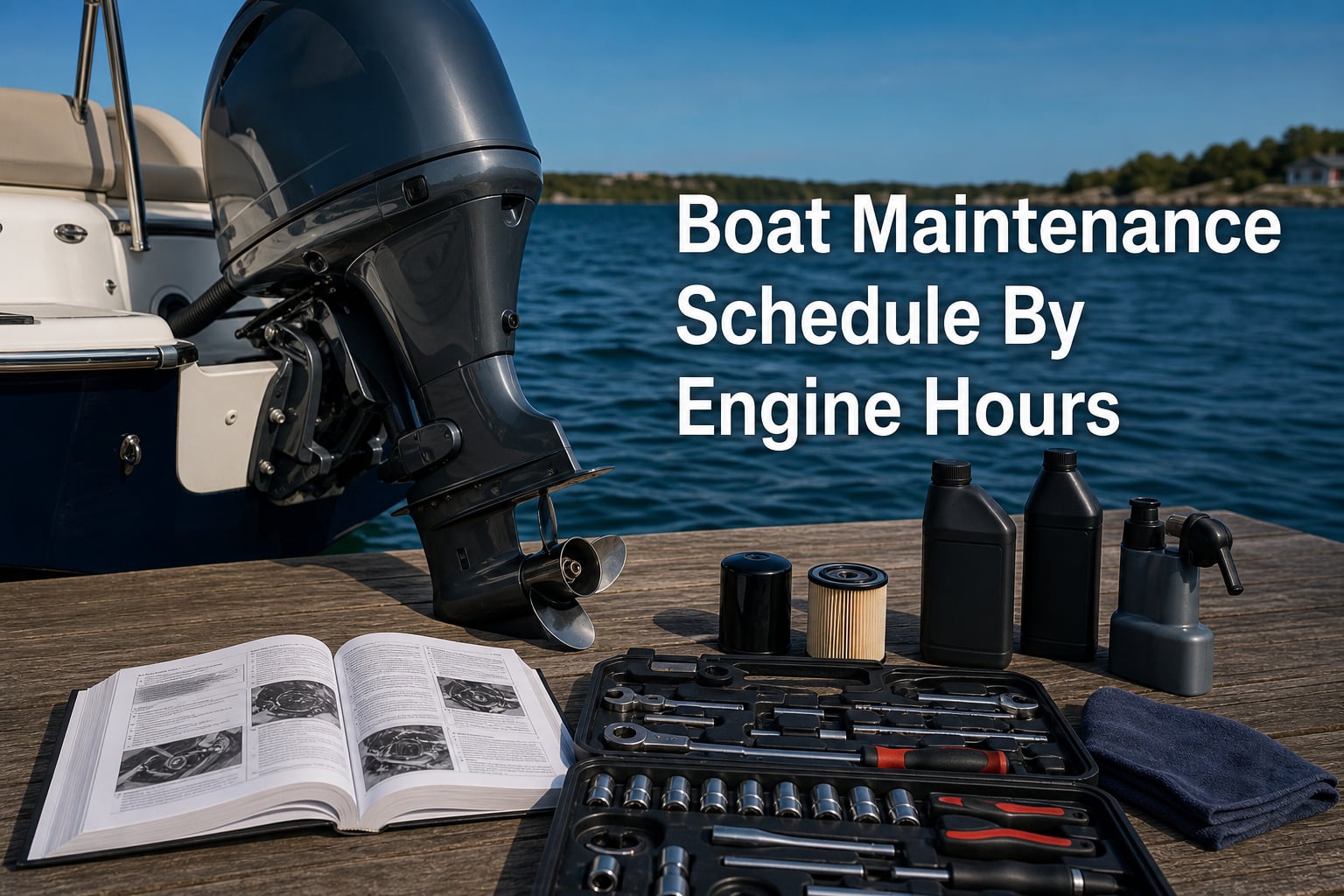
Maintaining your boat engine by tracking hours instead of just calendar dates is one of the smartest ways to protect your investment and avoid costly breakdowns. A boat maintenance schedule by engine hours accounts for actual usage rather than guessing when service is needed based on time alone. This approach ensures your outboard motor, sterndrive, or inboard engine gets the right service at the right time, whether you’re on the water 50 hours a year or 200 hours each season.
In this guide, I’ll break down exactly what needs to happen at each service milestone: 20, 100, 300, 500, and 1,000 hours. You’ll learn what tasks you can tackle yourself, when to call a professional, and why following an hour-based schedule matters for engine longevity. I’ve spent years helping boat owners understand their maintenance requirements, and the difference between engines that get proper service and those that don’t is dramatic.
By the end of this article, you’ll have a complete reference for maintaining your boat engine throughout its entire service life, plus answers to common questions about engine hours, service intervals, and how to track everything properly.
What Are Engine Hours and Why They Matter
Engine hours represent the total running time of your boat’s motor from the moment it was first started. Every time you turn the key and the engine runs, that time gets logged by an hour meter. Most modern boats have this built into the multi-function display (MFD) or gauge cluster. Older boats might have a mechanical hour meter mounted near the helm.
Think of engine hours like the odometer on your car, but instead of measuring distance traveled, it measures time spent running. This distinction is crucial because boat engines experience different wear patterns than car engines. A boat might only travel 20 miles in a four-hour fishing trip, but the engine runs at varying RPMs the entire time, accumulating hours of wear even at idle.
Recreational boats typically accumulate 50 to 100 engine hours per year on average. A boat used for weekend cruising might see 75 hours annually, while a serious angler running to offshore fishing spots could easily log 150-200 hours each season. Commercial vessels and charter boats often exceed 500 hours per year. Understanding your usage pattern helps you plan maintenance more accurately than calendar-based schedules alone.
Gasoline boat engines typically last 1,000 to 1,500 hours with proper maintenance before requiring major work or rebuild. Diesel marine engines are considerably more durable, often running 5,000 hours or more with proper care. These numbers vary based on maintenance quality, operating conditions, and how hard the engine gets pushed. An engine that receives regular service at the correct intervals will almost always outlast one that gets sporadic attention.
Boat Maintenance Schedule By Engine Hours: Complete Breakdown
Here’s the foundation of every hour-based maintenance plan. Each milestone builds on the previous one, meaning the 100-hour service includes everything from previous intervals, plus additional tasks. This layered approach ensures nothing gets missed as your engine accumulates running time.
The standard service milestones are 20 hours (break-in), 100 hours (annual), 200-300 hours (2-3 year), 500 hours (5 year), and 1,000 hours (major service). Some manufacturers use slightly different intervals, so always check your owner’s manual for brand-specific requirements. Mercury, Yamaha, Suzuki, Honda, and Evinrude all publish detailed maintenance schedules specific to their engines.
One critical rule: whichever comes first, hours or calendar time, triggers the service. If you’ve only run your engine 50 hours but it’s been 12 months since the last service, you still need that annual service. Sitting idle doesn’t mean components aren’t aging. Fuel degrades, corrosion can develop, and seals dry out even without engine operation.
20-Hour Break-In Service (First Service)
The 20-hour break-in service is the most critical maintenance milestone for a new engine, yet many boat owners skip it or don’t realize it’s required. This first service removes manufacturing debris, fresh break-in oil, and initial wear particles that accumulate during those crucial first hours of operation. Skipping this service can shorten engine life significantly.
During break-in, microscopic metal particles shed from bearings, cylinder walls, and gears as surfaces mate together. This is normal and expected, but those particles need to come out of the engine quickly. The original oil and filter trap this debris. Running too long on break-in oil circulates those particles through the engine, causing accelerated wear.
The 20-hour service typically includes an engine oil and filter change, lower unit gear oil change, fuel filter inspection, and general inspection of all accessible components. Your technician will also check for proper fluid levels, inspect the propeller, and verify that the engine is breaking in correctly. Some manufacturers require valve adjustments or specific checks during this initial service.
Break-in period operating guidelines are equally important. Most manufacturers recommend varying RPMs frequently during the first 10 hours and avoiding sustained operation at a single speed. Don’t run at wide-open throttle for extended periods during break-in. Follow your manufacturer’s specific break-in procedure to ensure proper ring seating and bearing mating. After the 20-hour service, normal operation can resume.
100-Hour Annual Service Checklist
The 100-hour service, often called annual service, forms the backbone of your maintenance routine. Most recreational boaters hit this milestone once per season, making it the most frequent major service interval. This service addresses the fluids and components that wear fastest or degrade with use.
Oil and filter change is the foundation of the 100-hour service. Fresh engine oil lubricates bearings, cools internal components, and carries away contaminants. The filter traps particles too small to see but large enough to cause damage. Use only manufacturer-recommended oil weights and types. Modern outboards often require specific synthetic blends designed for marine applications.
Fuel filter and water separator replacement prevents contaminated fuel from reaching your engine. Water in fuel causes corrosion, injector damage, and poor performance. The fuel water separator is your first line of defense against moisture and debris. Replace it at every 100-hour interval without fail. If you boat in areas with questionable fuel quality, inspect it more frequently.
Spark plug inspection and replacement keeps your engine running efficiently. Fouled or worn plugs cause poor fuel economy, hard starting, and reduced power. Most manufacturers recommend replacement at 100-hour intervals, though some plugs last longer depending on engine type and usage. Inspect plug condition for signs of engine problems like oil burning or lean conditions.
Lower unit gear oil change is essential for protecting the gears and bearings in your outboard’s lower unit. This oil lubricates the prop shaft, forward and reverse gears, and water pump driveshaft. Water intrusion into the lower unit causes rapid gear failure. When changing gear oil, inspect the old oil for metallic particles or water contamination, both signs of developing problems.
Water pump impeller inspection ensures your cooling system functions properly. The rubber impeller inside the water pump spins to draw water through the engine. Over time, impeller blades become stiff, crack, or wear down. A failed impeller means no cooling water flow and rapid engine overheating. At 100 hours, inspect the impeller for wear and replace if needed. Many mechanics recommend replacement at 300 hours regardless of condition.
Anode inspection protects your engine from galvanic corrosion. Sacrificial anodes made of zinc, aluminum, or magnesium corrode instead of your engine’s metal components. Check anode condition at every service. If anodes are more than 50% deteriorated, replace them immediately. Saltwater use depletes anodes faster than freshwater, requiring more frequent inspection.
Grease fittings and linkage maintenance keeps moving parts operating smoothly. Control cables, steering components, and trim systems all require periodic lubrication. Use marine-grade grease designed to resist water washout. Don’t overlook grease points on the engine itself, including the prop shaft and swivel bracket on outboards.
200-300 Hour Service Escalation
The 200-300 hour interval adds more extensive maintenance tasks beyond the standard 100-hour items. If you’re approaching 300 hours, this service represents a more thorough inspection of components that wear over longer periods. Most boat owners encounter this interval every 2-3 years of average use.
Everything from the 100-hour service gets repeated first. Oil, filters, gear lube, and spark plugs all get fresh replacements. Don’t skip these basics just because you’re doing additional work. The foundation maintenance matters just as much at 300 hours as it did at 100.
Water pump impeller replacement becomes mandatory at this interval for most engines. Even if the impeller looks acceptable, rubber degrades over time regardless of use. A three-year-old impeller is more likely to fail than a fresh one. The cost of impeller replacement is far less than repairing an overheated engine. Many mechanics replace the entire water pump assembly including housing, impeller, and seals at this interval.
Thermostat inspection ensures proper engine operating temperature. A stuck thermostat causes overcooling (reduced efficiency) or overheating (engine damage). Remove and test the thermostat, or simply replace it given its relatively low cost. Also inspect the thermostat housing for corrosion and scale buildup that can restrict water flow.
Fuel system cleaning addresses deposits that accumulate in injectors, carburetors, and fuel passages. Modern ethanol-blend fuels tend to leave varnish deposits over time. Professional fuel system cleaning or treatment with quality fuel system cleaner helps maintain proper fuel delivery. This is especially important for engines that sit unused for extended periods.
VST filter service applies to many modern four-stroke outboards. The Vapor Separator Tank filter catches debris before it reaches the high-pressure fuel pump and injectors. A clogged VST filter causes lean running, poor performance, and potential engine damage. Service intervals vary by manufacturer, but 300 hours is common for inspection and cleaning.
500-Hour Deep Inspection Milestone
The 500-hour service marks a significant milestone in engine maintenance. This interval requires more invasive inspections and component replacements that protect against catastrophic failures. Think of 500 hours as the point where your engine needs professional attention beyond basic owner maintenance.
Timing belt replacement is critical at this interval for engines equipped with timing belts. A broken timing belt destroys the engine in many cases, as valves collide with pistons when the belt fails. Unlike automotive applications where timing belts might last 100,000 miles, marine timing belts face harsher conditions including heat, moisture, and varying loads. Replace the belt, tensioner, and related components at manufacturer-recommended intervals, typically around 500 hours or 5 years.
Valve clearance adjustment ensures proper engine breathing and performance. Over time, valve train components wear, changing the gap between the valve stem and rocker arm or cam. Incorrect valve clearance causes poor running, reduced power, and potential valve damage. This adjustment requires specialized knowledge and tools, making it a job for professional marine technicians.
Compression testing reveals the internal health of your engine. A compression test measures how well each cylinder seals during the compression stroke. Low compression indicates worn rings, valves, or cylinder walls. Variations between cylinders of more than 10% suggest developing problems. Catching compression issues early allows for planned repairs rather than sudden engine failure.
Power head inspection involves checking for leaks, corrosion, and component wear that isn’t visible during routine service. A qualified technician will inspect the cylinder head, gasket surfaces, and external components. Signs of oil leaks around the power head indicate gasket or seal failures requiring attention. Minor leaks can become major failures if ignored.
Exhaust system check identifies corrosion and cracking that develops from heat cycling and water exposure. Exhaust manifolds, elbows, and risers corrode from the inside out. Internal failure allows water to enter cylinders, causing hydrolock and catastrophic damage. Inspect exhaust components for external corrosion and check for signs of internal deterioration.
1,000-Hour Major Service
Reaching 1,000 hours represents a major milestone in your engine’s life. For gasoline outboards and stern drives, this is approaching the upper range of expected service life. Major service at this interval goes beyond maintenance into assessment of whether the engine is worth rebuilding or if replacement makes more economic sense.
Complete engine teardown and inspection is the only way to truly assess internal condition at this mileage. Bearings, seals, cylinder walls, and internal components wear over time. A full inspection reveals whether the engine has remaining service life or needs major work. This level of service should be performed by certified marine technicians with experience in engine rebuilding.
Leakdown testing provides more detailed cylinder condition information than compression testing alone. While compression testing measures the cylinder’s ability to build pressure, leakdown testing identifies exactly where pressure is lost. This test differentiates between valve problems, ring wear, and head gasket failures. Leakdown percentages above acceptable limits indicate the engine needs internal repair.
Bearing and seal replacement addresses components that typically fail between 1,000 and 1,500 hours. Main bearings, connecting rod bearings, and crankshaft seals wear even with perfect maintenance. Many technicians recommend proactive bearing replacement at major service intervals to prevent catastrophic failure. The cost of bearing service during a planned rebuild is far less than engine replacement after a spun bearing.
Consider rebuild versus replace carefully at this interval. A complete rebuild including machine shop work can approach the cost of a new or remanufactured engine. Consider the engine’s overall condition, your intended use, and the cost difference between rebuilding and replacing. Sometimes a rebuild makes sense for a well-maintained engine. Other times, replacement offers better value with warranty protection and known reliability.
Cost considerations at 1,000 hours are significant. A thorough major service with inspections and necessary repairs can cost several thousand dollars in labor and parts. Budget for this milestone well in advance. Engines that receive proper service throughout their life typically cost less at major intervals because fewer components require emergency replacement.
Hours vs Calendar Time: Why Both Matter
The relationship between engine hours and calendar time confuses many boat owners. Some assume that low hours mean low maintenance, while others follow only calendar-based schedules. The reality is that both matter, and you need to service based on whichever comes first.
Calendar-based minimums ensure that time-sensitive components get attention even if the engine hasn’t accumulated many hours. Fuel degrades over time, absorbing moisture and forming varnish. Rubber components like impellers and hoses harden and crack regardless of use. Corrosion develops on electrical connections and metal surfaces even when the boat sits idle. Annual service addresses these age-related issues.
Hours are more accurate for wear-based service because they measure actual engine operation. The more an engine runs, the more wear it accumulates. Fluids break down, filters clog, and components wear based on running time. An engine that runs 200 hours in six months needs the same service as one that accumulates 200 hours over two years, calendar aging aside.
The whichever comes first rule means you service at either the hour milestone or the calendar milestone, whichever arrives first. If you’ve run 100 hours in four months, get the service done. If it’s been 12 months but you’ve only logged 50 hours, you still need annual service. This approach ensures neither wear nor age catches you off guard.
Seasonal considerations affect the calendar side of maintenance. Many boat owners schedule service in spring before the season begins or fall before winter storage. Pre-season service ensures reliability during peak boating months. Pre-storage service addresses any issues discovered during the season and prepares the engine for sitting idle. Either approach works, but consistency matters.
Saltwater vs Freshwater Maintenance Differences
The environment where you boat dramatically affects your maintenance schedule. Saltwater use accelerates corrosion and requires more aggressive maintenance than freshwater operation. If you boat in salt or brackish water, plan for shorter intervals between certain services.
Anode replacement happens much more frequently in saltwater. The magnesium and zinc anodes that protect your engine sacrifice themselves to corrosion, and saltwater dramatically accelerates this process. Inspect anodes monthly in saltwater use and replace them when they show 50% deterioration. Aluminum anodes work better than zinc in saltwater, while magnesium is preferred for freshwater. Using the wrong type reduces protection effectiveness.
Corrosion inspection intervals should increase in saltwater environments. Check all metal components for signs of corrosion at every service. Pay special attention to fasteners, mounting hardware, electrical connections, and cooling system components. Apply anti-corrosion spray to electrical connections and exposed metal surfaces regularly. Corrosion that’s caught early can be treated. Ignored corrosion causes structural failures.
Flushing requirements are more critical after saltwater use. Flush your engine with freshwater after every saltwater outing if possible. Some newer engines have integrated flush systems, while others require connecting a garden hose to a flush fitting. Flushing removes salt residue that causes corrosion inside cooling passages. Freshwater boats still benefit from periodic flushing to remove sediment and debris.
Anti-corrosion spray applications should happen more frequently in saltwater environments. Products like CRC Marine Corrosion Inhibitor or similar sprays coat electrical connections and metal surfaces with a protective film. Apply these products after flushing and before storage. Pay attention to wire terminals, fuse blocks, and engine mounting bolts. This small step significantly extends component life in corrosive environments.
DIY vs Professional Service Guide
Some maintenance tasks are well within the capabilities of mechanically-inclined boat owners, while others require professional tools, training, and experience. Knowing the difference protects your engine and your wallet.
You can safely do yourself: oil and filter changes, lower unit gear oil changes, fuel filter replacement, spark plug replacement, anode replacement, basic grease fitting lubrication, and visual inspections. These tasks require basic hand tools, manufacturer-specified fluids, and the ability to follow instructions. Many boat owners handle all routine maintenance themselves, saving significant money over dealer service.
Call a certified marine mechanic for: valve adjustments, timing belt replacement, compression and leakdown testing, water pump replacement requiring lower unit removal, carburetor or injector service, electrical diagnostics, and any internal engine work. These tasks require specialized knowledge and tools. Attempting them without proper training can cause expensive damage. The cost of professional service is less than repairing mistakes from DIY attempts beyond your skill level.
Cost comparison favors DIY for routine maintenance. A 100-hour service performed at a dealership can cost $300-$600 in labor plus parts. Performing the same service yourself might cost $100-$150 in supplies. However, major services requiring special tools may still be more economical when performed by professionals who have the equipment and expertise to do the job correctly the first time.
Warranty considerations may require professional service during the warranty period. Some manufacturers require proof of professional maintenance to validate warranty claims. Check your warranty terms before deciding on DIY service for newer engines. After the warranty expires, you have more flexibility, but proper maintenance procedures remain essential for engine longevity.
Common Maintenance Mistakes to Avoid
Even well-intentioned boat owners make mistakes that compromise engine reliability. Learning from others’ errors helps you avoid expensive lessons.
Skipping break-in service is perhaps the most damaging mistake. Those initial hours produce wear particles that must be removed early. Skipping the 20-hour service circulates debris through your engine for the entire season. The result is accelerated wear and reduced engine life. Always perform break-in service, even if you think the engine seems fine.
Ignoring hour meter readings leads to deferred maintenance. Many boat owners simply don’t pay attention to hours accumulated. They service based on calendar time alone, missing the hours that indicate real wear. Check your hour meter regularly and track when service milestones approach. A simple log book or app prevents this common oversight.
Using wrong fluids causes immediate and long-term damage. Each engine requires specific oil weights, types, and grades. Lower unit gear oils have specific viscosity and additive packages. Using automotive oils in marine engines can cause failures from inadequate corrosion protection or incorrect viscosity at operating temperature. Always use manufacturer-specified fluids or marine-specific equivalents.
Neglecting calendar-based minimums is equally problematic. Some owners assume that if the hours aren’t there, service isn’t needed. But fuel ages, rubber hardens, and corrosion develops even with the engine sitting. Perform annual service regardless of hours accumulated. The cost of annual service is far less than repairing damage from neglected time-based aging.
Poor record keeping makes it impossible to know what service is due. Without documentation, you can’t verify when the last service happened or what was done. Keep detailed records of every maintenance task, including date, hours, and specific work performed. A simple log book or spreadsheet works well. Good records also increase resale value when you eventually sell the boat.
How to Track and Log Your Engine Hours
Accurate hour tracking is essential for proper maintenance timing. Several methods exist, and the best approach depends on your boat’s equipment and personal preferences.
Analog hour meters provide basic functionality with mechanical displays. These meters are simple and reliable, often installed as aftermarket additions. They display total hours accumulated since installation. Check the meter periodically and record readings in your maintenance log. Analog meters can’t be reset without disconnection, providing accurate historical data.
Digital hour meters and MFD displays offer more features in modern boats. Multi-function displays often show engine hours on the main screen or in a submenu. Some systems track hours by RPM range, giving insight into how the engine operates. Digital systems may require battery power to display, so photograph your hours periodically to preserve the record.
Reading your gauge display varies by manufacturer. Most MFD systems include an engine hours screen accessible through the menu. Consult your gauge or engine manual for specific instructions. Some systems require holding buttons or navigating through multiple screens. Don’t assume hours are displayed on the main screen by default.
Maintenance log best practices ensure you capture essential information. Record the date, engine hours at service, specific work performed, and parts used. Note any observations or concerns discovered during inspection. Keep receipts for parts and fluids. A well-maintained log book proves service history for warranty claims and resale.
Apps and tools for tracking have become popular alternatives to paper logs. Several marine-specific apps track engine hours, maintenance intervals, and service history. Some connect to engine monitoring systems to track hours automatically. Choose an app that allows photo documentation of receipts and work performed. Digital backups prevent loss of service records.
FAQs
Is 500 engine hours a lot for a boat?
For gasoline boat engines, 500 hours represents roughly one-third to one-half of expected service life. Most gasoline outboards last 1,000-1,500 hours with proper maintenance, so 500 hours is significant but not excessive. For diesel marine engines, 500 hours is relatively low, as diesels often exceed 5,000 hours. The key factor is how well the engine has been maintained throughout those hours.
What is the 30 60 90 maintenance schedule?
The 30 60 90 maintenance schedule typically refers to automotive maintenance intervals, not marine applications. For boats, the standard maintenance schedule follows engine hours: 20-hour break-in service, 100-hour annual service, 300-hour service, 500-hour service, and 1,000-hour major service. Some manufacturers use varying intervals, so always check your specific owner’s manual for the correct schedule for your engine.
How often should your boat engine be serviced?
Most boat engines require service at least annually or every 100 hours, whichever comes first. This includes oil and filter changes, fuel filter replacement, spark plug service, and lower unit gear oil change. Additional service intervals occur at 300, 500, and 1,000 hours with progressively more extensive maintenance tasks. Even if you haven’t accumulated many hours, annual service addresses time-based aging of fluids and components.
Is 200 hours on a boat engine a lot?
No, 200 hours on a boat engine is not a lot. Recreational boats typically accumulate 50-100 hours per year, so 200 hours represents roughly two seasons of average use. Most gasoline boat engines last 1,000-1,500 hours with proper maintenance. An engine with 200 hours that has been properly serviced is still in its early life and should provide years of reliable service with continued maintenance.
How do I check engine hours on my boat?
Check your engine hours through your boat’s multi-function display (MFD) or gauge cluster. Most modern boats display total hours on a dedicated screen or in the engine information menu. Navigate through your MFD menu to find engine hours or total run time. Older boats may have a mechanical hour meter near the helm. Some systems track hours by RPM range, providing detailed usage data. Consult your gauge or engine manual for specific instructions.
What happens if I skip a scheduled service interval?
Skipping scheduled service accelerates engine wear and increases failure risk. Missed oil changes allow contaminated oil to circulate, causing bearing and cylinder wear. Overdue timing belt replacement risks catastrophic engine failure if the belt breaks. Neglected impellers can fail, causing overheating and engine damage. Deferred maintenance costs far more than scheduled service when components fail unexpectedly. Consistent maintenance at proper intervals is the cheapest way to own a boat engine.
Conclusion
Following a boat maintenance schedule by engine hours ensures your engine receives service when it actually needs it, not just when the calendar says it’s time. The milestones of 20, 100, 300, 500, and 1,000 hours each address specific wear items and inspection requirements that protect your investment. Skipping any of these intervals risks premature failure and expensive repairs.
I’ve seen engines with 2,000 hours still running strong because their owners followed the schedule religiously. I’ve also seen engines destroyed at 300 hours because maintenance was deferred. The difference isn’t luck or engine brand. It’s consistent, proper maintenance at the right intervals based on actual engine operation.
Start tracking your engine hours today if you haven’t already. Check your MFD or hour meter and write down the current reading. Build a simple maintenance log. Schedule your next service based on your hours and the intervals in this guide. Your engine will reward you with years of reliable performance, and your wallet will thank you for avoiding preventable failures.
A well-maintained boat engine is a joy to own. Following the proper maintenance schedule by engine hours is the path to that ownership experience. Refer back to this guide as your engine accumulates hours, and don’t hesitate to consult a professional when service needs exceed your skills. The investment in proper maintenance pays dividends every time you turn the key and hear that engine fire to life.